

Fact-checked by Steve Rhode, consumer debt expert since 1994 • Last reviewed July 13, 2026 • Every claim below links to a primary source.
Each weekday I send one short email: one money story that caught my attention, why it might matter to you, and one manageable thing you can do with it. A couple of minutes, and a dad joke.
In the latest issue (Oct 14): Do you want the money back you left behind?
Free. I sell nothing. Unsubscribe any time.
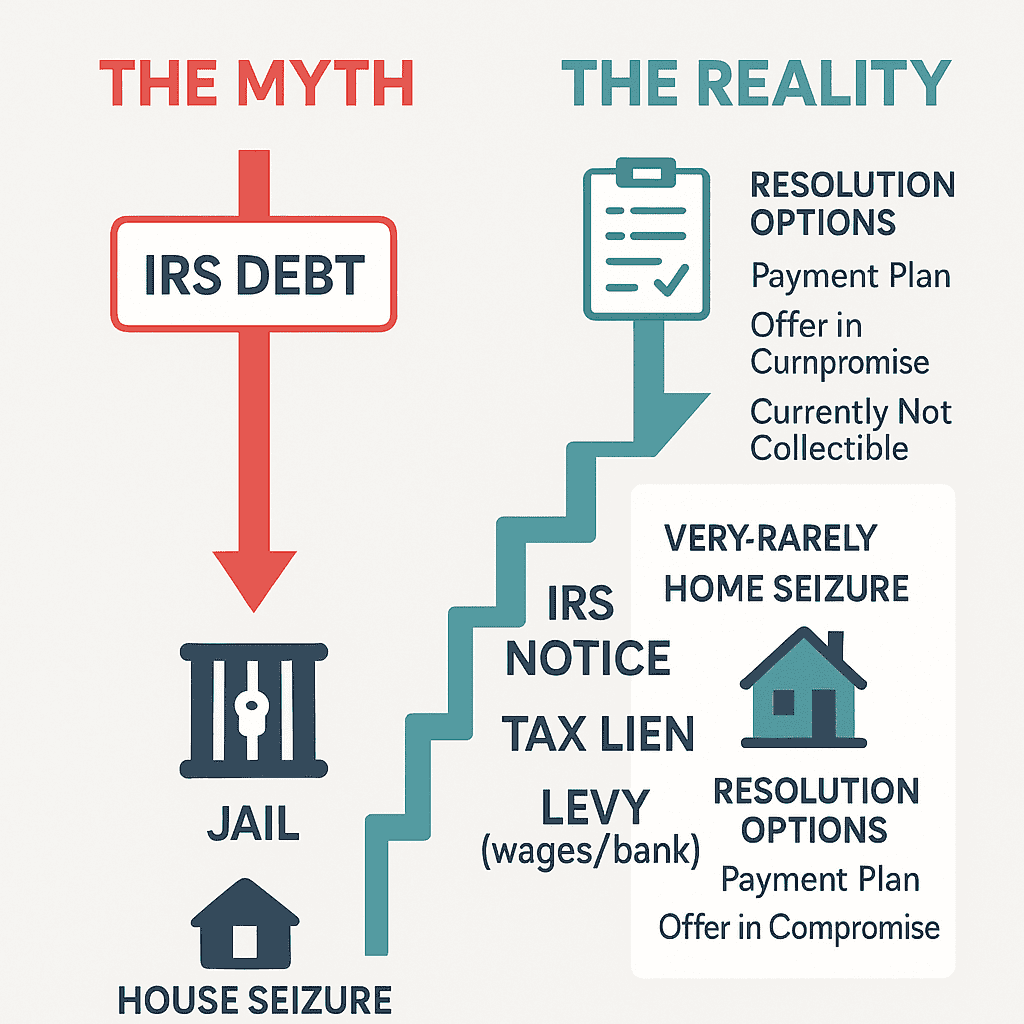
The verdict: Partly True. The IRS can seize a primary residence — but only after a federal judge signs off in writing, and only after the IRS has exhausted every other collection option first. That almost never happens for ordinary back taxes. Jail is a completely different story: criminal prosecution is reserved for willful tax evasion and fraud, not for simply owing money. The fear is real. The reality is far more survivable — and there are resolution options the panic keeps you from using. IRS Internal Revenue Manual 5.17.3.5.5 and IRC §6334(e) confirm the court-order requirement. IRC §7201 confirms that criminal prosecution requires willful evasion — not just a balance due.
I have to tell you about this. Since 1994, I have been sitting across the table from people who owe the IRS money. And the single most common thing I see is not recklessness — it is paralysis. People stop opening mail. They stop answering the phone. They let a manageable problem compound into a serious one, all because they are convinced that the moment they engage, someone is coming to take their house and put them in handcuffs. Here is the belief that drives that paralysis — one I hear all the time:
“If you owe the IRS back taxes, they will seize your home and throw you in jail.” — an extremely widespread belief in American popular culture
I couldn’t let that sit. The fear is understandable. The version people believe is not. Let me walk you through what actually happens.
Well, Actually…
Here is the part they left out. The IRS has enormous collection power, and I am not going to pretend otherwise. They can file a tax lien that attaches to your property and wrecks your ability to sell or refinance it. They can issue a levy that grabs your wages, your bank account, even your Social Security benefits. Those are real, and they happen. But the specific nightmare scenario that lives in everyone’s head — federal agents showing up to padlock your front door while a van idles outside — has a much higher legal bar than most people know.
Under IRC §6334(e)(1), seizing a principal residence is not something a revenue officer can decide to do on a Tuesday morning. The IRS must first obtain written approval from the Area Director. Then it must go to federal court, where IRM 5.17.3.5.5 requires the IRS to demonstrate three things to a judge or magistrate: (1) all applicable legal and administrative procedures have been followed, (2) the tax is legitimately owed, and (3) — this is the big one — no reasonable alternative for collecting the debt exists. A federal judge must approve the levy in writing before it happens. This is not a rubber stamp. The IRS rarely pursues home seizure precisely because that bar is high and because they have faster, cheaper tools available.
The jail piece is even more misunderstood. IRC §7201 makes it a felony to willfully attempt to evade or defeat a tax — hiding income, filing fraudulent returns, operating entirely in cash to dodge reporting, lying to investigators. People who owe money but could not pay, who misunderstood their obligations, who fell behind during a divorce or a medical crisis — those are civil matters. The IRS responds with liens, levies, penalties, and interest, plus a menu of resolution programs. Prosecution is for the person who deliberately hid half a million dollars in an offshore account and lied about it under oath. Not for you.
The real harm in the myth is not what it says — it is what it stops people from doing. Every month that passes without engagement adds failure-to-pay penalties, interest, and makes the IRS more likely to escalate. The Taxpayer Advocate Service documents this pattern constantly: the people who end up in the worst situations are almost always the ones who went silent the longest.
The IRS will take your house if you owe back taxes.
The IRS can seize a principal residence — but the law requires two layers of approval first: written sign-off from the IRS Area Director, then a federal judge or magistrate must approve the levy in writing (IRC §6334(e)(1)). At that hearing, per IRM 5.17.3.5.5, the IRS must prove that no reasonable alternative collection method exists. Home seizure is a rare last resort, not a routine collection tool.
IRS Internal Revenue Manual 5.17.3.5.5 — Seizure of a Residence/Principal Residence • IRC §6334(e)(1) (Cornell Law)
You can go to jail for owing the IRS money.
The felony statute is IRC §7201 — “willfully” attempting to evade or defeat a tax: hiding income, filing fraudulent returns, lying to investigators. Owing taxes you cannot pay is a civil matter that triggers liens, levies, penalties, and interest — not handcuffs. (One precision: willfully choosing not to file at all is a separate misdemeanor under IRC §7203, but that is a different situation from the myth being corrected here — the handcuffs-for-owing-money fear.) The IRS Criminal Investigation division initiates roughly 2,500 to 2,700 criminal investigations per year, per IRS CI Annual Reports, in a country of 330 million taxpayers. The overwhelming majority involve deliberate concealment schemes, not people who owed and could not pay.
If you owe the IRS, there’s nothing you can do — you just wait for the worst to happen.
The IRS offers multiple formal resolution programs: installment agreements (payment plans), Offer in Compromise (settle for less than you owe if you meet criteria), and Currently Not Collectible status (collection suspended when paying would cause genuine hardship). These are not loopholes — they are official IRS programs that have existed for decades. Using them is exactly what the IRS expects people who cannot pay in full to do.
IRS: Offer in Compromise • IRS: Payment Plans / Installment Agreements
Why You Were Told This
Partly, this myth exists because the IRS is genuinely powerful. A tax lien can destroy your credit. A wage levy can empty your paycheck before you see it. The IRS does not need to sue you to collect most debts — it is one of the few creditors that can take money directly without first getting a court judgment. That extraordinary power makes for terrifying stories, even when the most dramatic version (losing your house, going to jail) is not what typically happens.
There is also an industry that profits from your fear. Tax resolution companies spend heavily on marketing that leads with worst-case scenarios — “the IRS is coming for your house, call us now” — because fear converts. I want to be clear: some tax professionals are genuinely valuable (more on that in a moment). But if the first thing an ad tells you is that you might go to jail for owing taxes, that company is amplifying a myth to sell you something. Check out the IRS’s own Dirty Dozen scam list — fear-based tax resolution fraud is on it every single year.
Finally, this myth has staying power because it is partly true, which makes it feel credible. The home seizure authority is real. The criminal statutes are real. The version that gets passed around just strips out all the guardrails — the court orders, the willfulness requirements, the exhaustion-of-alternatives standard — until what is left is pure fear with no nuance.
What to Actually Do
- Open every IRS letter immediately. I know it feels counterintuitive. But the IRS has a defined escalation sequence: notices, then a lien, then levy action, then (in extreme cases) seizure. Every stage gives you an opportunity to respond and resolve. Ignoring the sequence is how people arrive at the serious stages. Here’s what to do if you just got an IRS notice.
- Understand your resolution options before paying anyone. The IRS offers installment agreements, Offer in Compromise, and Currently Not Collectible status. These are official programs with real criteria — not sales pitches. The complete guide to IRS back tax options walks through how each one works.
- Get professional help if the amount is significant. A tax attorney or enrolled agent can negotiate with the IRS on your behalf, assess whether you qualify for an OIC, and make sure you do not accidentally restart any collection clocks. This is an area where a professional earns their fee. If cost is a barrier, Low Income Taxpayer Clinics (LITCs) provide free or low-cost representation for qualifying taxpayers in disputes with the IRS.
- If the tax debt is old, check whether bankruptcy applies. Federal income tax debt can, under specific timing conditions, be discharged in bankruptcy. This is not guaranteed and involves strict eligibility tests — but it is a real option most people do not know about. Here’s how the bankruptcy-and-tax-debt rules actually work.
- Never pay a tax resolution company under duress before doing your own research. The FTC and CFPB have both taken action against firms that collect large upfront fees and deliver nothing. If someone says they can “settle your IRS debt for pennies on the dollar” over a late-night TV ad, check the Scam-O-Meter first.
Steve’s Take
In over 30 years of helping people with debt, I have watched IRS fear do more damage than the IRS itself. The debt compounds while people hide. Opportunities to settle for less close. Liens get recorded that mess up home sales years later. All of it preventable — but only if you engage. I am not saying the IRS is your friend. They are a collection agency with extraordinary power. But they are also a collection agency with an official menu of options for people who cannot pay in full — which is most people who find themselves in this situation. The court order requirement for home seizure and the willfulness requirement for prosecution are not technicalities. They are real legal protections. Use them by knowing they exist. Then pick up the phone, or hire someone who knows this territory, and start solving the problem instead of dreading it.
Frequently Asked Questions
Can the IRS really seize my primary home for back taxes?
Yes, legally — but it requires written approval from the IRS Area Director and then a federal judge or magistrate must also approve the levy in writing. At the court hearing, the IRS must prove that no reasonable alternative collection method exists. This process is rare and is considered a last resort, reserved for large liabilities where all other options have been exhausted. For a typical balance due on a return, this outcome is extremely unlikely. (IRM 5.17.3.5.5; IRC §6334(e)(1))
Can I go to jail for owing the IRS money?
No — not for simply owing. The felony statute, IRC §7201, requires willful evasion: deliberately hiding income, filing fraudulent returns, or actively deceiving the IRS. That is who goes to federal prison. Being unable to pay is a civil matter — it results in liens, levies, penalties, and interest, not prosecution. One important distinction: willfully choosing not to file at all is a separate misdemeanor under IRC §7203, which does not require a concealment scheme. But that is a different situation from the fear driving this myth (owing money you cannot pay). The IRS’s Criminal Investigation division initiates roughly 2,500 to 2,700 investigations per year, and those cases overwhelmingly involve intentional concealment schemes, not people who owed money they could not pay.
What does the IRS actually do when I owe back taxes?
The IRS follows a defined sequence: it sends notices, files a Notice of Federal Tax Lien (which attaches to your property and affects your credit), issues levy notices (which can tap wages, bank accounts, and benefits), and in extreme, long-running cases with large balances and no cooperation, pursues seizure of assets. At every stage before seizure, you have the right to request a Collection Due Process hearing and to apply for an installment agreement, Offer in Compromise, or Currently Not Collectible status.
What is Currently Not Collectible status?
Currently Not Collectible (CNC) is an official IRS status that suspends active collection when the IRS determines that requiring you to pay would leave you unable to meet basic living expenses. It does not eliminate the debt (interest and penalties continue to accrue), but it stops levies while you are in that status. The IRS periodically reviews CNC cases. It is a legitimate program, not a loophole — you request it by demonstrating your financial situation to the IRS.
What is an Offer in Compromise and does it actually work?
An Offer in Compromise lets you settle your tax debt for less than you owe if you meet specific criteria around your ability to pay, income, expenses, and asset equity. The IRS acceptance rate for Offers in Compromise varies significantly from year to year, per IRS Data Books; in recent years it has generally ranged from roughly 25% to 40% of processable offers, depending on the year and the makeup of applications submitted. The key is submitting a realistic offer that reflects your actual financial picture. People who submit without professional guidance often get rejected for preventable reasons. An enrolled agent or tax attorney can tell you whether you are likely to qualify before you apply.
What if I owe taxes but simply cannot pay?
Contact the IRS or have a professional do it for you. Doing nothing is the worst option. An installment agreement lets you pay over time — the IRS generally approves these for balances under $50,000 if you file all required returns. If you genuinely cannot pay anything right now, Currently Not Collectible status may be available. If the amount is large and you have few assets and low income, an Offer in Compromise may reduce what you owe. And if the debt is old enough, bankruptcy discharge may apply. None of these options are available to someone who disappears.
What is a Low Income Taxpayer Clinic?
Low Income Taxpayer Clinics (LITCs) are IRS-funded programs — usually run by law schools or nonprofit organizations — that provide free or low-cost representation to qualifying taxpayers in disputes with the IRS, including audits, appeals, and collection matters. If you cannot afford a private tax attorney or enrolled agent, an LITC is a legitimate alternative. Find one through the Taxpayer Advocate Service’s LITC directory.
What is the difference between a tax lien and a tax levy?
A lien is a legal claim against your property — it attaches to everything you own (home, car, financial accounts) once the IRS records a Notice of Federal Tax Lien and notifies you. It does not take anything; it establishes the IRS’s priority as a creditor. A levy is the actual seizure of assets — the IRS can levy your bank account, garnish your wages, or (in rare, court-approved cases) seize property. The IRS files a lien before a levy but they are different legal actions. That is a federal IRS lien — a county property tax lien is a separate process entirely, and if yours was sold to a private investor, here is what to do right now. If you have an IRS tax lien on your home, that is serious but not the same as losing the home.
This is my perspective after 30-plus years in this space. I am not a tax attorney or CPA, and nothing here is legal or tax advice for your specific situation. Take this as informed input — one data point in your thinking — and then make the decision that is right for you, ideally with a qualified professional who knows your numbers.
The bottom line: Owing the IRS back taxes is a serious problem with real consequences — liens, levies, penalties, and compounding interest. But losing your home requires a court order the IRS rarely seeks, and going to jail requires willful fraud that most people who simply owe money have not committed. The options that can actually resolve this — payment plans, Offers in Compromise, Currently Not Collectible status, even bankruptcy for old tax debt — only work if you engage with the problem. If someone you know is frozen by IRS fear right now, send them this. The real risk is survivable. The paralysis makes it worse.
Another version of this same government-impersonation con is the government-grant “pay a fee first” scam.
Dealing With Debt? Understanding your options is the first step. See how all your debt relief options compare — including ones most sites won’t tell you about. The Find Your Path quiz gives a recommendation based on your actual numbers, and the Scam-O-Meter checks any company’s complaint history before you sign. Federal Reserve research shows bankruptcy filers recover faster than those who don’t file.



