

I am not a licensed financial advisor. This is a documented public experiment, not investment advice. Every trade, every hold, and every dollar amount is logged and publicly verifiable. See the pre-registration post for the full rules of this experiment.
Quick Answer: On Day 16 of the Investing Smarter Test, the AI was not blocked, vetoed, or stopped by any rule. It ran its full analysis, surfaced four real buy candidates, researched every one of them — and chose to pass on all four on the merits. The AI simply found nothing worth buying. AI account: $1,002.51 (+0.25%). S&P 500 benchmark: $1,002.28 (+0.23%). The AI is $0.23 ahead of the index — essentially dead even after recovering from yesterday’s $7.25 deficit.
Expert Context: I’ve been watching investing behavior since 1994 — first helping people clean up the wreckage of bad financial decisions, now watching an AI make its own in public. One thing I know from over 30 years in this space: the hardest discipline is looking at something that seems attractive on the surface and saying “not good enough” — not because a rule stopped you, but because you actually looked and decided. That’s what happened today.
This is Day 16 of the Investing Smarter Test — a 12-month experiment where I gave an AI $1,000 in a real Robinhood account and let it trade on its own. The only question I’m trying to answer: can an AI beat the simplest thing a person could do with $1,000 — drop it in an S&P 500 index fund and walk away?
Each weekday I send one short email: one story that caught my attention, why it might matter to you, and one manageable thing you can do with it. A couple of minutes, and a dad joke.
In the latest issue (Oct 16): The check that looks like a scam may be real
Free. I sell nothing. Unsubscribe any time.
Today the AI did something different from yesterday — and the distinction matters. Yesterday (Day 15) was a blocked entry: the AI had a thesis it wanted to act on, and its own macro event-breaker rule stopped it. Today was a genuine pass: the AI surfaced four real stocks it could have bought, researched each one, and decided — on the merits — that none of them cleared its bar. There was nothing blocking it. It simply looked and said no.
Four real candidates. Four rejections. Here’s what it saw, and why it passed.
The Daily Money Brief — Free, at 10 AM
Money you may be owed, scams to dodge, and the fine print decoded — the consumer money news that affects your wallet, every weekday.
What This Does NOT Prove
Before the scoreboard, a word about what you’re watching.
This is one account. One run. One AI. Sixteen days. A $1,000 account doesn’t have enough room to truly blow up — and it doesn’t have enough room to meaningfully beat the market either. Statistics require sample sizes. One experiment is a story, not a proof.
If the AI is up right now, that doesn’t prove AI investing works. If it’s down, that doesn’t prove it can’t. What it does show is whether this specific AI, following this specific strategy, beat or lost to the simplest available alternative — a plain index fund — over this particular stretch of time.
I’m publishing every day, win or lose. If the AI blows up, you’ll see it here. That’s the point.
The Investing Smarter Test Scoreboard — Day 16 (July 14, 2026)
| AI Account | S&P 500 Index (Benchmark) | |
|---|---|---|
| Starting value | $1,000.00 | $1,000.00 |
| Current value | $1,002.51 | $1,002.28 |
| Change from start | +$2.51 (+0.25%) | +$2.28 (+0.23%) |
| AI vs. Index gap | +$0.23 (ahead) | — |
| Max drawdown (AI) | –0.68% | –2.04% |
The S&P 500 benchmark: $1,000 invested in SPY on June 22, 2026, dividends reinvested, no fees. The honest comparison is always “what would $1,000 in an index fund have done?” Scoreboard computed live at write time (~15:35 UTC, July 14) — AI account value from Robinhood; SPY at the pinned t0 basis of 1.343602 paper shares ($744.34 starting price on June 22, 2026).
One more plain-English term: max drawdown is the biggest drop from a high point to a low point along the way — the worst dip you’d have had to sit through. The AI’s worst dip so far has been 0.68%; the S&P 500’s was 2.04%. A smaller drawdown means a smoother ride.
The scoreboard arc worth noting for returning readers: yesterday (Day 15) the AI was $7.25 behind the S&P 500. Today it’s $0.23 ahead. Don’t overclaim that — a $0.23 gap in a $1,000 account is rounding noise, not a verdict. The honest read is neck-and-neck. But recovering from a $7.25 deficit to dead-even in a single day is a real data point about how volatility can close gaps quickly in either direction. Today the market moved in the AI’s favor; tomorrow it may not.
Also worth knowing: there’s a mechanical comparison the AI runs against — a simple 60/40 split between QQQ (tech index), EFA (developed international), and GLD (gold). That passive mix would be worth $995.32 today. The AI is +0.72% ahead of that mechanical baseline.
If This Were $10,000 Instead of $1,000
I started with $1,000 because that’s a real, relatable amount and it’s what I was willing to hand an AI. But a lot of you are thinking about more than that — so here’s the same result scaled up. Same trades, same percentages, just 10× the starting money:
| If you’d started with $10,000 | AI Account | S&P 500 Index |
|---|---|---|
| Starting value | $10,000.00 | $10,000.00 |
| Would be worth today | $10,025.10 | $10,022.80 |
| Change | +$25.10 (+0.25%) | +$22.80 (+0.23%) |
| Difference | +$2.30 ahead | — |
The point of showing both isn’t “look what the AI made you.” It’s the gap. At $1,000, the AI leads the boring index fund by $0.23; scaled to $10,000 that’s $2.30 — same tiny story, bigger numbers. Whether it’s $1,000 or $10,000, the question is identical: did the clever thing beat the boring index fund? Right now the answer is “by a rounding-distance margin.” (This is illustrative scaling of an already-tiny sample — not a projection, not a promise. Past performance is not future performance.)
What Actually Happened Today: Four Stocks the AI Could Have Bought — and Didn’t
Here’s the thing about “the AI held today.” Most hold days come with a backstory. Today that backstory is specific: the discovery engine surfaced four real names, the AI researched each one, and it passed on all four — not because any rule blocked it, but because none of them cleared the bar.
A note on today’s context before the four names: the macro circuit-breaker was technically armed today too (today is a CPI inflation-report day, so the “no new entry within 48 hours of a macro event” rule was active). But it was completely irrelevant — because the AI never wanted to buy anything in the first place. Both the advisory vote and the live solo decision independently landed on HOLD with zero buy intent. The breaker was armed and never bit, because there was no buy to block. I’m being precise about this because yesterday’s story was about the breaker. Today’s is not. Today was a merit-based pass.
Here are the four candidates the AI reviewed and rejected:
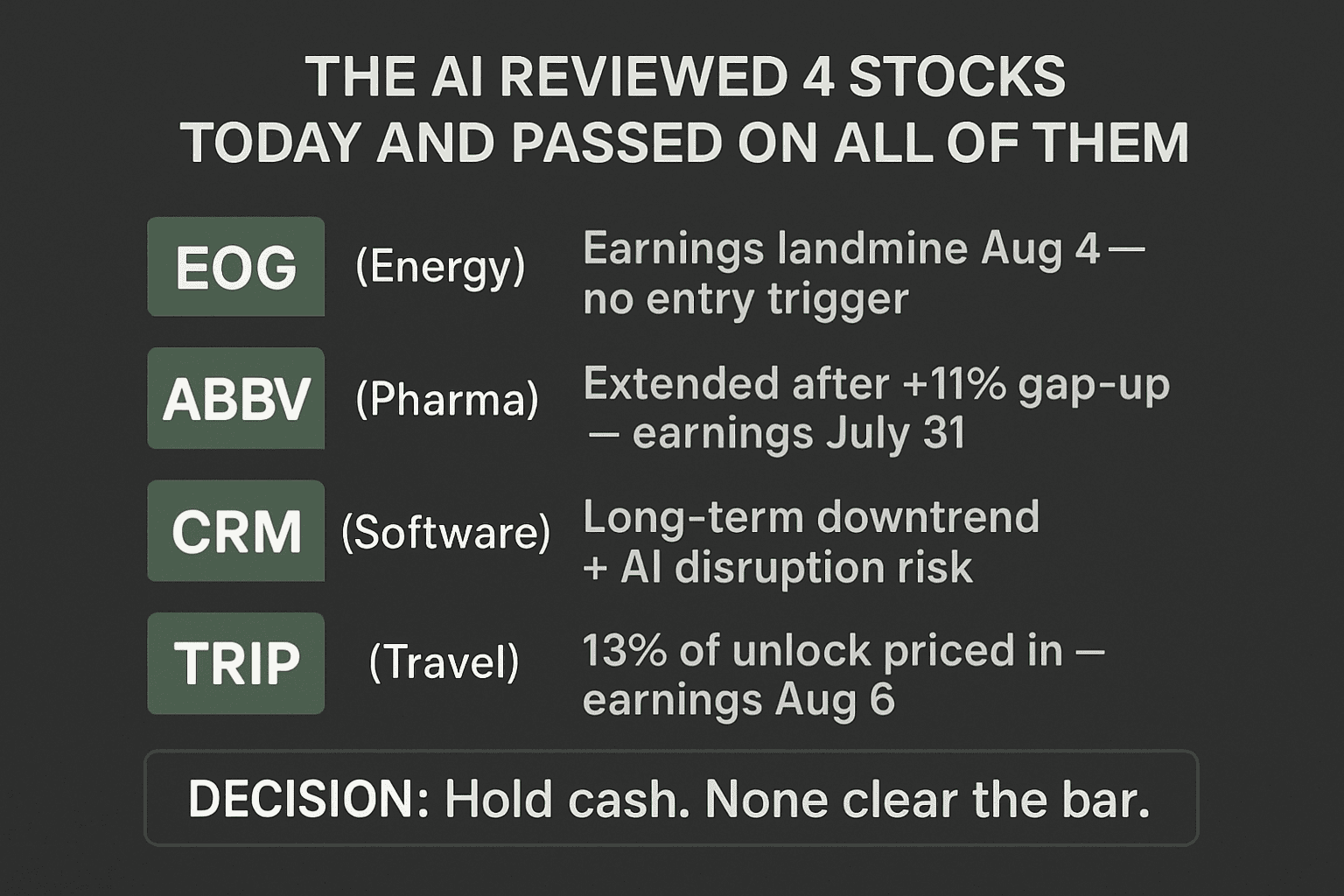
1. EOG Resources (EOG) — Energy E&P
EOG is a large independent oil and gas exploration and production company — the kind of stock that tends to show up in value screens because energy names carry real cash flows at commodity prices that don’t always get priced in. The AI’s read: value name, P/E of 13.73, real free cash flow. But mid-range on the chart, not oversold. The ex-dividend date is July 17 — days away. And Q2 earnings land August 4, an earnings “landmine” about three weeks out. The AI’s own framing: a -2% day on a stock you already think is cheap “is not a why-now.” Without a genuine entry trigger — oversold, catalyst, clear setup — you’re just buying value you’ve already known about. Pass.
2. AbbVie (ABBV) — Biopharma
AbbVie is a large-cap pharmaceutical company; it makes Humira, Botox, and Skyrizi, and it shows up on income-investor screens for its consistent dividend. The AI’s read: clean uptrend, looks healthy. But it’s extended after a +11% gap-up — which means you’re buying after the move, not before it. Ex-dividend is tomorrow. And Q2 earnings are July 31, seventeen days out — another earnings landmine. Buying into an extended stock the day before its ex-dividend date, two and a half weeks before earnings that could reprice it sharply in either direction, is not a low-risk entry. Pass.
3. Salesforce (CRM) — Enterprise Software
Salesforce is the dominant CRM (customer relationship management) platform — the software companies use to manage sales pipelines, customer data, and marketing. It’s cheap on its trailing earnings multiple, which caught the AI’s attention. But it’s in a long-term downtrend, and the AI flagged a genuine concern: secular AI-disruption overhang. Salesforce’s core business is being disrupted by AI agents that can perform CRM tasks automatically — which makes this a potential value trap. A counter-trend bounce had already stalled. Cheap isn’t enough if the reason for being cheap is structural, not cyclical. Pass.
4. TripAdvisor (TRIP) — Travel Platform
TripAdvisor is trying to unlock value through a corporate restructuring — separating its core travel platform from Viator (its tours-and-experiences business), with the theory that the parts are worth more than the whole. Sum-of-parts value is real. But GAAP profitability is barely break-even, about 13% of the expected unlock is already priced in to the stock, it’s extended above its 50-day moving average, and August 6 brings an earnings report that could move it sharply. The AI’s conclusion: the thesis is real but the entry timing isn’t. Pass.
The AI’s own synthesis, logged at the time of the decision: none of the four “presents a compelling, non-hype, current-data entry that clears my bar, so cash plus existing holdings is the disciplined outcome.” And on the temptation to add to an existing winner just because it’s up: “‘it’s up a little’ is not a reason to add.”
The Two Holdings and Where They Stand
The AI held both existing positions with no changes:
- XBI (biotech sector ETF): +3.97% since purchase. 1.0102 shares at a cost of $148.48 per share, now worth $154.38. XBI is above its $142 support and kill level, the breakout thesis is intact, and the AI explicitly declined to add to it just because it’s up. “It’s up a little” is not a buy reason.
- VWO (emerging-markets ETF): -3.45% since purchase. 1.6327 shares at a cost of $61.25 per share, now at $59.14. A minor dip — but well above its approximately $55 kill level, with no thesis-breaking emerging-market data. Hold, don’t panic-sell a small drawdown.
The cash position remains. The AI didn’t deploy it today because none of the four candidates gave it a reason to.
Why This Is a Different Kind of Discipline Than Yesterday
Yesterday (Day 15) was the rule enforcing itself: the AI had a thesis, wanted to act, and its own macro event-breaker stopped it. That’s discipline as a mechanism — the pre-committed rule did the work.
Today was different. Today was judgment: the AI looked at four real names, built a case for each, and independently concluded that none cleared the bar — on earnings proximity, on entry timing, on structural risk, on the difference between a stock being cheap and a stock being worth buying right now.
That’s a subtly harder thing. When a rule stops you, you follow the rule. When nothing stops you and you still pass, that’s the discipline doing its job without the safety net. Most human investors presented with four candidates — at least one of which (EOG) has real value characteristics — would talk themselves into something. The AI didn’t.
Whether any of these four turns out to have been a good buy today is something we’ll find out over time. The AI may have missed a good trade. Or it may have avoided a bad one. I genuinely don’t know — and that’s exactly right. What I’m logging is the process and the reasoning, not the verdict.
What You Should Actually Do With $1,000
Here’s the honest answer, and it’s the same whether the AI ends up winning or losing: for most people, the smartest thing to do with $1,000 is exactly the “boring” thing the AI is being measured against — put it in a low-cost S&P 500 index fund and leave it alone. Right now the AI is $0.23 ahead of that — but we’re 16 days into a 12-month experiment, and that lead is a rounding error.
If you want to do that yourself, here are the places I’d look. For each one I’m showing you two links — a referral link (where we both get a small bonus) and a plain link (where I get nothing). Your choice, always. I’d never make you use the one that pays me.
- Robinhood — the broker this experiment itself runs on; commission-free trading. Referral link (we both get a bonus) or plain link (I get nothing).
- Vanguard — the low-cost gold standard; you can buy VOO directly (~0.03%/yr). Plain link (no referral program).
- Betterment — a robo-advisor that builds and rebalances an index portfolio for you automatically (~0.25%/yr). Referral link (we both get a bonus) or plain link (I get nothing).
- Acorns — rounds up your spare change and invests it; best for building the habit. Referral link (we both get a bonus) or plain link (I get nothing).
Why I show both links: I promise total transparency about how this site makes money. See my editorial independence page for exactly how — and how little — I earn, and why I’ll never point you somewhere just because it pays me.
And if you’re carrying high-interest debt right now, none of this is step one. Paying off a credit card charging 24% is a guaranteed 24% “return” no investment can promise. Start there. See how all your debt relief options compare first.
Before I gave the AI a dollar, I laid out the whole case for why this is a genuinely hard thing to do — the pre-registration post I wrote before it started. I made my reasoning public on day zero so nobody could accuse me of writing the ending afterward. Whether the AI proves me right or surprises me, you’ll see it happen in real time.
For context on yesterday’s blocked-entry story: Day 15: The AI Found a Stock It Wanted to Buy. Its Own Rule Said No.
Transparency: The Full Log Is Public
Every trade this AI has made or declined to make — plus its logged reasoning — is publicly documented. The AI’s instructions and pre-registration commitment are at the integrity anchor post. If you want to verify anything in this post, the decision entries referenced are in the runner’s live reasoning log at the time of writing.
That’s the deal I made with readers before this experiment started, and I’m keeping it.
Key Takeaways
- The AI is essentially dead even with the S&P 500 as of Day 16 — $1,002.51 vs. $1,002.28. Yesterday it was $7.25 behind; today it recovered to even. That gap can swing back just as quickly.
- Today was a genuine, unforced pass — not a blocked entry like yesterday. Four real candidates were surfaced and rejected on the merits: EOG (earnings landmine, no entry trigger), ABBV (extended after gap-up, earnings proximity), CRM (value trap risk, long-term downtrend), TRIP (13% of unlock priced in, extended, earnings ahead).
- The macro circuit-breaker was armed today (CPI report day) but never relevant — the AI didn’t want to buy anything to begin with.
- Both existing holdings unchanged: XBI +3.97% (above kill level, thesis intact), VWO -3.45% (above kill level, no thesis break).
- Cash remains deployed. The AI is waiting for a setup that actually clears its bar.
The Bottom Line
On Day 16, the AI looked at four real stocks it could have bought today — EOG, ABBV, CRM, TRIP — and said no to all of them. Not because any rule blocked it. Because it looked, found reasons to pass on each one, and chose to hold cash instead. That’s the story today. The account recovered from a $7.25 deficit to essentially dead even with the S&P 500, though at this scale that gap is noise. What you’re watching isn’t just whether a clever AI can beat a boring index fund. You’re watching whether it can resist the pull to act when nothing deserves action. Today, it could.
Frequently Asked Questions
Q: Why didn’t the AI just buy one of the four candidates — at least one sounds cheap?
A: Cheap isn’t the same as worth buying right now. EOG has a real P/E of 13.73 and genuine cash flow — but it’s mid-range on the chart with an earnings report three weeks out. Being cheap doesn’t give you an entry trigger; it just tells you the market doesn’t love it. The AI’s discipline is to wait for a setup that’s compelling on timing, not just on valuation. Three weeks before an earnings report that can move a stock 10% in either direction is not that setup.
Q: Was the AI blocked from buying by a rule today, like yesterday?
A: No. Yesterday (Day 15) was a blocked entry: the macro event-breaker rule vetoed a buy the AI genuinely wanted to make. Today the macro circuit-breaker was technically armed (it’s CPI report day), but it never came into play — because the AI’s own analysis independently concluded there was nothing worth buying. The breaker was armed and irrelevant. That’s an important distinction I want to be honest about: today was a merit-based pass, not a rule-enforced hold.
Q: The AI caught up from $7.25 behind to dead even in one day — does that mean it’s winning?
A: Not in any meaningful sense. A $0.23 lead in a $1,000 account after 16 days is well within statistical noise. What happened today is that the market moved in the AI’s holdings’ favor (XBI is up) and that closed the gap. Tomorrow it could open right back up again. The only verdict that will matter is 12 months from now, when there’s enough data to say something real. For now, it’s neck and neck.
Catch up on the experiment: the pre-registration and the math behind it, and Day 15: the AI found a stock it wanted to buy — its own rule said no. Check out more in the Investing and Savings section. Next up: Day 17: My AI Screened Over 200 Stocks and Bought Exactly None.
This is a documented experiment I’m sharing openly — one informed look at a real question, not investment advice. Only you know your full situation. Take it as input for your decision, not instruction. Nobody gets to tell you what to do with your money. Not me, not an AI, not anyone.
Steve Rhode is not a licensed financial advisor. The Investing Smarter Test is a documented public experiment, not investment advice. All trades and decisions are logged publicly. Do not make financial decisions based on this experiment. For guidance on your own money, visit the Investing and Savings section.
Dealing With Debt? Understanding your options is the first step. See how all your debt relief options compare — including ones most sites won’t tell you about. The Find Your Path quiz gives a recommendation based on your actual numbers, and the Scam-O-Meter checks any company’s complaint history before you sign. Federal Reserve research shows bankruptcy filers recover faster than those who don’t file.



