

“Debt is math wrapped in emotion — and so is found money. The moment relief arrives, most people spend it before they even know it arrived.”
For months, I’ve been writing about gas prices going up. In May it was $4.39 at the pump and a credit-card trap closing around people. In April, even a ceasefire headline didn’t help. This is the post where the direction reverses — at least for one month — and I want to make sure you don’t let the relief quietly disappear.
What You Need to Know
The Bureau of Labor Statistics released the June 2026 Consumer Price Index on July 14, 2026. The headline number — overall inflation fell 0.4% for the month — got all the attention. But the real story is what drove it: energy prices dropped 5.7% in June, and that was the single largest contributor to the monthly decline.
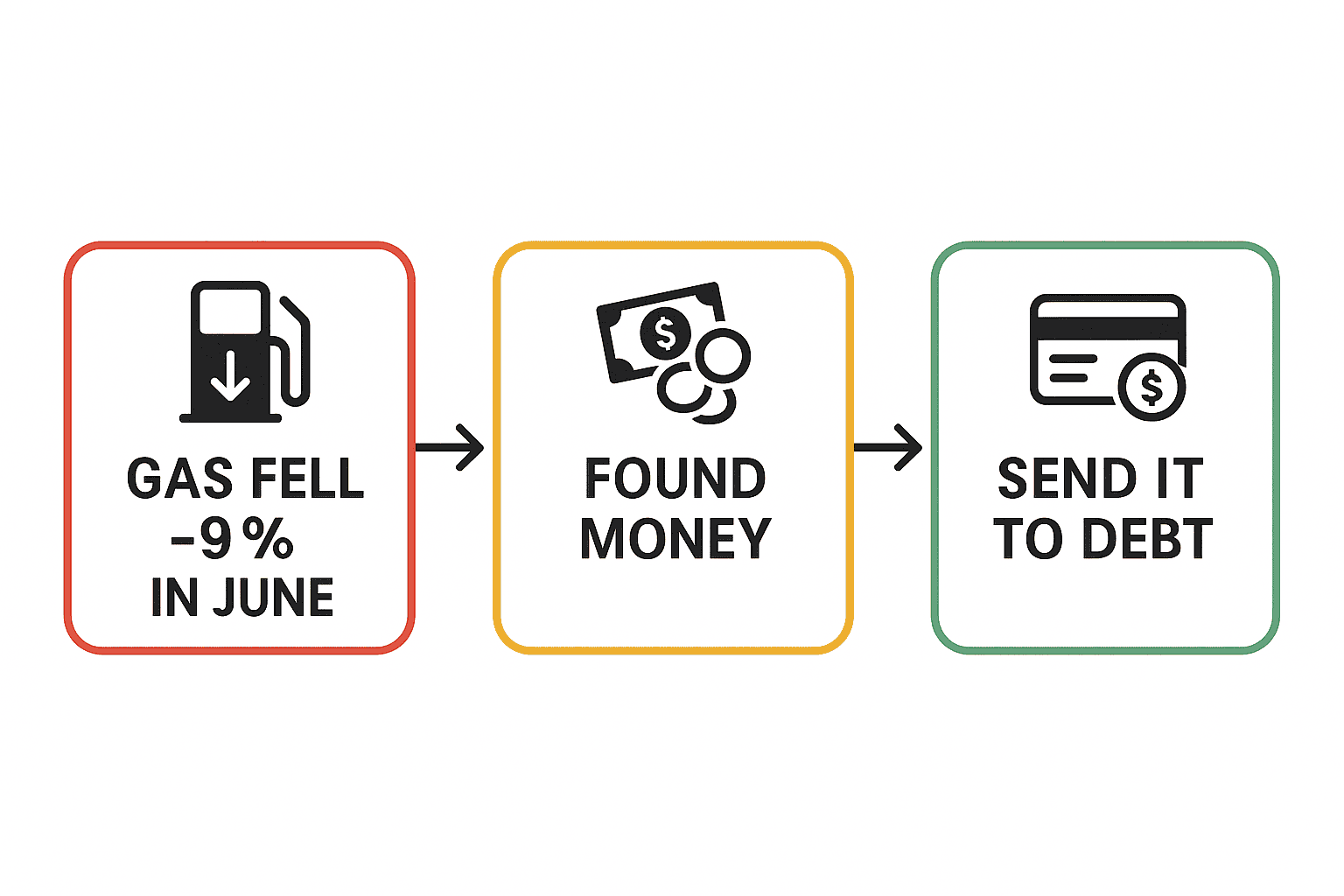
Gasoline specifically? Down more than 9% for the month. Fuel oil also fell more than 9%.
Each weekday I send one short email: one money story that caught my attention, why it might matter to you, and one manageable thing you can do with it. A couple of minutes, and a dad joke.
In the latest issue (Oct 16): The check that looks like a scam may be real
Free. I sell nothing. Unsubscribe any time.
Gasoline fell in June 2026 (month-over-month)
Energy index overall in June — the biggest monthly driver of cooling inflation
Gas is still up year-over-year — this is relief, not cheap
Source: Bureau of Labor Statistics, CPI News Release, July 14, 2026.
The Daily Money Brief — Free, at 10 AM
Money you may be owed, scams to dodge, and the fine print decoded — the consumer money news that affects your wallet, every weekday.
Important context before you celebrate too hard: Gas fell more than 9% in June — that is real, and you felt it at the pump this month. But zoom out twelve months and gasoline is still up roughly 26.7% year-over-year. This is relief at a still-elevated level, not a return to cheap gas. I’m not going to let you misread this — that’s not what’s happening here. And inflation overall is still at 3.5% annually, still above the Fed’s 2% target. One good month is not victory. But it is an opportunity, and that’s what this post is about.
Why You Need to Know It
Over 30 years in this space — since 1994 — I’ve watched the same pattern play out more times than I can count. A bill drops. A raise comes through. A refund arrives. And within 30 to 60 days, the money is gone. Not spent on anything dramatic. Just quietly absorbed into everyday life.
Behavioral economists have a name for this: lifestyle creep. I have a less academic name for it: the drain. Money that enters at the level of a bill gets spent at the level of a bill. The gas line item in your budget goes down by $40 this month, but somehow your total spending stays flat or goes up. You got the relief — you just didn’t keep it.
This is the moment where most people miss the move. And it only takes one month to capture it.
Things to Consider
The “found money” reframe is simple: the dollars you are NOT spending on gas this month compared to the past three months (when energy rose 3.8%, 3.9%, and 10.9% in March, April, and May respectively) are still yours — for now. The question is whether they end up doing something useful or just evaporate.
A few things to hold in mind:
- It may not last. Energy markets are volatile. Gas went up three months straight before this drop. I’m not predicting where it goes next — nobody reliably can — but treating this as a new permanent baseline would be a mistake. Treat it like a windfall to capture now, not a feature of your new normal budget.
- Small amounts moved consistently do more than large amounts moved eventually. If this month’s pump savings amounts to $30 or $50 or $80 fewer dollars spent — that goes directly to the highest-interest debt you’re carrying. Credit cards running at 24-29% APR? That extra payment is worth more than almost anything else you can do with that money.
- The math only works if you’re actually honest about what you’re spending on gas. Don’t estimate. Go look at your last three months of statements. What did you actually spend on fuel? What did you spend this month? The difference — that’s the found money. Real numbers only.
A quick capture calculation: If you were spending $200/month on gas and June dropped you to $180, that’s $20 in found money — small, but real. If you were spending $350 and you’re now spending $318, that’s $32. Whatever the number, write it down right now, log into your credit card account, and add that exact amount to this month’s payment. Not a round number. The exact amount. That specificity matters psychologically — it closes the loop between the relief you felt at the pump and the debt you’re chipping away at.
What to Think About Doing
Here’s what I’d suggest, and I’m giving you options because what makes sense depends entirely on where you are:
- If you have carrying credit-card debt at high interest: Find your actual June gas savings (compare to last 2-3 months). Transfer that exact dollar amount as an additional payment to your highest-APR card today. Not when it’s convenient — today, while you’re reading this. The window closes fast.
- If you’re current on everything but stretched thin: Even a $20-$50 extra payment builds the habit of capturing windfall money. The habit is as important as the dollar amount. You’re training yourself to capture found money instead of losing it.
- If you’re already underwater and a $40 extra payment isn’t going to change the math: A gas-price drop isn’t going to fix a structural debt problem. What you need is a real plan — and I’d point you toward a free consultation with Damon Day, who has been helping people in real debt trouble since long before the word “influencer” existed. Damon Day, an independent debt coach and my co-host on the Get Out of Debt Guy podcast, whom you can reach at DamonDay.com — I receive no payment for this referral. He’s not selling you a program. He helps you figure out what actually makes sense for your situation.
- Do NOT assume this relief will continue and budget against it going forward. Gas was up 10.9% in March. It can go back up.
- Do NOT cash out retirement to pay debt — that math never works in your favor. Gas savings are captured money; retirement is protected money. They’re not the same pool.
The Bottom Line
Gas prices dropped more than 9% in June 2026, and that’s the main reason inflation cooled. It’s real relief at the pump right now — but it’s not cheap gas and it may not last. The move is to find the exact dollar amount you saved compared to last month, and put it directly on your highest-interest debt before lifestyle creep takes it. Found money only becomes debt-fighting money if you make an active decision to capture it. Most people don’t. You can.
If you have questions about what any of this means for your specific situation, I’m right here — ask me directly. I’ll give you my honest read on what makes sense for your numbers, not a formula that works for someone else’s.
This is my take on what this economic data means and some thoughts on what you might consider doing. What’s right for your specific situation depends on your numbers, your income, your other obligations, and your priorities — not on a general post. Think of this as input, not instruction. Your situation is yours, and the right decision is the one that fits it.
Related experiment: While everyone argues about what the Fed will do next, I handed an AI $1,000 in a real account to see whether it can beat a plain index fund — and I log every decision publicly. See where the Investing Smarter Test stands today.
Dealing With Debt? Understanding your options is the first step. See how all your debt relief options compare — including ones most sites won’t tell you about. The Find Your Path quiz gives a recommendation based on your actual numbers, and the Scam-O-Meter checks any company’s complaint history before you sign. Federal Reserve research shows bankruptcy filers recover faster than those who don’t file.



