

“As a general proposition, forward guidance isn’t the business we should be in.” — Fed Chair Kevin Warsh, June 17, 2026
Something structurally changed at the Federal Reserve last month, and I don’t think most people realize what it means for how they manage debt.
At his very first FOMC meeting as Chair on June 17, 2026, Kevin Warsh did something no Fed Chair had done in years: he gutted the post-meeting statement. It shrank from more than 300 words to roughly 130. He also skipped submitting his own interest-rate projection in the dot-plot — the summary that shows where each Fed official thinks rates are heading.
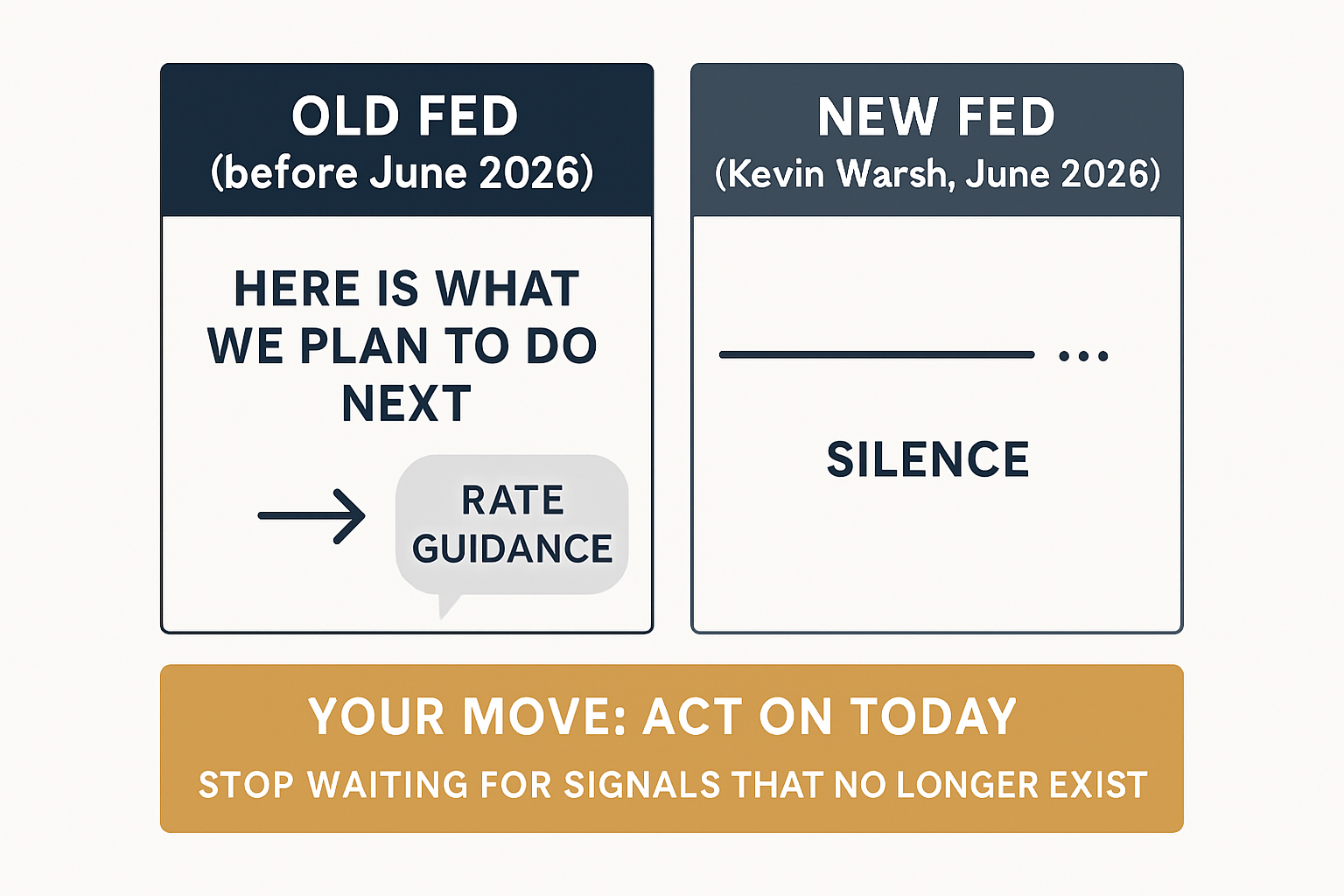
But here’s what matters most: Warsh said, plainly, that forward guidance “isn’t the business we should be in.” He called it “not well suited for the current policy conjuncture.”
Each weekday I send one short email: one story that caught my attention, why it might matter to you, and one manageable thing you can do with it. A couple of minutes, and a dad joke.
In the latest issue (Nov 9): Check your power bank and your French press
Free. I sell nothing. Unsubscribe any time.
Translation: the Fed has stopped telling you what it plans to do next. And that changes something important about how a lot of people approach their debt.
What You Need to Know
For years, the Federal Reserve’s communication playbook included “forward guidance” — deliberate signals about the likely direction of rates. Markets, journalists, and financial advisors became expert at parsing every word of every Fed statement. “Patient.” “Data-dependent.” “Gradual.” The language was designed to tell investors and households what was coming.
Warsh just eliminated that practice. His stated reasoning — and I want to be clear this is his reasoning, not my opinion — is that markets became too dependent on Fed guidance, and that such guidance is more useful during crises and downturns than in ordinary times.
The June statement was stripped to its essentials: current rates (3.50–3.75%), a brief acknowledgment of economic conditions, and nothing more. No hint of where things go from here.
This week’s data made the stakes concrete. June CPI came in cool — headline inflation at +3.5% annually, core down to 2.6% from 2.9%, energy and gas prices declining. That helped swing the odds of a rate hold at the July meeting to roughly 84.5%, after Fed Governor Christopher Waller had warned on July 13 that a hot reading could force a hike. In a single week: hike warning, cool data, rate expectations shift. That’s the new environment — rapid, data-driven whiplash, with no Fed guidance to smooth it out ahead of time.
I covered the CPI report and that hike-vs-hold whiplash in a separate post this week, and the gas price drop and what to do with that found money in another. This is the structural piece that ties both together: why week-to-week data volatility matters so much now is because the Fed stopped buffering you from it in advance.
The assumption to drop: “I’ll wait until the Fed signals rate cuts are coming before I refinance / pay down / take action on my debt.”
The new reality: The Fed has stopped signaling. If your debt plan depended on “waiting for the cut signal,” that signal no longer exists. Warsh eliminated it — deliberately, explicitly, at his first meeting. The era of Fed-guided timing is over by design.
Why You Need to Know This
Over 30 years in this space — since 1994 — I’ve watched the same movie play out hundreds of times. Someone carries high-interest credit card debt. The rate is 22%, 24%, 29%. But they don’t attack it aggressively because they’re “waiting to see what the Fed does.”
Maybe they heard rate cuts were coming. Maybe their financial advisor mentioned the dot-plot. Maybe they just read a headline. So they wait.
And while they wait, the interest compounds. Minimum payments mostly service interest. The balance barely moves. Months become years.
The “wait for the Fed signal” strategy was always a bad bet, even when the signals existed. Credit card APRs have their own economics — the relationship between the fed funds rate and what you pay on your card is far looser than most people assume. Card issuers capture the spread between what they borrow and what they charge you. Rate cuts don’t automatically flow to cardholders in full, or fast, or at all.
Now, though, it’s not even a game you can play. The Fed Chair explicitly told markets he’s not in the guidance business anymore. There are no signals to wait for. The data drives everything, and — as this week proved — the data can flip the rate-expectation picture in 48 hours.
Things to Consider
A few things worth holding in your head at the same time:
A data-dependent Fed means more noise, not less. When the Fed telegraphed moves in advance, rate expectations were relatively stable between meetings. Now, every major economic report — CPI, jobs, PCE, retail sales — can swing rate expectations dramatically in 48 hours. This week was a perfect case study. Waller’s hike warning on Monday, cool CPI on Tuesday, odds shifting sharply. That whiplash isn’t a glitch — it’s the system working exactly as Warsh intends. You’ll see more of it, not less.
Your credit card rate isn’t waiting on Fed guidance anyway. I wrote about this when Warsh’s broader philosophy became clear, and earlier about what Fed inaction costs you monthly in real dollars. Card issuers set their own APRs. When the Fed cuts, card rates sometimes follow — slowly, partially, and only when it serves the issuer. When the Fed raises, card rates tend to respond faster. The gap between the federal funds rate and what you pay at 29% APR isn’t accidental. It’s the profit margin. Waiting for the Fed to rescue you from that rate is a losing strategy in any environment.
I won’t predict where rates go, and you should be skeptical of anyone who does. Warsh’s whole move was to acknowledge that forward-looking rate commitments aren’t reliable in the current environment. That applies to me, too. I don’t know whether the Fed cuts in September, holds through year-end, or gets blindsided by a data reversal. Neither do the markets, the Fed’s own governors, or the Chair himself. Anyone telling you otherwise is telling you their hope, dressed up as analysis. My job is to give you the structural picture and let you make your own call from there.
The core shift: Before June 17, 2026, there was a defensible argument for watching Fed communication carefully before making major financial moves. Warsh didn’t just change the communication — he eliminated the rationale for waiting on it. If you’ve been planning around a signal, the signal has been turned off.
What to Think About Doing
The Plan, in Plain English
Your debt plan should be based on today’s interest rate reality — not on a forecast the Fed has explicitly stopped making. Here’s what that means in practice.
- Attack high-APR debt now, not when the Fed moves. If you’re carrying a balance at 22%, 24%, or 29%, every month you wait costs you real money. The math is simple and not in your favor. The “wait for the cut” logic was always thin; now the cut signal has been turned off. Run the numbers on what you’re paying monthly in interest and ask yourself how much longer that’s sustainable.
- Tune out the weekly rate-expectation whiplash. Fed funds futures, dot-plot interpretations, “will they or won’t they” headlines — this was always speculation dressed as analysis. In a purely data-dependent environment, the speculation gets louder and less reliable. I’d rather you spend that mental energy on your actual balance sheet. The noise isn’t information you can act on.
- If you’re stuck, get a real plan — not a forecast. If the debt feels unmanageable, the answer isn’t to wait for a better rate environment that may or may not arrive on any timeline you can count on. The answer is to look at your actual options. For an honest, personalized read on what those options are, I recommend reaching out to Damon Day at DamonDay.com — he offers a free initial call and gives you a straight picture of what makes sense for your situation, not what’s easiest to sell. Damon Day, an independent debt coach and my co-host on the Get Out of Debt Guy podcast, whom you can reach at DamonDay.com — I receive no payment for this referral.
- Consider whether the math of your debt means it’s time to reset. For people carrying significant unsecured debt, the question isn’t “when will my rate drop?” — it’s “does continuing to service this debt actually make mathematical sense?” Federal Reserve research shows bankruptcy filers recover faster than those who don’t file. A rate cut won’t give you that kind of reset. A good bankruptcy attorney might. Find one through NACBA (National Association of Consumer Bankruptcy Attorneys).
Debt is math wrapped in emotion. The emotion — the waiting, the hoping, the “things will ease when rates drop” — is exactly what keeps people stuck. The math says: every month at a high APR is money you’re spending on interest instead of your future. The Fed just told you the timing picture won’t get clearer. So the math should win.
Bottom line: Kevin Warsh’s first act as Fed Chair was to eliminate the communication tool people have used to delay acting on their debt. That’s not partisan commentary — it’s a structural fact with a clear consumer implication. Stop waiting for a signal that no longer exists. Act on today’s reality. Your rate is what it is right now, and that’s the only number that actually matters for your plan.
A note on what I do here: I share my analysis and perspective based on more than 30 years of consumer advocacy work — since 1994. This is informed input to help you think clearly, not a directive, and not advice tailored to your specific situation. What’s right for you depends on your full financial picture. Use this to inform your thinking, then talk to a professional who knows your actual numbers before making major decisions. You are not your debt. You just need to deal with it and look forward.
Related experiment: While everyone argues about what the Fed will do next, I handed an AI $1,000 in a real account to see whether it can beat a plain index fund — and I log every decision publicly. See where the Investing Smarter Test stands today.
Dealing With Debt? Understanding your options is the first step. See how all your debt relief options compare — including ones most sites won’t tell you about. The Find Your Path quiz gives a recommendation based on your actual numbers, and the Scam-O-Meter checks any company’s complaint history before you sign. Federal Reserve research shows bankruptcy filers recover faster than those who don’t file.
Free Tool — Contract Decoder: Have a contract from a debt relief company? The free Contract Decoder analyzes it for red flags, hidden fees, and problematic terms — before you sign anything. Decode My Contract →
Frequently Asked Questions
Free Tool — Cost of Inaction Calculator: Thinking about waiting to deal with your debt? The free Cost of Inaction Calculator shows exactly how much more you'll owe — in interest and lost retirement savings — for every month you delay. Calculate the Cost →
What is forward guidance, and why did the Fed use it?
Forward guidance is the practice of signaling what the Fed expects to do with interest rates in the future. It was a tool to stabilize financial conditions — if markets knew a cut was coming, they could price it in before it happened, reducing volatility. The Fed leaned heavily on it especially after the 2008 financial crisis and through the COVID period.
What exactly did Kevin Warsh change at his first FOMC meeting?
At his first meeting as Fed Chair on June 17, 2026, Warsh stripped the post-meeting statement down to roughly 130 words — less than half its recent length — and eliminated forward-looking language about the rate path. He also chose not to submit his own interest-rate projection to the Summary of Economic Projections (the “dot-plot”). At the press conference he said directly: “As a general proposition, forward guidance isn’t the business we should be in.” He described it as “not well suited for the current policy conjuncture.”
Does the end of forward guidance mean my credit card rate will go up or down?
It doesn’t directly move your card rate either way, and I’m not going to predict the direction — that’s precisely the point. What it does is increase the volatility of rate expectations between meetings, because every economic data release now carries more weight with no Fed guidance to smooth it. Your credit card APR has its own pricing dynamics that lag (and often don’t fully reflect) changes in the fed funds rate. The practical takeaway is the same regardless of direction: don’t build your debt payoff plan around a rate forecast you can’t rely on.
Should I wait to see if rates drop before paying down debt aggressively?
This was always a questionable strategy; it’s now even harder to defend. The Fed has explicitly removed the communication tool people used to time rate moves. Your APR is compounding today. Every month of delay has a real cost. The better move is to act on the rate you have right now — attack high-APR debt aggressively based on your current math, not a forecast that may or may not materialize on any timeline that helps you.
If there’s more uncertainty, is now actually a bad time to make financial decisions?
No — uncertainty about future rates is an argument for resolving high-cost debt sooner, not later. The options available to you (debt management, settlement, bankruptcy) don’t hinge on the federal funds rate. They hinge on your actual numbers: your income, your balances, your monthly cash flow. That math is available to you right now. Get a real assessment. Damon Day at DamonDay.com offers a free initial consultation and will give you an honest picture of what your options actually are based on your situation. Damon is my podcast co-host, and I receive no payment for this referral.
Is the Fed’s decision to end forward guidance good or bad for consumers?
I’m deliberately not taking a political side on Warsh’s policy choices — that’s not what this site is for. What I can say is that the consumer implication is neutral in terms of direction, but significant in terms of behavior: if you’ve been managing your financial life around what the Fed signals, you now need a different framework. Act on today’s rate reality. Build your plan around what’s true now, not what you’re hoping the Fed will telegraph next.



