

Quick Answer: Hawaii Governor Josh Green signed Senate Bill 3025 (now Act 220, Session Laws of Hawaiʻi 2026) on July 9, 2026, creating a Medical Debt Acquisition and Forgiveness Program that can buy and cancel qualifying residents’ medical debt with no application required. Up to 50,000 residents could see up to $91 million erased, but only $500,000 has actually been funded so far — so don’t wait on a letter in the mail to protect yourself. Get an itemized bill and dispute anything wrong right now, because this program erases existing debt already sold into the system; it doesn’t correct billing errors or stop new debt from piling up.
Expert Context: I’ve been helping people navigate medical debt since 1994, including running a nonprofit credit counseling organization that fielded thousands of calls from people drowning in hospital bills. I’ve watched “debt forgiveness” headlines give people false comfort before — they assume they’re covered, stop fighting a wrong bill, and find out later they weren’t in the batch that got erased. That’s the gap I want to close for you here.
Hawaii just became the newest state to let a nonprofit buy up medical debt for pennies on the dollar and wipe it out — and if you live there, you may never have to lift a finger to benefit. But “automatic” doesn’t mean “guaranteed,” and it definitely doesn’t mean “stop paying attention.”
Key Terms Defined
Act 220, SLH 2026 (SB 3025): The Hawaii law signed July 9, 2026 that creates the Medical Debt Acquisition and Forgiveness Program, run by the state’s Office of Wellness and Resilience (now housed under the Department of Human Services). See the Governor’s official announcement.
Each weekday I send one short email: one story that caught my attention, why it might matter to you, and one manageable thing you can do with it. A couple of minutes, and a dad joke.
In the latest issue (Nov 6): Owed money on an Amazon return? Check by Dec. 1
Free. I sell nothing. Unsubscribe any time.
Nonprofit debt buyback model: A nonprofit purchases old medical debt from hospitals, providers, and collection agencies for a fraction of face value — often less than a penny per dollar — then cancels it entirely instead of trying to collect. The same model erased $642 million in Arizona.
400% of the Federal Poverty Level (FPL): One of Hawaii’s two eligibility tests — roughly $140,000 for a Hawaii family, per KITV’s reporting. The second test: your medical debt exceeds 5% of your income, which can qualify higher earners too.
What You Need to Know
Hawaii Governor Josh Green signed Act 220 into law on July 9, 2026, establishing a Medical Debt Acquisition and Forgiveness Program inside the state’s Office of Wellness and Resilience. According to the Governor’s office, roughly one in 20 Hawaii adults carries medical debt that shows up on their credit report — debt that delays care, blocks housing and job applications, and deepens the cycle it’s supposed to help people escape.
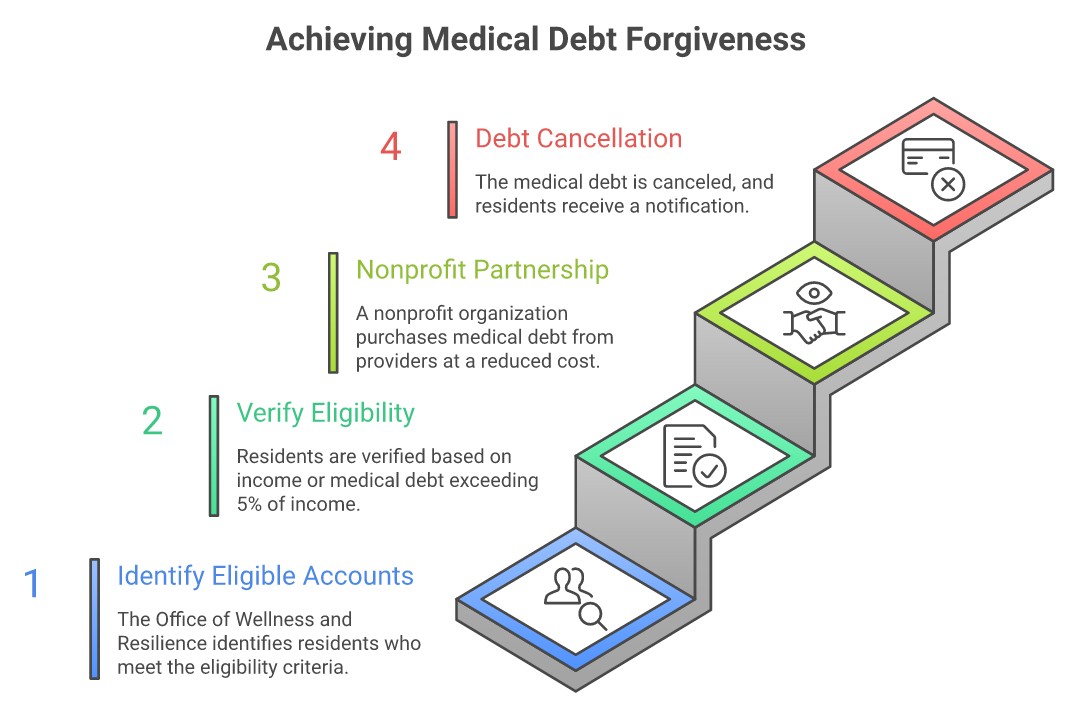
Here’s the mechanism, as KITV reported: this is not an application process. A nonprofit partner identifies eligible accounts — based on income at or below 400% of the federal poverty level, or medical debt that exceeds 5% of a person’s income — and buys that debt directly from hospitals and providers at a steep discount. The debt is then simply canceled. Qualifying residents get a notice in the mail telling them it’s gone. No forms, no calls, no proof of hardship required.
The scale is real on paper: up to 50,000 residents and $91 million in medical debt, according to Hawaii News Now. But the law only creates the framework — it doesn’t fund the whole $91 million. Reporting from Big Island Now confirms the program still needs funding and implementation before debt actually starts getting bought and canceled, and the legislature has appropriated $500,000 to start. That’s the gap between the headline number and what actually happens this year.
Hawaii isn’t inventing this approach. The Governor’s own team notes this model is already running in 27 other U.S. cities and states, including Arizona, which erased $642 million for 485,000 residents.
Why You Need to Know It
I’ve spent more than 30 years watching what happens when people hear “your debt might get erased” and stop being their own advocate. Here’s the part the headlines skip: this program buys debt that already exists in a collections pipeline — it’s not a bill-correction service, and it’s not retroactive to charges you haven’t been billed for yet.
If you were overcharged, billed for a procedure you never had, or double-billed by a hospital, that’s a billing dispute, not “debt” in the sense this program targets. If you pay a wrong bill today out of fear or confusion, that money is gone — it never becomes debt sitting in a portfolio waiting to be forgiven. Waiting on a possible future erasure is not a substitute for disputing a wrong charge the moment you see it.
The Claim: “Hawaii has a debt forgiveness program now, so I don’t need to worry about my medical bills anymore.”
The Reality: The program only reaches debt that a nonprofit partner actually buys from a participating provider or collector, and only after the state funds it beyond the initial $500,000. It does nothing for a bill you haven’t disputed, a provider that doesn’t participate, or new medical debt you rack up after the snapshot the nonprofit buys. Assuming you’re covered is exactly how people let real billing errors go unchallenged.
Things to Consider
A few second-order effects worth thinking through before you relax:
- The funding gap is the whole ballgame. $500,000 buys a fraction of $91 million in debt at buyback prices — likely a meaningful chunk given how cheaply debt trades, but nowhere near guaranteed to cover every eligible resident this year. Watch for future legislative appropriations, not just the headline number.
- Eligibility is invisible to you until it happens. Because there’s no application, you have no way to confirm in advance whether you qualify. You find out only when a notice arrives — or never arrives, because your account wasn’t in the batch purchased.
- It doesn’t touch debt with providers who don’t sell in. Not every hospital, clinic, or collection agency will participate. If yours doesn’t, this program can’t help you regardless of your income or debt-to-income ratio.
- Tax treatment has precedent, but confirm it for your situation. In Arizona’s version of this same model, the nonprofit buyer is treated as a “disinterested third party,” so canceled debt hasn’t triggered a 1099-C or taxable-income issue, according to 12News’ reporting on Arizona’s program. I’d expect Hawaii’s program to work the same way, but confirm with a tax professional if you receive a cancellation notice.
- Credit reports don’t self-correct instantly. If your debt is bought and canceled, ask for written confirmation and check your credit report at AnnualCreditReport.com a few months later to make sure it’s actually reflected there.
Other States Running This Same Model
- Arizona — $642M erased for 485,000 residents, targeting $2 billion
- North Carolina — erased debt for roughly 2.5 million residents through hospital agreements
- New Jersey — budgeted funds targeting up to $1 billion in eliminated debt
- Connecticut — a multi-round state program running since 2024
What Hasn’t Changed
- You still have to dispute wrong bills yourself — no program does that for you
- New medical debt you incur going forward isn’t covered
- Providers who don’t sell into the program leave you unprotected
- About 15 million Americans still have medical debt on their credit reports, according to the CFPB
Free Tool — 1099-C Tax Calculator: Received a 1099-C for cancelled debt? The free 1099-C Tax Calculator runs the exact IRS insolvency math from Publication 4681 Worksheet 2 — and covers the partial insolvency case most people miss. Run the Calculator →
What to Think About Doing
If you live in Hawaii:
- Don’t wait passively for a letter. Contact every provider you owe and request an itemized bill now — not a summary statement, the line-by-line breakdown.
- Dispute anything wrong in writing, with your provider’s billing office, immediately. Don’t assume a future buyback will fix it — it won’t correct an error, it can only erase a balance that’s accurate.
- If a debt has already gone to collections, demand written validation before paying anything. Use the free Debt Validation Letter Generator.
- If you get a notice that your debt was forgiven, save it, and check your credit report a few months later to confirm the tradeline updated.
If you live anywhere else:
- Search “[your state] medical debt relief program” or check with your state’s version of this guide — Arizona, Connecticut, New Jersey, North Carolina, and dozens of cities already run one.
- Regardless of whether your state has a program, get an itemized bill and dispute billing errors now. That’s true with or without a forgiveness program.
- If medical debt is already affecting your ability to pay rent, keep the lights on, or sleep at night, look at what the research actually shows about bankruptcy before assuming it’s a last resort. It discharges medical debt entirely and protects your retirement — something no debt-buyback program does for the debt it misses.
- Never cash out a 401(k) or IRA to pay medical debt. That money is protected from creditors in bankruptcy; a hospital bill generally isn’t worth trading your retirement for.
Not Sure Where to Start? Take the free Find Your Path quiz for a recommendation based on your actual numbers — not a generic checklist.
Key Takeaways
- Hawaii’s Act 220 can erase medical debt automatically — no application required — for residents at or below 400% of the federal poverty level or whose medical debt exceeds 5% of income.
- Only $500,000 has been funded toward a potential $91 million; the framework exists, but full-scale relief isn’t guaranteed yet.
- The program can’t fix a wrongly billed charge or protect you from a provider that doesn’t participate — keep disputing bad bills regardless.
- At least 27 other U.S. cities and states run a similar nonprofit debt-buyback program — check whether yours does.
The Bottom Line
If you’re carrying medical debt right now, a new law in Hawaii is genuinely good news — proof that lawmakers are finally treating medical debt as what it actually is: math broken by a health crisis, not a moral failing. But good news at the state level doesn’t replace good instincts at your kitchen table. Get your itemized bills, dispute what’s wrong, and don’t let the hope of automatic forgiveness talk you out of protecting yourself today. I filed bankruptcy in 1990 and rebuilt from nothing — the one thing I always tell people is that no rescue program, government or otherwise, works better than knowing your own numbers cold.
Free Tool — Debt Validation Letter Generator: Being contacted by a debt collector? The free Debt Validation Letter Generator creates a personalized FDCPA validation letter in seconds — forcing the collector to prove the debt is real before they can continue. Generate My Letter →
Frequently Asked Questions
Do I need to apply for Hawaii’s medical debt forgiveness program?
No. According to KITV’s reporting, Hawaii’s Medical Debt Acquisition and Forgiveness Program under Act 220 works automatically. A nonprofit partner identifies eligible accounts based on income and debt-to-income criteria, buys the debt from providers, cancels it, and mails you a notice. There’s no form to fill out.
How do I know if my medical debt qualifies under Act 220?
You qualify if your income is at or below 400% of the federal poverty level (roughly $140,000 for a Hawaii family, per KITV) or if your medical debt exceeds 5% of your annual income. You won’t know for certain until you either get a notice or don’t — there’s no lookup tool to check eligibility in advance, since the nonprofit partner identifies accounts on its own.
Will Hawaii’s program fix a medical bill I was wrongly charged for?
No. This program buys and cancels debt that already exists in the billing or collections pipeline — it isn’t a dispute-resolution service. If you believe a charge is wrong, request an itemized bill and dispute it directly with the provider’s billing office now. Don’t wait to see if a future debt buyback corrects it, because it won’t.
Is medical debt canceled through a program like this taxable?
In Arizona’s version of the same nonprofit buyback model, canceled debt hasn’t triggered a 1099-C because the nonprofit is treated as a “disinterested third party” rather than the original creditor forgiving a loan, according to 12News. Hawaii’s program uses the same structure, but confirm your specific situation with a tax professional if you receive a cancellation notice.
What should I do if my state doesn’t have a program like Hawaii’s?
Get an itemized bill from every provider and dispute anything wrong — that protects you no matter what your state does. Ask about hospital charity care and financial assistance programs, which most nonprofit hospitals are required to offer. And if medical debt is genuinely overwhelming, bankruptcy research shows it discharges medical debt entirely while protecting your retirement accounts — it’s worth a real look, not an automatic no.
One more thing — everything I share here is based on more than 30 years of helping people through exactly this. But my advice is input for your decision, not the decision itself. Only you know your full situation. Talk to a consumer attorney or a housing/medical billing advocate, look at your own numbers, and make the choice that serves your future.
Know someone in Hawaii carrying medical debt, or drowning in hospital bills anywhere else? Please forward this to them. A law like this only helps if people actually know it exists — and know what it doesn’t cover.
Dealing With Debt? Understanding your options is the first step. See how all your debt relief options compare — including ones most sites won’t tell you about. The Find Your Path quiz gives a recommendation based on your actual numbers, and the Scam-O-Meter checks any company’s complaint history before you sign. Federal Reserve Bank of New York research shows bankruptcy filers recover faster than those who don’t file.



