

Written by Steve Rhode, consumer debt expert since 1994 • Last updated July 28, 2026
Quick Answer: A title lender has seized (or is about to sell) the car you pledged as collateral. There’s no federal cap on what a civilian title loan can charge — the typical single-payment title loan runs about 300% APR, and one in five borrowers loses the car, according to the CFPB. What happens next depends entirely on your state: in Georgia the loan is legally a “pawn,” and once they take the car the debt is satisfied by law — no lawsuit over this debt, ever. In most other states, you can still be sued for a deficiency balance. Get your exact payoff amount today, retrieve your personal property, and consider bankruptcy before the car is sold if you can’t redeem it in time. Don’t wait — some states allow the sale in as little as 10 days.
What Just Happened to Your Car
When you took out that title loan, you handed the lender your car’s title as collateral for cash — usually a single 30-day loan of a few hundred dollars, structured so the entire balance, principal plus a steep finance charge, comes due in one payment. The CFPB’s analysis of 3.5 million title loan records found the typical loan is about $700 at roughly 300% APR, and that more than four in five of these loans get renewed the same day they’re due because the borrower can’t pay it off in one shot — more than two-thirds of all title-loan business comes from people re-borrowing seven or more times in a row. One in five single-payment title loan borrowers eventually has the vehicle seized.
Once you fell behind, the lender didn’t need a court order to take the car. Most title loan agreements let the lender repossess the moment you default — day or night, from your driveway, a parking lot, wherever the car happens to be — as long as they don’t “breach the peace” (break into a locked garage, use physical force, or keep going after you clearly object). What happens next — whether you can still get the car back, what it costs, and whether you can be chased for money afterward — depends almost entirely on which state’s title loan law covers your contract. (If this was a standard auto loan rather than a title loan, the mechanics are similar but the deficiency risk is different — see the general car repossession guide.)
Title loans get sold as a fast, no-credit-check way to raise cash against a car you already own outright. I’ve written before about when title loans help and when they hurt — this guide picks up at the moment it’s already gone wrong.
The Mistake You’re About to Make: Assuming every state treats a seized title-loan car the same way, or assuming you have weeks to sort this out. You might not — depending on your state, the lender may only owe you 10 to 15 days’ written notice before the car is auctioned. The second mistake: assuming that if you can’t pay, this debt follows you forever. In several states — Georgia is the clearest example — a title loan is legally structured as a pawn transaction. Once the lender takes the car, the debt is considered paid in full by law. No lawsuit, no deficiency, ever. Find out which rule applies to YOU before you panic and take out a rollover loan at an even worse rate to try to save it.
Your Options Right Now
What to Do in the Next 48 Hours
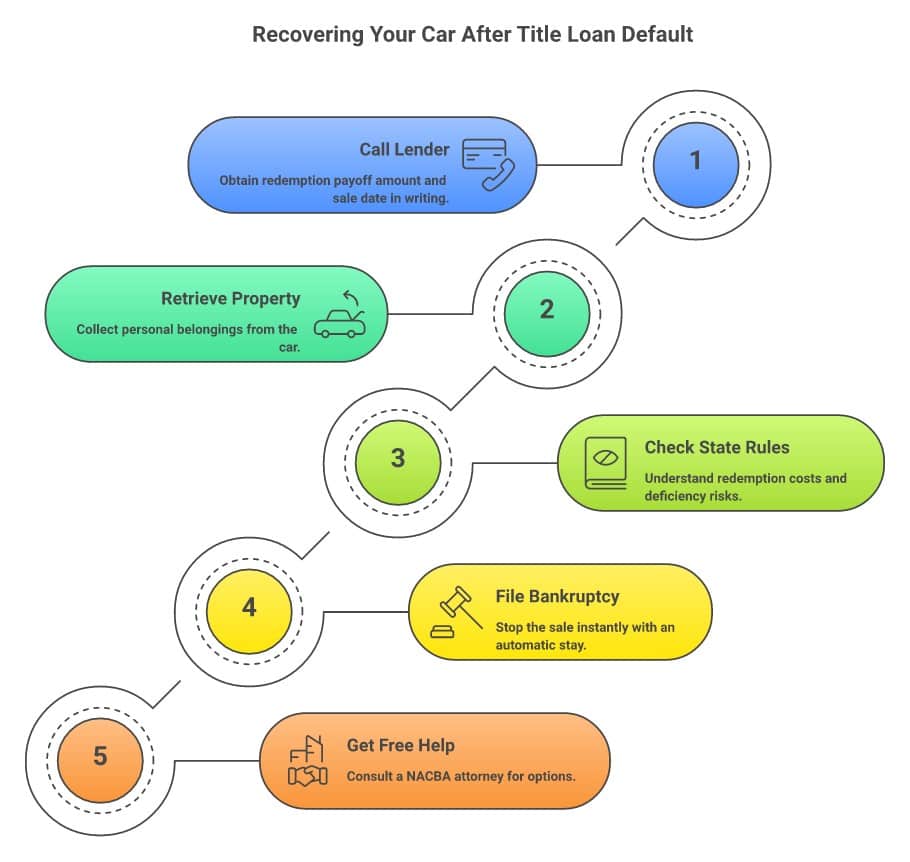
- Call the lender today and get your exact payoff in writing. Ask for both the “redemption” amount (pay it in full to get your title back) and, if your state allows it, the “reinstatement” amount (catch up only the past-due payments to restart the loan) — those can be very different numbers, and assuming you need the full payoff when you only needed to reinstate can cost you hundreds you didn’t have to spend. A simple script: “I’m requesting my redemption and reinstatement amounts and the scheduled sale date in writing today. I am not authorizing any new loan or any payment right now.” Many states require this payoff information in writing before a sale — don’t rely on a verbal number.
- Go get your personal property out of the car now. Under CFPB guidance and FTC guidance, a lender generally shouldn’t keep or charge you a fee to return personal items left in a repossessed vehicle — though state and tow-lot rules vary, so if you are charged one, document it for a complaint rather than assuming the law was broken. Photograph everything that was inside before you call.
- Find out how your state treats title loans before you agree to anything — see the state comparison below. The rules on notice, redemption cost, and whether you can be sued afterward vary more for title loans than for almost any other debt.
- If you can’t redeem in time, look at bankruptcy before the sale date. The automatic stay takes effect the moment you file — not weeks later — and stops any future sale of the vehicle under 11 U.S.C. § 362. Take the free bankruptcy quiz and talk to a NACBA bankruptcy attorney today if the sale date is close.
- Get free help now. Talk to Damon Day for free about your overall debt picture, or if this is a straightforward legal-rights problem — an illegal repossession, withheld property, an unlawful fee — a NACA consumer attorney handles that. Damon Day, an independent debt coach and my co-host on the Get Out of Debt Guy podcast, whom you can reach at DamonDay.com — I receive no payment for this referral.
How to Actually Stop It — Your 4 Paths
- File bankruptcy before the sale — but know its real limits. Filing stops the auction the instant the petition is filed. What it does NOT automatically do is force the lender to hand back a car that was already repossessed before you filed. The Supreme Court held in City of Chicago v. Fulton (2021) that simply holding onto a repossessed vehicle isn’t a stay violation — your attorney typically has to file a turnover motion under 11 U.S.C. § 542 to get it back. That’s exactly why speed and a bankruptcy attorney matter here, not just filing the petition.
- Redeem or reinstate the loan. Paying the exact payoff amount (which most states require the lender to calculate and disclose) gets you the title back before the sale. In Virginia, for example, that amount is capped by statute at principal plus interest through the repossession date plus limited fees — see the exact formula.
- File a state complaint if the lender broke the rules. Missed notice deadlines, withheld personal property, or an APR above your state’s cap are all things your state’s financial regulator or attorney general can act on — sometimes forcing the car back or the debt canceled entirely. State AG enforcement against title lenders isn’t rare — North Carolina’s AG office has gotten cars and clear titles back for consumers in exactly this kind of case.
- What won’t work: taking out another title or payday loan to cover this one. That’s how the CFPB’s “seven or more loans in a row” statistic happens. It doesn’t undo the repossession — it just adds a second high-cost loan on top of the first. A debt settlement company also can’t “un-repossess” a car; settlement only works on money debts, not collateral that’s already gone.
- Already in an active Chapter 13 and thinking about a new title loan to dig out of this? Stop before you sign — most trustees require permission first, and pledging your car again can put your whole case at risk.
Free Tool — Contract Decoder: Have a contract from a debt relief company? The free Contract Decoder analyzes it for red flags, hidden fees, and problematic terms — before you sign anything. Decode My Contract →
What You Need to Know About Title Loan Rules
Typical single-payment title loan (CFPB)
Borrowers who lose the vehicle (CFPB)
For active-duty military & dependents (Military Lending Act)
Before permanent forfeiture under Georgia’s pawn law
There’s no federal interest rate cap on a civilian title loan. The one federal rate limit that does exist is the Military Lending Act’s 36% Military APR cap, which covers active-duty service members and their dependents — if that’s you and your rate was higher, the loan may not be enforceable as written.
| Where You Are | The Rule | What It Means for You |
|---|---|---|
| Federal baseline | No APR cap on civilian loans; automatic stay under 11 U.S.C. § 362 stops a scheduled sale the moment you file bankruptcy | Bankruptcy stops a future sale instantly, but doesn’t force return of a car already seized (see Fulton, above) |
| Active-duty military & dependents | 36% MAPR cap under 32 C.F.R. Part 232 | If your loan exceeded 36% MAPR, get it reviewed by JAG or a legal aid attorney — it may be void |
| Georgia | Title loan = legal “pawn” transaction; 30-day grace period after the loan’s maturity date, then ownership is automatically forfeited by statute | You permanently lose the car once the grace period runs, but the lender can never sue you for a deficiency |
| Virginia | 36% APR cap; ≥10 days’ notice before repossession, ≥15 days before sale; your redemption payoff is calculated with interest only through the date the lender repossessed the car | One of the more borrower-protective state title loan statutes |
| Illinois | Effectively banned since 2021 under the 36% all-in APR cap in the Predatory Loan Prevention Act | Many licensed title lenders surrendered their licenses — if you have an Illinois “title loan,” get the paperwork reviewed |
| Texas | Structured through a licensed Credit Access Business; right to redeem before sale; personal property must be returned | Effective APRs can still run very high through broker fees — read your contract’s total cost, not just the stated rate |
If you live in Georgia — your loan is legally a pawn, not a loan, and once the statutory grace period passes without redemption, your ownership interest is automatically extinguished. That also means the pawnbroker can’t come after you for a deficiency; the debt is satisfied by taking the car. If you live in Illinois, Colorado, Connecticut, Hawaii, or a handful of other states where high-cost title lending is effectively banned or capped at 36% APR, get your loan paperwork reviewed — it may not be a legal debt at all.
If the lender withheld your personal property, missed your state’s notice deadline, or charged an illegal rate, file a complaint with the CFPB and your state attorney general. If you need legal help but can’t afford an attorney, find free legal aid through LSC.gov.
One important exception — online and tribal lenders. If you got your title loan online, or from a lender that describes itself as tribal or tribe-affiliated, the state rules in the table above may not work the way you’d expect — some of these lenders claim they aren’t bound by your state’s rate cap or notice requirements at all. Don’t assume the protections above cover you, and don’t assume they don’t. File a complaint with the CFPB and your state attorney general, and have the contract reviewed by a legal aid or NACA consumer attorney before you pay a dollar based on what the lender told you.
Steve’s Take
I filed bankruptcy in 1990, and one of the debts on my list was secured by a vehicle. I remember exactly what that fear feels like — not just losing the property, but losing the ability to get to work, get the kids to school, keep the rest of your life running. Title loans exist because someone needed cash fast and had nothing left to borrow against except a car they already owned free and clear. That’s not a character flaw. It’s math — a short-term cash gap met with the only collateral available, priced at 300% APR because the lender knows exactly how much leverage they have over you in that moment. Losing the car doesn’t mean you’ve lost the argument. There’s a specific rule that applies to your state and your loan, and there’s very likely a way through this that doesn’t mean carrying this debt for years. I’ve watched thousands of people find their way out — the ones who moved fast and got real information did better than the ones who froze.
Frequently Asked Questions
A title loan company took my car — can I still get it back?
Usually yes, until it’s actually sold. Most states give you a “right of redemption” — pay the payoff amount (principal, accrued interest, and limited repossession costs) and the lender must return the title. The exact formula and deadline vary by state, so get your state’s rule and your exact payoff in writing today.
Do I still owe money after they take my car?
It depends on your state. In Georgia, a title loan is legally a pawn transaction — once the lender takes the car, the debt is satisfied by law and they can’t sue you for more. In most other states, if the car sells at auction for less than you owe, the lender can pursue you for that deficiency balance — check your state’s rule before you assume either way.
I filed bankruptcy — will they have to give my car back right away?
Filing stops any future sale of the car the instant the petition is filed, under 11 U.S.C. § 362. But the Supreme Court ruled in City of Chicago v. Fulton (2021) that a lender simply holding onto a car it already repossessed doesn’t violate the automatic stay — your attorney generally has to file a turnover motion to force its return. Don’t assume the car comes back automatically; ask your attorney to file that motion right away.
Can they keep the stuff that was in my car?
Generally no. Both the CFPB and the FTC say you shouldn’t be charged a fee to return your personal belongings left inside a repossessed vehicle. State and tow-lot rules do vary, so if you are charged one, document it and include it in your complaint. Photograph what was inside and ask for it back immediately, in writing if they resist.
Was my title loan even legal?
Maybe not, depending on where you live. Several states ban high-cost title lending outright or cap rates so low the traditional model can’t operate — the Illinois Attorney General’s office confirms Illinois effectively ended it in 2021 with a 36% all-in APR cap under the Predatory Loan Prevention Act. If you got your loan online or from an out-of-state lender while living in one of these states, have the contract reviewed by a legal aid attorney or your state attorney general’s office before you assume you owe what the lender says you owe.
I’m active-duty military, or a military spouse or dependent — do I get extra protection?
Yes. The Military Lending Act caps the “Military APR” on a title loan to covered service members and their dependents at 36%, under 32 C.F.R. Part 232. If your rate exceeded that, the loan may not be enforceable — a JAG legal assistance office or legal aid attorney can review it for free.
How much notice does the lender have to give before selling my car?
It varies a lot by state. Virginia requires at least 15 days’ written notice before the sale; Texas, where title lenders are licensed through the Office of Consumer Credit Commissioner, requires about 10 days. Some states have no specific statutory minimum beyond a general “commercially reasonable” notice requirement. Always demand the sale date and notice in writing — don’t rely on a verbal timeline from the lender.
I’m in Georgia — is a title pawn really treated differently?
Yes, and it matters both ways. Georgia’s Attorney General confirms that a car title loan there is legally a pawn transaction, not a loan, under O.C.G.A. § 44-14-403. There’s a 30-day grace period after the loan’s maturity date (the day your final payment was due) before your ownership is automatically forfeited by statute — but once that period runs, the car is gone for good, with no further right to redeem. The upside: because it’s a pawn, the lender’s only remedy is the car itself. They cannot sue you afterward for a deficiency on the title-pawn debt. (That protection covers this loan itself — if you receive other collection notices, verify what each one is actually about rather than assuming everything is covered.)
One more thing — everything I share here is based on over 30 years of helping people through exactly this. But my advice is input for your decision, not the decision itself. Only you know your full situation. Talk to an attorney, look at your numbers, and make the choice that serves your future.
Important: This guide is for informational purposes only and is not legal advice. Title loan law varies enormously by state, and your situation may have details that change what options are available to you. For legal advice specific to your case, consult an attorney licensed in your state. NACBA can help you find a bankruptcy attorney, NACA can connect you with a consumer attorney, or talk to Damon Day for free (a debt coach, not an attorney) about your situation. Damon Day, an independent debt coach and my co-host on the Get Out of Debt Guy podcast, whom you can reach at DamonDay.com — I receive no payment for this referral.
Key Takeaway: Losing a title-loan car is serious but the debt itself isn’t always permanent — whether you can be chased for more money depends entirely on your state. Get your exact payoff amount, get your personal property back, and talk to a bankruptcy or consumer attorney this week if the sale date is close. The longer you wait, the fewer options you have.
The Bottom Line
You’re not bad with money because a title loan went wrong — you took the only collateral you had left and priced it against a 300% APR lender who counted on you not knowing your rights. The law built specific protections into this exact moment: a right to redeem, a right to your personal property, and in some states, a hard limit on what the lender can ever collect from you. The people who moved fast — got the payoff number, got their belongings, checked their state’s rule, and talked to a real attorney before the sale — did better than the ones who froze and hoped it would go away. If someone you know just had their car seized by a title lender, send them this page; the clock is often shorter than they think. See the full Crisis Guides library and take the Find Your Path quiz for a recommendation based on your actual numbers.
Dealing With Debt? Understanding your options is the first step. See how all your debt relief options compare — including ones most sites won’t tell you about. The Find Your Path quiz gives a recommendation based on your actual numbers, and the Scam-O-Meter checks any company’s complaint history before you sign. Federal Reserve Bank of New York research shows bankruptcy filers recover faster than those who don’t file.
Right now you are dealing with the thing in front of you, and that is exactly where your attention belongs. When it is handled — and it will be — there is a next stage, and it is the one I most enjoy writing about.
In the latest issue (Nov 12): A 10% cap on your credit card rate? Here's what's real.
Each weekday I send one short email: one story that caught my attention, why it might matter to you, and one manageable thing you can do with it. It is free, I sell nothing, and I take no money from any company I write about.



