

Quick Answer: The Costco email settlement is a $14 million class action payout — Aaland v. Costco Wholesale Corporation, Case No. 25-2-16392-0, King County Superior Court, Washington — resolving claims that Costco sent promotional emails with misleading “limited time” subject lines. Only people who were Washington state residents when they received a Costco commercial email between June 2, 2021 and July 7, 2026 qualify, the claim deadline is August 24, 2026, no proof or receipts are required, and the “up to $500” number you’ve seen in headlines is the legal ceiling under Washington law — not what your check will actually say.
Expert Context: I’ve helped people navigate debt relief and consumer claims since launching GetOutOfDebt.org in 2008, and I’ve watched the same pattern play out with every viral settlement story — the headline number is the legal maximum, not the average payout, and the fine print that actually determines who qualifies gets buried below the fold. This one has an extra wrinkle most coverage is skipping entirely: it’s a Washington state law claim, not a national one.
Costco agreed to put $14 million into a settlement fund after a Washington shopper alleged the warehouse chain’s marketing emails used false urgency — “last day,” “5 days only” — on discounts that quietly kept running past the stated deadline. If you’re picturing a nationwide $500 check landing in every Costco member’s mailbox, that’s not what’s happening. Here’s what the court filing and the official claim site actually say.
Key Terms Defined
CEMA (Commercial Electronic Mail Act): Washington’s state law regulating commercial email, which allows recipients to seek statutory damages — up to $500 per violating email — for messages that use false or misleading information in the subject line. It only applies to emails sent to people who were Washington residents at the time.
Claiming money you are owed is one good day. What you do over the following year is what actually changes your position.
In the latest issue (Oct 16): The check that looks like a scam may be real
Each weekday I send one short email: one story that caught my attention, why it might matter to you, and one manageable thing you can do with it.
Free. I sell nothing. Unsubscribe any time.
Pro rata distribution: The settlement fund, after attorneys’ fees and administrative costs are deducted, gets divided evenly among everyone who files a valid claim. The more people who file, the smaller each individual check — there’s no fixed per-person amount promised in the settlement itself.
Class period: The date range that determines whether you’re eligible. Here, that’s June 2, 2021 through July 7, 2026 — but only for people who lived in Washington state when they received the email.
What the Costco Email Settlement Actually Covers
The case is Aaland v. Costco Wholesale Corporation, filed in the Superior Court of Washington for King County under Case No. 25-2-16392-0. The complaint alleged Costco violated Washington’s Commercial Electronic Mail Act and Consumer Protection Act by sending promotional emails with subject lines like “Today is the last day to access Member-Only Savings” and “Hot Buys available for 5 Days Only” — while, according to the allegations, the same discounts remained available well past those stated deadlines. Costco denies wrongdoing but agreed to resolve the claims for $14 million, and the court has scheduled a final approval hearing for October 2, 2026, according to the case tracking maintained by Top Class Actions and ClassAction.org, which both link the court-approved administrator site.
I’ve covered a similar pattern before — Vistaprint settled its own class action over misleading email subject lines, and it’s becoming a recognizable enforcement lane as more states test commercial-email laws against marketing departments that treat “today only” as a suggestion rather than a deadline.
Who Actually Qualifies — This Is the Part Getting Skipped
The Claim: Every Costco member nationwide who ever got a marketing email is owed up to $500.
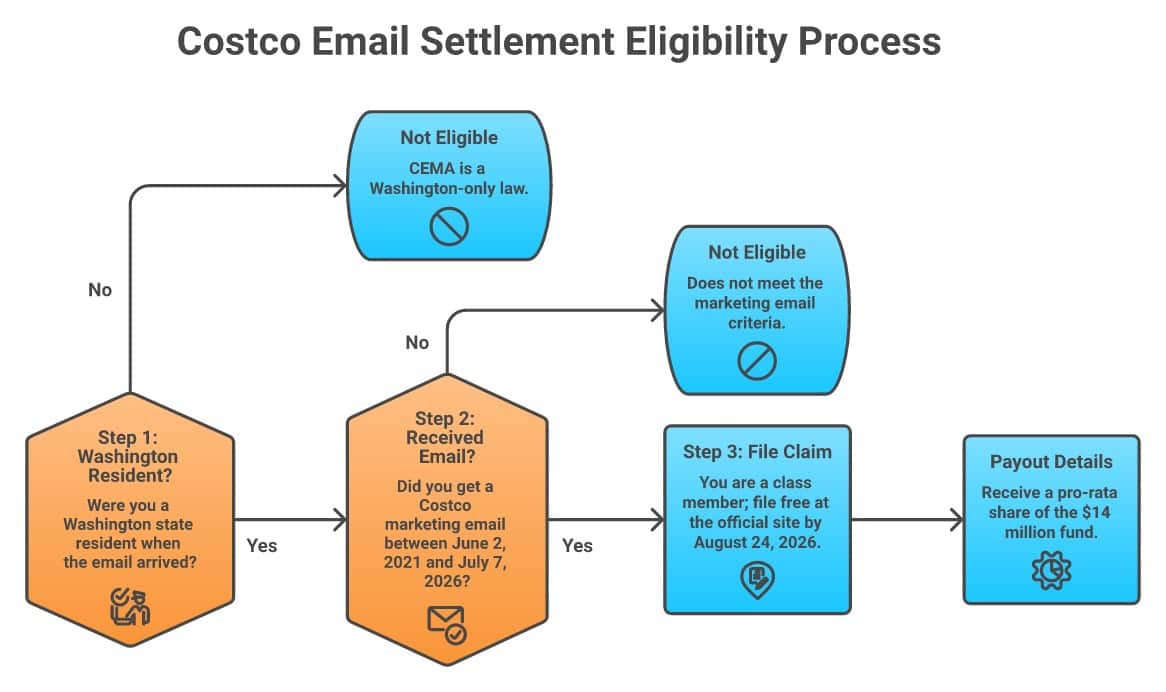
The Reality: This is a Washington state law claim. To qualify, you had to be a Washington resident at the time you received the email, and the email had to arrive between June 2, 2021 and July 7, 2026. Costco members in every other state were sent the exact same emails but have no claim here, because CEMA is a Washington statute — it doesn’t reach residents of other states, according to the settlement notice hosted at WashingtonCommercialEmailSettlement.com.
If you live in Washington and had a Costco membership (or even just received Costco marketing email without being a member) during that window, you’re a class member. If you live anywhere else, this specific settlement isn’t yours to claim — but the underlying lesson about reading class definitions before you get excited about a number applies to every settlement story you’ll see this year.
The “$500” Number — What It Actually Means
The Claim: Filing a claim gets you a $500 check.
The Reality: $500 per email is the maximum statutory damages a Washington resident could have sought in court under CEMA — it’s the ceiling the lawsuit was built on, not the settlement payout. The actual settlement is a single $14 million fund split pro rata among everyone who files a valid claim, after legal fees and administrative costs come out. Nobody — including the administrator — knows the exact per-person amount yet, because it depends on how many valid claims get filed by the deadline. It could be a meaningful check. It could be a fraction of $500. Reporting from Fortune and ClassAction.org both confirm there’s no guaranteed dollar figure attached to an individual claim.
This is the same headline-math trick I see in almost every viral settlement post: journalists (myself included, when I’m not careful) report the legal maximum because it’s the most clickable number in the filing, not because it’s what anyone should expect to receive. If you’ve read my breakdown of the Amazon Prime $2.5 billion settlement or the RealPage $360 million rent-fixing settlement, you’ve seen this same gap between the fund total and the individual check before.
The Daily Money Brief — Free, at 10 AM
Money you may be owed, scams to dodge, and the fine print decoded — the consumer money news that affects your wallet, every weekday.
How to File Your Claim
- Confirm you were a Washington resident when you received a Costco commercial email between June 2, 2021 and July 7, 2026.
- Go directly to WashingtonCommercialEmailSettlement.com — the court-approved settlement site — or file directly through the administrator’s claim portal at veritaconnect.com. Never click a claim link texted or emailed to you; type the address in yourself.
- No receipts, purchase history, or proof of the emails is required — this is a no-documentation claim. You can file even without a Claim ID.
- File online or postmark a paper claim form by August 24, 2026. That’s also the exclusion and objection deadline if you’d rather opt out and preserve your own right to sue.
- Choose electronic payment over a paper check if the form offers it, and save your confirmation number.
Scam Warning: Any text message, email, or call that asks you to pay a fee to “release” your Costco settlement money, or that asks for your full Social Security number or bank login to “process” your claim, is not coming from a legitimate settlement administrator. I’ve said this for over 30 years and it hasn’t changed: no real class action administrator ever charges a fee to file or collect a claim, and none of them need your full SSN or banking password over text. If you get a message like that, delete it and go straight to the official site yourself.
Key Takeaways
- This settlement only covers people who were Washington residents when they received the email — not all Costco members nationwide.
- “$500” is the Washington CEMA statutory maximum, not the promised or expected settlement payout.
- No proof or receipts are required to file — this is a simple attestation claim.
- The deadline to file, object, or exclude yourself is August 24, 2026.
- File only through the official court-approved site — never a link texted to you.
If a check does show up, my advice hasn’t changed in three decades: don’t let $200 or $300 evaporate into the grocery budget. Put it against whatever card is charging you the highest interest rate. At 26% APR, a few hundred dollars applied to principal today saves you real money every month it’s not compounding against you — and if you’re not sure which of your debts to attack first, my debt relief options comparison walks through the math on every path.
The Bottom Line
If you’re in Washington and got a Costco marketing email in the last few years, file the claim — it costs you nothing but a few minutes and there’s no proof required. Just don’t let the “$500” headline set your expectations, and don’t let anyone convince you that claiming it requires a fee, your Social Security number, or a text-message link. A found $200 or $300 is still real money, and applied to your highest-interest debt instead of spent, it’s the kind of small win that adds up to a genuinely different balance a year from now.
Frequently Asked Questions
Do I have to be a current Costco member to file a claim?
No. The class covers anyone who received a Costco commercial promotional email while living in Washington state during the class period, whether or not they held an active membership at the time.
What if I live outside Washington but got the same Costco emails?
You’re not part of this class. The claims are based on Washington’s Commercial Electronic Mail Act, a state law that only covers people who were Washington residents when the email arrived. Other states may see similar lawsuits in the future, but this settlement doesn’t extend to them.
Do I need to prove I received the emails or show a receipt?
No. According to the official settlement notice, class members can submit a claim with no supporting documentation — it’s an attestation-based claim, not a documented-proof claim.
How much money will I actually receive?
Nobody knows yet. The $14 million fund, minus attorneys’ fees and administrative costs, will be divided pro rata among everyone who files a valid claim by the deadline. The final per-person amount depends on how many people file.
What’s the deadline, and what happens if I miss it?
Claims must be submitted online or postmarked by August 24, 2026 — the same date as the deadline to object to the settlement or exclude yourself from it. If you miss the deadline, you won’t receive a payment and you’ll still be bound by the settlement’s release of claims.
This is what I’m seeing after more than 30 years of helping people with debt. Take it as one informed perspective — but only you know your full situation. Use it as input for your decision, not a directive. Nobody gets to tell you what to do with your money. Not me, not anyone.
Related settlement myth: another big headline number that isn’t what it sounds like — why you can’t “claim” the $54 million Roblox settlement, and how to actually get your kid’s unauthorized charges refunded.
Dealing With Debt? Understanding your options is the first step. See how all your debt relief options compare — including ones most sites won’t tell you about. The Find Your Path quiz gives a recommendation based on your actual numbers, and the Scam-O-Meter checks any company’s complaint history before you sign. Federal Reserve Bank of New York research shows bankruptcy filers recover faster than those who don’t file.



