

Written by Steve Rhode, consumer debt expert since 1994 • Last updated July 31, 2026
Quick Answer: You didn’t do anything wrong — you were physically unable to act, and your rent, car payment, credit cards, and utilities don’t know that. There is no single federal law that pauses all of your bills during a hospital stay (the exception is the Servicemembers Civil Relief Act for active-duty military). The fastest fix: within days of getting home, call every creditor in the right order, say the words “I was hospitalized,” and ask for a hardship forbearance before anything is charged off, repossessed, or sent to collections.
What Just Happened While You Were in the Hospital
Nothing stopped just because you couldn’t answer the phone. Your mortgage or rent, your car payment, your credit card minimums, and your utility bills kept coming due on the same schedule they always have — there’s no formal legal status of “medically incapacitated” that automatically pauses a consumer contract. Some payments may have gone through on autopay even while your hospital bills drained your checking account, which can trigger overdraft fees on top of everything else. Anything NOT on autopay just quietly aged: 30 days late, then 60, then 90, each one a step closer to a real consequence — repossession, foreclosure proceedings, or a charged-off account sent to collections.
You got here without doing anything wrong. You got here because being unconscious, in surgery, in the ICU, or simply too sick to think about money is not a defense any creditor’s computer system checks for automatically. The system only responds when a human tells it what happened — which means the first move is yours, not theirs.
The Mistake You’re About to Make: Paying whichever bill is loudest — usually the collector who calls the most — instead of the one with the worst real-world consequence. A credit card company can hurt your credit score. A mortgage lender or landlord can eventually take your home. An auto lender can send a tow truck with no warning and no court hearing. Prioritize by consequence, not by volume. And don’t drain retirement savings to “catch up all at once” before you’ve even called anyone — a phone call is free and a 401(k) withdrawal isn’t reversible.
Your Options Right Now
What to Do in the Next 48 Hours
If you can’t make phone calls right now — because you’re still recovering, still in pain, or your thinking isn’t back to normal yet — you are not stuck. Every step below can be done another way: put a trusted family member or friend on the line with you, register someone as an authorized representative with each creditor so they can call on your behalf, use the creditor’s secure online portal or app, or send a dated letter (keep a copy). Written requests have one real advantage over a phone call — they create a paper trail. Do not let “I can’t face the phone today” turn into another three weeks of silence.
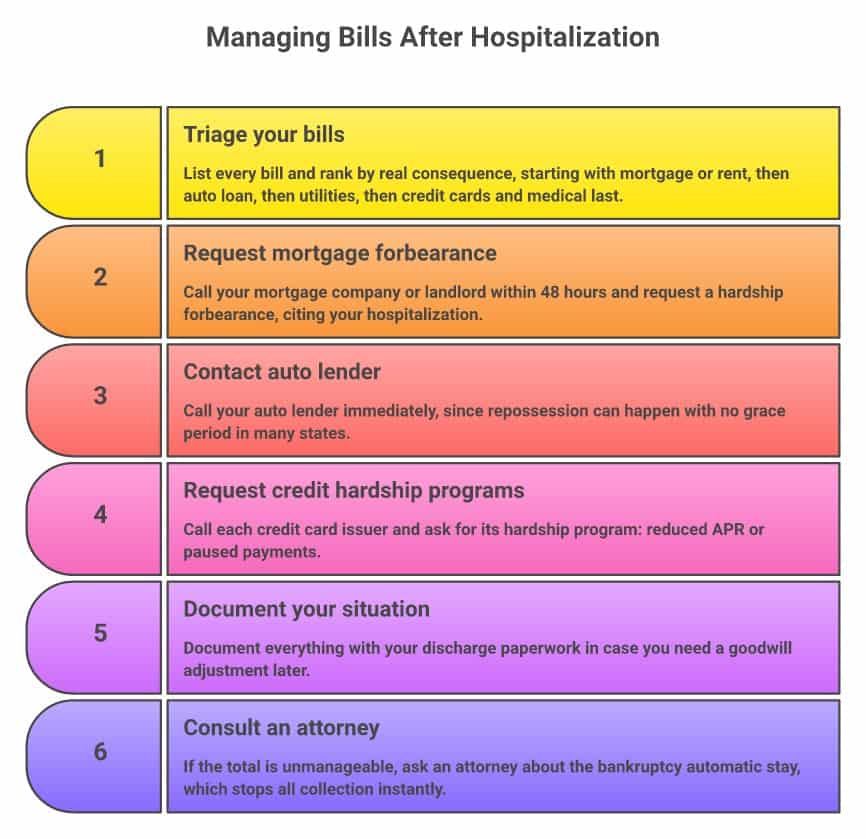
- Triage first. List every recurring bill and how many days delinquent it is. Rank by real consequence, not by who’s calling the most: mortgage/rent, then auto loan, then utilities, then credit cards and the medical bill itself last — those carry the least immediate real-world risk.
- Call your mortgage servicer or landlord within days, not weeks. Ask directly for a hardship forbearance and cite your hospitalization. Some servicers require the request within a specific window after the hardship, so don’t wait.
- Call your auto lender immediately. In most states there is no federally mandated grace period before a lender can repossess a vehicle in default — it can happen without a court order under state repossession law. If you are not yet late, call before the due date. If you are already late — which, after a hospital stay, you probably are — call anyway. Lenders routinely grant a deferment or skip-a-payment after a missed payment; being late is a reason to call today, not a reason the door has closed.
- Call your utility companies before a shutoff notice becomes a disconnection. Ask specifically about a medical certificate or medical hold. Many state utility commissions require a delay in disconnection when a doctor certifies a serious or life-threatening medical condition in the household — the threshold is usually a physician’s certification, not just “I was in the hospital,” and the hold is normally a defined window (often 30–60 days), not a cancellation of the debt. For heating, cooling, or electric accounts, apply for a LIHEAP crisis grant the same day — LIHEAP is a home-energy program, so it will not cover a water bill; for water, ask the utility directly about a hardship payment plan or a local water-assistance fund. Do not assume an application pauses the clock: some states require the utility to hold off while assistance is pending and others do not, so ask your utility point-blank whether your account is protected while it processes. Heat, power, and water outrank a credit card because losing them can put you back in the hospital.
- Call each credit card issuer and ask for its hardship program. The CFPB confirms issuers can pause payments or cut your APR temporarily — get any agreement in writing. Federally regulated card issuers must charge off an account by 180 days past due, so the clock is real but not immediate.
- If the total is unmanageable once you add it up, ask an attorney about bankruptcy. The automatic stay takes effect the moment you file — not weeks later — and it stops the collection efforts on this list under 11 U.S.C. § 362. Two honest caveats: § 362(b) carves out some actions (criminal proceedings and most child-support obligations keep going), and prior dismissed cases matter: if one earlier case was dismissed within the past year, § 362(c)(3) ends the stay after 30 days unless the court extends it; if two or more were dismissed in that year, § 362(c)(4) means no stay arises at all. Note the trigger is a case that was dismissed — a prior case that ended in a normal discharge does not count. Tell your attorney about any earlier filing either way. Find a bankruptcy attorney through NACBA, take the 2-minute bankruptcy quiz, or talk to Damon Day for free. Damon Day, an independent debt coach and my co-host on the Get Out of Debt Guy podcast, whom you can reach at DamonDay.com — I receive no payment for this referral.
How to Actually Stop It — Your 4 Paths
- Bankruptcy, if the whole pile is unmanageable. The automatic stay stops mortgage/rent collection, repossession, credit card calls, and lawsuits the same day you file — giving you time to actually recover instead of negotiating from a hospital recliner. (One caveat carried from below: if you had an earlier case dismissed within the past year, that protection is time-limited or unavailable — see the FAQ.) Federal Reserve Bank of New York research shows filers recover financially faster than people who don’t file.
- Hardship forbearance or deferment on each individual account. This is the fastest, cheapest, no-court option for most people — a phone call, a documented hardship, and (usually) a temporary pause or reduced payment. Works on mortgages, auto loans, and credit cards; ask each creditor by name.
- Negotiate a settlement on unsecured debt only after your essentials (housing, transportation) are stabilized. Get any settlement agreement in writing before you send a dollar — verbal promises from a collections rep are not enforceable.
- What WON’T work: assuming they’ll “understand” and catch up next month without calling anyone. No consumer contract has an automatic hospitalization exception. Silence reads as default, not as a medical emergency, and it escalates on the same timeline whether you call or not.
What You Need to Know About the Real Deadlines
until a bank must charge off a delinquent credit card account under federal banking rules
required by federal law before a vehicle in default can be repossessed in most states
of unpaid job-protected leave under the FMLA — only if you meet the eligibility rules
If you or your spouse is an active-duty servicemember, the Servicemembers Civil Relief Act may already cap interest at 6% on debts taken on before you entered service and can pause certain foreclosure, repossession, and default-judgment actions — this protection is tied to active-duty status, not to being hospitalized specifically. If your job is what’s at risk, the Family and Medical Leave Act can give you up to 12 weeks of unpaid job-protected leave with continued health benefits — but only if you qualify: generally 12 months with the employer and 1,250 hours worked in the past year (29 U.S.C. § 2611(2)), at a worksite where the employer has at least 50 employees within 75 miles (§ 2611(4)). That 75-mile radius matters — a small satellite office can still qualify if the company has 50 people within that distance. Read that word unpaid carefully. FMLA protects your job and your health insurance; it does not replace your paycheck. If lost income is the problem, ask separately about short-term disability coverage or your state’s paid family and medical leave program if it has one — those can run alongside FMLA and are what actually address the missing money. (Social Security disability is a different animal and generally will not help here: it requires a condition expected to last at least a year, and has a five-month waiting period, so it is not a bridge for a hospital stay you recover from.)
| Bill Type | Real Deadline Before It Gets Worse | Fastest Fix |
|---|---|---|
| Mortgage / rent | Varies by servicer; some require a forbearance request within a set window after the hardship | Call servicer/landlord, request hardship forbearance |
| Auto loan | No federal grace period — repossession law allows it as soon as you’re in default | Call the lender now — even if the payment is already late — and ask for a deferment |
| Utilities | Varies by state; a shutoff can follow a notice period, and a pending assistance application does not automatically stop it — some states require a hold, others do not | Ask about a physician-certified medical hold; apply for LIHEAP for heating/cooling/electric (not water) — and ask the utility point-blank whether you are protected while it processes |
| Credit cards | 180 days past due before mandatory charge-off (the interagency Uniform Retail Credit Classification and Account Management Policy) | Hardship program, reduced APR or paused payments |
| The medical bill itself | Lowest immediate real-world risk — 501(c)(3) nonprofit hospitals must maintain a written financial assistance policy | Charity care application |
If your state has a medical-hardship utility protection — many state utility commissions require a delay in disconnection when a physician certifies a serious or life-threatening medical condition in the household, even if the account is past due — call your utility and ask specifically about a medical certificate or medical hold. Rules vary by state and by utility, so confirm with your state attorney general’s office or public utility commission. See the complete utility shutoff guide for the LIHEAP application process.
If a creditor is threatening illegal collection tactics while you document a genuine hardship, file a complaint with the CFPB and your state attorney general. If you need legal help but can’t afford an attorney, find free legal aid through LSC.gov.
Steve’s Take
I filed bankruptcy in 1990. Mine wasn’t triggered by a hospital stay, but I’ve talked with thousands of people since 1994 who went through exactly this — a health crisis that had nothing to do with money turned into a debt crisis because nobody called the mortgage company for three weeks. There’s no shame here. You weren’t irresponsible; you were unconscious, or in surgery, or too sick to think about a credit card statement. Debt is math wrapped in emotion, and right now the emotion is doing all the talking. Make the calls, in order, and let the math catch up. The people I’ve watched come through this fastest are the ones who picked up the phone before the collector picked up theirs.
Frequently Asked Questions
I was in the hospital for weeks and now everything’s late — where do I even start?
Start with the bill that carries the worst real-world consequence, not the one calling you the most. That’s usually your mortgage or rent, then your car payment, then utilities, then credit cards and the medical bill itself last. Call the top of that list first, say you were hospitalized, and ask for a hardship forbearance.
Will I lose my house because I couldn’t pay the mortgage while I was hospitalized?
Not immediately, and usually not at all if you call. Foreclosure is a process, not an event — most servicers offer forbearance for a documented hardship like a hospitalization. The risk is in staying silent, not in the hospital stay itself.
Can my car get repossessed for missing a payment while I was in the hospital?
Yes — in most states there is no federally required grace period, and a lender can repossess collateral as soon as you’re in default under state repossession law, without a court order. Call the lender before the payment is late if you possibly can, or the moment you’re home if you can’t.
The medical bill itself feels like the biggest number — is that different from my other debts?
Usually yes, in terms of urgency. The medical bill can’t take your house or your car, and nonprofit hospitals with 501(c)(3) tax-exempt status are required by 26 U.S.C. § 501(r)(4) to maintain and publicize a written financial assistance (charity care) policy — ask for it by name. (A for-profit hospital has no such federal obligation, though many offer help anyway.) If the medical bill itself has already gone to collections, here’s what I told a reader in that exact situation.
I’m active-duty military and got hospitalized — does that change anything?
It can. The Servicemembers Civil Relief Act caps interest at 6% on debts you took on before entering service and can pause certain foreclosure, repossession, and default-judgment actions while you’re on active duty — separate from and in addition to anything tied to the hospitalization itself. Tell every creditor about your SCRA status when you call.
Will a hospitalization goodwill letter actually get late payments off my credit report?
Sometimes, but it’s a request, not a right. Creditors can remove an accurate late payment as a one-time “goodwill adjustment,” and hospitalization with documentation is one of the stronger reasons they’ll consider — but the CFPB and FTC don’t guarantee it, and most creditors say no more often than yes. It’s worth asking anyway; it costs nothing.
I filed bankruptcy — how fast does it stop all of this after a hospital stay?
Immediately. The automatic stay under 11 U.S.C. § 362 takes effect the moment your case is filed — not weeks later — and it legally stops mortgage foreclosure, repossession, wage garnishment, and collection calls the same day. It is not absolute: § 362(b) exempts things like criminal proceedings and most child support. And if you had an earlier case dismissed within the past year, the stay ends after 30 days unless extended (§ 362(c)(3)); with two or more dismissals in that year, no stay arises at all (§ 362(c)(4)). A prior case that ended in a normal discharge does not trigger either rule.
Free Tool — Wage Garnishment Calculator: Worried about your paycheck being seized? The free Wage Garnishment Calculator shows exactly how much creditors can legally take in your state — and some states prohibit garnishment entirely. Calculate My Risk →
Does being hospitalized automatically pause my bills?
No. There is no federal law that automatically pauses consumer debt because you were hospitalized (military active-duty status under the SCRA is the narrow exception). Every hardship program requires you to call and ask — nothing happens on its own.
One more thing — everything I share here is based on 30-plus years of helping people through exactly this. But my advice is input for your decision, not the decision itself. Only you know your full situation. Talk to an attorney, look at your numbers, and make the choice that serves your future.
Important: This guide is for informational purposes only and is not legal advice. Laws vary by state, and your situation may have details that change what options are available to you. For legal advice specific to your case, consult an attorney licensed in your state. NACBA can help you find a bankruptcy attorney, NACA can connect you with a consumer attorney, or talk to Damon Day for free about your situation. Damon is my podcast co-host, and I receive no payment for this referral.
Key Takeaway: A hospital stay is a health crisis, not a character flaw, and it doesn’t have to become a permanent debt crisis. Call your creditors in order of real consequence — mortgage/rent, auto, utilities, then credit cards — before anything gets worse. Talk to an attorney this week if the total feels unmanageable. The longer the silence goes on, the fewer options you’ll have left.
The Bottom Line
You didn’t cause this by getting sick, and you’re not bad with money because bills piled up while you were incapacitated. The system has hardship programs built in precisely for moments like this — you just have to be the one who asks. The people who come through this fastest are the ones who called within days of getting home, in the right order, before anything escalated. If someone you know is recovering from a hospital stay and dreading the mail pile on their counter, send them this page — it could save them from making the one call last that should have been first. See the minimum payments crisis guide if credit cards are the biggest piece, or take the Find Your Path quiz for a full picture of your options.
Dealing With Debt? Understanding your options is the first step. See how all your debt relief options compare — including ones most sites won’t tell you about. The Find Your Path quiz gives a recommendation based on your actual numbers, and the Scam-O-Meter checks any company’s complaint history before you sign. Federal Reserve Bank of New York research shows bankruptcy filers recover faster than those who don’t file.
Right now you are dealing with the thing in front of you, and that is exactly where your attention belongs. When it is handled — and it will be — there is a next stage, and it is the one I most enjoy writing about.
In the latest issue (Nov 6): Owed money on an Amazon return? Check by Dec. 1
Each weekday I send one short email: one story that caught my attention, why it might matter to you, and one manageable thing you can do with it. It is free, I sell nothing, and I take no money from any company I write about.



