

Written by Steve Rhode, consumer debt expert since 1994 • Last updated August 3, 2026
Quick Answer: Whether a debt collector calling your family is legal depends on who they called and what they said. For most relatives — a parent, a sibling, an adult child, a friend, a neighbor — there is only one narrow legal reason to call them at all: contacting them ONE TIME to confirm your address, phone number, or workplace, without saying a word about the debt itself. Your spouse is the main exception, because 15 U.S.C. § 1692c(d) folds your spouse — along with your parent or guardian if you are a minor, and your executor or administrator — into the definition of “consumer,” so a collector generally may discuss the debt with those people directly. Outside that short list, under the Fair Debt Collection Practices Act, 15 U.S.C. § 1692c(b), a collector generally cannot discuss your debt with anyone but you and your attorney. If they told your mother, your sibling, or your neighbor how much you owe, or that you owe anything at all, that’s a documented violation worth real money. Don’t confront the collector yet — write down exactly what was said first. That’s what turns “they can’t do that” into an actual claim.
Part of the Crisis Guide Series: This is one of my emergency triage guides. See all available Crisis Guides — step-by-step action plans for the worst financial moments.
Part of the FDCPA Rights Hub: This crisis guide is the emergency-room version of my complete Debt Collectors and Your FDCPA Rights: The Complete Guide — what collectors can and cannot do, how to demand validation, and how to fight back in court.
Free Tool — Debt Collector Rights Lookup: Being contacted by a debt collector? The free Debt Collector Rights Lookup shows your state-specific protections — statute of limitations, garnishment limits, and what collectors are legally prohibited from doing. Look Up Your Rights →
What Just Happened — and Why the Answer Isn’t a Simple Yes or No
A debt collector contacted someone you know — a parent, a sibling, a friend, a neighbor, your employer — about your debt. Whether that’s illegal depends entirely on what they actually said, and this is the part almost nobody understands correctly, including a lot of the collectors themselves.
Congress built the FDCPA with two very different rules that live right next to each other. 15 U.S.C. § 1692b lets a collector contact a third party solely to acquire “location information” — your address, phone number, or place of employment — when they can’t otherwise reach you. The CFPB’s implementing rule, Regulation F, 12 CFR § 1006.10, spells out exactly how that contact has to work: the collector must identify themselves by name, state only that they’re “confirming or correcting” your location information, and they are flatly barred from stating that you owe any debt. They also cannot contact that same person more than once, unless the person asks them to or the collector reasonably believes the first answer was wrong or incomplete.
The moment a collector says anything more than that — the amount you owe, the fact that you’re behind, that “we’re trying to collect a debt,” or asks your relative to relay a message about paying — they’ve crossed into § 1692c(b) territory: communicating about the debt with someone who isn’t you, your spouse, your attorney, or (if you’re a minor) your parent or guardian. That is illegal unless you gave the collector your prior consent directly, a court expressly permitted the contact, or it was reasonably necessary to enforce a judgment — and “we were only trying to reach you” appears nowhere on that short list. The CFPB confirms this directly: “A debt collector can’t discuss your debt with anyone other than you” and your spouse or attorney — not even to your employer, who can only be asked for your address or phone number, never told that a debt exists.
Here’s the practical reality I’ve seen in over 30 years of this work: the location-information exception is genuinely useful for skip-tracing someone who’s dodging calls — but it’s also routinely stretched and abused. Collectors “confirming your address” turn into collectors fishing for a payment through your mother, or leaving a voicemail with your sister that says more than it should. The 2013 FTC enforcement action against Expert Global Solutions (whose subsidiaries then included NCO Financial Systems, Transworld Systems, and ALW Sourcing, together described by the FTC at the time as the world’s largest debt collection operation) charged exactly this — “leaving phone messages that disclosed the debtor’s name, and the existence of the debt, to third parties.” The companies settled, agreeing to a $3.2 million civil penalty and to a proposed consent decree barring the practice, a settlement that resolved the FTC’s allegations without any admission or judicial finding of liability and that was subject to court approval. Those were allegations the companies settled rather than fought in court, and that distinction matters. But it isn’t a hypothetical either — it’s what the federal government accused the world’s largest debt collection operation of doing, and the conduct it described looks a lot like what may have just happened to you.
The Mistake You’re About to Make: Don’t skip straight to yelling at the collector on the phone, and don’t shrug it off as “they’re allowed to do that.” Both reactions throw away your leverage. If you scream at them with no witness and no notes, you have nothing to prove later. If you assume any third-party contact is automatically fine, you may be letting a real, money-worth violation slide. The first move isn’t confrontation — it’s documentation. Get the exact words down before you do anything else.
Your Options Right Now
What to Do in the Next 48 Hours
- Get the exact words down today. Call or text the family member and ask them to write out, in their own words, who called, the phone number, the date and time, and what was said — as close to verbatim as they can remember. “They just asked if this was your right number” is a completely different case than “they said you owe $4,200.” This is the single most important step, and it can’t be done later from memory.
- Sort it into one of two buckets. A ONE-TIME call that only asked to confirm your address, phone, or workplace = a legal location-information contact under Reg F § 1006.10. Anything that named the debt, an amount, or asked your relative to pay or relay a payment message = a violation of § 1692c(b) unless you had already given that collector your direct consent to speak with them.
- Decide which letter you are actually sending — there are two, and they do very different things. A limited-contact letter documents the third-party contact, objects to any further disclosure of your debt to anyone else, and asks the collector to put all future communication about this debt in writing to you. That is the lower-risk move: it builds your evidence file without closing any doors. A cease-communication notice is a different and stronger thing. Under § 1692c(c) a collector must stop communicating with you only if you notify them in writing that you refuse to pay the debt or that you want them to stop contacting you — simply demanding they “talk only to me” does not trigger that section — and even after a valid notice they may still contact you to say they are ending collection efforts, or to tell you they intend to invoke a specific remedy, such as filing suit. Before you send the stronger version, weigh the trade-off: shutting off contact also shuts off settlement offers, and a collector holding a claim it believes is valid may answer a cease letter by suing rather than negotiating. If you have wages, a bank account, or property a judgment could reach, it is entirely reasonable to send only the limited-contact letter for now — or to send nothing yet and talk to a consumer attorney through NACA first. Whichever you send, use certified mail, return receipt requested, and keep a copy — the letter itself becomes part of your evidence file.
- If it was a real disclosure violation, you likely have an FDCPA claim. A court may award up to $1,000 in additional statutory damages for the lawsuit as a whole — not $1,000 per phone call and not $1,000 per violation — on top of any actual damages you can prove (embarrassment, lost wages from a workplace disclosure, etc.), plus attorney’s fees the collector has to pay under 15 U.S.C. § 1692k(a). The statute is specific: in “any action by an individual” a court may allow “such additional damages as the court may allow, but not exceeding $1,000.” So ten illegal calls and one illegal call carry the same statutory ceiling — what actually grows with the number of violations is your actual damages and how bad the pattern looks to a judge. But the clock is short — you have exactly one year from the date of the violation to sue under § 1692k(d). Talk to a consumer attorney through NACA; most FDCPA cases are taken on contingency, meaning it costs you nothing upfront.
- If the underlying debt — not just how they’re collecting it — is the real problem, filing bankruptcy triggers the automatic stay under 11 U.S.C. § 362. It stops collectors from pursuing you for the debt the moment your case is filed — not weeks later — which in practice removes their reason to keep working your family or your employer. If the collector called your job instead, here is my crisis guide on what to do when a debt collector calls your workplace. One limit worth knowing up front: if a family member is actually a co-signer or joint account holder, a Chapter 7 stay protects you and not them, while Chapter 13 adds a co-debtor stay for consumer debts under 11 U.S.C. § 1301. Take the 2-minute bankruptcy quiz, check NACBA for an attorney, or talk to Damon Day for free about whether it makes sense for your numbers. Damon Day, an independent debt coach and my co-host on the Get Out of Debt Guy podcast, whom you can reach at DamonDay.com — I receive no payment for this referral.
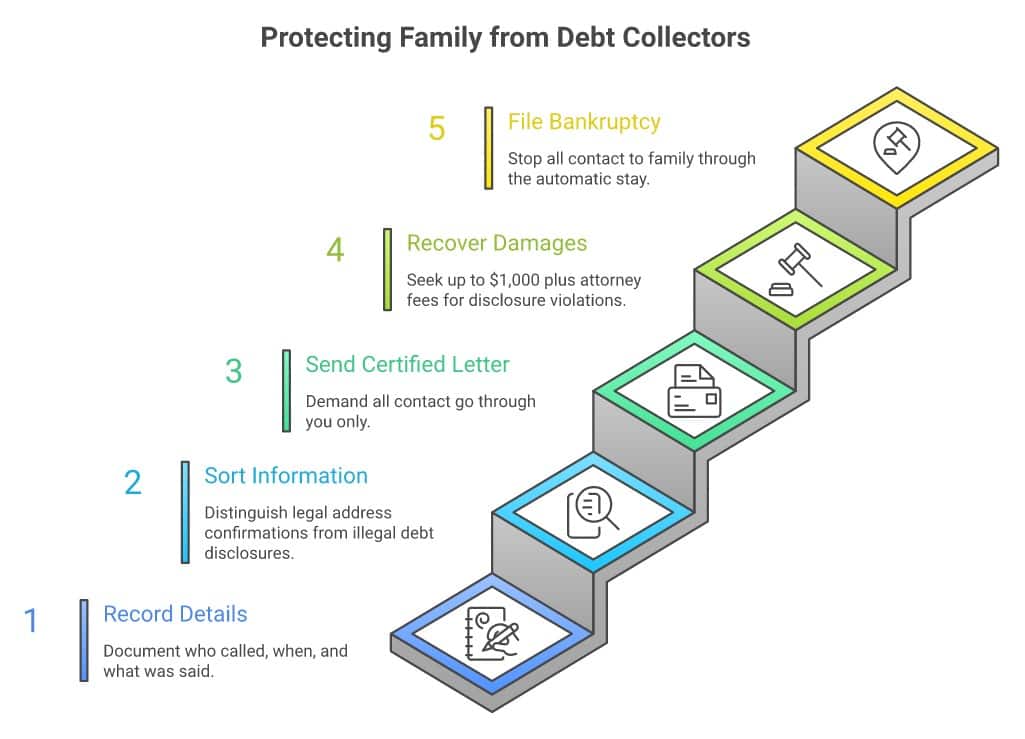
How to Actually Stop It — Your 4 Paths
- File bankruptcy — the fastest full stop. The automatic stay under 11 U.S.C. § 362 bars further collection activity against you the instant your petition is filed — which is usually what ends the calls to your family and your employer as collectors receive notice — but if a family member is a co-signer or joint account holder, Chapter 7 does not protect them, while Chapter 13 adds a co-debtor stay under 11 U.S.C. § 1301 — and CFPB and Federal Reserve research shows filers recover financially faster than people who keep struggling with collectors year after year.
- Send a written letter — but pick the right one. A limited-contact letter, objecting to the third-party disclosure and asking that everything about this debt come to you in writing, is the lower-risk version and keeps settlement talks alive. A full cease-communication notice under § 1692c(c) — which requires you to state in writing that you refuse to pay or that you want contact to stop — shuts down the calls, but it also ends settlement offers and can prompt a collector who believes the debt is valid to sue instead of negotiate, so weigh it against what a judgment could reach before you send it. Either way: certified mail, return receipt, dated, and kept in a folder with the family member’s written account, because that paper trail is what proves a later violation.
- File a complaint and talk to an FDCPA attorney. A genuine disclosure violation can carry additional statutory damages of up to $1,000 for the case as a whole, plus any actual damages you can prove, and consumer attorneys who handle these cases through NACA typically work on contingency — the collector pays their fee if you win, not you.
- What WON’T work: letting your family member “just pay it” to make the calls stop (a payment generally doesn’t erase a violation that already happened, and it generally doesn’t make them liable for the rest of the debt), assuming ignoring it will make it go away (collectors who cross this line often escalate, not retreat), or confronting the collector by phone with no notes (no record means no case).
What You Need to Know About Your Rights
The most a collector may make to any one third party for location information — unless that person asks them to call back, or the collector reasonably believes the first answer was wrong or incomplete
Maximum additional statutory damages a court may award in an FDCPA lawsuit brought by an individual — a ceiling for the whole case, not an amount per call or per violation — awarded on top of any actual damages and attorney’s fees
Your deadline to file an FDCPA lawsuit, counted from the date the violation happened
When the bankruptcy automatic stay legally bars further collection activity against you — though in practice the calls stop as each collector actually receives notice of your case
Federal law is the floor everywhere, but some states go further. California’s Rosenthal Fair Debt Collection Practices Act (Civil Code § 1788.17) incorporates the federal third-party contact rules (15 U.S.C. §§ 1692b–1692j) and applies them to original creditors collecting their own debts, not just outside collection agencies — a gap the federal FDCPA leaves wide open. Massachusetts goes even further under 940 CMR 7.05: it makes it an unfair or deceptive act for a creditor to “imply the fact of a debt, orally or in writing, to persons who reside in the household of a debtor, other than the debtor” — covering household members the federal location-information exception doesn’t clearly reach.
| Jurisdiction | Rule on Third-Party Contact | Notes |
|---|---|---|
| Federal (FDCPA) | One-time location-information contact only, with no disclosure of the debt to anyone outside the narrow group § 1692c allows | Applies to third-party debt collectors and debt buyers, not most original creditors |
| California | Same rule extended to original creditors | Rosenthal Act, Civ. Code § 1788.17 |
| Massachusetts | Treats implying the fact of a debt to a person who resides in the debtor’s household, other than the debtor, as an unfair or deceptive act | 940 CMR 7.05(2), which reaches household members the federal location-information exception does not clearly cover |
If you live in California or Massachusetts and the collector was actually the original creditor (your credit card company, medical provider, or auto lender) rather than an outside collection agency, these state laws may give you a claim the federal FDCPA alone would not. See the complete FDCPA guide for the full state-by-state breakdown.
If a collector disclosed your debt to a third party, file a complaint with the CFPB and your state attorney general. If you need legal help but can’t afford an attorney, find free legal aid through LSC.gov.
Steve’s Take
I filed bankruptcy in 1990, and one of the things that scared me most wasn’t the debt itself — it was the idea that people I loved would find out and quietly judge me for it. That fear is exactly what a collector calling your family is designed to exploit, whether they meant it that way or not. You didn’t do anything wrong by owing money. Debt is math wrapped in emotion, and the shame you feel about your mom knowing is doing more damage right now than the actual dollar amount. Deal with the violation calmly, get it documented, and look to the future rather than spend years reliving the moment your family found out. I’ve watched thousands of people go through this — the ones who wrote it down and acted came out ahead of the ones who just stewed in embarrassment.
Frequently Asked Questions
A collector called my mom about my debt — is that illegal?
It depends entirely on what they said. If they only asked her to confirm your address, phone number, or workplace — once — that’s legal location-information contact under 15 U.S.C. § 1692b. If they told her you owe money, how much, or asked her to relay a payment message, that’s an illegal disclosure under § 1692c(b). Ask her exactly what was said before you decide which one this is.
Can a debt collector tell my family how much I owe?
No — not your parent, your sibling, your adult child, your friend, your neighbor, or your employer. For purposes of § 1692c only a narrow group stands in your shoes: you, your spouse, your parent or guardian if you are a minor, your executor or administrator, and your attorney. The CFPB puts it the same way — “generally, a debt collector can’t discuss your debt with anyone other than” you and that short list. Telling a relative or friend the amount you owe is a violation unless you had already given that collector direct permission to do it, a court allowed it, or it was reasonably necessary to enforce a judgment.
What exactly is a debt collector allowed to say to my family or neighbors?
Only that they’re trying to reach you, their own name, and a request to confirm or correct your address, phone number, or workplace — and only once, unless your relative asks them to call back or the collector reasonably believes the earlier answer was wrong. See Reg F § 1006.10 for the exact script the law requires.
I already told them to stop calling my family — can they call again?
Generally no. Once someone tells a collector the earlier answer was correct, or asks them not to call back, a repeat contact violates the “no more than once” rule in § 1692b(3). Put your objection in writing and keep a copy — a written record is much stronger evidence than a verbal warning.
Can I sue a debt collector for talking to my family?
Yes, if it went beyond legal location-information contact. Under 15 U.S.C. § 1692k(a), a court may award up to $1,000 in additional statutory damages for the case as a whole — that is a per-lawsuit ceiling, not $1,000 for each illegal call — plus any actual damages you suffered and attorney’s fees — and most consumer attorneys who handle these cases through NACA work on contingency. You have one year from the violation date to file.
What if my family member already paid the collector on my behalf?
A voluntary payment by someone else generally doesn’t make you liable for anything you weren’t already liable for, and it generally doesn’t erase a disclosure violation that already happened. Have your relative get written confirmation of the payment and keep it with your documentation, and still pursue the violation separately — the payment and the illegal disclosure are two different issues. One caution though: if your relative signed anything to make that payment, was asked to co-sign or guarantee the debt, or the paperwork used release language like “in full satisfaction of all claims,” have a consumer attorney read it before anyone assumes the claim survived intact.
Does filing bankruptcy stop them from calling my family?
Yes. The automatic stay under 11 U.S.C. § 362 takes effect the moment your bankruptcy case is filed — not weeks later — and it stops collection contact against you, which usually removes the collector's reason to keep contacting family members who are not on the debt — but if a family member is a co-signer or joint account holder, Chapter 7 does not protect them, while Chapter 13 adds a co-debtor stay under 11 U.S.C. § 1301.
How long do I have to take legal action over this?
One year from the date the violation occurred, under 15 U.S.C. § 1692k(d). Don’t sit on documented evidence — get it to a consumer attorney well before that window closes.
One more thing — everything I share here is based on over 30 years of helping people through exactly this. But my advice is input for your decision, not the decision itself. Only you know your full situation. Talk to an attorney, look at your numbers, and make the choice that serves your future.
Important: This guide is for informational purposes only and is not legal advice. Laws vary by state, and your situation may have details that change what options are available to you. For legal advice specific to your case, consult an attorney licensed in your state. NACBA can help you find a bankruptcy attorney, NACA can connect you with a consumer attorney, or talk to Damon Day for free about your situation. Damon Day, an independent debt coach and my co-host on the Get Out of Debt Guy podcast, whom you can reach at DamonDay.com — I receive no payment for this referral.
Key Takeaway: A collector contacting your family isn’t automatically illegal — but disclosing your debt to them almost always is. Document exactly what was said, take the 2-minute bankruptcy quiz if the underlying debt is the real crisis, and talk to an attorney this week. The longer you wait past the one-year deadline, the more likely you lose the right to recover anything at all.
Was the debt they mentioned to your family already paid? That’s its own violation, separate from the disclosure itself. See I Already Paid This Debt But a Collector Says I Still Owe It for what to do next.
The Bottom Line
You’re not bad with money, and you didn’t cause this by owing a debt. The system built real protections around exactly this moment, because lawmakers knew collectors would use your family’s embarrassment as leverage if they could. The people who documented what was said and acted on it came out ahead of the ones who just absorbed the shame. If someone you know just had this happen — a collector calling their mom, their sibling, their boss — send them this page. It could be the difference between them shrugging off a real violation and actually getting paid for it. See the complete FDCPA guide and the Find Your Path quiz for your next step.
Dealing With Debt? Understanding your options is the first step. See how all your debt relief options compare — including ones most sites won’t tell you about. The Find Your Path quiz gives a recommendation based on your actual numbers, and the Scam-O-Meter checks any company’s complaint history before you sign. Federal Reserve Bank of New York research shows bankruptcy filers recover faster than those who don’t file.
Right now you are dealing with the thing in front of you, and that is exactly where your attention belongs. When it is handled — and it will be — there is a next stage, and it is the one I most enjoy writing about.
In the latest issue (Nov 6): Owed money on an Amazon return? Check by Dec. 1
Each weekday I send one short email: one story that caught my attention, why it might matter to you, and one manageable thing you can do with it. It is free, I sell nothing, and I take no money from any company I write about.



