

Quick Answer: Damon Day — the debt advisor I send people to most often — also runs a YouTube channel called The Penny Stupid Project, where he films his real gig-work shifts on DoorDash, Instacart, Walmart Spark and Uber Eats. Damon and I actually started that project together back in 2022 to test side hustles in public. His newest video walks through one Friday afternoon where a bad $11 order nearly wrecked an otherwise great hour. The numbers in the video are what happened to him on that one shift — not a typical hourly rate, and not a promise of what you’d make.
Debt is math wrapped in emotion — and so is income. The only way to know if a side hustle actually helps is to test it in public and show the real numbers, including the hour that goes wrong.
If you’ve been reading this site for a while, you know the name Damon Day. I recommend him more than anyone else I know when someone writes in asking who can actually help them with their debt. What you might not know is that Damon and I go back further than debt advice.
Back in 2022, Damon and I started something called The Penny Stupid Project — a public, no-BS test of side hustles. My half of it was retail arbitrage and Amazon FBA: buying clearance items and trying to flip them, publishing Kindle books, figuring out fulfillment houses. Damon’s half was rideshare and gig delivery — Lyft, then DoorDash and Uber Eats. The whole idea was simple: don’t guess, test it in public and report back what actually happened, good or bad, because neither of us was selling anything.
Each weekday I send one short email: one money story that caught my attention, why it might matter to you, and one manageable thing you can do with it. A couple of minutes, and a dad joke.
In the latest issue (Oct 14): Do you want the money back you left behind?
Free. I sell nothing. Unsubscribe any time.
Damon has essentially taken the whole thing over since then — it is his project now, and I am glad it is. His channel is called The Penny Stupid Project on YouTube, and on August 3, 2026 he posted a new one: “This $11 DoorDash Order Wrecked My $46 Hour | Walmart Spark + Instacart.” It’s a real-time recording of one Friday afternoon shift, and it’s a genuinely useful watch if you’ve ever wondered what gig delivery work actually looks like hour to hour — not the highlight reel, the actual math.
What’s Actually Happening in the Video
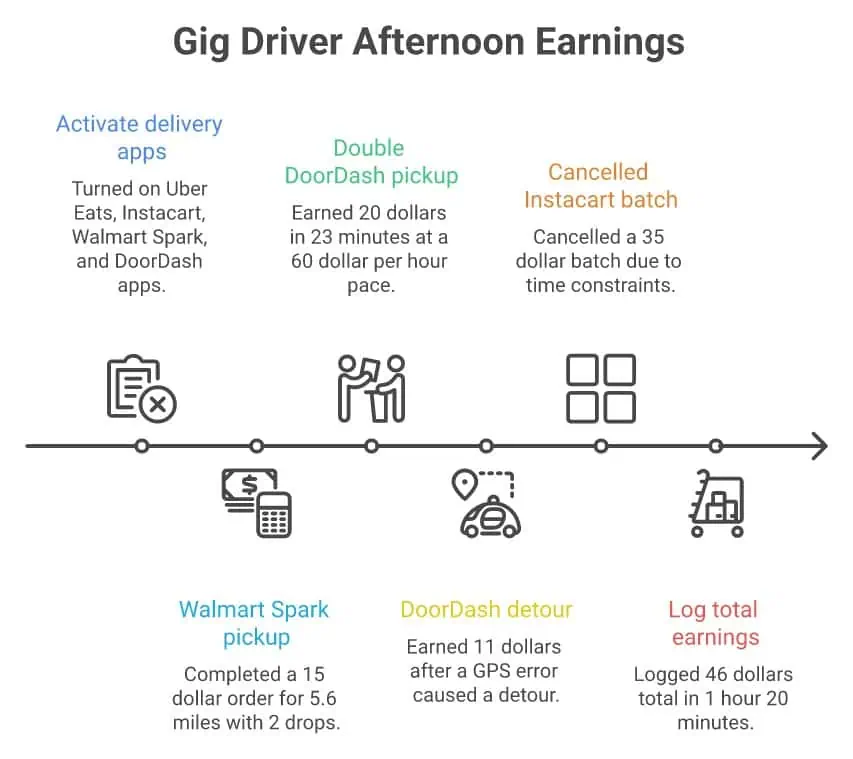
Damon drops his son off at Taekwondo for the hour and decides to work while he waits. Before he even starts driving, he turns on four apps at once — Uber Eats, Instacart, Walmart Spark and DoorDash. He explains this is his standard practice, which he calls “multi-apping”: you never know which platform is going to have work on a given day, so you keep several open and take whichever offer actually makes sense when it comes in. He mentions he used to keep Lyft in that rotation too, but has mostly dropped it because, in his experience, the pay isn’t there compared to delivery work right now. I also wrote about the math behind the low Walmart Spark offers Damon turned down.
The Daily Money Brief — Free, at 10 AM
Money you may be owed, scams to dodge, and the fine print decoded — the consumer money news that affects your wallet, every weekday.
The shift starts well. He picks up a Walmart Spark order — a curbside pickup, two drops, about 5.6 miles, paying $15. Right behind it, DoorDash offers him a two-restaurant, two-drop order for $20 that he can knock out in 23 minutes because the stops are close together. Twenty minutes in, he’s sitting around $35 for the hour.
Then he takes an $11 DoorDash order — two drops, seemingly close by — and that’s the decision that unravels the afternoon. His car’s navigation gave him the wrong location for where the Walmart order needed to be dropped, so instead of finishing nearby, he ends up driving well out of his way. He gets a “you’re late” notice on one drop and has to wait at a restaurant that he says is chronically slow (he’d already had a bad experience there once before and says he won’t order from it again). By the time he sorts it all out, he has to cancel a $35 Instacart batch entirely because his son finished Taekwondo early and there wasn’t time left to do it all.
What was tracking toward a strong hour turns into an hour and 20 minutes for $46 total — after driving several extra miles for a decision that, in hindsight, he says he wouldn’t make again. As he put it about the restaurant he’s since sworn off: “You can’t afford me.”
Pace after the first two orders (23 minutes, $20)
The order that turned into extra miles and a wait
Instacart batch cancelled when time ran out
Figures are what Damon logged on this one shift — not typical pay, an average, or a projection.
The Real Insight: Why a Bad Order Can Wreck a Good Hour
The math lesson here isn’t the dollar total — it’s that gig-delivery income is not additive the way it looks on paper. A single order that adds a few extra miles, a wrong turn, or a slow pickup doesn’t just cost you the time for that one order. It eats into every order around it, because your hourly rate is calculated across the whole block of time, not per delivery. One $11 mistake turned a pace that was tracking toward $60/hour into an hour-plus that barely cleared $34/hour before expenses.
The Behind-the-Scenes Insight: How Platforms Inflate “Batch Pay”
The most interesting few minutes of the video come near the end, after Damon’s shift is technically over. Two Instacart orders pop up on his phone offering roughly $40 for just two items each — one with a $2 tip attached, one with no tip at all. Damon recognizes immediately that this is unusual, because a normal two-item Instacart batch doesn’t pay anywhere close to that.
He works out why on camera: the customer placing the order is around 75 miles away, late at night, and the nearest grocery store to them — a Fry’s, based on what he could tell — is already closed for the night. Instacart’s system doesn’t cancel the order. It reroutes it to the nearest store that’s still open, which happens to be near Damon, and then attaches an unusually large “batch pay” to the order to make it worth some driver’s time to accept a delivery that far out of the way.
That’s the real lesson: a huge payout on a gig app isn’t generosity from the platform. It’s the platform solving a supply problem — nobody local wants that trip — by throwing money at it until someone will. Damon didn’t take either order (75 miles is 75 miles), but recognizing what’s actually happening behind an unusually large offer is exactly the kind of pattern-reading that separates gig workers who do this well from people guessing at what a “good” offer looks like.
Why I’m Not Giving You a Dollar-Per-Hour Number
I want to be very direct about something before you take any of this as a plan. Every number in that video — the $20, the $15, the $11, the $46, the $38 batch pay Instacart dangled — is what happened to one driver, on one afternoon, in one market, on one platform’s algorithm that day. It is not a typical hourly rate. It is not an average. It is not what you should expect to make. Gig-delivery pay varies enormously by city, time of day, day of the week, how many other drivers are online, and plain luck.
Any site that shows you a gig-work video and lets you walk away thinking “so I could make $46 an hour doing this” has done you a disservice — and it’s usually the first step toward an unrealistic pitch. The value in Damon’s video isn’t the income. It’s the method: how he decides what to accept, why multi-apping matters, and how a single bad call compounds. That’s math literacy you can use no matter what the market looks like when you try it.
Is Gig Work a Real Tool When You’re Behind on Bills?
I get asked some version of this constantly: should I drive for DoorDash or Instacart to catch up on debt? My honest answer is the same one I give about every option on this site — it depends on your specific numbers, and most people never actually run them.
Gig delivery work can be a legitimate way to generate quick cash when you need money now and don’t have savings to draw on. Unlike a lot of side hustles, you can start today and get paid within days, sometimes hours. That immediacy is real and valuable if you’re trying to close a short-term gap — a car payment, a medical bill, a shutoff notice.
But before you count on it as extra income, do the math Damon does in the video — on your own numbers:
- Mileage costs money whether or not you write it off. The IRS’s own 2026 standard mileage rate is 76 cents a mile (as of July 1) — that figure exists because the IRS has calculated what gas, maintenance, tires, insurance and depreciation actually cost per mile. A $15 order that takes you 12 miles round trip has roughly $9 of vehicle cost baked into it before you’ve made a dime.
- You owe self-employment tax on top of income tax. Gig platforms pay you as an independent contractor. Nobody withholds anything. Set money aside or the IRS bill in April will wreck the very budget you were trying to fix.
- An hourly “pace” during a good stretch is not your real hourly rate for the day. Damon’s own video is the proof — a $60/hour pace turned into something closer to $34/hour once one bad order, a wrong turn, and a cancellation were averaged in.
- Sometimes the math says don’t. If your car is old, your insurance doesn’t cover delivery driving, or the miles you’d need to drive don’t pencil out against what your market actually pays, the right answer might be “not this, not right now” — and that’s a legitimate conclusion, not a failure.
“Do nothing until you’ve run your own numbers” is not a cop-out. It’s the same advice I’d give about any debt option on this site. Gig work is a tool, not a rescue plan, and it works best as one piece of a bigger decision — not the whole strategy.
More From the Side Hustle Archive
Damon and I have been writing about this experiment since it started. A few from the archive that are worth revisiting alongside this video:
- Get Out of Debt by Increasing Income With Side Hustles: The Introduction to the Penny Stupid Project — how this whole experiment started
- Yes, You Can Make Money Today to Pay a Bill Tomorrow: Myth vs Reality — the honest version of the “quick cash” pitch
- Making More Money From Home With Online Arbitrage and Amazon — my half of the experiment, for comparison
- Online Arbitrage Mistakes: Myth vs Reality — what I got wrong so you don’t have to
Key Takeaway
Damon Day and I have been testing side hustles in public since 2022 through the Penny Stupid Project — his lane is gig delivery, mine was retail arbitrage. His newest video shows one Friday afternoon where a single $11 order, a wrong GPS location, and a slow restaurant turned a great hour into a mediocre one. The $46 he logged is what happened to him that day, not a promise. The real value is the method: multi-apping across platforms, reading why a payout looks unusually large, and recognizing when a decision that seemed fine in the moment quietly costs you the whole hour.
This is what I’ve seen after over 30 years of helping people with money and debt. This is one video, one driver, one afternoon — take it as input for your thinking, not a directive. Only you know your full financial situation, what your car actually costs you to run, and whether your time is better spent on this or something else. Nobody gets to tell you what to do with your time or your money. Not me, not Damon, not anyone.
If you know someone who’s been eyeing gig work to close a gap, send them this before they sign up for an app blind. Watching someone else’s honest hour — including the part that goes wrong — is worth more than any recruiting pitch.
Dealing With Debt? Understanding your options is the first step. See how all your debt relief options compare — including ones most sites won’t tell you about. The Find Your Path quiz gives a recommendation based on your actual numbers, and the Scam-O-Meter checks any company’s complaint history before you sign. Federal Reserve Bank of New York research shows bankruptcy filers recover faster than those who don’t file.
Free Tool — Contract Decoder: Have a contract from a debt relief company? The free Contract Decoder analyzes it for red flags, hidden fees, and problematic terms — before you sign anything. Decode My Contract →
Common Questions
Who is Damon Day, and why does Steve recommend him?
Damon Day is a debt advisor I’ve worked with and mentored for years. I recommend him to readers because he does individualized phone consultations and builds solutions around a person’s actual situation rather than a one-size-fits-all script. Read the full explanation in Why Do You Recommend Damon Day as a Debt Advisor? His own debt-advice site is damonday.com, which is also the first link listed in the description of his Penny Stupid Project YouTube channel.
What is the Penny Stupid Project?
The Penny Stupid Project is a side-hustle testing effort Damon and I started together in 2022 at pennystupid.com. Damon has essentially taken it over since then, so the channel is his work now rather than a joint operation — I am telling you I helped start it so you know where I stand. Neither of us sells anything through it — the point was, and still is, to test income opportunities in public and report the real results, including the ones that didn’t work.
Is the $46-an-hour figure in the video typical gig-work pay?
No. It’s what one driver made on one specific Friday afternoon in one market, and by his own account in the video, a bad decision partway through dragged it down from a pace that was tracking much higher. Gig-delivery pay varies by city, time of day, and platform demand — don’t treat any single video’s numbers as a guarantee or an average.
What is “multi-apping” in gig delivery work?
Multi-apping means running several gig-delivery apps at the same time — in Damon’s case, Uber Eats, Instacart, Walmart Spark and DoorDash — so you can accept whichever order actually pays well when it comes in, instead of waiting on one platform that might be slow that day.
Why did Instacart offer such a large “batch pay” for a two-item order in the video?
Because the customer was about 75 miles away and their nearest grocery store was closed for the night. Instacart rerouted the order to a store that was still open — much farther from the customer — and attached an inflated payout to make the long trip worth a driver’s time. A large payout like that usually signals a logistics problem the platform is paying someone to solve, not extra generosity.
Is gig delivery driving a good way to pay off debt?
It can help close a short-term cash gap, since you can start quickly and often get paid within days. But it comes with real costs — the IRS’s own 2026 mileage rate of 76 cents a mile is a good stand-in for what a mile actually costs you in gas, wear and depreciation — plus self-employment taxes nobody withholds for you. Run your own numbers before counting on it as a fix, the same way you would with any debt option.
Cleaned-Up Transcript
YouTube’s auto-generated captions garble a lot — including two things worth fixing here: the platform Damon calls a former staple is “Lyft,” not “Lift,” and the grocery store that closed on him was “Fry’s,” not “fries.” One restaurant name in the captions was unclear enough in the audio that I’ve left it as “the restaurant” rather than guess at the spelling. What follows is a lightly cleaned, readable version of the captions — not a verbatim court transcript — so watch the video above for the real thing.
What? Why did I do two deliveries for $11? What am I thinking? Eleven dollars from Walmart — just a disaster all the way around. It went from being a great hour to… I don’t even want to look.
All right, Friday afternoon, five minutes to six. I just dropped my son off at Taekwondo — same as Wednesday. He’s there for an hour. I got the car washed since it needed it, and flipped on all my apps, like I always do. You never know what’s going to be hot and what’s not, which is why I multi-app. My staples are Uber Eats, Instacart, Walmart Spark and DoorDash. I used to have Lyft in there as a staple too, but I don’t really do that anymore — the money’s just not there. A lot of full-time Lyft and Uber drivers aren’t making as much as they could with these other apps, in many cases. Not every situation, but many. You never know what’s going to be hot — sometimes I’ll go three, four, five days without a single DoorDash, then do five in one night. That’s why you multi-app.
I turned my apps on right when the car was done. Walmart Spark offered $15 for 5.6 miles — curbside pickup, 13 items, two drops. Not great, not terrible. I’m right by that Walmart, so I took it. Two pickups, two deliveries, but it was actually a good route — only about five miles combined, and $20 total. I started my timer as soon as I grabbed the DoorDash. Twenty dollars in 23 minutes — that’s a $60-an-hour pace. I’ll do DoorDashes like that all day. That Walmart put me at $35 for the hour already.
Then I picked up an $11 order — two drops, only three miles from where I was. That put me at what I figured would be $46 for the hour. The first Walmart drop was only 1.3 miles, so I was doing that first. I know the restaurant I was waiting on is always slow — I’ve been there twice now and both times it’s been the same. It wasn’t crowded, just no urgency at all. I told myself: get some new employees, because the price to pick up from there just doubled for me.
Here’s the thing — my Tesla’s navigation told me the Walmart drop address was way over by where those two DoorDash deliveries were. So my thinking was: grab those two since I’m “over there anyway,” then finish in time to get my son. That was the plan for $46 in an hour. Except when I checked Apple Maps, the Walmart delivery was actually on the other side of the mountain — nowhere near those DoorDash stops. So for $11, I drove several miles out of my way, then had to wait at that slow restaurant again. Fool me once, shame on you. Fool me twice — you know the drill.
Then my son finished Taekwondo 20 minutes early, so I had to cancel the Instacart batch I’d grabbed — a personal emergency, which was kind of true. Now instead of eating dinner with my family, I had to go drop off one Walmart item five miles from my house. Just a disaster all the way around.
When I finally checked how long I’d been out: an hour and 20 minutes. That included driving back to get my son, dropping him at the house, and telling my wife not to heat dinner yet. And it was still only going to add up to $46 — because I’d had to cancel that $35 Instacart batch. If I’d had time to finish it, I’d have been at $80 already.
Here’s what I should have done: if my Tesla hadn’t sent me to the wrong area, I never would have taken that two-drop DoorDash for $11. I’d have been much better off just sticking with the $35 I already had and picking up my son when he was done. Thirty-five dollars in 40 minutes beats $46 in an hour and 35 minutes. Between the extra driving and picking up my son, that $11 order effectively cost me an hour.
Later that night, two Instacart orders popped up — around $40 each for just two items, one with a $2 tip, one with none. Here’s what’s actually happening: the person ordering was about 75 miles away. It was 10 p.m., and the grocery store nearest them — the only one open in that whole area — was actually a Fry’s that had already closed. So Instacart threw the order out to the nearest store that was still open, which happened to be near me, and attached a huge batch payment to get someone to take it. That’s the behind-the-scenes part most people never see: a giant payout on a normal two-item order almost always means the platform is solving a distance problem, not being generous.



