

Quick Answer: Damon Day — the debt advisor I recommend more than anyone else, and the guy I started The Penny Stupid Project with back in 2022 — is two days into his self-set $500-a-week gig-work challenge. Day 2 opened with a $28 Uber order that turned out not to exist, a chain of two forced cancellations, and a full first hour at zero dollars. He still finished the night with $53. The number worth your attention isn’t the total. It’s everything that happened between “I got nothing” and “we’re still going to salvage the 500” — because that’s the part of gig work nobody puts in a highlight reel.
Debt is math wrapped in emotion — and so is a bad night at work. Watch what happens when the math goes sideways for reasons that have nothing to do with effort.
If you’ve read my write-ups of Damon’s earlier videos this month — the $11 order that wrecked a good hour, the six offers he turned down before taking one, the $76 chase to close out a prior week, or Day 1 of this new $500 challenge — you already know the backstory. If this is the first one you’ve landed on: Damon and I started something called The Penny Stupid Project together in 2022, a public, no-BS test of side hustles where neither of us sold anything. My half was retail arbitrage and Amazon FBA. Damon’s half was gig delivery. He’s run with it since, and his channel is still called The Penny Stupid Project on YouTube. I tell you I helped start it every time I feature his videos, because you deserve to know where I stand before you take my recommendation.
His newest video, posted August 7, 2026 and titled “I Made $0 My First Hour—Then Everything Got Worse (Day 2),” picks up his self-set challenge: $500 gross for the week, under 20 hours of work, under 300 miles of driving. Day 1 ended at $120 gross across four hours and 74 miles — you can read that one here. Day 2 starts around 7 p.m., and within the first few minutes he says on camera that he can already tell it’s going to be a slow night. He was right.
Each weekday I send one short email: one story that caught my attention, why it might matter to you, and one manageable thing you can do with it. A couple of minutes, and a dad joke.
In the latest issue (Oct 16): The check that looks like a scam may be real
Free. I sell nothing. Unsubscribe any time.
What Day 2 Actually Looked Like
Here’s the order of what happened, beat by beat:
- A real $13 pickup, canceled for a better-looking one. Damon already had a small DoorDash shop-and-deliver order accepted at Tractor Supply — two items, about five miles, $13 — when a $28 Uber pickup offer came in nearby. He canceled the smaller order to chase the bigger number.
- The $28 order that didn’t exist. When he arrived, the restaurant told him he was roughly the ninth driver sent for that same order — it had been entered twice in their system, and the duplicate kept re-dispatching to driver after driver. There was nothing to pick up. The $28 evaporated.
- A second cancellation, forced by the first. Before the Uber offer showed up, Damon had also grabbed a DoorDash pickup near Chipotle worth an extra $10 — reasonable only because he was already driving that direction for the Uber run. With the Uber order gone, the math flipped: taking the Chipotle order alone meant roughly ten extra miles for $10. He canceled it too — two DoorDash cancellations back to back, something he says he hates doing because of what it can do to a driver’s completion rate.
- A full hour, zero dollars. He sits in a Walmart parking lot with nothing to show for it, weighing whether to cut his losses and go home — his gut, he says later, told him to.
- Every app breaks at once. Walmart’s app won’t load, Uber won’t let him go online, Instacart can’t find batches. He restarts his phone. It takes several tries before anything works again — dead time that isn’t his fault and isn’t recoverable.
- A $7.50 DoorDash pickup he’d normally skip. Once the apps come back, a small McDonald’s pickup appears. Normally too low to bother with, he takes it anyway, partly to get a completed delivery on the books after two cancellations in a row.
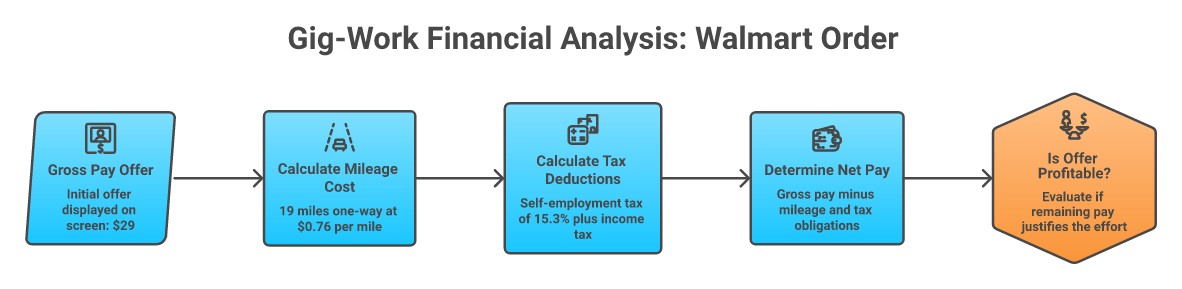
- A $29 Walmart pickup, 19 miles out. Longer than he’d usually accept, but it heads toward his regular zone rather than away from it, and it’s curbside — so the drive isn’t wasted the way a random 19-mile run would be. He takes it, even though the pickup window is delayed nearly 30 minutes.
- A dropped, broken jar. Delivering the Walmart order, a bag slips and one of two glass jars of gravy breaks inside it. The customer has a Ring camera. Damon explains what happened on camera, apologizes, and tells her to request a refund through the app. She’s understanding about it — he notes it’s the first thing he’s broken in roughly two years of doing this work.
- A $16 Uber Eats order he almost turned down. The offer starts at $13 and climbs to $16 as it sits unaccepted. He worries the food will be cold and the tip will get pulled — but when he arrives, the kitchen is still finishing the order, meaning it’ll actually be fresh. He proactively texts the customer to say so before she can worry about the wait.
- One last decline, then home. A final offer — roughly $8 for 14 miles — is an easy no. He calls the night over.
Earned in the first hour of Day 2, after a fake order and two cancellations
Gross earned across roughly 2.5 hours once orders started landing
Combined gross across Day 1 ($120) and Day 2 ($53) toward his $500 weekly goal
Figures are what Damon logged on these two specific days, in one market — not typical pay, an average, or a promise of what Day 3 will look like.
The Daily Money Brief — Free, at 10 AM
Money you may be owed, scams to dodge, and the fine print decoded — the consumer money news that affects your wallet, every weekday.
The Order That Was Never There
This is the mechanic worth slowing down on, because it’s different from anything in Damon’s earlier videos this series. A ghost order — one entered twice into a restaurant’s system — isn’t rare in gig work, and it isn’t something a driver can see coming. Damon didn’t do anything wrong chasing the $28 Uber offer. The problem is what it cost him beyond the $28 he never made: a real $13 order he’d already secured, a second order he’d only taken because it paired with the first, and whatever it does to a driver’s completion rate to cancel twice in a row.
The Miles That Never Paid
Every mile Damon drove toward that $28 pickup before learning it wasn’t real cost him money — the 2026 IRS standard mileage rate is 76 cents a mile as of July 1, a figure the IRS calculated from what gas, maintenance, tires, insurance and depreciation actually cost per mile driven. A canceled order doesn’t refund those miles. Neither does an hour spent sitting in a parking lot waiting to see if anything else comes through. The dollar total Damon reports at the end of a video is gross pay for the orders he completed — it was never counting the driving, the waiting, or the two orders that fell through along the way.
Why He Took a $7.50 Order He’d Normally Skip
Damon has said in earlier videos that a shop order needs to clear a real floor before it’s worth his time. A $7.50 McDonald’s pickup, on its own, wouldn’t usually meet it. He took it anyway — not because the math changed, but because two cancellations in a row put him in a position where finishing something, anything, mattered more than optimizing for dollars per mile in that specific moment. That’s a real trade-off gig workers make that a simple per-order rate never captures: sometimes the smart move is to protect your standing on the platform, not your hourly rate.
Trusting the Gut He Didn’t Listen To
The most honest moment in the video is Damon admitting, after the fact, that his instinct told him to go home the moment he hit zero dollars an hour into the shift — and he didn’t listen. He stayed out roughly another hour and fifteen minutes and turned that instinct into $53. Whether that was the right call depends entirely on what his time and his miles were actually worth that night, after gas, wear, and self-employment tax — numbers the video doesn’t run, and numbers I won’t run for him, because only he knows his own vehicle costs and tax bracket. I see this same pull constantly in people managing debt, not just gig offers: “I’m so close to paying this off” or “I’ve already put in an hour, might as well keep going” can keep you working past the point where the math actually supports it. Noticing that pull — and being honest about whether it’s serving you — is the whole skill, in gig work and in a budget.
Why I’m Not Giving You a Dollar-Per-Hour Number
I want to be direct about this before you take anything in that video as a plan. The $53 Damon made across roughly 2.5 hours once orders started landing, the $173 combined gross across his first two days, the $500 weekly target itself — all of it is what happened to one driver, on one night, in one market (Phoenix-area, during what he’s called the slowest month of his year), on whichever offers that night’s algorithm and a malfunctioning set of apps happened to hand him. It is gross, before a dollar of gas, vehicle wear, or taxes comes out. It is not a typical hourly rate, not an average, and not what you should expect to make. Gig-delivery and gig-shopping pay varies enormously by city, time of day, day of the week, how many other drivers and shoppers are online, technical glitches entirely outside anyone’s control, and plain luck in what shows up on your screen.
Any site that shows you a gig-work video and lets you walk away thinking “so I could make about that much doing this” has done you a disservice. The value in Damon’s video isn’t the income figure. It’s the method: recognizing that a canceled order can cascade into a second cancellation, knowing that app outages are a real cost of the job even though no app ever bills you for them, and being honest on camera about the exact moment he ignored his own gut. That’s math literacy you can use no matter what your local market looks like when you try it.
Is Gig Work a Real Tool When You’re Behind on Bills?
I get some version of this question constantly: should I drive or shop for these apps to catch up on debt? My honest answer is the same one I give about every option on this site — it depends on your specific numbers, and most people never actually run them the way Damon does on camera.
Gig work can be a legitimate way to generate quick cash when you need money now and don’t have savings to draw on. You can often start today and get paid within days. That immediacy is real and valuable if you’re closing a short-term gap — a car payment, a medical bill, a shutoff notice. But before you count on it as ongoing income, run your own version of the math Damon runs in this video:
- A canceled order still costs you miles. Damon’s $28 ghost order and the $13 order he gave up for it are a reminder that time and mileage spent chasing something that falls through are real costs — they just never show up as a line item.
- Mileage costs money whether or not you write it off. The IRS’s 2026 standard mileage rate is 76 cents a mile as of July 1. Every mile you drive — including the miles spent chasing an order that evaporates — carries that real cost before you see a dime of profit.
- You owe self-employment tax on top of income tax. Gig platforms pay you as an independent contractor. Nobody withholds anything for you. Set money aside, or the IRS bill next April will wreck the very budget you were trying to fix.
- Technology will fail you sometimes, and there’s no recourse. A night where every app glitches at once is unpaid time you can’t get back. Budget for it happening, the same way you’d budget for a slow week at any job.
“Run your own numbers before you count on it” isn’t a cop-out. It’s the same advice I’d give about any debt option on this site. Gig work is a tool, not a rescue plan, and it works best as one piece of a bigger decision — not the whole strategy.
More From the Side Hustle Archive
Damon and I have been writing about this experiment since it started in 2022. A few from the archive that pair well with this video:
- Side Hustles: When They Help and When They Hurt — the honest boundaries of what a side hustle can actually fix
- Making More Money From Home With Online Arbitrage and Amazon — my own half of the original project
- Online Arbitrage Mistakes: Myth vs Reality — my own rookie mistakes, the flip side of Damon’s rules-first discipline
- Side Hustle Income Fear: Myth vs Reality — what actually holds people back from starting
- Day 1 of This Challenge — $120 in four hours, and the Walmart trick most drivers never notice
- Damon Day Was $76 From His Weekly Goal — what “almost there” did to good math last time
- Day 4: $138 Multi-Apping and the Rate Floor That Made It Work — running four apps at once and holding the line on junk offers
Key Takeaway
Day 2 of Damon Day’s $500 weekly gig-work challenge opened with an order that turned out not to exist, a chain reaction that forced two cancellations, and a full hour at zero dollars — none of it caused by anything Damon did wrong. He finished the night at $53 anyway, after his apps stopped glitching and the offers finally turned real. He also admits, on camera, that he ignored his own gut telling him to go home an hour earlier. What he earned — $53 gross across roughly 2.5 hours, $173 combined across his first two days — is what happened to him on these two specific nights. It’s not a plan, and it’s not a promise.
This is what I’ve seen after more than 30 years of helping people with money and debt. This is one video, one driver, one bad night — take it as input for your thinking, not a directive. Only you know your full financial situation, what your car actually costs you to run, and whether your time is better spent on this or something else. Nobody gets to tell you what to do with your time or your money. Not me, not Damon, not anyone.
If you know someone chasing a bad night trying to make it a good one instead of just calling it and going home, send them this. Watching someone else admit he ignored his own gut, on camera, is worth more than any lecture about knowing when to stop.
Dealing With Debt? Understanding your options is the first step. See how all your debt relief options compare — including ones most sites won’t tell you about. The Find Your Path quiz gives a recommendation based on your actual numbers, and the Scam-O-Meter checks any company’s complaint history before you sign. Federal Reserve Bank of New York research shows bankruptcy filers recover faster than those who don’t file.
Free Tool — Contract Decoder: Have a contract from a debt relief company? The free Contract Decoder analyzes it for red flags, hidden fees, and problematic terms — before you sign anything. Decode My Contract →
Common Questions
Who is Damon Day, and why does Steve feature his videos?
Damon Day is a debt advisor I’ve worked with and mentored for years, and the debt advisor I recommend to readers most often, because he builds solutions around a person’s actual situation rather than a one-size-fits-all script. Read the full explanation in Why Do You Recommend Damon Day as a Debt Advisor? His own debt-advice site is damonday.com, listed first in the description of his Penny Stupid Project YouTube channel.
What is the Penny Stupid Project?
The Penny Stupid Project is a side-hustle testing effort Damon and I started together in 2022 at pennystupid.com. Damon has run with it since — it’s his work now rather than a joint operation, and I disclose that I helped start it every time I feature his videos so you know where I stand. Neither of us sells anything through it; the point was, and still is, to test income opportunities in public and report the real results, including the nights that don’t go well.
What happened on Day 2 of Damon’s $500 weekly gig-work challenge?
A $28 Uber order turned out to be a duplicate entered twice into a restaurant’s system, which never existed to pick up. Chasing it cost Damon a real $13 order he’d already secured and forced him to cancel a second order that only made sense paired with the first. He sat at zero dollars for the first hour, then his apps glitched simultaneously. Once things came back online, he pieced together $53 across roughly 2.5 hours from a $7.50 DoorDash pickup, a $29 Walmart pickup, and a $16 Uber Eats delivery — while also dropping and breaking a jar during one delivery.
Why did Damon cancel two orders in one night, and what did it risk?
He canceled a real $13 order to chase a $28 Uber offer that turned out not to exist, which then forced a second cancellation of an order that had only made sense as a pairing with the first. Back-to-back cancellations can hurt a driver’s completion rate on a delivery platform — something drivers informally call getting sent to “DoorDash jail” — which is part of why he took a low-paying $7.50 order afterward rather than holding out for a better one.
Is $53 in two and a half hours typical gig-work pay?
No. It’s what one gig worker logged on one specific night in one market, after a first hour that produced nothing and app outages he couldn’t control, before gas, vehicle wear, or taxes came out. Gig pay varies by city, time of day, platform demand, technical reliability, and plain luck in what offers appear on your screen — don’t treat any single video’s total as a guarantee or an average.
What’s the biggest lesson in this video for someone managing debt, not gig work?
Damon admits on camera that his gut told him to go home the moment he hit zero dollars an hour in — and he didn’t listen, staying out another hour and turning that instinct into $53. The same pull shows up in debt decisions: “I’ve already put in the work, might as well keep going” can keep you in a bad situation past the point the math supports. Noticing the pull, and being honest with yourself about whether it’s still serving you, is the skill — in gig work and in a budget.
What He Works Through On Camera
YouTube’s auto-generated captions garble names and numbers badly enough that I won’t put them in quotation marks and call them his words. So what follows is my paraphrase of the beats in the video, not a transcript. Watch it above for what he actually says.
The ghost order. He explains that a restaurant told him he was roughly the ninth driver sent for the same pickup — the order had been entered into their system twice, and the duplicate kept re-dispatching after each driver gave up on it. There was nothing to deliver.
The cascade. He walks through, out loud, why canceling the Uber order’s near-miss backup — a Chipotle pickup he’d only taken because it paired with the Uber run — was the right call once the pairing fell apart, even though he hates stacking two cancellations in a row.
The app outage. He narrates trying and failing to get any platform to load, restarting his phone, and getting frustrated that none of his usual tools are working at the exact moment he needs them.
The gravy jar. He’s upfront and apologetic on camera, in front of a customer’s Ring doorbell camera, about a dropped bag that broke a jar of gravy — noting he’s never broken anything delivering before.
The filet-of-fish save. He explains why an order he almost declined for fear of arriving with cold food actually worked out — the kitchen hadn’t finished cooking it yet — and why he texted the customer proactively rather than waiting for her to notice the delay herself.
Closing out the night. He totals the outing at $53 across about 2.5 hours, calls it one of the slowest stretches of his multi-year part-time gig career, and reflects that listening to his gut an hour earlier would have gotten him home sooner for not much less money.



