

A Get Out of Debt series · Reading the filings so you don’t have to
What They Told Wall Street
FORM 10-QBANK OF AMERICA CORPORATION (BAC)FILED 07/31/2026Q2 ENDING 06/30/2026CIK 0000070858
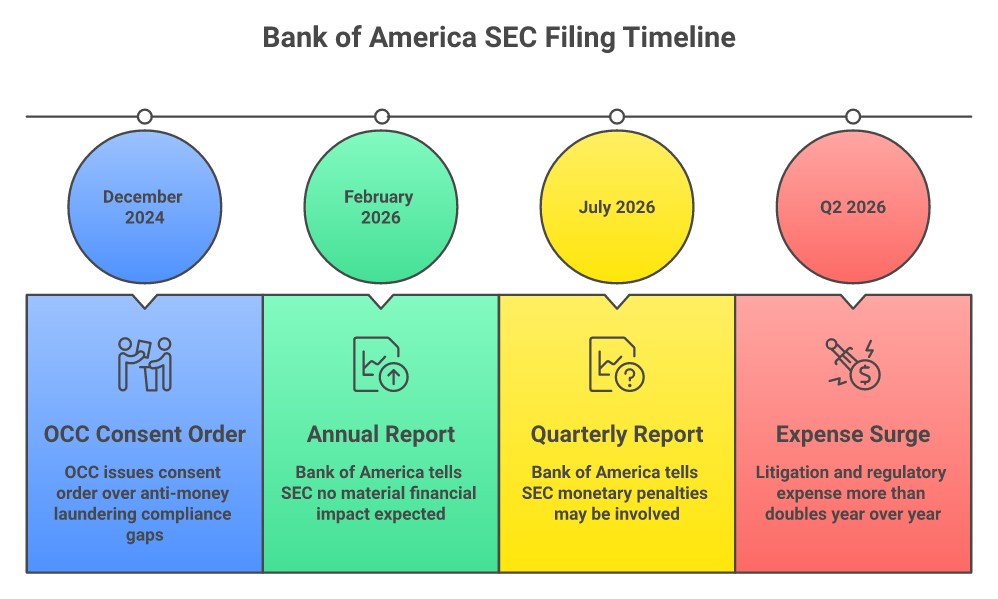
In February, Bank of America’s annual report to the SEC said it did not believe an anti-money-laundering compliance problem would cost the company anything material. Five months later, in the quarterly report it just filed, that sentence is gone — replaced with a new one: resolving the same matter “may include the payment of monetary penalties…” As far as I can find, nothing was announced publicly between those two filings. The change showed up first in the paperwork.
Each weekday I send one short email: one story that caught my attention, why it might matter to you, and one manageable thing you can do with it. A couple of minutes, and a dad joke.
In the latest issue (Nov 9): Check your power bank and your French press
Free. I sell nothing. Unsubscribe any time.
This series has already read what American Express told the SEC about facing its own AML enforcement action, and I’ve separately covered a Bank of America double-billing class action and the BofA/7-Eleven ATM fee settlement. This one is different from all three — it isn’t a new scandal. It’s a company changing the language it uses about money it already told regulators it was fixing — with no press release, and no announcement anywhere but the filing itself.
What BofA told the SEC in February
“The Corporation does not believe that these issues relating to the Programs will have a material adverse financial impact on the Corporation.”
What BofA told the SEC in July
“…resolution of the OCC Consent Order and/or other regulatory inquiries may include the payment of monetary penalties and other remedial actions.”
Bank of America is one of the largest banks in the country, and its bank subsidiary is supervised by the Office of the Comptroller of the Currency (OCC). In December 2024, the OCC issued a public enforcement order against that subsidiary over its anti-money-laundering and economic-sanctions compliance program. At the time, no fine was attached. For over a year, Bank of America’s own filings described the situation the same confident way — the company was fixing it, and did not believe it would have a material adverse financial impact. That phrase matters, and it is not the same as “this will cost us nothing.” “Material” is a term of art: it means large enough to matter to the company’s overall financial picture, and for a bank earning $9.1 billion in a single quarter, a penalty can run into nine figures and still not be “material.” This quarter, for the first time in a filing most people will never see, even that carefully limited reassurance has a caveat.
Q2 2026
Q2 2026
June 30, 2026
Source: Bank of America Corporation Form 10-Q for the quarter ended June 30, 2026, filed with the U.S. Securities and Exchange Commission on July 31, 2026.
What’s old vs. what’s new in this filing
The consent order itself isn’t new — the OCC announced it in December 2024, and Bank of America has referenced it before. What changed is the money language. I read this quarter’s filing side by side against the immediately preceding 10-Q (filed May 1, 2026, for the quarter ended March 31) and the company’s most recent annual report (filed February 25, 2026, for fiscal year 2025). The consent order isn’t mentioned anywhere in that March-quarter filing — not one word. That’s normal on its own: a 10-Q is only required to supplement its most recent annual report with what’s new, so a quiet quarter can just mean nothing changed. The annual report does mention the consent order, and closes the topic with a confident line: no material financial impact expected. This quarter’s filing brings the topic back — which means there was something new to say — and drops that confident line entirely, replacing it with language that opens the door to penalties.
The disclosure — what BofA told the SEC this quarter
“BANA agreed to a Consent Order announced by the Office of the Comptroller of the Currency (OCC) on December 23, 2024, and the Corporation continues to respond to requests for information from other regulators, relating to certain aspects of its BSA/AML and Economic Sanctions Compliance Programs (Programs). Since late 2023, the Corporation has been working with regulators to make changes to its Programs and has already completed significant steps to satisfy requirements of the Consent Order; however, resolution of the OCC Consent Order and/or other regulatory inquiries may include the payment of monetary penalties and other remedial actions.“
Here’s the same paragraph from five months earlier, from the FY2025 annual report filed February 25, 2026, so you can see exactly what changed: “Since late 2023, the Corporation has been working with regulators to make changes to its Programs and has already completed significant steps to satisfy requirements of the Consent Order. The Corporation does not believe that these issues relating to the Programs will have a material adverse financial impact on the Corporation.” Everything up through “satisfy requirements of the Consent Order” is word-for-word identical in both filings — and has been for longer than that: the line that Bank of America “continues to respond to requests for information from other regulators” has appeared unchanged since the company’s annual report for fiscal year 2024, filed back in February 2025. That part isn’t new. What’s new is only the last clause. The February 2026 version ends the paragraph with reassurance. The July 2026 version ends it with a warning about penalties instead. One clause changed; the rest of the paragraph has been sitting there, unchanged, for a year and a half.
What I think they’re really saying
A company doesn’t add the words “may include the payment of monetary penalties” to a filing by accident, and it doesn’t remove “does not believe…material adverse financial impact” by accident either. Securities law generally requires a public company to update investors when its assessment of a real financial risk changes — and Bank of America’s assessment changed between February and July. My read: something happened in that window — likely continued back-and-forth with the OCC and the “other regulators” the filing has referenced since February 2025 — that moved a penalty from “we don’t expect this” to “this is now on the table.” The filing doesn’t say what that something was, and neither will I guess at it. What I can tell you is what changed, because I read both versions side by side.
One more number from the same Note, for balance: Bank of America’s litigation and regulatory investigation-related expense — a line item separate from what it pays its own lawyers — was $180 million for the quarter, more than double the $82 million it reported for the same quarter in 2025, and $376 million for the first half of 2026, up 58% from $238 million a year earlier. The filing doesn’t say how much of that increase, if any, relates to the AML matter specifically — it’s a company-wide total covering every legal and regulatory matter Bank of America is dealing with. I’m including it because it’s real and verifiable, not because it proves anything about this matter — it is company-wide, the filing does not attribute any of the increase to the consent order, and it would be easy to line it up next to the language change and imply a connection the filing never makes. I’m not doing that. Read it as context on what the bank is spending overall, and nothing more.
And in fairness, I’m not cherry-picking the bad news out of this filing — I read the whole Note, and it cuts both ways. A separate, years-long fight with the FDIC over deposit-insurance assessments mostly went against Bank of America: the bank paid the FDIC $657 million in July 2025 on the underlying judgment. What it won this spring was narrower — a court ruling that it didn’t also owe additional interest on top of that payment, a dispute that concluded in June with no appeal filed. And the Note’s general reassurance line is still there this quarter, too: management still says it “does not believe” pending matters overall will have a material adverse effect on the company — that broad statement just no longer covers the AML consent order specifically, the way the narrower sentence used to. One more number, and I want to be precise about what it is and isn’t: the company’s estimated range of possible loss beyond what it has already set aside shrank from up to $0.5 billion in February to up to $0.25 billion in July. That figure is a company-wide aggregate — the filing applies it to “any matter disclosed in this Note,” which pools the data-breach cases, the FDIC dispute, and everything else in there along with this one. The filing does not break out how much of it, if any, relates to the AML consent order, and the AML paragraph itself carries no dollar figure at all. So it is a real number moving in a favorable direction for the company overall — not evidence about this matter specifically, and I am not going to present it as though it were.
What the legal words actually mean
OCC Consent Order
In plain English
A consent order is a formal, public enforcement document a bank regulator — here, the Office of the Comptroller of the Currency, which supervises national banks like Bank of America, N.A. — issues after finding real deficiencies. The bank agrees to fix specific, listed problems on a timeline, usually under an independent monitor, without formally admitting or denying wrongdoing. The OCC’s December 2024 order against Bank of America cited a failure to timely file suspicious activity reports, uncorrected weaknesses in customer due-diligence, and gaps in internal controls, governance, testing, and staff training — and required the bank to bring in an independent consultant and strengthen its compliance leadership. No fine was part of that original order, though the order itself reserved the OCC’s right to bring a separate civil money penalty action later, based on the same findings — a possibility that was written into the order from the start, even though nothing was assessed at the time. As of this writing (August 18, 2026), no penalty has been announced in the OCC’s enforcement database or its monthly enforcement releases. Press coverage discussing a possible penalty began appearing in early August 2026, after the July 31 filing — which is consistent with this having surfaced in the paperwork first, but if you are reading this later, check the OCC’s enforcement database for the current status rather than trusting this sentence’s date.
BSA/AML compliance program
In plain English
Every U.S. bank is legally required, under the Bank Secrecy Act (BSA) and its implementing regulations, to run a program that verifies customer identity, watches for suspicious transactions, and reports certain activity to the federal government — the same law behind why a bank sometimes asks unusual questions about a large deposit or freezes a transfer while it checks the source of funds. It exists to catch money laundering, terrorism financing, and sanctions evasion, not to police ordinary customer behavior. When a bank’s program has “deficiencies,” regulators are saying the bank’s internal box-checking process is not thorough enough — not that any particular customer did something wrong.
What this is not
In plain English
This filing doesn’t mention the Consumer Financial Protection Bureau, and it isn’t a CFPB enforcement action. That distinction matters, because CFPB consent orders over unfair or deceptive practices often come with customer restitution — money back to affected accountholders. A BSA/AML consent order from a banking regulator like the OCC is different: it’s about the bank’s internal compliance infrastructure, and when penalties do get attached, they’re typically paid to the government, not distributed to customers. Nothing in Bank of America’s filing describes any customer harm, refund, or restitution tied to this matter.
What this means for you
If you bank with Bank of America, this filing doesn’t change your account, your interest rate, or your loan terms — and it doesn’t describe any specific customer being harmed. What it does show is that we’re fixing the problem and we don’t expect this to be financially material are two separate statements, and a company can keep working on the first one while the language supporting the second quietly changes. That’s a useful thing to know any time a bank, a collector, or a lender tells you a problem is “being handled” — handled and free are not the same word. It’s also worth knowing, generally: a regulatory penalty is money paid to a regulator, not restitution to customers — it almost never becomes a check in your mailbox.
What I’d do — None of this requires action on your part; it’s institutional, not personal. But if you ever get a vague explanation from any bank about an account hold, a frozen transfer, or extra paperwork tied to “compliance” or “review,” you can ask, in writing, for the specific reason, and keep whatever the bank sends you. If you believe you were treated unfairly, you can file a complaint with the CFPB or with the OCC’s own consumer assistance office, which is the regulator that issued this specific order. And separate from any of this: if Bank of America debt itself is what’s weighing on you, look at all your options before assuming the balance is something you’re stuck with.
Steve’s bottom line
Bank of America told the SEC in February that it did not believe its compliance problem would have a “material adverse financial impact.” In July, without a press release or an announcement, it dropped that sentence and said instead that resolution “may include the payment of monetary penalties.” Those are the company’s own words, five months apart. Note what the February sentence did and did not promise: not that this would be free, only that it would not be big enough to matter to a company this size. Nothing here says Bank of America did anything new wrong, and nothing here says a single customer was harmed — the filing doesn’t allege either one. What it shows is a company’s own confidence changing, in real time, in the one place it’s legally required to be candid: the paperwork it files under penalty of law, not the marketing it puts in a commercial.
That’s the whole reason this series exists. Companies tell Wall Street things they’d never volunteer to a customer, because securities law makes them. Read the filing. Compare it to the last one. That’s how you catch the sentence that quietly disappeared.
Frequently asked questions
What did Bank of America disclose about its anti-money-laundering consent order?
In its Form 10-Q filed with the SEC on July 31, 2026, Bank of America disclosed that resolving its December 2024 OCC consent order over anti-money-laundering and economic-sanctions compliance “may include the payment of monetary penalties and other remedial actions.” Five months earlier, in its FY2025 annual report filed February 25, 2026, the company had said it did not believe the same matter would have a material adverse financial impact.
Is this a new consent order, or the same one from 2024?
The same one. The Office of the Comptroller of the Currency (OCC) issued the consent order against Bank of America, N.A. on December 23, 2024, over deficiencies in its Bank Secrecy Act/anti-money-laundering and sanctions compliance programs. What changed in this filing is not the order itself, but the company’s own statement about whether resolving it will cost money.
Does this mean Bank of America has to pay a fine right now?
No. The filing says a penalty “may” be part of the resolution — it does not name a dollar amount, a regulator, or a timeline, and no fine has been announced. The original December 2024 order did not include a monetary penalty.
Is this a CFPB action, or does it mean customers get money back?
No to both. Bank of America’s filing does not mention the CFPB, and this is not a consumer-protection enforcement action. It’s a banking-regulator (OCC) matter about internal anti-money-laundering compliance infrastructure. The filing does not describe any customer harm, refund, or restitution connected to this matter, and penalties in this type of case are typically paid to the government, not distributed to accountholders.
Should I be worried about my own Bank of America account?
This disclosure is about the bank’s institutional compliance program, not about any individual customer’s account, balance, or credit terms. It doesn’t allege that any customer was harmed. If you’ve ever had a transfer held or an account questioned for “compliance” reasons, that’s a routine and lawful part of how banks manage Bank Secrecy Act requirements, and it isn’t connected to this specific filing.
What else changed in this quarter’s filing?
Bank of America also disclosed that its company-wide litigation and regulatory investigation-related expense was $180 million for the quarter — more than double the $82 million reported for the same quarter in 2025 — and $376 million for the first half of 2026, up 58% from $238 million a year earlier. Separately, the same section of the filing noted that Bank of America paid the FDIC $657 million in 2025 on a related deposit-insurance dispute, and won a narrower fight this spring over whether it also owed additional interest on top of that payment — a dispute that concluded in June with no appeal filed.
Read it yourself — the primary sources
Bank of America Corporation — Form 10-Q, quarter ended June 30, 2026 (SEC.gov) →
Filed with the SEC on July 31, 2026. The AML disclosure is in the Notes to Consolidated Financial Statements, Note 10 — Commitments and Contingencies, “Litigation and Regulatory Matters.”
Filing index — Form 10-Q, Accession No. 0000070858-26-000394 →
Bank of America Corporation — prior Form 10-K, fiscal year ended December 31, 2025, filed February 25, 2026 (used for comparison) →
Bank of America Corporation — prior Form 10-Q, quarter ended March 31, 2026 (used for comparison — no AML consent order language appears in this filing) →
OCC news release — Cease and Desist Order Against Bank of America, December 23, 2024 (OCC.gov) →
To find any company’s SEC filings yourself: sec.gov/edgar/search → type the company name.
How to read this
Two different things appear above, kept separate on purpose. The quotes in the gray boxes are fact — Bank of America’s own words, from its own SEC filings, public record filed under penalty of law, quoted verbatim and linked above so you can verify them yourself. The plain-English explanations and the amber notes are my interpretation — offered to help you understand what changed and why it matters, not Bank of America’s position, and not a statement about your specific account.
Nothing here says Bank of America has done anything wrong beyond what its own filings describe, and nothing here says any customer was harmed. A disclosure that a resolution “may include” monetary penalties is not itself a penalty, a finding of wrongdoing, or proof of consumer harm — no dollar figure, additional regulator, or timeline has been disclosed. I’m using this filing to explain what changed between two SEC filings and why that kind of change matters, not to make a claim about Bank of America’s conduct beyond what its own words say. This is general information and my opinion after more than 30 years helping people with debt, not legal or financial advice. If you have a specific dispute with Bank of America about your own account, talk to a consumer attorney or file directly with the CFPB or the OCC.
Know someone who banks with Bank of America? Please forward this to them. Most people never see what changes quietly between one filing and the next.
Dealing With Debt? Understanding your options is the first step. See how all your debt relief options compare — including ones most sites won’t tell you about. The Find Your Path quiz gives a recommendation based on your actual numbers, and the Scam-O-Meter checks any company’s complaint history before you sign. Federal Reserve Bank of New York research shows bankruptcy filers recover faster than those who don’t file.
“What They Told Wall Street” reads the SEC filings of the companies that handle your money and translates what they disclosed — one filing at a time. Sourced entirely from public SEC records. · See the whole series →



