

Quick Answer: Meta agreed today to pay at least $12.1 billion — and possibly a good deal more, in a way the attorneys general themselves describe inconsistently — to settle child-safety lawsuits brought by 51 jurisdictions — 47 states, the District of Columbia, and three territories — over Instagram and Facebook. Every dollar either attorney general named is a payment to a state government — not to you. Neither announcement describes a consumer fund, a claim form, or anything for you to file. What you actually get is a set of forced changes to how your kids’ accounts work: time limits, nighttime blocks, quieter notifications during school, and an independent auditor watching to make sure Meta follows through.
Related: If you’re picturing the check you got from the other Facebook settlement earlier this year, that’s a completely different case — I explain the difference below, because the confusion between the two is going to be real today.
I’ve been writing about debt and consumer money for the working man and woman since 1994, and I want to be straight with you about something that’s going to be all over your feed today: Meta — the parent company of Instagram and Facebook — just agreed to what’s being called the largest state consumer-protection settlement in history outside the old Big Tobacco deals. The number attached to it is enormous. And almost none of what makes it enormous is coming to your mailbox.
According to the District of Columbia Attorney General’s official announcement, published today, a bipartisan coalition of 51 attorneys general — every state and territory that joined the multistate effort — has reached a settlement with Meta Platforms, Inc. resolving lawsuits that accused the company of designing Instagram and Facebook to be intentionally addictive to children, knowing the psychological harm that caused, and misleading the public about it. NPR reports the case had already gone to trial in federal court in Oakland, California last week, with the trial expected to run through early October — the settlement ends that trial before a jury ever reaches a verdict. In court, Meta has denied the underlying allegations, so I want to be precise about what follows: this is a settlement of claims, not a court finding that Meta is guilty of anything. Nothing here is proven in the legal sense — it’s what the states alleged, and what Meta agreed to pay and change to make the case go away.
Claiming money you are owed is one good day. What you do over the following year is what actually changes your position.
In the latest issue (Oct 15): The ones who need the Social Security raise the most keep the least of it
Each weekday I send one short email: one money story that caught my attention, why it might matter to you, and one manageable thing you can do with it.
Free. I sell nothing. Unsubscribe any time.
What the Headline Says
“Meta to pay $17.1 billion.” That’s the number leading almost every story about this today — and depending on which outlet you read, you may see it reported as $16.7 billion, $17 billion, or even $18 billion. That’s not sloppy reporting. It’s because the settlement has two layers folded into one headline number, and different outlets are rounding or describing those layers differently.
What’s Actually True
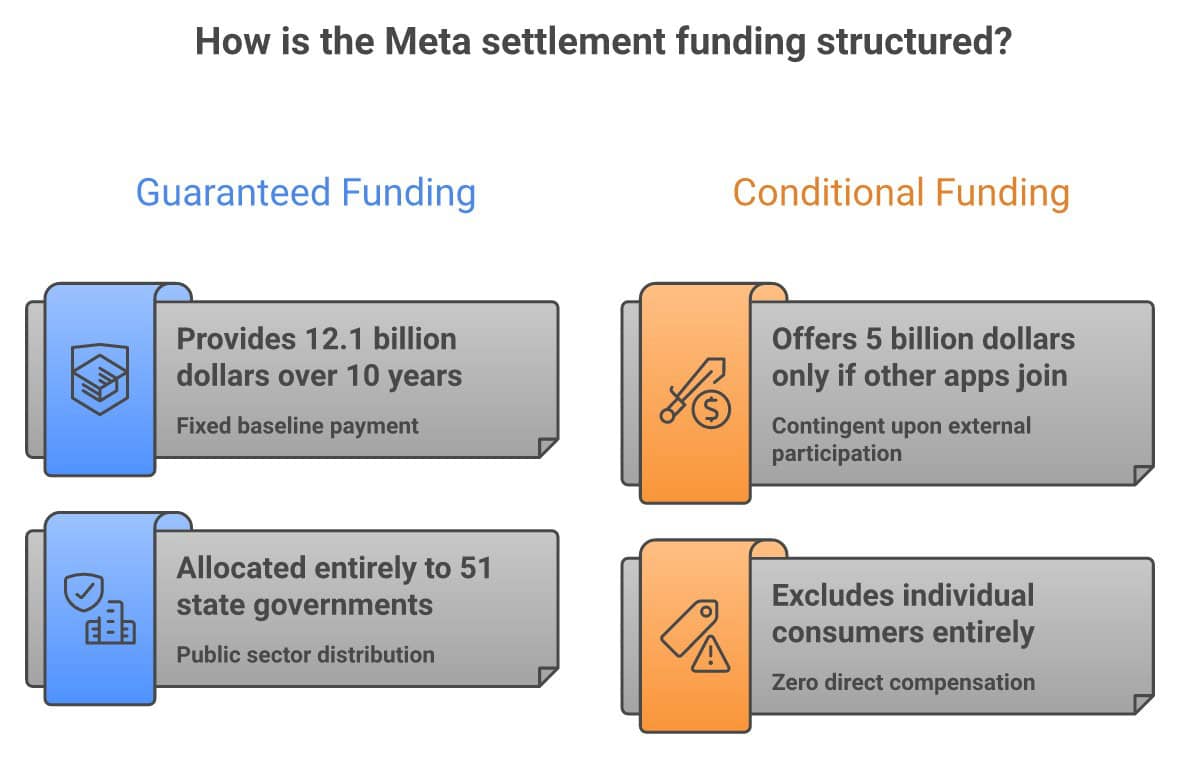
Per the DC Attorney General’s own release, Meta is guaranteed to pay at least $12.1 billion over a ten-year period to resolve the states’ lawsuits. On top of that, Meta has agreed to pay an additional $5 billion — bringing the total to $17.1 billion — but only “if and when other major social media companies also agree to adopt these features,” meaning platforms like Snapchat, TikTok, and YouTube. That is the DC reading, and on it “$17.1 billion” is the ceiling rather than a number Meta has definitely agreed to pay today. Oregon’s office describes the same deal differently, and I walk through that disagreement below. What survives under both descriptions — and the only money figure I will stand behind today — is that Meta pays at least $12.1 billion.
Where the Money Actually Goes — and Why There’s No Check for You
Here’s the part I most want you to hear, because it’s the part that matters to your household budget: I read through the entire DC Attorney General’s release, and there is no mention anywhere in it of a consumer redress fund, a claim portal, or a per-person payout. None. Every dollar figure in that release is described as money paid to a state, not to a person. The District of Columbia’s own cut makes that explicit in black and white:
“The District will receive at least $90,395,940 and up to $129,356,762 to resolve the lawsuit the Office of the Attorney General (OAG) filed alleging that Meta has caused long-lasting psychological damage to children through its exploitative, addictive social media platforms…”
That money goes into the District of Columbia’s own treasury — the same way it would for California, Texas, or any of the other jurisdictions that settled. NPR’s own reporting describes this the same way: “$17 billion in penalties to the states.” Penalties. Paid to states. Not “refunds.” Not “consumer payments.” I looked specifically for language suggesting individual families would see any of this money directly, and it simply isn’t there — in the DC release or in the wire coverage.
This matters because I already know what’s going to happen in the comment sections and Facebook groups today: someone is going to post “$17 BILLION Meta settlement, here’s how to file your claim,” and it’s going to get shared thousands of times before anyone checks whether that’s true. It isn’t. If you see a site asking for your Social Security number, bank login, or a “processing fee” to release your share of this settlement, it is a scam. No legitimate settlement administrator has ever asked anyone for a bank login, a Social Security number by email, or a fee to release money owed to them — that rule holds whether or not a claims process ever exists here.
I’ve written about this exact pattern before, because it happens every time a settlement makes headlines with a huge total: people assume the total is a pot of money waiting for them. It happened with Roblox’s $54 million child-safety settlement, which also went entirely to state governments with zero consumer payout. It’s the mirror image of a case like the Hopper travel app’s $35 million FTC settlement, where consumers genuinely are owed money, just not yet through an open claim process. Learning to tell those two situations apart at a glance — “money to states” versus “money to consumers” — will save you from both false hope and real scams.
The Daily Money Brief — Free, at 10 AM
Money you may be owed, scams to dodge, and the fine print decoded — the consumer money news that affects your wallet, every weekday.
One thing I could not reconcile, and I’m telling you rather than picking a side
Two attorneys general described the same settlement on the same day using figures that do not agree, and I can’t tell you which is right because neither office has posted the settlement document.
The District of Columbia’s announcement says Meta “will pay at least $12.1 billion to resolve the states’ lawsuits,” plus “an additional $5 billion” if other platforms adopt the same safety rules — which is where the $17.1 billion headline comes from. Read that way, $17.1 billion is the ceiling.
The Oregon Attorney General’s announcement says states are “guaranteed a combined $17.1 billion,” with “a separate contingency payment of up to $5.7 billion” on top. Read that way, $17.1 billion is the floor, and the real ceiling is closer to $22.8 billion.
A third office has now weighed in and it leans toward the DC reading. The California Attorney General’s announcement describes “a monetary payment of up to $17 billion to the states over ten years” — a ceiling, like DC’s, not a floor. That is two offices to one. It is still not proof: I am counting press releases, not reading the settlement.
Those cannot both be true. It is most likely that one office described the deal loosely, and press releases are summaries written to be read quickly, not contracts. But I’m not going to guess which one and hand you a number I can’t stand behind. That is why the boxes above lead with “at least $12.1 billion” — it is the one figure that survives either description — and mark the ceiling as disputed rather than picking one. When the actual settlement document is filed and public, that will settle it — and none of it changes the part that matters to you, because under either reading every dollar named goes to a state government.
Where one state says the money is actually going
California’s announcement is the most specific I have found about the destination, and it is worth quoting because it shows what “the money goes to the states” means in practice. California expects to receive $1.5 billion to $2.1 billion, and its release says that how “a significant portion” gets spent “will ultimately be decided by the Legislature and Governor, but in the proposed settlement it is earmarked for purposes related to the prevention or remediation of mental health or other harms to young Californians associated with social media use.”
That is a state legislature deciding how to spend money on youth mental health programs. It is not a fund with your name on it, and there is no step in that process where a parent files anything.
The Facebook Settlement You’re Actually Thinking Of Is a Different Case
I need to be really clear here, because I published a post back in June about a Facebook settlement that sent surprise bonus payments to 15.7 million people, and if you got a check or a Venmo deposit from that one, it’s completely reasonable to assume this new $17.1 billion story means another payment is coming. It doesn’t. That June settlement was a private class-action case about a totally different set of claims — and it genuinely did distribute cash directly to consumers who filed claims or were automatically identified. This settlement, announced today, is a set of 51 separate government lawsuits about child-safety design, brought by state attorneys general, and it resolves with money paid to state governments and forced product changes — not a consumer distribution. Same company. Same “Facebook” and “Instagram” names in the headline. Two entirely different legal cases, two entirely different kinds of outcome. Only one of them ever had a check for you, and it isn’t this one.
What Actually Changes for Your Kids’ Accounts
Here’s where I think the real story is, and where I’d focus my attention if I were a parent reading this today — because unlike the money, this part does land directly on your household. Per the DC Attorney General’s release, Meta is required to build these changes into Instagram and Facebook:
- A two-hour daily time limit across both platforms combined for children, with mandatory “productive pauses” that interrupt continuous scrolling at 15 minutes, then again at 60 and 90 minutes. These limits stay in effect for five years. If Snapchat, TikTok, and YouTube adopt comparable terms, the daily limit on each platform drops to 60 minutes for ten years — which is what the contingent payment below is tied to.
- A nighttime block from midnight to 6:00 a.m., restricting feed access, with notifications silenced separately from 10:00 p.m. to 7:00 a.m.
- No push notifications during school hours — weekdays, 8:00 a.m. to 3:00 p.m., during the school year.
- Stronger age verification — what the release calls “robust age assurance measures” — intended to make it harder for kids to lie their way past age gates.
- Restrictions on features tied to social comparison, including beauty filters and visible “like” counts on posts by minors, both of which researchers have linked to poor mental health outcomes in teens.
- Stronger, more user-friendly parental controls and safer, age-appropriate content controls, including additional safeguards against bullying and content related to eating disorders, suicide, and self-harm.
- An independent auditor, with oversight from the settling states, who will regularly assess whether Meta is actually implementing these features — not just promising to.
The DC release calls these “more consequential and comprehensive” child-safety changes than any court has previously ordered for a social media platform. I’ll let you be the judge of whether that’s true once you’ve seen whether Meta actually follows through — that’s exactly what the independent auditor requirement is there to check.
Steve’s Take
In thirty-plus years of doing this work, I’ve watched a lot of “biggest settlement ever” headlines get shared by people hoping there’s a check in it for them. Most of the time there isn’t, and this is one of those times. But I don’t want you to read this as “nothing happened here.” Something real did happen — a two-hour daily cap, a midnight-to-6am block, and an independent auditor checking Meta’s homework are changes that will land on your kid’s phone whether or not a dollar ever lands in your bank account. Whether that’s worth more than a check is a genuinely fair question, and I don’t think there’s one right answer to it. If your household budget is tight enough that you were hoping for a payout today, I get the disappointment — and I’d rather tell you honestly there isn’t one than let you go looking for a claim form that doesn’t exist.
Key Takeaways
- Meta will pay at least $12.1 billion to settle child-safety lawsuits brought by 51 states and territories. The two attorneys general who announced it describe the maximum differently — $17.1 billion (DC) versus up to $22.8 billion (Oregon) — and the settlement document is not public yet.
- Every dollar either attorney general named is a payment to a state government. Neither announcement describes a consumer fund or a claim form.
- This is a different case from the June 2026 Facebook settlement that paid 15.7 million people directly — don’t confuse the two.
- What you actually get: mandatory time limits, nighttime blocks, quieter school-hours notifications, stronger age checks, and an independent auditor watching Meta’s compliance.
- No consumer claims process has been announced. Anyone asking for your Social Security number, a bank login, or a fee is running a scam — and if a real process is ever created, your state attorney general will announce it.
The Bottom Line
This is among the largest Big Tech settlements ever announced, and no one has announced a check for you. I know that’s not the exciting version of this story, but it’s the true one, and I’d rather you hear it from me than lose ten minutes today hunting for a claim form nobody has announced. The real change here is that your kid’s Instagram and Facebook accounts are about to work differently — checked by an independent auditor, for the next several years — once the court enters it, which has not happened yet. California’s release calls this a “proposed settlement, which remains subject to court approval through entry of a consent judgment”. That’s worth knowing, even without a dollar sign attached to your name.
Frequently Asked Questions
Can I claim money from the Meta settlement announced August 26, 2026?
As of today, no. Neither attorney general has announced a consumer claim process, and every dollar named in the DC Attorney General’s release and the Oregon Attorney General’s release is money paid to a state government. I have not seen the settlement document itself — it had not been posted when I wrote this — so I can’t rule out terms nobody has announced yet. If a claims process is ever created, your state attorney general will announce it. If you see a website or email asking you to “file a claim” or provide personal information to collect part of this settlement, it is a scam.
Is this the same Facebook settlement that already sent me a payment?
No. If you received a payment earlier in 2026, that was from a separate private class-action settlement that distributed cash directly to consumers. This new settlement, announced August 26, 2026, resolves 51 states’ child-safety lawsuits against Meta, and it pays state governments, not individuals. They involve the same company, but they are entirely different legal cases with entirely different outcomes.
How much is Meta actually paying?
Both attorneys general agree Meta pays at least $12.1 billion over ten years. They describe the maximum differently: the DC release caps it at $17.1 billion, while Oregon’s calls $17.1 billion guaranteed with up to $5.7 billion more on top. Neither office has posted the settlement document, so the ceiling is unresolved as of August 26, 2026. The contingent money in both descriptions is tied to whether Snapchat, TikTok, and YouTube adopt comparable child-safety features.
What changes for my kids on Instagram and Facebook because of this settlement?
Per the attorneys general’ announcements, Meta must implement a combined two-hour daily time limit for minors with scroll-interrupting pauses, a midnight-to-6am nighttime access block, silenced notifications from 10pm to 7am, no push notifications during school hours, stronger age verification, restrictions on beauty filters and visible “like” counts, improved parental controls, and oversight from an independent auditor.
Did Meta admit wrongdoing?
No. This is a settlement of the states’ claims, not a court verdict. In court, Meta has denied the underlying allegations, and settling a lawsuit is not a legal finding that the allegations are true. The states alleged that Meta designed Instagram and Facebook to be addictive to children and misled the public about the harm; Meta agreed to pay and to make the described changes to resolve the case rather than continue the trial that was underway in federal court in Oakland, California.
This is what I’m seeing today, read straight from the state’s own announcement, and it’s my honest read on what it means for your family — not legal advice, and not the only way to look at it. Only you know your own situation and your own kids. Take this as one informed perspective from someone who has spent more than 30 years watching how these “biggest settlement ever” stories actually play out for regular families, and decide for yourself what it’s worth to you.
Know a parent who’s going to see “$17 billion Facebook settlement” in their feed today? Send them this before they go looking for a claim form that doesn’t exist. The five minutes it saves them is worth more than the headline.
Dealing With Debt? Understanding your options is the first step. See how all your debt relief options compare — including ones most sites won’t tell you about. The Find Your Path quiz gives a recommendation based on your actual numbers, and the Scam-O-Meter checks any company’s complaint history before you sign. Federal Reserve Bank of New York research shows bankruptcy filers recover faster than those who don’t file.



