

Written by Steve Rhode, consumer debt expert since 1994 • Last updated August 31, 2026
Quick Answer: If it’s a federal student loan, the government doesn’t need to sue you to garnish your pay — it can order your employer to withhold up to 15% of your disposable pay through administrative wage garnishment (20 U.S.C. § 1095a), and it’s supposed to send you a 30-day written notice first. You have a right to request a hearing, but you only get one guaranteed before the garnishment starts if you file it within 15 days of the date the notice was mailed — not 15 days from the day you opened the envelope, so the clock may already be running down by the time you read this. Federal wage garnishment for defaulted student loans has actually been paused by the Department of Education since January 16, 2026, with no restart date announced when I checked ED’s release on August 31, 2026 — but a pause is not a guarantee that nothing is coming out of your check, because an order issued before the pause can still be running, so check your notice carefully to confirm whether this is federal, private, or something else entirely. Don’t ignore it either way — it gets worse, not better.
Before you read further: this guide is about a defaulted student loan garnishment specifically — if what’s missing from your check is child support, an IRS or state tax levy, or a court-ordered garnishment for some other debt, this guide doesn’t apply to you, so confirm what the withholding actually is on your pay stub or notice before acting on anything here.
Part of the Crisis Guide Series: This is one of Steve’s emergency triage guides. See all available Crisis Guides for step-by-step action plans for the worst financial moments. If you’re earlier in the process — behind on payments but not yet garnished — see My Student Loans Are in Default instead. And if the loan is for a school that closed, closed school discharge may end it entirely.
What Just Happened to Your Paycheck
A federal student loan is different from almost every other debt you can owe. Once you’re 270 days behind, the loan is in default, and the U.S. Department of Education doesn’t have to sue you, win a judgment, or get a judge’s permission before it starts taking money out of your check. Under 20 U.S.C. § 1095a — a power called administrative wage garnishment (AWG) — it can order your employer directly to withhold up to 15% of your disposable pay. This is the single fact most people don’t know, and it’s why this guide exists separately from an ordinary wage garnishment.
Before that can happen, the law requires a written notice mailed to your last known address at least 30 days in advance, telling you the amount owed, that garnishment is coming, and what your rights are (34 CFR § 34.4). If you’re already seeing money missing, one of three things happened: you got that notice and the 30 days ran out, an older garnishment order from before the current pause was never rescinded, or the money coming out isn’t federal AWG at all — it might be a private student loan that a lender sued you over and won a judgment on, which follows a completely different set of rules explained below. One more wrinkle: the federal government can also sue you directly on a defaulted loan and get a court judgment, then enforce it through ordinary court garnishment under 28 U.S.C. § 3205 — so a court case caption by itself doesn’t prove the loan is private.
Timely, dated fact worth knowing: The Department of Education paused Administrative Wage Garnishment and the Treasury Offset Program on January 16, 2026, while it rolls out new repayment options. That press release was still ED’s published position when I checked it on August 31, 2026 — the page carries a “Page Last Reviewed: August 27, 2026” stamp of its own — and no restart date has been announced. If a federal AWG order is actively taking money from your paycheck right now, it most likely started before that pause, or the pause has ended without a fresh public announcement — either way, confirm your status directly at studentaid.gov/manage-loans/default rather than assuming. The federal hearing, hardship, and rehabilitation steps below apply the moment AWG resumes — but they do not apply if what’s hitting your check right now is a private loan. A private student loan garnishment runs on a completely different, court-based process; see the comparison table below, and note that unlike federal AWG, negotiating with a private lender can stop that kind of garnishment, though nothing obliges a lender to accept.
The Mistake You’re About to Make: Don’t call your servicer or a debt relief company and agree to a payment plan before you know whether this is a federal or private loan, and before you check whether your hearing window is still open. The fix is completely different depending on which one it is, and once you agree to terms over the phone, you’ve often given up the leverage you had. Read your options first.
Free Tool — Wage Garnishment Calculator: Worried about your paycheck being seized? The free Wage Garnishment Calculator shows exactly how much creditors can legally take in your state — and some states prohibit garnishment entirely. Calculate My Risk →
Your Options Right Now
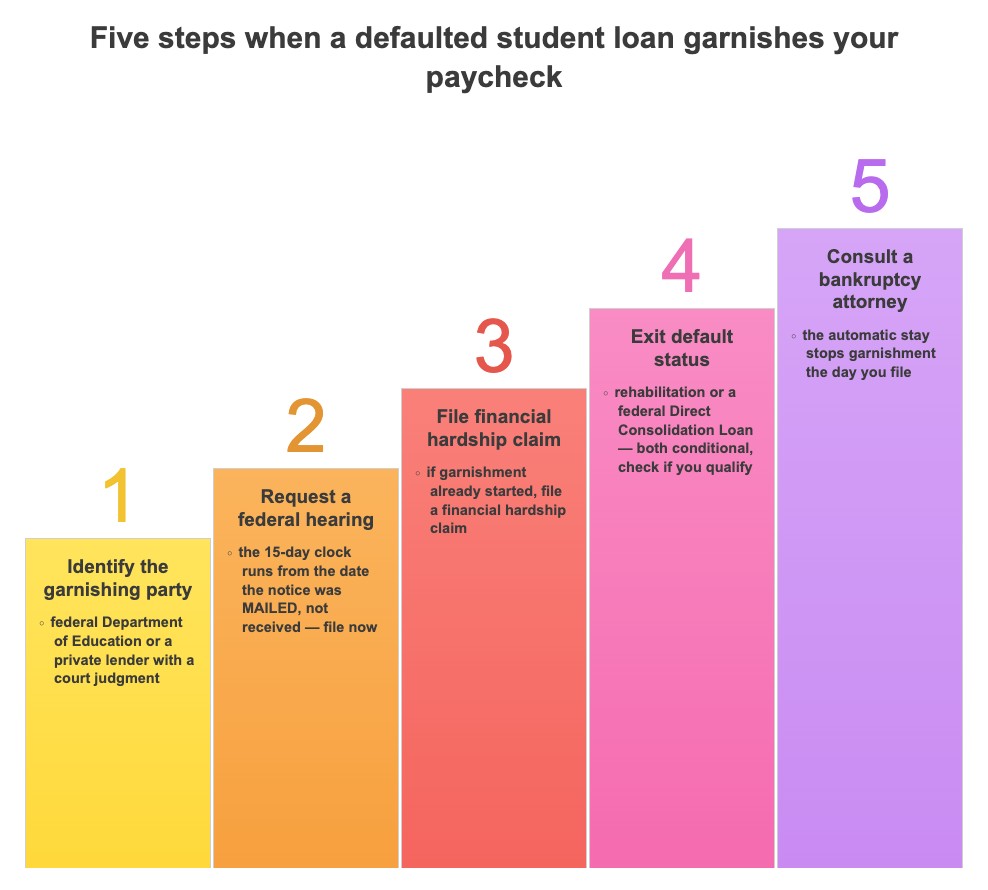
What to Do in the Next 48 Hours
- Ask payroll or HR for a copy of the actual withholding order — don’t trust the name alone. The name on your notice can mislead you: guaranty agencies and private collection contractors run federal AWG under their own trade names that look exactly like a private company’s, so the name by itself doesn’t settle it. Your employer is required to have the order — get a copy. An administrative order has no court case number and comes from the Department of Education, a guaranty agency, or a collection contractor. A court writ has a court name, a case caption, and a case number you can look up in your state’s court records, which usually means a private loan (occasionally the federal government suing you directly — see above). If you can’t find a notice, log in at studentaid.gov to check your federal loan status directly.
- If it’s federal, check whether you’re still inside the hearing window — it runs from when the notice was mailed, not from today. Filing on or before the 15th day following the date the notice was mailed guarantees a hearing before the garnishment order is issued (20 U.S.C. § 1095a(b)) — so a notice mailed 9 days ago leaves you 6 days, not 15. Miss that window and you can still request one, but the government doesn’t have to hold off on garnishing while you wait for it.
- If a FEDERAL garnishment already started, object on financial hardship — and know the timing rule. This step is federal-only: 34 CFR Part 34 is a Department of Education procedure, and a private lender with a court judgment has no such process — if that is your situation, your real remedy is your state’s exemption claim, and those deadlines are often shorter than this one. You may object to the amount or rate at any time (34 CFR § 34.24(b)), and if your finances changed substantially after the notice because of something like injury, divorce, or catastrophic illness, you can be heard sooner than the ordinary schedule (34 CFR § 34.24(c)(2)). Absent that showing, the Department provides a hearing on an objection to an order that is already running only after it has been outstanding at least six months (34 CFR § 34.24(c)(1)). So file the objection now, and if a real change has happened, say so explicitly and document it — that is the thing that moves the hearing up.
- Get the loan out of default fast — rehabilitation or consolidation (federal loans only). A Direct Consolidation Loan — the free, federal government program, not a commercial one — can pull a defaulted loan out of default quickly, but it is conditional, and the conditions land squarely on someone in your situation. To consolidate a loan that is already in default you must either make three consecutive, voluntary, on-time, full monthly payments first, or agree to repay the new Direct Consolidation Loan on an income-driven plan — that second route is the one that skips the waiting (34 CFR § 685.220(d)(1), with “satisfactory repayment arrangement” defined at 34 CFR § 685.102(b)). Read the word voluntary carefully, because it is doing real work: the regulation says voluntary payments “do not include payments obtained by Federal offset, garnishment, or income or asset execution.” The money already being taken out of your paycheck does not count toward those three payments. But before either route matters, ask the first question: is consolidation open to you at all right now? The same paragraph is explicit, and you need the exact words: a borrower qualifies if “not subject to an order for wage garnishment under section 488A of the Act, unless the order has been lifted,” and separately, not subject to a judgment unless it has been vacated. Read on its face, that closes consolidation while a garnishment order is live — and I am not going to tell you the Department always applies it that strictly, because I cannot verify how it is administered case by case. So confirm it with the Department’s Default Resolution Group rather than assuming either way — and ask them the specific question, because a general “am I eligible?” will not get you the answer: does the Department treat a rescinded garnishment order as lifted for consolidation purposes, and as of what date? Here is the part that makes the two rules fit together, and it is the thing most people miss: on a Direct Loan, rehabilitation is how the order gets lifted. The regulation says the Secretary, “unless otherwise directed by the borrower,” rescinds the garnishment order after your fifth qualifying payment — and once it is rescinded there is no order left for you to be subject to, which is the exact status the consolidation rule turns on. So rehabilitation is often not a rival to consolidation; it is the step that opens the door to it. Two conditions decide whether that door actually opens for you, and you should settle both before you start counting payments. First, that suspension of garnishment while you rehabilitate is available only once before July 1, 2027 (twice per loan on or after that date) — if you have already used it, a second rehabilitation attempt will not get the order rescinded at payment five. That does not make rehabilitation useless to you — and this distinction matters enough that I want to be exact about it. Those payments still count toward the nine that complete the rehabilitation, and completing it is what takes the loan out of default, which is the outcome consolidation was only ever a faster route to. What you lose is the early lift of the garnishment, not the exit. Keep going. Second, ask who issued your order. Everything I just described is the Direct Loan rule, binding the Secretary. If your garnishment came from a guaranty agency on an older FFEL loan, a different part of the regulations governs it and I have not verified that it contains the same fifth-payment rescission — so do not assume this sequence applies to you; ask the agency directly which rule it is operating under. And if what is taking your wages is a federal court judgment enforced under 28 U.S.C. § 3205 rather than an administrative order, none of this bridge applies at all: a court order is not something the Department can rescind, and the judgment itself has to be dealt with. I am telling you where the edges of this are because a wrong guess here costs five months of payments, and that is too expensive to leave to an assumption. Loan rehabilitation is a formal written agreement based on your actual income, and signing that agreement does not stop the garnishment by itself — it keeps running until you have made five qualifying payments under the agreement, at which point the Department rescinds the order sent to your employer (34 CFR § 685.211(f)(11)). Completing the rehabilitation is a separate, longer milestone, and it is the one that actually matters: finishing it takes the loan out of default — which is the same outcome consolidation is trying to buy you, by a different road. It takes nine payments across ten consecutive months, and note that a defaulted loan on which a judgment has already been obtained cannot be rehabilitated at all (34 CFR § 685.211(f)(1)). If that is your situation, you still have live options and you should reach for them now: ask the Department’s Default Resolution Group about a negotiated repayment agreement, and know that filing bankruptcy stops the garnishment the day the case is filed. Rehabilitation is the one door that is closed on a judged loan — it is not all of them.
- Talk to a bankruptcy attorney this week. Filing bankruptcy triggers an automatic stay the moment your case is filed, not weeks later, which halts wage garnishment, including federal AWG, while your case is open. Find a bankruptcy attorney through NACBA, take my own free 2-minute bankruptcy quiz, or talk to Damon Day for free about your specific numbers. Damon Day, an independent debt coach and my co-host on the Get Out of Debt Guy podcast, whom you can reach at DamonDay.com — I receive no payment for this referral.
How to Actually Stop It — Your Four Paths
- File bankruptcy to buy immediate breathing room. The automatic stay under 11 U.S.C. § 362 stops federal AWG the day you file — even though the government doesn’t need a court order to garnish you, it still can’t ignore a bankruptcy filing. This pauses the garnishment; it doesn’t automatically erase the debt (see the discharge question below). Federal Reserve research shows bankruptcy filers recover faster than those who grind through years of collection.
- Rehabilitation (federal loans only) — the one built for people already being garnished. On a Direct Loan the order is rescinded after your fifth qualifying payment, but that early lift is available only once before July 1, 2027, and a guaranty-agency FFEL order runs under different rules. Closed entirely if a judgment has already been obtained. Completing nine payments is what actually cures the default. See step 4.
- Consolidation (federal loans only) — faster, but check the door first. Garnished wages do not count as the voluntary payments it requires, and a live garnishment order or a judgment can block it until that order is lifted. See step 4.
- Request a hearing or a financial hardship reduction (federal loans only). If the amount is wrong, the debt itself is disputed, or the 15% is taking food off your table, the hearing and hardship processes above exist specifically for that.
- What won’t work against federal AWG: a commercial debt settlement or “debt consolidation loan” company. A commercial consolidation loan or settlement plan has zero legal power to stop federal administrative wage garnishment — only the government’s own consolidation/rehabilitation process, a hearing decision, or a bankruptcy filing can. (A federal Direct Consolidation Loan through the Department of Education is a real, legitimate, free tool — don’t confuse it with a commercial consolidation loan sold by a private company.) If what’s hitting your check is a private loan judgment instead, this is reversed: negotiating a settlement with the lender can actually stop that garnishment — a commercial settlement company still isn’t required to deliver that and carries its own risks, but the legal wall that blocks settlement against federal AWG doesn’t exist here.
What You Need to Know About the Limits
Federal law caps AWG on a defaulted federal student loan at the lesser of 15% of your disposable pay, or the amount your weekly pay exceeds 30 times the federal minimum wage — the same 30-times-minimum-wage floor that protects ordinary wage garnishment (34 CFR § 34.19). If you were involuntarily separated from a job and haven’t yet been reemployed continuously for 12 months, federal law excludes you from AWG during that window — but it isn’t automatic: you carry the burden of telling the Department the circumstances of your separation (34 CFR § 34.23). And your employer legally cannot fire you over this garnishment (20 U.S.C. § 1095a(a)(8)).
Here’s the part almost nobody explains clearly: federal student loan AWG works completely differently from a garnishment on an ordinary credit card or medical debt.
Another way a federal loan differs from other debts is age, since age alone does not end it, as I explained in a post on old federal student loans and the statute of limitations.
| Type | How It Starts | Cap | State Law Protections Apply? |
|---|---|---|---|
| Federal student loan (AWG) | No lawsuit — 30-day notice, then an administrative order | 15% of disposable pay | No — federal law overrides state garnishment protections (20 U.S.C. § 1095a) |
| Private student loan | Lawsuit → judgment → court garnishment order | 25% of disposable pay, or the amount above 30× minimum wage, whichever is less | Varies by state — state exemptions apply, and a few states, including Texas and North Carolina, sharply restrict wage garnishment for most consumer debts; check your own state’s rules |
| Ordinary consumer debt (credit card, medical) | Lawsuit → judgment → court garnishment order | 25% federal baseline | Yes — same state protections as private student loans |
A few states, including Texas and North Carolina, sharply restrict wage garnishment for most consumer debts — the rules and exceptions vary state to state, so if it’s a private student loan, check the complete wage garnishment guide for your state’s specific protections. But that same state protection does nothing against a federal AWG order; Congress wrote federal student loan garnishment to override state law entirely.
If you believe the amount being taken is wrong, or if you were never sent a notice, file a complaint with the CFPB and your state attorney general. If you need legal help but can’t afford an attorney, find free legal aid through LSC.gov, or find a consumer attorney through NACA.
Steve’s Take
I filed bankruptcy in 1990, so I know what it does to your head to watch a check that’s already too small get smaller. What surprises people most about student loan garnishment isn’t the math — it’s finding out the government never had to ask a judge’s permission. That feels unfair, and honestly, it is a different rulebook than every other kind of debt. But the rulebook also gives you real rights: a notice, a hearing window, a hardship claim, a rehabilitation path, and bankruptcy’s automatic stay if you need to buy time fast. The people I’ve watched do best weren’t the ones who assumed nothing could be done — they were the ones who read their notice line by line and used every right on it.
Free Tool — Statute of Limitations Checker: Dealing with old debt? The free Statute of Limitations Checker tells you if the collection clock has expired in your state — including the zombie debt and clock-restarting traps collectors use. Check My Status →
Frequently Asked Questions
My paycheck already has money missing for a student loan — is that even legal without a court case?
Yes, if it’s a federal loan. Administrative wage garnishment under 20 U.S.C. § 1095a lets the Department of Education withhold up to 15% of your disposable pay without suing you first — it only has to send a 30-day written notice. If it’s a private loan, the lender legally had to sue you and win a judgment before any garnishment could start; if you never heard about a lawsuit, that’s worth checking into immediately.
I never got a notice — can they still garnish me?
The law requires a written notice mailed to your last known address at least 30 days before garnishment starts. If you moved and never updated your address with your loan servicer, the notice may have been sent and still count as legally delivered. If you genuinely never received one, that’s grounds to request a hearing and object — do it now.
I filed bankruptcy — how fast does it stop my student loan garnishment?
The same day you file. The automatic stay under 11 U.S.C. § 362 takes effect immediately, including against federal administrative wage garnishment, and stops the withholding while your case is open. Stopping the garnishment and discharging the underlying debt are two separate questions — see the next one.
Can student loans actually be discharged in bankruptcy?
Yes — this is one of the most repeated myths out there, and it’s wrong. Federal student loans can discharge through an undue hardship showing — but read the next part before you count on it, because it is the step people miss: it does not happen automatically with your bankruptcy. It takes a separate lawsuit filed inside the bankruptcy case, called an adversary proceeding, and if nobody files it your discharge order will simply not touch the loans. Private student loans have a second route: many fall entirely outside the bankruptcy code’s student-loan exception and can discharge like ordinary debt with no hardship showing required at all. I go through exactly how both routes work in They Said Student Loans Can Never Be Discharged in Bankruptcy. That Quietly Changed.
Is federal student loan garnishment even happening right now?
As of my check of ED’s release on August 31, 2026, the Department of Education had paused Administrative Wage Garnishment and the Treasury Offset Program on January 16, 2026, with no restart date announced. If you’re seeing federal garnishment on your check anyway, it likely started before that pause and was never formally lifted — check your status at studentaid.gov rather than assume the pause protects you. Nothing about a private student loan garnishment is affected by this pause at all.
How much of my paycheck can they actually take?
For federal AWG, the lesser of 15% of your disposable pay or the amount above 30 times the federal minimum wage. For a private loan judgment, the lesser of 25% of your disposable pay or the amount above that same 30-times-minimum-wage floor, though your state may cap it lower or restrict it further.
Does my state’s wage garnishment law protect me?
It depends entirely on whether this is federal or private, and on your specific state. A few states, including Texas and North Carolina, sharply restrict wage garnishment for most consumer debts, including private student loans — the rules and exceptions vary, so check your own state. But federal law says administrative wage garnishment for a federal student loan applies notwithstanding any provision of State law — no state protection stops that.
Can they also take my Social Security or tax refund?
Potentially, through a related but separate process called the Treasury Offset Program, and the rules on what’s protected are more layered than most people assume. I cover that in detail, including what the current pause does and doesn’t cover, in They Said No Creditor Can Ever Touch My Social Security — Except the Government Can.
One more thing — everything I share here is based on 30-plus years of helping people through exactly this. But my advice is input for your decision, not the decision itself. Only you know your full situation. Talk to an attorney, look at your numbers, and make the choice that serves your future.
Important: This guide is for informational purposes only and is not legal advice. Laws vary by state, and your situation may have details that change what options are available to you. For legal advice specific to your case, consult an attorney licensed in your state. NACBA can help you find a bankruptcy attorney, and NACA can connect you with a consumer attorney.
Key Takeaway: Federal student loan garnishment is serious but not permanent, and it comes with real rights most people never use — a notice, a hearing window, a hardship claim, and a bankruptcy option that stops it the same day. Take the bankruptcy quiz, and talk to an attorney this week, not next month. The longer this sits, the more of your paycheck disappears.
The Bottom Line
Finding out the government can take part of your paycheck without ever taking you to court feels like the rules changed on you without warning — but they didn’t, and the same law that gave the government that power also gave you a notice, a hearing right, a hardship claim, and a path out of default. You’re not the only one dealing with this, and you’re not bad with money for being here. The people I’ve watched come through this fastest were the ones who read their notice instead of avoiding the mail. If someone you know just found a smaller check and doesn’t know why, send them this page — it might be the thing that gets them moving before their 15-day window — counted from when the notice was mailed, not from today — closes. Start with the complete wage garnishment guide for a deeper look at your rights, or take my own free Find Your Path quiz to see all your options side by side.
Dealing With Debt? Understanding your options is the first step. See how all your debt relief options compare. The Find Your Path quiz gives a recommendation based on your actual numbers, and the Scam-O-Meter checks any company’s complaint history before you sign — both of those are my own free tools, built for this site. CFPB and academic research shows bankruptcy filers recover faster than those who don’t file.
Right now you are dealing with the thing in front of you, and that is exactly where your attention belongs. When it is handled — and it will be — there is a next stage, and it is the one I most enjoy writing about.
In the latest issue (Nov 9): Check your power bank and your French press
Each weekday I send one short email: one story that caught my attention, why it might matter to you, and one manageable thing you can do with it. It is free, I sell nothing, and I take no money from any company I write about.



