
When a farm or ranch business folds, most people assume the debt folds with it. The tractor, the baler, the livestock trailer — the lender took the collateral back, the operation is done, so the loan should be done too. That assumption is usually wrong, and it’s the single most expensive misunderstanding I see in this situation. Equipment and livestock financing for small ag operations is routinely backed by a personal guarantee, and if you ran as a sole proprietor, there was never a liability shield to begin with. Start with two questions — what kind of business entity you actually had, and whose name is on the loan paperwork — but those two are the starting point, not the whole list, and none of it turns on whether the business itself still exists.
Quick Answer: Closing the business does not automatically close the debt. If you’re a sole proprietor, you were always personally liable — there’s no line between “business debt” and “your debt.” If you ran an LLC or corporation, you’re generally shielded unless you personally guaranteed the equipment loan (common in small ag lending), or you were named on the note yourself, or one of the wind-down exceptions further down this page applies to you. If the lender repossesses and sells the equipment for less than the loan balance, whoever is actually on the hook for that loan — the entity, or you personally if one of those exceptions applies to you — can still be billed for the difference, called a deficiency balance. Bankruptcy is a real option once you know which debts are actually yours, and Chapter 12 was built specifically for family farmers — though it is a reorganization chapter with its own eligibility tests, so it fits best when there is still an operation to save.
Where this topic came from: Conversations in my free Ask Steve chat keep raising situations like this. I’m not giving away any personal information here — I never do — but when real questions show me a gap worth covering, I write the answer for everyone. If you’re facing something like this yourself, ask me about it in the chat. It’s free, it’s private, and I’m not selling anything.
Debt is math wrapped in emotion. When a farm business fails, the accounting doesn’t care that it broke your heart — it only cares what you signed.
The part the headline left outEach weekday I send one short email: one money story that caught my attention, why it might matter to you, and one manageable thing you can do with it. A couple of minutes, and a dad joke.
In the latest issue (Oct 15): The ones who need the Social Security raise the most keep the least of it
Free. I sell nothing. Unsubscribe any time.
Read this first, because it is the only thing on this page with a clock on it. If a written notice has already arrived from USDA’s Farm Service Agency or from a lender — about loan servicing, an adverse decision, acceleration, foreclosure, or mediation — find it today and look for a response deadline. On FSA direct loans the windows are fixed: 60 days from receipt of the 90-days-past-due servicing notice (FSA-2510 or 2510-IA) or the non-monetary-default notice (FSA-2514) to file a complete application, or FSA notifies you of its intent to accelerate (7 C.F.R. §§ 766.101(d), 766.103(b)); 45 days to accept a servicing offer (§ 766.101(b)(1)); and 30 days from notice of an adverse decision to request a hearing at USDA’s National Appeals Division (7 C.F.R. § 11.6(b)(1)). USDA also funds certified agricultural mediation programs in many states (7 C.F.R. Part 785), and the federal rule expressly leaves state laws requiring mediation before foreclosure on agricultural property in place — so answer a mediation notice, don’t file it. Everything else here can wait a week — unless a repossession is already moving or a notice of sale has landed. Those run on the lender’s schedule rather than a federal one, and they do not wait for you. These cannot, because a missed deadline is the one mistake on this page you cannot undo later.
Why Closing the Business Doesn’t Automatically Close the Debt
The business structure you operated under decides a great deal here. There are really three positions to be in, and they lead to very different answers.
Sole Proprietorship
- Legally, there is no separation between you and the business — the equipment loan was always a personal debt wearing a business label.
- Closing the operation changes nothing about who owes the money. You do.
- This is true even if you filed a “Doing Business As” (DBA) name — a DBA is a name, not a legal entity.
LLC or Corporation — With a Personal Guarantee
- The entity was supposed to shield your personal assets from business debt — that’s the whole point of forming one.
- A personal guarantee sets that shield aside for whatever obligations the guaranty document actually covers. Read the scope clause: a guaranty titled “continuing,” “unlimited,” or “all present and future indebtedness” is typically written to reach every obligation that entity owes that lender — the operating line, the next tractor, the fuel account — not just the one loan you had in mind when you signed.
- It doesn’t matter that the LLC is dissolved — the guarantee survives the entity.
- Small ag equipment and vehicle lenders ask for a personal guarantee far more often than borrowers expect, because a young or thinly capitalized LLC often has no real credit history of its own.
An LLC or corporation without a personal guarantee on that debt is a different story: the debt generally stays with the business, and a defunct entity’s unpaid loan does not automatically become your personal problem — but “generally” is doing real work in that sentence, and three things bite specifically when a business has just closed:
- What you took out on the way down. State LLC and corporation acts generally make owners answerable for distributions taken while the entity still owed known creditors, and the look-back windows run in years. If you kept the pickup, the shop tools, or the last check from the co-op as the operation wound up, that is squarely the issue — ask a lawyer in your state before you assume otherwise.
- Unpaid payroll withholding. If the operation had employees and the withheld trust-fund taxes were never paid over, the IRS can assess a penalty equal to the full unpaid amount personally against a responsible person who willfully failed to pay it over (26 U.S.C. § 6672). That does not care whether the entity still exists.
- Piercing the veil. If personal and business money were commingled, or the entity was never really kept separate, a creditor can ask a court to disregard it — more common in small, thinly capitalized operations than owners expect, and a court fight rather than an automatic result, so don’t assume it either way.
- Marriage, in a community-property state. A spouse can be exposed to a debt they never signed, depending on how the state treats debts incurred during the marriage — so “I didn’t sign it” is not the end of the analysis for a married couple in those states.
Find Out What You Actually Signed
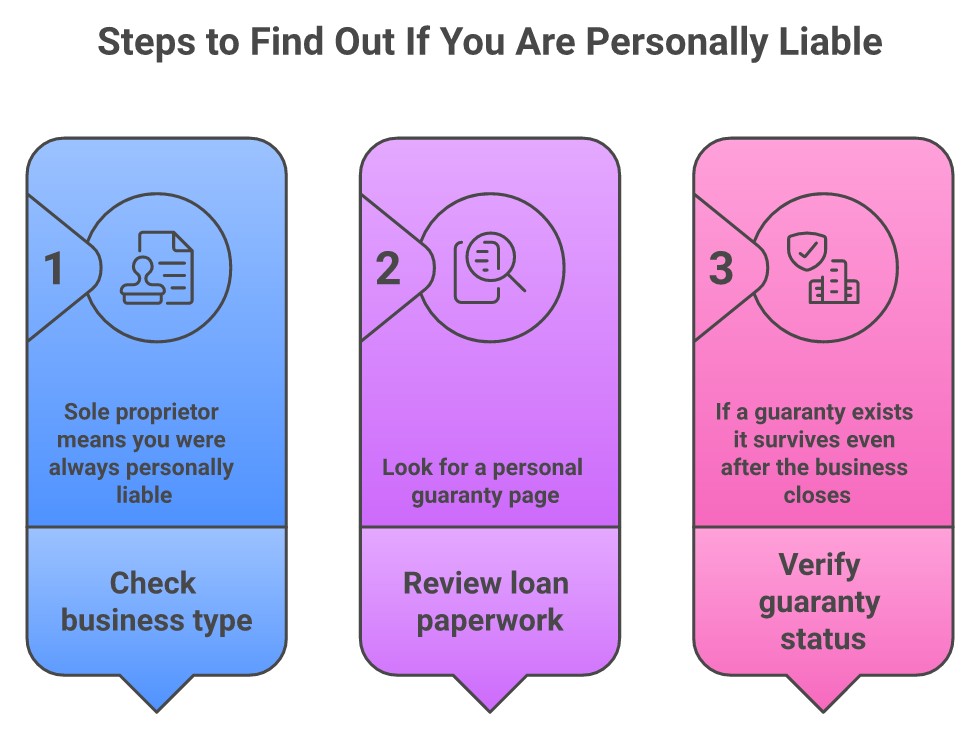
Don’t guess. Pull the loan file for the equipment financing — the dealer paperwork, the bank or captive-finance-company documents, whatever closed the deal. You’re looking for three things, and the first one is the one people skip:
The Daily Money Brief — Free, at 10 AM
Money you may be owed, scams to dodge, and the fine print decoded — the consumer money news that affects your wallet, every weekday.
- The promissory note — specifically, who is named as the Borrower. Check this before anything else. In small ag lending it is extremely common for the individual to be the named borrower, with the farm name showing up only as a trade name: “Jane Doe d/b/a Doe Farms.” If that’s what the note says, you are the debtor outright. There is no guaranty to go hunting for, because you never guaranteed someone else’s debt — the debt was always yours.
- A security agreement. This is normal and expected — but read what it actually covers: ag security agreements are frequently written broadly — “all equipment, livestock, crops, accounts, proceeds, and after-acquired property” — and are often cross-collateralized with other notes or with a real-estate mortgage. It matters, because it decides what else the lender can still reach after the tractor is gone.
- A separate guaranty page or guaranty clause — often titled “Personal Guaranty,” “Continuing Guaranty,” or folded into the signature block with language like “the undersigned, individually and personally, guarantees payment.” If your name is on that page in your individual capacity, you personally guaranteed the debt.
Two things people get backwards here. First: a dissolved LLC does not cancel a personal guarantee. Winding down or administratively dissolving the business has zero effect on a guaranty you signed as an individual — the lender can pursue you directly. Second, and this is the one that costs the most: writing “Manager, [Farm Name] LLC” next to your name on a guaranty is not a safe harbor. Courts have enforced guaranties against individuals who added a corporate title, reasoning that the document names the person as guarantor and that a company cannot meaningfully guarantee its own debt — outcomes vary by state and by drafting, which is exactly why a title next to your signature is not an answer. If your name appears anywhere on a guaranty page, treat yourself as exposed until a lawyer who has read the document tells you otherwise.
If you can’t find the original paperwork, ask the lender in writing for the note, the security agreement, any guaranty, and a current payoff figure. Many lenders simply send them — but know where you actually stand, because the consumer-credit laws that force disclosure do not reach this kind of loan: the Truth in Lending Act excludes credit “primarily for business, commercial, or agricultural purposes” (15 U.S.C. § 1603(1)) and the FDCPA only covers debts “primarily for personal, family, or household purposes” (15 U.S.C. § 1692a(5)). So there is generally no legal right to demand the origination file on farm equipment paper, and a “debt validation” letter has no effect here. What you do have under your state’s UCC is narrower and genuinely useful: as the debtor you can send the secured party an authenticated request for an accounting of the unpaid obligation, a list of the collateral, or a statement of account, and it generally must answer within 14 days (UCC § 9-210). Other routes to the paperwork: the dealer’s file, your accountant, the UCC-1 financing statement at your Secretary of State, and your own bank records. Don’t sit waiting on documents while a repossession is already moving.
What Happens to the Equipment — and What Happens After
Most farm and ranch equipment loans are secured: the tractor, combine, trailer, or livestock itself is the collateral. When the business can’t pay, the lender typically repossesses the collateral and sells it, usually at auction. That part is expected. What surprises people is what happens next.
How a deficiency balance works: Say $80,000 is owed on a piece of equipment. The lender repossesses it and sells it at auction for $50,000. Under the UCC the sale proceeds are applied first to the reasonable expenses of retaking, holding, preparing and selling the collateral — plus the lender’s attorney’s fees where the agreement provides for them and the law allows it (UCC § 9-615(a)) — and only what’s left goes against the loan. So the leftover you get billed for is usually more than the raw $30,000 difference, not less. That remaining amount is called a deficiency balance. (These are illustrative numbers to show how the math works — your actual figures depend on your loan and your state’s rules.)
A deficiency is not automatically ordinary unsecured debt just because the machine is gone — it is unsecured only if that note had no other collateral. If the security agreement was written broadly, or the note was cross-collateralized with your land, cattle, crops, or operating line, the lender may still hold a lien on those other assets for the same leftover balance, which changes how you negotiate it, what you can sell, and what a bankruptcy filing looks like. Read the security agreement before you treat a deficiency like a credit card balance.
Whether a deficiency is enforceable, and how it is calculated, is governed by your state’s version of the Uniform Commercial Code. Every aspect of the sale — method, manner, time, place, and terms — must be “commercially reasonable” (UCC § 9-610(b)), and you are generally entitled to authenticated notice beforehand. Two cautions, because readers keep building a defense on a misreading of this. A private sale is expressly permitted under § 9-610 and is not by itself evidence of anything wrong. And notice isn’t always required: it is excused where the collateral is perishable, threatens to decline speedily in value, or is of a type customarily sold on a recognized market (UCC § 9-611(d)) — which is exactly the fight that gets litigated over livestock. Where notice was required, the uniform rule is that it can only be waived by an agreement made and signed after default (UCC § 9-624(a)), so a waiver buried in a guaranty you signed years earlier is not the last word — though states vary in how they apply this, especially to guarantors. If a sale looks rushed or far under market, raise it with an attorney as a commercial-reasonableness question rather than a “they never sent me a letter” question.
Your Bankruptcy Options: Chapter 7, Chapter 12, and Chapter 13
Once you know which debts are genuinely yours — sole proprietor debt, a personally guaranteed loan, or a deficiency balance — bankruptcy is one of the tools for dealing with them. Farmers and ranchers actually have an option most people have never heard of.
Chapter 12 exists specifically for family farmers — and, under a separate definition with different numbers, for family fishermen. Most people never learn it exists until they need it. It was built to let a farm reorganize its debt and keep operating, using tools Chapter 11 and Chapter 13 weren’t designed for. Because it is a reorganization chapter, eligibility is written around a debtor who is “engaged in a farming operation” — so if the operation has permanently stopped, Chapter 12 may not be the right chapter for you, and Chapter 7 or 13 is the conversation to have instead.
More than 50%
of your gross income must have come from the farming operation — either in the taxable year before you file, or in each of the 2nd and 3rd taxable years before you file — not “any two of the last three” (11 U.S.C. § 101(18)(A))
At least 50%
of your aggregate noncontingent, liquidated debts must arise from the farming operation — and debt on your principal residence is left out of that calculation entirely unless it arose from the farm itself — so this is not a “total debt” test (11 U.S.C. § 101(18)(A))
$12,562,250
aggregate debt ceiling for an individual family farmer under Chapter 12, adjusted to this figure effective April 1, 2025 and in force until the next adjustment on April 1, 2028 (11 U.S.C. § 104; notice of Jan. 30, 2025, 90 Fed. Reg. 8941)
If you fish rather than farm, none of those three numbers are yours. “Family fisherman” is a separate definition at 11 U.S.C. § 101(19A) with a much tighter test — the debt ceiling is $2,568,000, not $12.5 million, and at least 80% of your noncontingent, liquidated debts, not 50%, must arise from the commercial fishing operation. Check your own category before assuming any figure here applies to you.
The home-mortgage point in that second card is the one I’d underline, because it disqualifies people who actually qualify. A family with $300,000 of farm and equipment debt and a $400,000 house mortgage runs it the wrong way — $300,000 of $700,000 is 43% — rules Chapter 12 out and never calls anyone. Run it the way the statute does and the residence debt drops out of the calculation entirely, so the farm debt is 100% of what counts and that prong is met. The income test, the debt ceiling, and the “engaged in a farming operation” requirement still have to be checked separately — but a big house mortgage by itself does not knock you out.
Chapter 7 liquidates non-exempt assets and discharges most unsecured debt relatively quickly — it’s often the right fit when the operation has already fully wound down and there’s little left to reorganize. Chapter 13 caps out at debt levels far smaller than what most farm operations carry, which is part of why Chapter 12 exists as its own category. Which one fits depends on how much debt you’re carrying, where it came from, and whether there’s still an operation worth saving — and that’s a conversation for a bankruptcy attorney who has actually handled Chapter 12 cases, which most consumer bankruptcy lawyers have not. Chapter 12 is a small bar: 336 Chapter 12 cases were filed nationwide in the 12 months ending June 30, 2026, up from 282 a year earlier — still 336 cases across the entire country (Administrative Office of the U.S. Courts, Table F-2). So ask any candidate a blunt question: how many Chapter 12 cases have you filed? The National Association of Consumer Bankruptcy Attorneys lets you search members by zip code and is a reasonable starting list, but it is a consumer directory and Chapter 12 is a farm chapter — so pair it with sources that know your local farm bar: your state bar’s agricultural law section, your land-grant extension’s farm financial staff, your state’s USDA-certified agricultural mediation program, and the Farm Aid hotline at 1-800-FARM-AID.
What Chapter 12 actually does is worth stating precisely, because it is routinely described in ways that oversell it. Its signature tools are writing a secured claim down to what the collateral is actually worth — the creditor keeps its lien and must be paid the present value of that secured claim, with the shortfall treated as unsecured (11 U.S.C. § 1225(a)(5), read with § 506(a)) — and stretching that secured debt over a period longer than the plan itself, which normally runs three to five years (11 U.S.C. § 1222(b)(9), (c)). On taxes the real rule is narrower than “Chapter 12 discharges taxes”: a government claim arising from the sale or other disposition of property used in the farming operation is treated as an ordinary pre-petition unsecured claim, gets no priority, and is discharged with the plan (11 U.S.C. § 1232) — powerful if selling farm assets triggered a capital-gains bill, but not a general tax eraser, since plenty of tax debt including recent trust-fund payroll tax is discharged in no chapter at all. And none of it is automatic — it happens through a plan a court has to confirm.
I’ve written before about Chapter 12 filings rising and why filing is a tool for staying in business, not a death sentence for the farm — that post looks at 2025 and at Minnesota specifically, and Chapter 12 counts are small enough nationally that the direction can turn inside a year, so treat any trend line as of its date rather than as today’s weather. If your situation is a personally guaranteed equipment loan rather than the whole operation, Chapter 7 may resolve it faster and more simply — but only if the entity is genuinely empty. Your membership interest in an LLC that still owns anything of value is property of the bankruptcy estate that a trustee can sell (11 U.S.C. § 541(a)(1)), and the entity itself gets no Chapter 7 discharge, because that discharge is available only to an individual (11 U.S.C. § 727(a)(1)). Find out what is actually left inside the entity before assuming Chapter 7 is the light-touch option.
Free Tool — Judgment Proof Checker: Think creditors can take everything? Many people in financial hardship are legally protected. The free Judgment Proof Checker shows whether collectors can actually collect anything from you in your state. Check My Status →
What You Get to Keep: Exemptions for Tools of the Trade
An exemption will not save financed equipment, and that misunderstanding costs farmers more money than anything else on this page. Exemptions protect property from the bankruptcy trustee and from unsecured creditors. They do not override a lender’s valid, perfected lien — if the tractor is collateral on a loan you’re behind on, no tools-of-the-trade exemption keeps it. The lien-avoidance power in 11 U.S.C. § 522(f)(1)(B)(ii) can strip a lien off tools of the trade, but only a nonpossessory, nonpurchase-money one — and dealer and captive-finance equipment paper is purchase-money almost by definition, so it usually isn’t available on the machine you financed. To keep a financed machine, the conversations that actually work are surrender-and-release, reaffirmation, or a Chapter 12 or 13 plan — not an exemption claim. And not bankruptcy redemption: 11 U.S.C. §722 reaches only “tangible personal property intended primarily for personal, family, or household use, from a lien securing a dischargeable consumer debt,” and a machine you financed for the operation is neither of those things. If someone tells you to ask about redemption on farm equipment, they are describing a remedy that does not exist for that asset.
Where exemptions do matter is equipment you own free and clear. Most states have a “tools of the trade” exemption that can cover farm implements, livestock, or equipment needed to earn a living. The federal exemption under 11 U.S.C. § 522(d)(6) protects $3,175 in tools of the trade, adjusted to that figure effective April 1, 2025 and in force until the next adjustment on April 1, 2028 — but here’s the part that actually matters: most states either opt out of the federal exemptions entirely or let you choose their own state exemption instead, and state tools-of-trade and agricultural exemptions vary enormously — some are far more generous than the federal figure, some far less. There is no single national answer here. This is exactly the kind of detail a bankruptcy attorney licensed in your state should walk through with you before you assume anything about what you’ll keep.
If Part of the Debt Is a Federal Farm Loan — a Different Track
Everything above applies to private financing — a bank, credit union, dealer, or captive finance company. If any of your debt is a direct loan from USDA’s Farm Service Agency (FSA), that’s a genuinely different track, and it is the track with deadlines on it. FSA offers its own loan servicing options for borrowers in financial distress on direct loans — including deferrals and restructuring through programs like Primary Loan Servicing and the Disaster Set-Aside Program — administered through your local FSA office, separate from anything a private lender offers. Those options are not automatic: they run on the written notices and the response windows described at the top of this page, and missing one is how a workable file turns into an accelerated one. A guaranteed FSA loan (one made by a private lender but backed by an FSA guarantee) is still serviced by that private lender, not directly by FSA, though FSA involvement can affect how a default is handled. If federal farm debt is part of your picture, start with your local FSA office — today, if a letter is already sitting on your counter.
The bottom line: “The business closed” tells you nothing about who owes what. What decides that is (1) whether you were a sole proprietor or an LLC/corporation, (2) whose name is on the note and whether you signed a personal guaranty, and (3) whether any of it is a federal farm loan on its own servicing track with its own clock. Then check the wind-down exceptions — distributions you took, unpaid payroll taxes, commingled money — because those reach past the entity. Skipping corporate formalities is not the same thing as signing a guaranty, and a tidy LLC binder does not undo one. Get those answers before you decide anything else, including whether bankruptcy makes sense and which chapter fits.
Frequently Asked Questions
If my farm LLC is dissolved, does that cancel a personal guarantee I signed?
No. Dissolving or administratively closing the LLC has no effect on a personal guaranty you signed as an individual. The guaranty is a separate contract between you and the lender — it survives the entity’s closure, and the lender can still pursue you directly for the guaranteed debt. Writing a title such as “Manager, [Farm Name] LLC” next to your signature does not reliably get you out of it either — courts have enforced guaranties against individuals who did exactly that, on the reasoning that a company cannot meaningfully guarantee its own debt, though outcomes vary by state and by document.
Can the lender come after me for more than the equipment was worth?
That depends on who the borrower was. If you were a sole proprietor, or you were named on the note personally, or you signed a personal guaranty, then yes — after a commercially reasonable sale the leftover is usually a deficiency claim against you, and under UCC § 9-615(a) the sale proceeds go first to the lender’s reasonable costs of retaking and selling, so the bill is often larger than the raw price gap. If the borrower was an LLC or corporation and you did not guarantee that debt, the deficiency is generally the entity’s problem rather than a personal bill — so don’t pay it from personal funds until someone has read the signature pages.
What makes Chapter 12 different from Chapter 7 or Chapter 13 for a farm?
Chapter 12 lets a family farmer reorganize while continuing to operate. Its real tools are writing a secured claim down to the collateral’s actual value, with the creditor keeping its lien and being paid that value’s present worth (11 U.S.C. § 1225(a)(5)), stretching secured debt out beyond the plan’s three-to-five-year term (§ 1222(b)(9), (c)), and treating a government claim arising from the sale of farm property as ordinary unsecured debt that gets discharged (§ 1232). To qualify under 11 U.S.C. § 101(18)(A), at least 50% of your aggregate noncontingent, liquidated debts must arise from the farming operation — excluding debt on your principal residence unless that debt itself came from the farm — and more than 50% of your gross income must have come from farming, either in the taxable year before filing or in each of the 2nd and 3rd taxable years before filing.
Am I personally liable if I only operated as a sole proprietor with a DBA?
Yes. A “Doing Business As” name is just a name — it creates no legal separation between you and the business. As a sole proprietor, you and the business are the same legal entity, so every equipment loan the business took on was always a personal debt, DBA or not.
Does it matter if some of the debt is a USDA Farm Service Agency loan?
Yes, quite a bit, and it is the part with a deadline. A direct FSA loan has its own loan servicing options for financially distressed borrowers — deferrals and restructuring handled through your local FSA office — that don’t exist with private lenders, but they run on fixed clocks: 60 days from receipt of the servicing notice to file a complete application under 7 C.F.R. § 766.101(d), 45 days to accept a servicing offer, and 30 days to request a National Appeals Division hearing on an adverse decision under 7 C.F.R. § 11.6(b)(1). A guaranteed FSA loan is still serviced by the private lender that made it. Either way, identify which of your debts are federal farm loans before you assume they’ll behave like the rest of your equipment financing.
I’m going to tell you what I’d tell my own family member in this spot: don’t let “the business is closed” stand in for an actual answer about who owes what. Read the note to see whose name is on it, find out whether you signed a guaranty, and find out whether any of the debt is a federal farm loan with a deadline running — those three facts change everything about what happens next. This is my general read on how these situations typically work, not legal advice for your specific loans or your state’s exemption rules — every operation, every lender, and every state’s laws are different, and an attorney who has actually seen your paperwork is the only one who can tell you exactly where you stand.
If this helped you make sense of a confusing situation, send it to another farm or ranch family going through the same thing. Nobody should have to guess whether they’re personally on the hook.
If your debt situation isn’t just about equipment loans but includes credit cards, medical bills, or other consumer debt piling up alongside the farm’s, you may also want to see how small business bankruptcy options compare, and if a lender is asking about a guarantee you signed on something like a COVID-era loan, I’ve also covered when EIDL personal guarantees were and weren’t actually required. And if this is playing out against the backdrop of the wider farm economy, I’ve written about why farms across the country are going broke right now and, separately, what to do when a repossession turns into a bill for more money — the deficiency-balance arithmetic works the same way whether it’s a car or a combine, though a personal-use vehicle can carry consumer protections that commercial farm equipment does not.
Facing a Similar Situation? You’re not alone — and you have more options than you think. Start with the all your debt relief options page to see what’s realistic, or take the 2-minute bankruptcy quiz if the debt feels unmanageable. Federal Reserve Bank of New York research found that insolvency is associated with worse financial outcomes than bankruptcy — people who stayed insolvent had less access to new credit and lower credit scores than people who filed. If a company is involved, run them through the Scam-O-Meter first.



