
Written by Steve Rhode, consumer debt expert since 1994 • Last updated September 3, 2026
Quick Answer: Eviction and debt collection are two separate legal systems that don’t talk to each other, and that’s exactly what makes this moment so dangerous — you can lose the fight in housing court while you’re busy fighting the phone. Filing bankruptcy before your landlord gets a judgment for possession triggers an automatic stay under 11 U.S.C. § 362(a)(1) that pauses the eviction case — but be clear about what that buys you, because the stay pauses the lawsuit and does not undo a lease your landlord has already ended, does not give you a right to stay in the apartment, and leaves three groups of filers with no stay at all, or only a short one (I name all three below). Meanwhile: pay rent before you pay any collector, verify any debt in writing before you send a dollar toward it, and treat your landlord’s notice deadline and your deadline to answer the lawsuit as two separate clocks — the court clock is the one that produces a default judgment, and it is printed on your court papers, not on the notice — read them to see whether they give you a deadline to FILE or a date to APPEAR, because in some states, Texas among them, showing up is what saves you and filing alone does not. Don’t ignore either one — they both get worse, not better, if you do.
What Just Happened to You
Two entirely separate legal processes just collided in your life at the same time, and neither one knows the other exists. Your landlord’s eviction case runs through state landlord-tenant court on its own clock — a notice period (which varies far more than most people expect: no advance notice at all in New Jersey for an ordinary nonpayment case under state law, 3 days in California and Texas, 14 days in New York — and federal rules can override all of those upward), then a lawsuit (often called an “unlawful detainer” or “forcible detainer”), then a summons or citation with its own short clock — a deadline to file an answer in most states, a date to appear in some — then a hearing, then a judgment, then a writ of possession carried out by a sheriff, constable, or marshal depending on where you live. A debt collector chasing you for a credit card, medical bill, or old loan runs through an entirely different track — phone calls and letters first, then possibly a separate lawsuit in civil court, then a judgment, then wage garnishment or a bank account levy if they win.
Here’s the real danger: a debt collector cannot take your home. Only your landlord, through the eviction court, can do that. But if a collector gets a judgment first and garnishes your paycheck or freezes your bank account, the money you needed for rent can disappear — and that’s how a debt collection problem turns into a housing crisis even though the two cases are legally unrelated. One protection worth knowing before you panic: if your Social Security, SSI, VA, or federal retirement benefits are directly deposited, 31 C.F.R. Part 212 requires your bank to automatically leave two months’ worth of those benefits accessible when an ordinary garnishment order arrives — and you do not have to file anything or claim any exemption to get it. I’ve watched people lose their housing not because they couldn’t have paid rent, but because they paid a collector instead.
The Mistake You’re About to Make: Sending your rent money to whichever creditor is calling the loudest. Debt collectors are trained to sound urgent because panic gets people to pay. But a collector’s threats are almost always weaker than they sound: most consumer debt collectors cannot touch your paycheck or your bank account without first suing you and winning, which takes months — and the dangerous exception is a collector who already did it without your knowing, because default judgments get entered all the time against people who were never properly served, and once a judgment exists garnishment can start with no further warning. Search your name in your state’s online court records today, and if you find a case you never knew about, tell legal aid the same day — a judgment entered without proper service can sometimes be set aside, and the window to ask is limited and in some states short. Your landlord’s eviction clock is often faster and its consequence — losing your home — is permanent in a way an old credit card bill isn’t. Read your options below before you send anyone a dollar.
Free Tool — Wage Garnishment Calculator: Worried about your paycheck being seized? The free Wage Garnishment Calculator shows exactly how much creditors can legally take in your state — and some states prohibit garnishment entirely. Calculate My Risk →
Your Options Right Now
What to Do in the Next 48 Hours
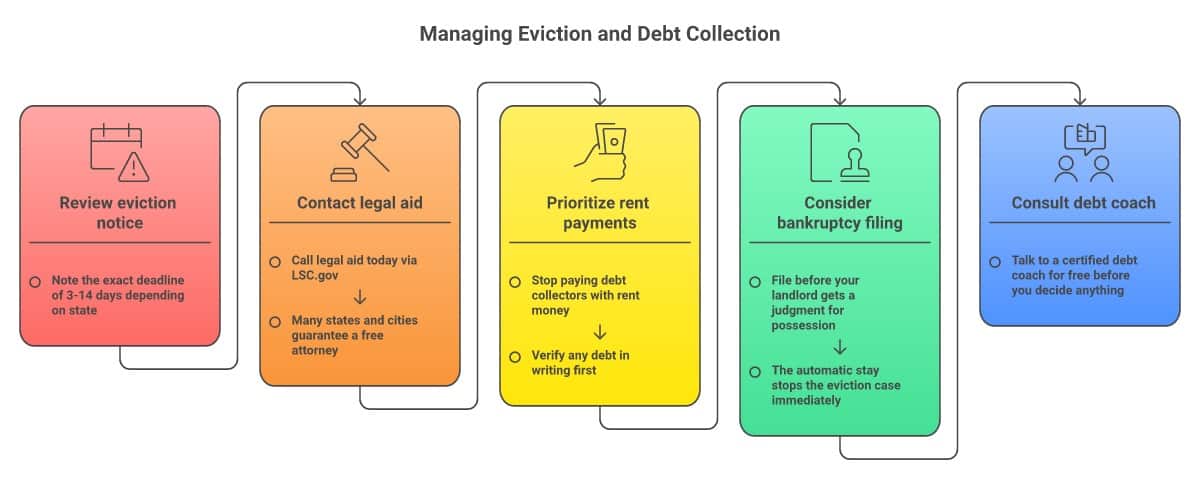
- Find both of your deadlines — there are two of them, and they are not the same thing. The first is your landlord’s notice (a pay-or-quit demand or a notice to vacate): 3 days in California and Texas, 14 days in New York, no advance notice at all in New Jersey for ordinary nonpayment of rent under its Anti-Eviction Act — the state’s notice statute lists the grounds that require a notice to quit and expressly excepts nonpayment (N.J.S.A. 2A:18-61.2). ⚠ Two things narrow that. Federal rules can still require 30 days regardless of what state law says, if your building has a federally backed mortgage or is federally subsidized — see the table below. And not every New Jersey tenancy falls under that Act at all; some are governed by different statutes with their own notice requirements. If you are in New Jersey and were served with no notice, that is a question for legal aid, not a closed door. Though a case pleaded as habitual late payment does require a month’s notice — and something different again in most other states. That notice is a demand from your landlord, not a court document, and there is nothing to file in response to it. The second deadline starts only when your landlord actually files the lawsuit and you are served with a summons — you then have a short window to respond — in most states by filing a written answer with the court, in some by appearing on a date the papers set — and that is the clock that hands your landlord a default judgment if you miss it. In California it is 10 days, excluding Saturdays, Sundays, and court holidays, under Cal. Code Civ. Proc. § 1167 (it was 5 days until AB 2347 changed it effective January 1, 2025) — but every state is different, and in some states there is no answer deadline at all. Texas is the one to know about, because it works the opposite way. Under Tex. R. Civ. P. 510.11(a) a tenant “may, but is not required to, file a written answer with the court on or before the day set for trial in the citation” — the citation gives you a trial date, not a filing deadline. And Rule 510.16(a) is the part that costs people their home: if you fail to appear at trial and filed no answer, the landlord’s allegations “must be taken as admitted and judgment by default rendered accordingly” — and even if you did file an answer, if you then fail to appear the court may hear the landlord’s evidence and rule without you. Filing is not what saves you there. Showing up is. So read your papers and answer one question first: do they give you a deadline to FILE something, or a DATE to APPEAR? If it is a filing deadline, file. If it is a court date, go — and go even if you have already filed. Do not rely on any website, including this one, for your number or your format.
- Ask what your state’s cure deadline is before you spend money on anything else. In many states, paying the full amount owed plus costs before judgment ends a nonpayment case outright — the landlord gets the money and the case dies. The cutoff differs by state and it is usually earlier than people think, and in some places it closes the moment judgment is entered. If there is any chance you can raise the arrears from family, a hardship fund, or emergency rental assistance, find out your state’s deadline first, because it may be the cheapest and most complete fix available to you. I am not naming a per-state rule here on purpose; ask legal aid or your court’s self-help center for yours.
- Call your local legal aid office today, not after you’ve tried everything else. Legal Services Corporation-funded programs represent tenants facing eviction for free if you qualify — they are chronically oversubscribed and turn away many people who do qualify, so call the day you are served, and if they can’t take your case, ask them for volunteer-lawyer, law-school-clinic, and tenant-union referrals instead of treating the first no as the end of it. Federal rules also bar them from a narrow set of cases, including defending some public-housing evictions based on drug charges (45 C.F.R. Part 1633). If you live in Connecticut, Maryland, Washington, or one of a growing list of cities, you may also have a right to a free attorney in eviction court — income limits apply in most of them.
- Stop paying debt collectors out of your rent money — and verify any debt in writing before you pay anything. Under the Fair Debt Collection Practices Act, 15 U.S.C. § 1692g, a collector must send you written notice of the debt — the amount and who they say you owe — within five days of first contacting you. You then have 30 days from that notice to demand verification in writing, and the name and address of the original creditor if it is different, before the debt is treated as valid. Two limits matter a great deal on this particular page: the FDCPA covers third-party collection agencies and generally not a creditor collecting its own debt or a landlord chasing his own rent (15 U.S.C. § 1692a(6)), and — this is the one that costs people their case — a verification letter does nothing to a lawsuit and does not extend any court deadline. If you have been served with court papers by anyone, you still have to respond the way those papers tell you to — by filing an answer if they set a filing deadline, or by appearing if they set a court date. A verification request is not an answer. Collectors count on you paying out of fear before you ever ask.
- If bankruptcy is on your list, do the credit counseling briefing today. You cannot file at all until you have completed a briefing from an approved credit counseling agency within the 180 days before you file (11 U.S.C. § 109(h)) — most take under an hour online, and someone who walks into the clerk’s office the morning of the hearing without that certificate is turned away. The exceptions are narrow: § 109(h)(3) lets you file on a certification of exigent circumstances, but only if you already asked an approved agency for the briefing and could not get it within seven days — which is exactly why you make that request today rather than on the courthouse steps — and § 109(h)(4) waives the briefing altogether for incapacity, disability, or active duty in a combat zone. After that, timing matters: filing before your landlord gets a judgment for possession triggers the automatic stay and pauses the eviction case immediately, not weeks later — and a pause is exactly what it is, which I explain below. Even if your landlord already has a judgment, a narrow 30-day option may still exist (see below). NACBA can connect you with a bankruptcy attorney, and my Find Your Path quiz can help you think through whether bankruptcy fits your numbers.
- Talk to someone free before you decide anything. Talk to Damon Day, a certified consumer debt coach (not an attorney), for free about which fire to put out first. Damon is my co-host on the Get Out of Debt Guy podcast, and I want you to know that before you decide anything. I receive no payment for this referral, and the consultation is free — money only changes hands if you decide on your own to hire him.
Free Tool — I'm Being Sued for Debt Guide: Being sued by a creditor or debt collector? The free I'm Being Sued Guide gives you a personalized action plan — deadlines, defenses, and options based on your state. Most states require a response within 20–30 days. Get My Action Plan →
How to Actually Stop It — Your 4 Paths
- File bankruptcy because your whole debt picture justifies it — and treat the eviction pause as a bonus, not as the reason. Under 11 U.S.C. § 362(a)(1), the automatic stay stops the continuation of the eviction lawsuit the moment you file, not weeks later. Now the part almost nobody tells you: the stay pauses the proceeding, and it does not revive a lease your landlord has already terminated, does not create a right to possess the apartment, and does not wipe out your landlord’s claim to the property the way it wipes out the back rent as a debt. Your landlord can ask the bankruptcy judge to lift the stay under § 362(d), and on a terminated residential lease judges often grant that within weeks. So don’t burn a Chapter 7 discharge — which you can only get once every eight years — to buy two or three weeks in an apartment you lose anyway. Bankruptcy is still the option I recommend most often and the one this industry works hardest to talk people out of, and the research is why: Federal Reserve Bank of New York research found that insolvency is associated with worse financial outcomes than bankruptcy — people who stayed insolvent had less access to new credit and lower credit scores than people who filed. File it as a debt decision. Not as an eviction tactic.
- If your landlord already has a judgment against you, there is a federal escape hatch — and it is far narrower than it sounds. Once a possession judgment exists before you file, the eviction is normally carved out of the stay altogether (11 U.S.C. § 362(b)(22)). You can hold that off for up to 30 days only if you do all of this: file with the petition itself, and serve on your landlord, a certification under penalty of perjury that your state’s law gives you circumstances in which you could cure the entire unpaid balance even after the judgment; deposit with the clerk of the bankruptcy court the rent coming due in those 30 days; then actually pay off 100% of the arrears inside those 30 days and file a second certification (§ 362(l)). It is a hard full-cure deadline, not breathing room. It is not 30 guaranteed days either — your landlord can object, and the court must hold a hearing within 10 days, so this can be over in under two weeks. And the precondition frequently fails, because many states give a tenant no right at all to cure the whole default after a judgment for possession. California’s route is discretionary relief from forfeiture — Cal. Code Civ. Proc. § 1179 says the court “may relieve a tenant against a forfeiture… in case of hardship” — and I could not find a settled answer on whether a discretionary remedy like that satisfies the certification, so treat it as an open question only a bankruptcy attorney should answer for you. Never certify something you are not certain is true; a false certification is a federal crime.
- Negotiate directly with your landlord and apply for emergency rental assistance before your court date. Most landlords would rather get paid than pay the cost, time, and vacancy risk of an eviction. Ask your local housing authority or 211 about current rental assistance funds — and get any payment agreement in writing.
- What won’t work: paying off a debt collector to “make the calls stop.” It does nothing for your eviction case, and a partial payment on an old, unenforceable debt can restart the clock on how long a collector can legally sue you in some states. If you’re weighing whether to prioritize a debt collector’s demand over your rent, read this on where to start when you owe everyone at once before you send a dollar.
Three Situations Where the Automatic Stay Won’t Do What You Expect: First, if the eviction is based on endangering the property or illegal drug use on the premises, your landlord can knock that eviction out of the stay by filing a certification under penalty of perjury with the bankruptcy court and serving it on you (11 U.S.C. § 362(b)(23)). It does not bite the moment he files it — the carve-out takes effect 15 days after the certification is filed and served, so the stay still protects you during those 15 days (§ 362(m)(1)). If you file an objection with the court and serve it on your landlord inside that window, the carve-out does not apply at all unless the judge orders otherwise, and the court must hold a hearing within 10 days of your objection (§ 362(m)(2)). Let the 15 days run without objecting and it applies immediately (§ 362(m)(3)). Second, if you had a bankruptcy case dismissed within the past year, the stay ends automatically on day 30 unless the court grants an extension — and the statute requires the hearing on that motion to be completed before the 30 days run, not merely filed by then (§ 362(c)(3)(B)) — so the motion goes in with your petition, not later. If you had two or more dismissed in that year, no stay arises at all unless you affirmatively ask for one, and a stay the court does grant starts on the day the judge signs the order, not on the day you filed (§ 362(c)(4)). People in this exact bind — eviction and collectors at once — are more likely than most to have a dismissed Chapter 13 behind them, so this is not a rare footnote. Third, you cannot file in the first place without the credit counseling briefing described above, and the exceptions to that are narrow (§ 109(h)). One more practical thing: the stay is legally effective the minute you file, but the court’s own notice to creditors goes out by mail and takes days to reach your landlord, and it never reaches the sheriff or the housing court at all. As a practical matter, a lockout already on the calendar stops only if the people holding the writ know you filed — so get your case number and a file-stamped copy of the petition to your landlord, his attorney, the housing court, and the sheriff the same day, and keep proof you did. If they lock you out anyway, call a bankruptcy attorney immediately instead of assuming it is over, because a willful violation of the stay can carry actual damages, costs, and attorney’s fees (11 U.S.C. § 362(k)). The same rule protects you against any creditor, not just a landlord — see my guide on what to do if a creditor keeps collecting after you file.
What You Need to Know About Your Legal Protections
Your landlord’s notice period (3 days in California and Texas, 14 in New York, none at all in New Jersey for ordinary nonpayment under its Anti-Eviction Act — but federal rules can still require 30 days if your building has a federally backed mortgage or is subsidized, so check the table below before you conclude you had no notice defense) is not your deadline to respond to the lawsuit — that one is printed on your court papers, as either a deadline to FILE or a date to APPEAR depending on the state, and it is the one that produces a default judgment.
Federal law caps consumer-debt garnishment at the lesser of 25% of your disposable pay or the amount that pay exceeds 30 times the federal minimum wage — that floor is $217.50 a week at the current $7.25 federal minimum, so a worker earning near it can have nothing at all taken (15 U.S.C. § 1673). Child support, federal student loans, and taxes run under different and harsher rules. See my wages are being garnished, here’s what to do if it’s already happening.
Penalty a California landlord owes you (minimum $250) for illegally locking you out or shutting off utilities instead of going through court — Cal. Civ. Code § 789.3, and you have to raise it in court rather than subtract it from the rent you owe.
The most a § 362(l) certification can hold off a post-judgment eviction — and only if you file and serve it with the petition, deposit the coming month’s rent with the bankruptcy court clerk, and cure the entire balance inside the window, because your landlord can object and force a hearing in 10 days.
For almost every tenant in the country, one rule holds: your landlord cannot legally remove you without a court order. Changing your locks, shutting off your water or heat, or piling your belongings on the curb to force you out is illegal self-help, and the removal itself has to be carried out by a law enforcement officer on a court-issued writ — a sheriff, constable, marshal, or court officer, depending on where you live. In New York, for example, the warrant is directed to “the sheriff of the county or to any constable or marshal of the city” (N.Y. RPAPL § 749), so seeing a marshal rather than a sheriff does not mean the removal is illegal.
There are narrow exceptions, and you need to know if you are in one: a single lodger renting a room inside the owner’s own home loses the right to remain by operation of law once the written notice period ends, and can be removed without any court case at all (Cal. Civ. Code § 1946.5 is the clearest example) — and hotel or motel guests who never became tenants can often be removed as trespassers. If that describes your situation, get advice today rather than assuming a lockout would be illegal.
| Jurisdiction | Nonpayment Notice Period | Notes |
|---|---|---|
| Federal baseline | No uniform federal notice period for private housing | Eviction procedure is set by state law; the automatic stay under bankruptcy is federal and applies everywhere. |
| Any building with a federally backed mortgage | 30 days’ notice to vacate for nonpayment | CARES Act § 4024(c), 15 U.S.C. § 9058(c) — a statute, not an agency rule, and it covers far more ordinary private apartment buildings than tenants realize. A May 2026 Congressional Research Service report found it “remains in effect” and available as a defense across much of the country — though the Iowa Supreme Court (2025) and the Arizona Court of Appeals (June 2026) have held it expired, and a repeal bill has moved out of House committee, so ask legal aid whether your building is covered and how your court treats it. |
| Public housing & Section 8 project-based | 30 days’ written notice before a nonpayment eviction can be filed | A federal protection that does not apply to Housing Choice Vouchers. HUD issued an interim final rule revoking it in February 2026, then delayed that rule’s effective date indefinitely and said it would treat the revocation as a proposal instead, so the 30-day rule remains in force — but confirm its current status with HUD or your legal aid office before you rely on it. |
| California | 3 days (excluding weekends/court holidays) | Cal. Code Civ. Proc. § 1161(2) |
| Texas | 3 days (unless lease says otherwise) | Tex. Prop. Code § 24.005 |
| New York | 14 days, written demand required | N.Y. RPAPL § 711 — oral demands no longer count |
| Connecticut, Maryland, Washington | Varies by state | All three have statewide right-to-counsel laws for tenants in eviction court, and all three are income-limited and funding-limited — ask your legal aid office whether you qualify, and file your answer by the deadline either way. |
Federal rows verified September 3, 2026: 15 U.S.C. § 9058 carries no amendment in the U.S. Code as published, and the 30-day public-housing requirement is still in the Code of Federal Regulations at 24 C.F.R. 966.4. Both are the kind of rule that can move between the day I write and the day you read it — check before you rely on either.
If you live in Connecticut, Maryland, Washington, or one of the 21 cities that now guarantee counsel — including New York City, Philadelphia, Newark, Baltimore, Cleveland, San Francisco, and Louisville — you may be entitled to a free attorney in your eviction case. Income limits still apply in most of them — Connecticut, Maryland, and Washington each cap eligibility by income, on cutoffs that differ from state to state, while San Francisco guarantees counsel to every tenant regardless of income. Ask your court clerk or local legal aid office directly; don’t assume you don’t qualify. And don’t wait for a lawyer to be assigned before you act — do what your papers require by the date on them — file the answer, or appear on the trial date — whether or not you have counsel yet.
If a debt collector is threatening you, calling before 8am or after 9pm, or telling you that you’ll be arrested for not paying, file a complaint with the CFPB and your state attorney general — threatening arrest for an unpaid consumer debt is illegal — but you can still be picked up on a bench warrant for ignoring a court order to appear, so never skip a court date. If you need legal help but can’t afford an attorney, find free legal aid through LSC.gov.
Steve’s Take
I filed bankruptcy in 1990. What I remember most isn’t the debt — it was the fear of losing the roof over my head while the phone kept ringing with people demanding money I didn’t have. Nobody explains that your landlord and your debt collector are fighting completely different battles with completely different weapons, so you end up defending against both at once, exhausted, sending money to whoever sounds scariest. Do the math, not the panic. I watched thousands of people go through this over 30 years — the ones who protected their housing first and dealt with unsecured debt second did dramatically better than the ones who paid collectors out of fear and lost their home anyway.
Frequently Asked Questions
I’m being evicted and a debt collector keeps calling — which one do I deal with first?
Your housing. A debt collector almost always needs to sue you and win a judgment before they can touch your wages or bank account — that process takes months. Your eviction case can move in days to weeks. Protect the roof over your head first, then deal with the collector once you know your housing is stable.
Will paying off my debt collector help me avoid eviction?
No. Your debt collector has nothing to do with your landlord or your eviction case — they’re separate legal proceedings. Paying a collector does not stop, slow, or influence your eviction in any way. It only reduces the money you have available for rent.
Can filing bankruptcy stop an eviction that’s already in court?
It pauses it, and the difference between pausing and stopping is the whole thing to understand before you file. If your landlord hasn’t gotten a judgment for possession yet, the automatic stay under 11 U.S.C. § 362(a)(1) halts the case the moment you file, not weeks later. What it does not do is revive a lease your landlord already terminated or give you a right to stay — your landlord can ask the bankruptcy court to lift the stay under § 362(d), and on a terminated residential lease judges often grant that within weeks, after which the eviction picks up where it left off. This is not the only way the stay fails you, and the biggest one comes first: if your landlord already had a judgment for possession before you filed, § 362(b)(22) carves the eviction out of the stay entirely — that is the most common way a reader of this page ends up with no pause at all, and I walk through it above. Beyond that, two more situations get no stay or only a short one: a drug or endangerment eviction, and a bankruptcy of yours dismissed within the past year. Separately — and it is a different kind of problem, not a stay rule — if you have not completed the required pre-filing credit counseling briefing you cannot file at all, so no stay ever arises to begin with. I lay each of these out in full above. File bankruptcy because your overall debt picture justifies it — the eviction pause is a bonus, not a strategy.
My landlord already has a judgment against me — is it too late to stop the eviction?
Not necessarily, but the option here is narrow and unforgiving. Once a possession judgment exists before you file, the eviction is normally carved out of the automatic stay entirely (11 U.S.C. § 362(b)(22)), and § 362(l) can hold that off for up to 30 days only if you meet every one of its conditions — the certification filed and served with the petition, the deposit with the bankruptcy court clerk, a full cure of the arrears inside the window, and a second certification — while your landlord can object and force a hearing in 10 days. I walk through all of it, and through why the precondition often fails in a state like California, in the “How to Actually Stop It” section above. This is a question for a bankruptcy attorney, not for a website. Talk to one through NACBA immediately if you’re in this situation.
Can my landlord change the locks or shut off my utilities to force me out?
Against a tenant, no — that is illegal self-help in virtually every state. In California, a landlord who changes your locks, removes your doors or windows, takes your belongings, or shuts off your utilities to force you out owes you your actual damages plus up to $100 for each day the violation continues, and never less than $250 per cause of action, under Cal. Civ. Code § 789.3 — you have to raise that in court, though, and you cannot simply subtract it from the rent you owe. The removal itself has to be done by a law enforcement officer on a court-issued writ of possession — a sheriff, constable, or marshal depending on your county. The narrow exception to all of this: a single lodger renting a room inside the owner’s own home can be removed without a court case once the written notice period ends (Cal. Civ. Code § 1946.5), and the same is often true of hotel and motel guests who never became tenants.
I can’t afford a lawyer — is there anywhere I get one for free?
Often, yes. Connecticut, Maryland, and Washington have statewide right-to-counsel laws for tenants in eviction cases, and 21 cities — including New York City, Philadelphia, Newark, and San Francisco — do the same locally. Most of them are income-limited and all of them are funding-limited — San Francisco is the exception on income and covers every tenant regardless of what they earn, though it runs short of lawyers like everywhere else — so ask your court clerk or legal aid the day you are served whether you qualify and how to request an attorney. Even outside those areas, Legal Services Corporation-funded legal aid programs represent income-qualifying tenants for free nationwide — they turn away many people who do qualify, purely on capacity, so if the answer is no, ask them for volunteer-lawyer, law-school-clinic, and tenant-union referrals. Whatever the answer, do what your papers require by the date on them — file the answer, or appear on the trial date; do not wait for a lawyer to appear first.
Does an eviction show up on my credit report the same way a collection does?
Not directly — courts don’t report eviction filings to the credit bureaus. But two things can still hurt you: if your landlord sends your unpaid balance to a collection agency, that collection account will show up on your credit report, and separately, eviction filings often appear on tenant-screening reports landlords use to approve new applicants. Those screening reports are covered by federal fair-reporting law, so you have the right to dispute errors — here’s what to do if a tenant-screening company gets your record wrong.
One more thing — everything I share here is based on 30 years of helping people through exactly this. But my advice is input for your decision, not the decision itself. Only you know your full situation. Talk to an attorney, look at your numbers, and make the choice that serves your future.
Important: This guide is for informational purposes only and is not legal advice. Laws vary by state, and your situation may have details that change what options are available to you. For legal advice specific to your case, consult an attorney licensed in your state. NACBA can help you find a bankruptcy attorney, NACA can connect you with a consumer attorney, or talk to Damon Day for free about your situation. Damon Day, an independent debt coach and my co-host on the Get Out of Debt Guy podcast, whom you can reach at DamonDay.com — I receive no payment for this referral.
Key Takeaway: Eviction and debt collection are separate legal battles, but the money to fight both comes from the same paycheck. Protect your housing first, verify any debt before you pay a dollar toward it, and if bankruptcy is right for your whole debt picture, filing before your landlord gets a judgment for possession gives you more room to work with — just don’t file it as an eviction tactic, because the stay pauses the case without saving the tenancy. My Find Your Path quiz can help you think through your options this week. The longer both cases sit unanswered, the fewer choices you’ll have.
The Bottom Line
You’re not bad with money, and you’re not the only person juggling a landlord and a debt collector at the same time — it’s one of the most common collisions I’ve seen in 30 years of doing this work. The law built real protections into both sides of this fight: notice periods your landlord must honor, an automatic stay bankruptcy gives you the instant you file, and rules that make it illegal for a landlord to lock a tenant out or freeze them out instead of going to court. The people who did best were the ones who protected their housing first and dealt with unsecured debt on a slower, more deliberate timeline. If someone you know is fighting an eviction and debt collectors at the same time, send them this page — most people don’t know these two systems are unrelated until it’s already cost them.
Dealing With Debt? Understanding your options is the first step. See how all your debt relief options compare — including ones most sites won’t tell you about. The Find Your Path quiz gives a recommendation based on your actual numbers, and the Scam-O-Meter checks any company’s complaint history before you sign. Federal Reserve Bank of New York research found that insolvency is associated with worse financial outcomes than bankruptcy — people who stayed insolvent had less access to new credit and lower credit scores than people who filed.
Right now you are dealing with the thing in front of you, and that is exactly where your attention belongs. When it is handled — and it will be — there is a next stage, and it is the one I most enjoy writing about.
In the latest issue (Oct 8): A parent's nursing home bill can become yours
I write Your Money Actually most weekdays — actionable money information you will not find anywhere else, and the small decisions that compound. It is free, I sell nothing, and I take no money from any company I write about.



