

Quick Answer: No — under 38 U.S.C. §5301 private debt collectors cannot garnish, levy, attach, or seize VA disability compensation, and under 31 CFR Part 212 a bank served with a garnishment order must leave accessible the federal benefits deposited in the prior two months, unless the order comes from the United States or a state child-support enforcement agency. If you’re a disabled veteran and your VA disability compensation is direct-deposited, it is federally protected from private creditors under 38 U.S.C. §5301, and even the money already sitting in your bank account gets a two-month automatic shield under federal regulation before any bank can freeze it for a garnishment order. A dead vehicle you still owe money on is a separate problem — the loan doesn’t go away just because the engine did, and if the lender repossesses it and sells it for less than you owe, you can be pursued for that “deficiency” balance. The two problems have different fixes, and you don’t have to guess which one you’re facing.
Expert Context: I’ve helped people with debt since 1994, including plenty of veterans on fixed VA disability incomes who were terrified by collector calls after a car died out from under them. I ran a nonprofit credit counseling organization for over a decade and watched collectors lean hardest on people who had the least room to absorb pressure — disabled veterans are exactly who that tactic targets, because collectors are betting fear will do what the law won’t let them do.
A truck engine doesn’t check anyone’s calendar before it fails, and it definitely doesn’t check whether collectors are already calling. I hear from disabled veterans in this exact bind more than you’d think: service-connected, living on VA disability compensation, and the one vehicle they depend on to get to appointments and the grocery store just died — while they still owe money on it and a collector is working the phone. It feels like two crises stacked on top of each other. It isn’t. It’s two separate legal questions, and both have clear, favorable-to-you answers once you know where to look.
Key Terms Defined
Deficiency balance: What you still owe a lender after they repossess and sell your vehicle, if the sale price doesn’t cover the loan balance plus repossession costs. See the FTC’s consumer guide on vehicle repossession.
Every weekday I read the enforcement actions, filings and fine print the outlets skip, and turn them into the one or two moves that actually improve your position — a rate worth moving for, a fee you can refuse, a deadline to beat before it costs you.
I write Your Money Actually most weekdays — actionable money information you will not find anywhere else, and the small decisions that compound. It is free, I sell nothing, and I take no money from any company I write about.
Voluntary surrender: Giving the vehicle back to the lender yourself instead of waiting for a tow truck to take it. It can reduce repossession fees but does not erase the deficiency balance — you still owe the difference. (FTC, same source.)
Lookback period: The two months immediately before the bank’s account review, which a bank must check for federal benefit deposits before it can freeze any of that money for a garnishment order, under 31 CFR Part 212.
Where this topic came from: Conversations in my free Ask Steve chat keep raising situations like this — disabled veterans whose only vehicle breaks down while they’re already fielding collector calls about what’s owed on it. I’m not giving away any personal information here — I never do — but when real questions show me a gap worth covering, I write the answer for everyone. If you’re facing something like this yourself, ask me about it in the chat. It’s free, it’s private, and I’m not selling anything.
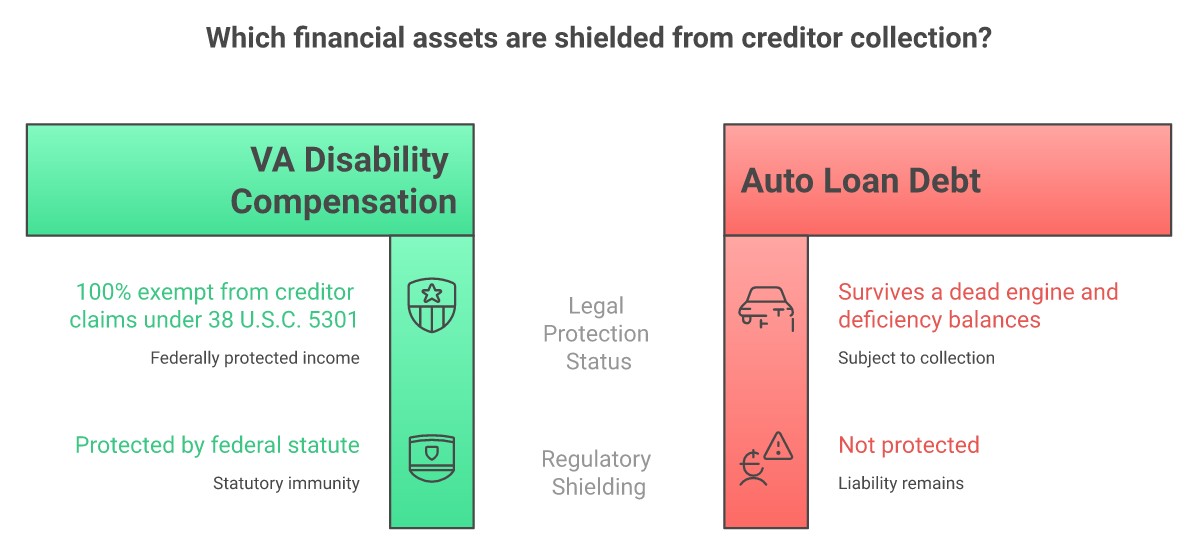
Your VA Disability Compensation Is Protected From These Collectors — By Federal Law
Start here, because it’s the fact that should let you exhale first. Under 38 U.S.C. §5301, VA disability compensation “shall be exempt from the claim of creditors, and shall not be liable to attachment, levy, or seizure by or under any legal or equitable process whatever, either before or after receipt by the beneficiary.” That’s not a summary I’m paraphrasing loosely — that’s close to the actual statutory language. A private auto lender, a debt collector, or a debt buyer that bought your account for pennies cannot attach, levy, or seize your VA disability compensation. The exceptions are narrow, and none of them is a consumer debt: the VA can recoup its own overpayments from your benefits, certain federal collections follow their own rules, and a court can still enforce a child support or alimony obligation against a veteran even when VA compensation is the only income available — not by attaching the benefit directly the way wages are attached, but by holding the veteran in contempt until the obligation is paid, which the Supreme Court upheld in Rose v. Rose, 481 U.S. 619 (1987). One real exception to “not by attaching the benefit directly”: if you waived part of your military retired pay in order to receive VA disability compensation, the portion you receive in place of that waived retired pay is legally treated as remuneration for employment under 42 U.S.C. §659 — and that portion CAN be withheld directly for child support or alimony, the same as wages. If you never had military retired pay to waive, this exception doesn’t apply to you.
Here’s what trips people up: that protection covers the benefit itself, but a lot of veterans assume it disappears the second the money lands in a checking account. It doesn’t — Congress and the Treasury Department built a second layer specifically for that moment.
The Two-Month Rule: What Happens When a Collector Tries to Freeze Your Bank Account
If a creditor sues you, gets a judgment, and sends that judgment to your bank to freeze your account, federal regulation requires the bank to look backward before it freezes anything — but only after checking who sent the order. Under 31 CFR Part 212, a bank first examines a garnishment order for a “Notice of Right to Garnish Federal Benefits.” If the order carries that notice — which happens on orders obtained by the United States itself, or by a state child support enforcement agency — the bank skips the automatic protection below and follows its normal procedures instead. On every other garnishment order (the kind an ordinary consumer-debt collector would send), the bank must perform an account review, generally within two business days of receiving the order, and protect the lesser of two amounts: the federal benefit payments — VA compensation, Social Security, SSI, and similar — deposited into the account during the two months immediately before that review, or the account’s balance at the time of the review. Only money above that protected figure can be frozen. Two things worth knowing about how that math actually works: VA money that arrived more than two months before the account review doesn’t count toward the protected amount, so older savings built up from benefits can be exposed; and mixing in other income — a paycheck, a tax refund — doesn’t help, because only benefit payments count toward the protected amount in the first place.
Practically: if your VA compensation is direct-deposited (not a paper check you cash somewhere), the bank’s own records already show it’s federal benefit income, and the two-month protection applies automatically — you don’t have to file anything or prove anything in the moment. Where veterans get hurt is when they don’t know this and pay a collector out of fear before ever finding out the money was never reachable in the first place. If your only income is VA disability or another protected federal benefit, you may be what’s called “judgment proof” — meaning a collector can win and still have no practical way to collect, because there is nothing legally reachable. The qualifier is “nothing legally reachable”: a paid-off vehicle, home equity, a second income, or a tax refund can be.
The Daily Money Brief — Free, at 10 AM
Money you may be owed, scams to dodge, and the fine print decoded — the consumer money news that affects your wallet, every weekday.
Being judgment proof today is not the same as being able to ignore a lawsuit. If you’re served with a collection lawsuit, answer it by the deadline printed on the papers anyway — a default judgment doesn’t go away on its own. If the deficiency is older than your state’s statute of limitations, that’s a real defense, but it’s yours to raise: you generally have to plead it in your written answer, and it’s considered waived if you don’t. Depending on the state, that judgment can be renewed for years, and it simply waits: for a paid-off vehicle, an inheritance, a second income, or any other non-exempt money or property you come into later, and it makes your bank account a standing target for a future garnishment order. Remember, too, that the automatic 31 CFR Part 212 protection only covers the lookback amount — older VA money or funds mixed with other income aren’t automatically shielded and would need to be claimed as exempt through the court’s own process if a creditor ever came after them.
One more wrinkle worth flagging: 31 CFR Part 212 governs what a bank does when it’s served with an outside creditor’s garnishment order — it says nothing about your own bank’s right of setoff. If you owe money to the same institution that holds your VA deposit — a credit card, an auto loan, an overdrawn checking account — your account agreement may purport to let that bank take funds directly from your account to pay itself. Whether that’s actually allowed against exempt federal benefits isn’t settled, so don’t test it: keep VA money at a bank you owe nothing to.
One more layer of protection is entirely in your hands: keep VA compensation in its own account. Once it’s mixed with a spouse’s wages, a side gig, or a tax refund, proving which dollars are exempt becomes a fight — and it’s a fight you can avoid entirely. If you’d like a bank built around understanding these protections in the first place, the VA’s own Veterans Benefits Banking Program (VBBP) connects veterans with participating banks and credit unions that help set up direct deposit and understand these veteran-specific protections.
The Claim: “The collector said they’ll garnish my VA check if I don’t set up a payment plan today.”
The Reality: A private debt collector cannot garnish VA disability compensation — there’s no court order that changes that, because the money itself is exempt under federal law before it’s even a question of garnishment mechanics. The exceptions are narrow and none of them is a consumer debt: the VA can recoup its own overpayments from your benefits, certain federal collections follow their own rules, and a court can enforce a child support or alimony obligation against a veteran even when VA compensation is the only income. A collector chasing an ordinary deficiency balance or credit card debt who says otherwise is either misinformed or hoping you won’t check. Ask them to validate the debt in writing instead of taking their word for what they can and can’t do.
Something you can say or send: “My VA disability compensation is exempt from creditor claims under 38 U.S.C. §5301. I am requesting, in writing, that you cease all further communication with me about this debt.” Sending that request in writing invokes your right under the Fair Debt Collection Practices Act (15 U.S.C. §1692c(c)) to stop a collector’s calls and letters about this debt — though it doesn’t erase what’s owed, and the collector can still contact you once more to say they’re closing the file or that they intend to sue. This cease-communication right binds third-party debt collectors; it does not stop your original lender from contacting you in its own name about its own debt. Send it by certified mail if you can, and keep a copy.
Free Tool — Statute of Limitations Checker: Dealing with old debt? The free Statute of Limitations Checker tells you if the collection clock has expired in your state — including the zombie debt and clock-restarting traps collectors use. Check My Status →
Now the Second Problem: The Truck Died, But the Loan Didn’t
This is the part that isn’t protected, and I want to be straight with you about it rather than soften it. If you financed the vehicle and it’s now mechanically dead, the loan contract doesn’t care why the vehicle stopped running. You still owe the balance. A blown engine, a transmission that gave out, a total mechanical failure — none of that is a legal defense against the debt, unless you had a specific mechanical breakdown warranty or gap coverage that applies (worth checking your original paperwork for either).
From here you generally have several paths, and none of them require you to guess or go it alone:
Free Tool — Debt Validation Letter Generator: Being contacted by a debt collector? The free Debt Validation Letter Generator creates a personalized FDCPA validation letter in seconds — forcing the collector to prove the debt is real before they can continue. Generate My Letter →
Option 0: Do Nothing, Deliberately
There’s also a real, if uncomfortable, option: do nothing for now, on purpose. If your only income is protected VA disability compensation and there’s little else a creditor could reach, you may be able to simply let an unsecured deficiency balance sit unpaid without much practical consequence today. The trade-off, from the section above: a judgment against you doesn’t expire quickly — it can sit on record for years, waiting for the day you have non-exempt money or property it can reach. A judgment is also a public record: lenders, especially for a mortgage, can find it and require it be resolved, and in many states it becomes a lien on real property. It isn’t a cost-free choice.
Option 1: Talk to the Lender Directly First
If the truck is repairable and you still need it, call the lender directly — not a third-party collector — about hardship options: a deferred payment, a modified repayment schedule, or a short forbearance, before you even think about putting your protected VA money on the table. Lenders would often rather work something out than repossess a vehicle they’ll have to sell at auction for a fraction of what’s owed. But if the truck is truly, mechanically dead and not coming back, keeping the loan current is paying for a driveway ornament — in that case, skip ahead to the surrender and deficiency discussion below rather than volunteering protected income to keep alive a loan on a vehicle you can’t drive. Either way: never pay from fear.
Option 2: Voluntary Surrender vs. Waiting for Repossession
If keeping the loan current isn’t realistic, you generally choose between voluntarily returning the vehicle or letting the lender repossess it. According to the FTC’s consumer guide on vehicle repossession, a voluntary surrender can reduce some repossession-related fees, but — and this is the part collectors sometimes let people misunderstand — you’re still responsible for the deficiency balance either way: the difference between what you owe and what the lender gets when it resells the vehicle. Voluntary surrender is about cost and dignity in the process, not about erasing the debt. State law generally requires the lender to send you proper notice before selling the vehicle and to sell it in a commercially reasonable way — a defective sale can reduce or even eliminate the deficiency balance you owe. If you think the sale was rushed, lowballed, or handled improperly, that’s exactly the kind of question a NACA consumer attorney (see below) can evaluate for you. I’ve written a full breakdown of what your rights are before, during, and after a repossession if you want the fuller picture before you decide which way to go.
Option 3: When Bankruptcy Is the Honest Answer
If the truck debt is sitting on top of other unsecured debt — medical bills, credit cards, a deficiency balance from the truck itself — and the math doesn’t work no matter how you rearrange it, bankruptcy deserves a serious, unemotional look. I filed bankruptcy myself in 1990 after my real estate business collapsed, and I’m not speaking about this from theory. Chapter 7 can discharge a vehicle deficiency balance along with other unsecured debt. Federal Reserve Bank of New York staff research found that people who stayed insolvent without filing had lower credit scores and less access to credit than people who filed — an association, not a matched comparison. And under the HAVEN Act (11 U.S.C. §101(10A)(B)(ii)(IV)), your VA disability compensation is excluded from “current monthly income” for the bankruptcy means test — it generally isn’t counted against you the way ordinary wage income would be.
I’m not telling you bankruptcy is automatically the right call — only you and, ideally, a bankruptcy attorney who’s looked at your full picture can decide that. But it should be on the table as a real option, not a last resort you only consider after years of grinding on debt that a fresh start could have resolved faster.
Key Takeaways
- VA disability compensation is exempt from private creditor claims under 38 U.S.C. §5301 — collectors cannot legally reach it, regardless of what they claim on the phone.
- Direct-deposited federal benefits get an automatic two-month “lookback” protection in your bank account under 31 CFR Part 212 before any garnishment freeze can touch anything above that protected amount.
- A mechanically dead vehicle does not erase the loan — you still owe the balance, and if it’s repossessed and resold for less than you owe, you can be pursued for the deficiency.
- Voluntary surrender can reduce fees but does not erase the deficiency balance; call the lender directly first to ask about hardship options if the truck is still worth keeping.
- Doing nothing on purpose is a legitimate option if you have little a creditor could reach — but a judgment doesn’t expire quickly and will wait for any non-exempt money or property you get later, so it’s a deliberate choice, not the same as ignoring a lawsuit.
- If the vehicle debt is part of a bigger pile that doesn’t add up, Chapter 7 bankruptcy can discharge a deficiency balance and deserves a real look — not as a last resort, but as an option on equal footing with the others.
If a Collector Crosses a Line
Debt collectors are still bound by the Fair Debt Collection Practices Act even when they’re chasing a legitimate deficiency balance. If a collector threatens to take income you already know is protected, calls repeatedly, or misrepresents what they can legally do, that’s worth documenting and potentially worth a consumer attorney’s time. The National Association of Consumer Advocates (NACA) can connect you with an attorney who handles FDCPA violations and collector abuse, often at no upfront cost to you. If bankruptcy looks like the right path, the National Association of Consumer Bankruptcy Attorneys (NACBA) can help you find someone who specializes in exactly this. And if any part of your situation touches your VA disability claim itself — a rating dispute, an appeal, anything claims-related — the VA’s own accredited representative directory connects you with help that’s free and vetted, separate from any consumer debt question.
The Bottom Line
If you’re reading this because a collector has you scared about your VA check while your truck sits dead in the driveway, take a breath: your VA disability compensation is not theirs to take, by law, and that fear tactic only works if you don’t know that. The truck debt is real and it needs a plan, but it’s an ordinary financial problem with ordinary financial solutions — talk to the lender, understand what surrender does and doesn’t erase, and put bankruptcy on the table as a legitimate option rather than a last resort. I filed bankruptcy in 1990 with nothing left but the math, and I rebuilt from there. You are not your debt, and a blown engine doesn’t get to decide how the rest of this goes.
This is what I’d tell my own family in this spot — but only you know your full situation, and only you get to decide what’s right for it. Take everything here as input, not instruction; don’t let anyone, including me, tell you what to do with your own money or your own claim.
If this reached you at the right moment, send it to someone else who needs it. A lot of veterans are sitting with the exact same fear about their VA check, and knowing the law is already on their side is sometimes the whole thing that changes how the next phone call goes.
Frequently Asked Questions
Can a debt collector garnish my VA disability compensation?
No. Under 38 U.S.C. §5301, VA disability compensation is exempt from the claims of creditors and cannot be attached, levied, or seized by any legal or equitable process, before or after you receive it. This applies to private debt collectors and ordinary civil judgment creditors chasing consumer debt. The exceptions are narrow and none of them is a consumer debt: the VA can recoup its own overpayments from your benefits, certain federal collections follow their own rules, and a court can enforce a child support or alimony obligation against a veteran even when VA compensation is the only income (the Supreme Court upheld this in Rose v. Rose, 481 U.S. 619 (1987), through contempt proceedings rather than direct attachment of the benefit). One real exception to that: if you waived part of your military retired pay to receive VA disability compensation, the portion received in place of the waived retired pay counts as remuneration for employment under 42 U.S.C. §659 and can be withheld directly for child support or alimony.
What is the two-month bank account protection for federal benefits?
Under 31 CFR Part 212, when a bank receives a garnishment order against your account (and it isn’t from the United States or a state child-support agency), it must perform an account review and look back over the two months immediately before that review. Whatever amount of federal benefits — including VA compensation — was deposited during that period becomes a protected amount the bank must leave accessible to you, regardless of the garnishment order.
If my truck’s engine dies, do I still owe the loan?
Yes. A mechanical failure does not cancel your loan obligation unless you specifically purchased a mechanical breakdown warranty or gap coverage that applies to your situation. The loan balance survives even if the vehicle itself doesn’t run anymore.
What happens if the lender repossesses my truck and sells it for less than I owe?
You can be held responsible for the “deficiency balance” — the gap between what you owed and what the lender got when it resold the vehicle, per the FTC’s consumer guide on vehicle repossession. This applies whether the vehicle was voluntarily surrendered or involuntarily repossessed.
Is bankruptcy a good option for a disabled veteran with vehicle debt they can’t pay?
It can be. Chapter 7 bankruptcy can discharge a vehicle deficiency balance along with other unsecured debt. Federal Reserve Bank of New York staff research found that people who stayed insolvent without filing had lower credit scores and less access to credit than people who filed — an association, not a matched comparison. Under the HAVEN Act (11 U.S.C. §101(10A)(B)(ii)(IV)), your VA disability compensation is excluded from the bankruptcy means test in a way ordinary wage income is not. Talk to a bankruptcy attorney about your specific situation before deciding.
Facing a Similar Situation? You’re not alone — and you have more options than you think. Start with the all your debt relief options page to see what’s realistic, or take the 2-minute bankruptcy quiz if the debt feels unmanageable. Federal Reserve Bank of New York research shows filers recover faster than those who don’t file. If a company is involved, run them through the Scam-O-Meter first.



