

Quick Answer: Damon Day — the debt advisor I recommend more than anyone else, and the guy I started The Penny Stupid Project with back in 2022 — spent $3,700 fixing his son’s Cadillac. It broke down again the same day, this time while his 17-year-old son was driving it, and Damon spent three hours waiting for a tow truck at 1 a.m. Damon is my podcast co-host, and I receive no payment for this referral. He uses the night to make a point that has nothing to do with cars: if you drive for gig work and you don’t set aside money for repairs before they happen, a bad night like this one turns into a financial emergency instead of an inconvenience.
Debt is math wrapped in emotion. A $3,700 repair bill isn’t a car problem — it’s a test of whether you already did the math before the car needed it.
If you’ve read my write-ups of Damon’s other gig-work videos, you know the drill. If this is your first one: Damon and I started something called The Penny Stupid Project together in 2022 — a public, no-BS test of side hustles where neither of us sold anything. My half was retail arbitrage and Amazon FBA. Damon’s half was gig delivery, and he’s run with it since — his channel is still called The Penny Stupid Project on YouTube. I tell you I helped start it every time I feature his videos, because you deserve to know where I stand before you take my recommendation.
His newest video, posted September 1, 2026, is titled “Gig Worker’s Worst Nightmare: $3,700 Repair and the Car Still Won’t Start.” The car in the video isn’t the one Damon currently drives for gig work — it’s a 2014 Cadillac XTS that’s now his 17-year-old son’s car. It’s also the same car Damon was driving when he first started doing Lyft years ago. He picked this particular breakdown to make his point precisely because it could happen to anyone’s vehicle, gig car or not, and most people have no plan for it.
Each weekday I send one short email: one story that caught my attention, why it might matter to you, and one manageable thing you can do with it. A couple of minutes, and a dad joke.
In the latest issue (Nov 9): Check your power bank and your French press
Free. I sell nothing. Unsubscribe any time.
What Actually Happened That Night
The Cadillac had just come back from the shop with a $3,700 bill — a new alternator, a new battery, and several other electrical services the mechanic said it needed. It seemed fixed. Hours later, Damon’s son drove it downtown to meet friends, and the same electrical problem killed the car while he was driving. He was able to coast it into a parking lot near a closed CVS. Damon drove down with a truck to try to jump it — that didn’t work — and then waited roughly three hours, past 1 a.m., for a tow truck that kept pushing back its own arrival estimate.
The mechanic wasn’t going to be open again until Monday. So the plan for the night was simple and expensive: get the car towed back to the shop’s lot and let it sit there, undriveable, for another weekend. This was the second time that week the car had been in and out of that same shop.
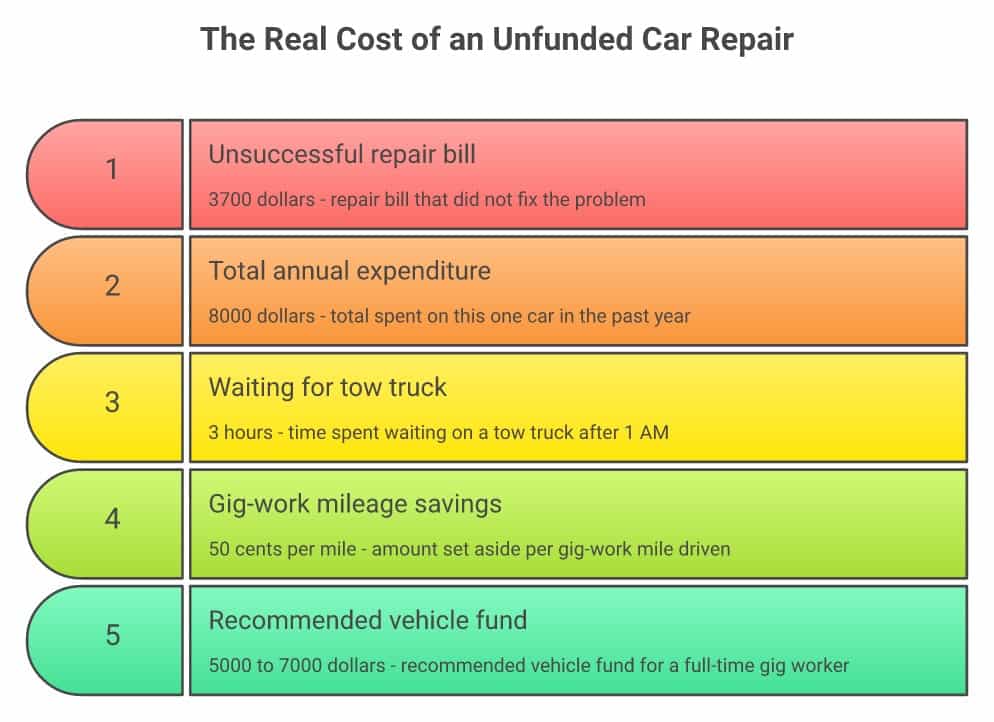
Repair bill that didn’t fix the problem
Total Damon has spent on this one car in the past year
Time spent waiting on a tow truck, past 1 a.m.
What Damon sets aside per gig-work mile driven
Figures are what happened to one driver, on one car, in one market — not a typical repair bill, an average, or a projection for your vehicle.
The Towing Company That Wouldn’t Tow Him Anywhere Useful
Damon carries roadside coverage through Good Sam, the RV-club plan that also covers his other vehicles — the kind of policy people buy specifically so a night like this one is handled. It didn’t work out that way. Because the breakdown happened after hours, the dispatcher told him the tow could only go to the nearest available mechanic, or simply drop the car at a “safe location” out of the roadway — which described the parking lot Damon’s son had already coasted into. Getting the car towed to the mechanic who’d already been working on it, and already had Damon’s $3,700, meant paying an extra $68 fee.
Damon paid it. The alternative was towing a car he’d already paid to have diagnosed to a mechanic who’d have to start over from scratch, or leaving it sitting in a parking lot indefinitely. Neither option would have gotten the car fixed faster or cheaper. That $68 is a small number by itself, but it’s a fair example of what a breakdown actually costs once you count everything around the repair bill — not just parts and labor, but the fees, the wasted evening, and the lost earning hours that come with it.
What roadside coverage doesn’t promise: A towing plan gets you a tow. It doesn’t promise you’ll get towed where you actually need to go, on your schedule, for no extra charge — especially after hours. If a breakdown happens on a work night, budget for the possibility that “covered” towing still costs you money and time you didn’t plan for.
The Rule Damon Won’t Let Anyone Talk Him Out Of
The reason Damon made this video at all — sitting in a parking lot at 1 a.m. instead of just posting the repair bill later — is the rule he’s repeated in nearly every gig-work video he’s made: set aside 50 cents for every mile you drive doing gig work. Gas, oil changes, tires, routine maintenance, repairs, and eventually replacing the car all come out of that fund, not out of whatever’s left in a checking account when something breaks. He’s pointed out before that a lot of drivers convince themselves their car “only costs” 20 or 25 cents a mile — and his answer is that the low number is usually a way of justifying rides that don’t actually pay enough to cover what the vehicle is really costing to run.
For a full-time gig worker, Damon’s benchmark is a vehicle fund holding at least $5,000 to $7,000 — enough to absorb a bill like this one without touching rent money or a credit card. The math is simple once you write it down: drive 1,000 miles in a week, and 50 cents a mile means $500 goes into the fund that week, whether or not anything breaks. When something does break, the money is already there.
Why 50 Cents a Mile Isn’t Arbitrary
The IRS’s own standard mileage rate is 76 cents a mile as of July 1, 2026 — a figure the IRS calculates from what gas, maintenance, tires, insurance, and depreciation actually cost to put a mile on a vehicle. Damon’s 50-cents-a-mile fund is a deliberately conservative slice of that same real cost, set aside specifically for the vehicle-repair and replacement side of the ledger. A driver banking less than that isn’t finding a cheaper way to own a car — they’re just deferring the bill to the night it breaks down, plus interest if it goes on a card.
This Is a Debt Story, Not Just a Car Story
Damon’s other work is helping people through Damon Day & Associates find their way out of debt, and it’s not a coincidence that a car-repair video ends up being the clearest debt lesson he’s posted in a while. A $3,700 bill that doesn’t fix the problem is exactly the kind of expense that pushes someone toward a credit card, a payday loan, or a “buy now, pay later” plan on car repair — options that turn one bad week into a year or more of payments. Damon’s point isn’t that breakdowns are avoidable. They aren’t. His point is that the choice of how you pay for one gets made months before it happens, in whether you built a fund for it or not.
That’s the same math I’ve spent decades explaining about debt in general: the emergency isn’t really the emergency. The emergency is not having planned for something that was always going to happen eventually. A car that’s driven for money will need repairs — that’s not bad luck, that’s ownership. The only real question is whether the money for that repair already exists somewhere, or whether it has to come from debt the moment the car dies.
- Treat vehicle costs as a bill you pay yourself, every week. Fifty cents a mile, transferred into a separate account before you spend the rest of what you earned, works the same way a mortgage escrow account works — the money is gone from your spending before you can miss it.
- A “cheap” cost-per-mile is usually a warning sign, not good news. If your own number is a lot lower than 50 cents a mile, ask honestly whether you’re actually banking that money or just not tracking it.
- Don’t let a working vehicle be your only plan for staying solvent. If your only car is also your only income source, one electrical gremlin can take out both at once. A vehicle fund and a small general emergency cushion do different jobs — you likely need both.
- A breakdown you funded in advance is an inconvenience. One you didn’t is a debt. Same car, same repair bill — the only difference is whether the $3,700 already existed or has to be borrowed at 1 a.m.
Making the Wait Pay: the $12 Ride
One small detail in the video is worth pulling out on its own. Once Damon realized the tow truck’s estimate kept sliding, he didn’t just sit in the parking lot — he picked up a short Lyft Black ride, about eight-tenths of a mile, and made $12 while he waited for an updated arrival window. It’s not a fix for an $8,000 repair year. It’s a reminder that gig work’s real advantage is flexibility, not the size of any single payout — you can turn dead time into a little bit of income precisely because there’s no shift schedule telling you not to.
Is Gig Work a Real Plan If You’re Behind on Bills?
I get some version of this question constantly: should someone drive or shop for these apps to catch up on debt? My honest answer is the same one I give about every option on this site — it depends on your specific numbers, and this video is a good example of why. Gig work can absolutely produce real, fast money when you need it. It can also quietly bleed money if the vehicle doing the earning isn’t funded to cover its own upkeep — in which case every dollar you make is partly borrowed against a repair bill you haven’t paid yet.
Before you count gig income as money you can spend, or as your plan for getting current on debt, run the same math Damon is running out loud in this video: what does the vehicle actually cost per mile, is that money set aside anywhere, and what happens the week it breaks. If the honest answer is “I’d have to put it on a card,” that’s not a plan — that’s a debt you’ve already taken on, you just haven’t been billed for it yet.
More From the Side Hustle Archive
Damon and I have been writing about the honest math of side hustles since The Penny Stupid Project started in 2022. A few from the archive that pair well with this video:
- Side Hustles for Debt: When They Help and Hurt — the honest boundaries of what a side income can and can’t fix
- Side Hustle Success: What It Means and What to Do — the mindset behind the math
- Quick Cash for Bills: Myth vs Reality — the honest version of “I need money fast”
- Side Hustle Income Fear: Myth vs Reality — what actually happens when the extra income doesn’t show up on schedule
- Damon Day Made $565 Driving New Year’s Eve — the most recent write-up before this one
Key Takeaway
Damon Day’s son was stranded at 1 a.m. after a $3,700 repair that didn’t fix the car’s electrical problem — on a vehicle that’s already cost about $8,000 in the past year. Damon’s rule, repeated for years on his channel: set aside 50 cents for every gig-work mile driven, in a fund built specifically to absorb repairs like this one. A full-time gig worker’s target is $5,000 to $7,000 sitting in that fund. The lesson isn’t about this Cadillac — it’s that a breakdown you’ve already funded is an inconvenience, and one you haven’t is a debt you just took on without meaning to.
This is what I’ve seen after more than 30 years of helping people with money and debt. This is one video, one car, one bad Friday night — take it as input for your thinking, not a directive. Only you know your own vehicle, your own numbers, and your own budget. Nobody gets to tell you what to do with your time or your money. Not me, not Damon, not anyone.
If you know a gig worker who’s one repair bill away from a real problem, send them this before the “it’ll never happen to me” math catches up with them. Watching Damon do the arithmetic out loud, at 1 a.m., in a parking lot, is worth more than any lecture about emergency funds.
Dealing With Debt? Understanding your options is the first step. See how all your debt relief options compare — including ones most sites won’t tell you about. The Find Your Path quiz gives a recommendation based on your actual numbers, and the Scam-O-Meter checks any company’s complaint history before you sign. Federal Reserve Bank of New York research shows bankruptcy filers recover faster than those who don’t file.
Free Tool — Contract Decoder: Have a contract from a debt relief company? The free Contract Decoder analyzes it for red flags, hidden fees, and problematic terms — before you sign anything. Decode My Contract →
Common Questions
Who is Damon Day, and why does Steve feature his videos?
Damon Day is a debt advisor I’ve worked with and mentored for years, and the debt advisor I recommend to readers most often, because he builds solutions around a person’s actual situation rather than a one-size-fits-all script. Read the full explanation in Why Do You Recommend Damon Day as a Debt Advisor? His own debt-advice site is damonday.com, listed first in the description of his Penny Stupid Project YouTube channel. Damon is my podcast co-host, and I receive no payment for this referral.
What is the Penny Stupid Project?
The Penny Stupid Project is a side-hustle testing effort Damon and I started together in 2022 at pennystupid.com. Damon has run with it since — it’s his work now rather than a joint operation, and I disclose that I helped start it every time I feature his videos so you know where I stand. Neither of us sells anything through it.
Was the Cadillac in the video Damon’s gig-work car?
No. Damon says directly in the video that this is not the car he currently uses for gig work — it’s now his 17-year-old son’s car, though it’s the same car Damon was driving when he first started doing Lyft. He uses the breakdown to make a point that applies to any vehicle, gig-work car or not: an unfunded repair bill is an unfunded repair bill regardless of whose name is on the title.
How much has Damon actually spent on this car?
He says the $3,700 repair — which didn’t fully fix the electrical problem — brought the total he’s spent on this one car over the past year to about $8,000, which includes an earlier $3,000 suspension repair. The car has around 119,000 to 120,000 miles on it.
Why did the tow truck charge an extra fee?
Because the breakdown happened after hours, Damon’s roadside plan would only tow the car to the nearest available mechanic or drop it at a safe location — not to the specific mechanic who already had his repair history and his money. Getting it towed to that mechanic cost an additional $68, which Damon paid rather than start the diagnosis over somewhere new.
What’s the “50 cents a mile” rule Damon keeps repeating?
It’s his standing advice for anyone driving for gig work: set aside 50 cents for every mile driven doing gig deliveries or rides, in a dedicated account used only for that vehicle’s gas, maintenance, repairs, and eventual replacement. For a full-time driver, he recommends keeping at least $5,000 to $7,000 built up in that fund so a repair bill like this one is a withdrawal, not an emergency.
What He Works Through On Camera
YouTube’s auto-generated captions garble names and numbers badly enough that I won’t put them in quotation marks and call them his words. So what follows is my paraphrase of the beats in the video, not a transcript. Watch it above for what he actually says.
Opening on the bill that didn’t work. Damon starts by naming the $3,700 the Cadillac just cost, fresh from the mechanic with a clean bill of health, and then immediately undercuts it — the car died again the same day, proving the repair hadn’t actually solved the problem.
The call from his son. He explains that his 17-year-old was driving the car downtown with friends when it died in traffic, and that the boy managed to coast it safely into a parking lot before calling his dad, who drove down with a truck to try to jump-start it.
The towing runaround. He walks through the roadside-assistance call step by step — being told an after-hours tow could only go to the nearest shop or a “safe location,” realizing that description already matched the parking lot he was sitting in, and being quoted an extra $68 to get the car to the mechanic he actually wanted.
The math he won’t let slide. He returns more than once to his standing rule — 50 cents a mile set aside for vehicle costs — and pushes back directly on the idea that a car “only” costs 20 or 25 cents a mile, framing that lower number as a way of excusing rides that don’t really pay enough.
The $8,000 total. He adds up what this specific car has cost him over the past year, including an earlier suspension repair, landing on roughly $8,000 — and contrasts that with the car’s relatively low, 119,000-to-120,000-mile odometer.
Using the dead time. While the tow kept sliding its own arrival estimate, he describes picking up a short rideshare fare near where he was parked rather than just waiting — turning a frustrating hour into a small bit of income.
The closing point. He ends by reframing the whole night: this wasn’t a disaster, it was an inconvenience, specifically because he already had the fund to cover it — and his advice to anyone driving for gig income is to build that same fund before their own version of this night happens.



