

Written by Steve Rhode, consumer debt expert since 1994 • Last updated September 8, 2026
Quick Answer: You paid a credit repair company and got nothing for it — and if they took that money before finishing the work, they broke federal law the moment they cashed your payment. The Credit Repair Organizations Act, 15 U.S.C. §1679b(b), bans charging you anything before the promised service is fully performed, full stop. Your fastest path to your money back is a credit card or bank dispute (usually a 60-day window); if that window has closed, CROA gives you at least 5 years to sue for every dollar you paid plus damages and attorney’s fees. Don’t ignore this — the window to act is real, and it’s closing.
Part of the Crisis Guide Series: This is one of Steve’s emergency triage guides. See all available Crisis Guides for step-by-step action plans for the worst financial moments.
What Just Happened to Your Money
You hired a company to fix your credit report. You paid — an “enrollment fee,” a “set-up fee,” a monthly charge that started before anything happened — and weeks or months later, your credit report looks the same, the disputed items are still there, or you can’t even get someone on the phone. That’s not how this is supposed to work, and it’s not a gray area.
If the disputes the company filed on your behalf came back rejected, that rejection is its own problem with its own fix — here is what to do when a credit dispute is rejected.
Since 1996, the Credit Repair Organizations Act has banned any credit repair company from taking your money before the service is fully performed — whatever the invoice calls the charge. If they took payment first and delivered nothing, that alone is a federal violation you can act on, separate from whether anything they promised was even possible in the first place.
The Mistake You’re About to Make: Don’t pay a second, “better” credit repair company to fix what the first one didn’t do. That’s the most common next move — and it just repeats the same illegal transaction with a different name on the invoice. Read your recovery options first. In most cases you don’t need to pay anyone anything else to fix this.
Your Options Right Now
What to Do in the Next 48 Hours
- Stop any further payments today. Contact your bank or card issuer directly and revoke authorization for recurring billing — don’t rely on a cancellation email or call to the company itself to actually stop it.
- Pull your file together. The contract, receipts, every email, and the specific items they said they’d dispute. Check whether they ever gave you the paperwork CROA requires before you pay: a written disclosure of your rights, a written contract stating services and total cost, and a 3-business-day right to cancel. Missing paperwork is a second violation, on top of the advance-fee one.
- Try the fast money-back route first — but the clock is short. If you paid by credit card, you can dispute the charge as a “billing error” for services never delivered under the Fair Credit Billing Act — but you generally must notify your card issuer within 60 days of the statement that listed the charge. Paid some other way? It depends on the rail, and the differences matter. On a debit card, what you have is your card network’s chargeback rules — Visa and Mastercard policy, granted at your bank’s discretion, not a statutory right. On a recurring bank debit (ACH) there is no chargeback at all, but you have something better and most people never use it: under 15 U.S.C. §1693e(a) you may stop payment on a preauthorized transfer by telling your bank — orally or in writing — “at any time up to three business days preceding the scheduled date of such transfer.” Do that first, today, before the next debit clears. And if the company keeps debiting you after you have revoked authorization, those later debits are unauthorized — which puts you back inside the Electronic Fund Transfer Act’s error-resolution process, provisional credit and all. What that process does not cover is the original payment you willingly made to a company that then did nothing; that is not an “error” under the law, however unfair it feels.
- If that window already closed, CROA itself gives you a much bigger one — at least 5 years. You can sue a credit repair organization directly for the greater of your actual damages or every dollar you paid it, plus punitive damages and attorney’s fees, within 5 years of the violation (15 U.S.C. §1679g; §1679i). Many advance fees are small enough — $99 to a few hundred dollars — that small claims court, no attorney required, is a realistic venue. For larger amounts, find a consumer attorney through NACA — CROA’s fee-shifting provision means many take these cases on contingency.
- Talk to Damon Day, an independent debt coach (not an attorney) and my co-host on the Get Out of Debt Guy podcast, for free — especially if the reason you hired a credit repair company in the first place is real debt you’re still carrying. I receive no payment for this referral. A cleaner-looking credit report doesn’t make the underlying balance disappear, and that’s a different problem worth solving on its own terms.
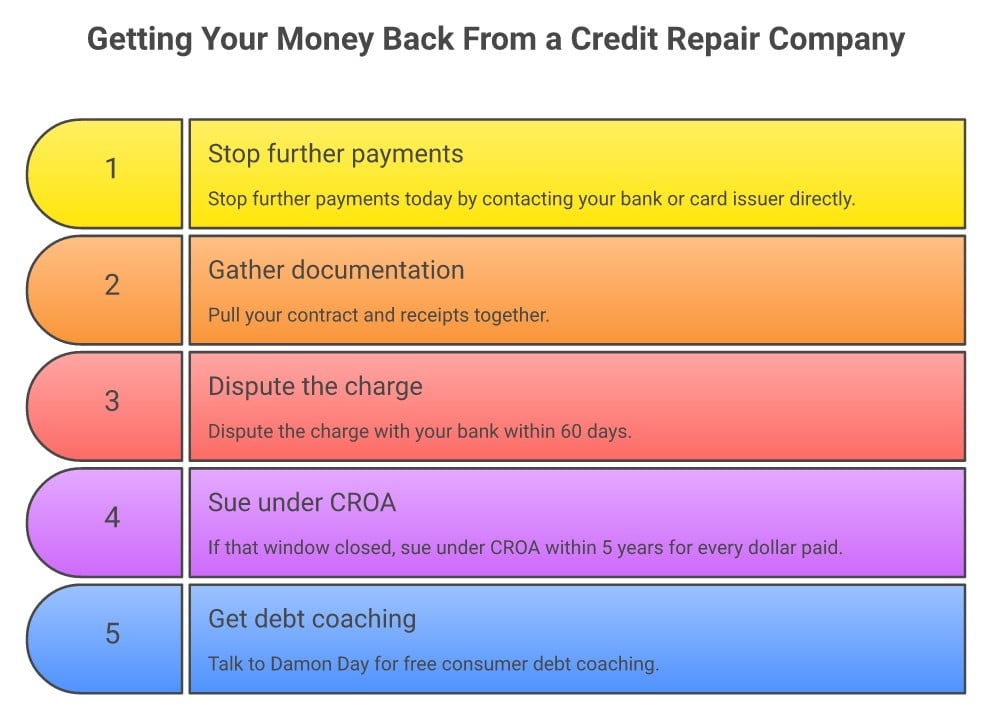
How to Actually Get Your Money Back — Your Four Paths
- Chargeback or bank dispute (fastest, if you’re still inside the window). On a credit card, a charge for a service you never received is a textbook “billing error,” and your issuer must investigate it. On a debit card it is not a statutory error — it is a network chargeback request, granted at your bank’s discretion. On a recurring ACH debit it is neither: your lever is the §1693e(a) stop-payment right above, and any debit taken after you revoke becomes an unauthorized transfer you can dispute. Put all of it in writing and keep the confirmation. This can put your money back in weeks, not months.
- CROA’s private right of action (your longest window — 5 years). Once the chargeback window closes, this is your main path. The company owes you the greater of your actual damages or every dollar you paid, and a court can add punitive damages and attorney’s fees on top. Small claims court is a real, low-cost option for smaller advance fees.
- File it with the regulators, even if you don’t expect a personal check. The FTC and CFPB build and size their enforcement cases from complaint volume — the CFPB’s $1.8 billion return to 4.3 million people harmed by two major credit repair companies started as individual complaints just like yours. If a redress fund is ever created for the company that took your money, having filed early is what puts you on the list.
- What WON’T work: paying another credit repair company to fix it, or trusting a “nonprofit” label as automatic proof of legitimacy. CROA exempts genuine 501(c)(3) nonprofits from its rules, but courts require the organization to actually operate as one — the label alone proves nothing, and general consumer-fraud law still applies to a fake charity.
What You Need to Know About Your Rights
Federal law is unambiguous here. 15 U.S.C. §1679b(b) bans any credit repair organization from charging or collecting money for a service before that service is fully performed — there’s no exception for a fee called “enrollment,” “administrative,” or “first month’s service.” If a phone call was involved in the sale, the FTC’s Telemarketing Sales Rule layers on an even stricter rule: the company can’t collect a fee until the promised results are proven with an actual, dated consumer report (16 CFR §310.4(a)(2)).
Some states go further than federal law. Here’s how California, one of the strictest, compares to the federal baseline:
| Jurisdiction | Rule | Notes |
|---|---|---|
| Federal baseline (CROA) | Advance fees banned nationwide | Applies regardless of state; 5-year private right of action |
| California | Same advance-fee ban, plus mandatory state registration and a $100,000 bond | Company must be registered with the CA DOJ before doing business; 5-business-day cancellation right; see the California AG’s credit services organizations page |
| Most other states | Many layer their own registration or bonding requirement on top of CROA | Check with your state attorney general for your state’s specific rule |
If you’re in California and the company that took your money was never registered with the state, that’s an independent violation you can report directly to the California Attorney General, on top of your federal CROA claim.
What no credit repair company — paid or free, legal or not — can ever legally do: remove accurate, current, verifiable negative information from your credit report. If that was the actual promise, it was a misrepresentation banned by CROA in its own right, separate from the advance-fee issue (15 U.S.C. §1679b(a)). And the dispute work most companies do — sending letters to the bureaus about inaccurate items — is something you can do yourself for free using your rights under the Fair Credit Reporting Act.
If the company is ignoring you or you believe you were scammed, file a complaint with the CFPB and at ReportFraud.ftc.gov, and report it to your state attorney general. If you need legal help but can’t afford an attorney, find free legal aid through LSC.gov.
Steve’s Take
I filed bankruptcy in 1990, so I know what it feels like to hand money to someone hoping they can fix a problem you can’t fix yourself — and then watch nothing change. What bothers me most about credit repair advance fees is who they target: people already anxious about qualifying for an apartment or a car loan, exactly the audience least likely to stop and ask “wait, is this legal?” before handing over a card number. Here’s the reframe: you didn’t fail by trusting a company that claimed to be able to help. You were sold something Congress made illegal thirty years ago. That’s on them, and the law gives you real ways to get your money back. Math beats shame every time — use the math.
Frequently Asked Questions
I already paid a credit repair company and nothing happened — can I get my money back?
Yes, in most cases. If a credit repair company charged you before fully performing the service, that itself violates 15 U.S.C. §1679b(b). Start with a credit card or bank dispute if you’re still within 60 days of the charge; after that, CROA lets you sue for every dollar you paid, plus damages, within 5 years.
Is it too late to dispute the charge with my credit card company?
The Fair Credit Billing Act generally requires you to notify your card issuer within 60 days of the statement that listed the charge (15 U.S.C. §1666). If that window has passed, the chargeback route is closed, but your CROA claim against the company directly is still open for at least 5 years.
Can I actually sue a credit repair company for taking my money?
Yes. CROA’s private right of action lets you recover the greater of your actual damages or the total amount you paid the company, plus possible punitive damages and your attorney’s fees, within 5 years of the violation (15 U.S.C. §1679g; §1679i). For smaller amounts, small claims court doesn’t require an attorney at all.
The company claims it’s a nonprofit — does that mean I have no rights?
No. CROA does exempt genuine 501(c)(3) nonprofits from its specific rules, but federal courts require an organization to actually operate as a nonprofit to claim that exemption — the label alone isn’t enough, and the burden is on the organization to prove it. General consumer-fraud law still applies regardless. Here’s how to check whether a “nonprofit” credit repair company is the real thing.
How do I know if a credit repair company is legitimate before I pay another one?
A legitimate company will never ask for money before doing the work — that alone screens out most bad actors. Beyond that, check the company name in the CFPB complaint database and run it through my Scam-O-Meter before you sign anything.
Free Tool — Contract Decoder: Have a contract from a debt relief company? The free Contract Decoder analyzes it for red flags, hidden fees, and problematic terms — before you sign anything. Decode My Contract →
Can they actually remove accurate negative items they promised to erase?
No, and this is worth knowing whether or not you ever get your money back. No one — paid or free — can legally remove accurate, current, verifiable negative information from your credit report. If a company promised to erase a real late payment or collection, that promise itself was a misrepresentation banned by CROA. Here’s what actually happens to a paid-off collection on your report.
I’m in California — do I have extra protection?
Yes. California requires credit services organizations to register with the state Department of Justice and post a $100,000 bond before doing business, on top of the federal advance-fee ban, and gives you a 5-business-day right to cancel. If the company that took your money wasn’t registered, report it directly to the California Attorney General.
One more thing — everything I share here is based on 30 years of helping people through exactly this. But my advice is input for your decision, not the decision itself. Only you know your full situation. Talk to an attorney, look at your numbers, and make the choice that serves your future.
Important: This guide is for informational purposes only and is not legal advice. Laws vary by state, and your situation may have details that change what options are available to you. For legal advice specific to your case, consult an attorney licensed in your state. NACBA can help you find a bankruptcy attorney, NACA can connect you with a consumer attorney, or talk to Damon Day for free about your situation.
Key Takeaway: If you paid a credit repair company before it did the work, federal law was already broken — and that gives you real leverage. Move fast on a chargeback if you’re inside 60 days; if not, CROA gives you 5 years to sue for every dollar back, plus damages. Check any company before you pay another one. The longer you wait, the harder your own paperwork is to reconstruct.
If the credit repair charge is one of several scam-related losses you’re sorting through right now, this recent $200 million FTC case walks through what a large-scale version of this looks like and how the agency builds a case from complaints like yours. And if disputing your own report is the next step, here’s what to do when your TransUnion or Experian dispute isn’t working.
The Bottom Line
Paying a company that took your money and delivered nothing doesn’t mean you were careless — you trusted a business model Congress made illegal specifically because it’s designed to look reasonable right up until it isn’t. The law gives you two real paths back to your money: a fast chargeback if you’re still in the window, and a 5-year window to sue directly if you’re not. Most of what a paid company would have done, you can also do yourself for free starting today. If someone you know just paid a credit repair company that’s gone quiet, send them this page — the clock on their fastest option is running whether they know it or not. Take the Find Your Path quiz if the debt underneath the credit score is the bigger problem to solve.
Dealing With Debt? Understanding your options is the first step. See how all your debt relief options compare — including ones most sites won’t tell you about. The Find Your Path quiz gives a recommendation based on your actual numbers, and the Scam-O-Meter checks any company’s complaint history before you sign. CFPB and academic research shows bankruptcy filers recover faster than those who don’t file.
Right now you are dealing with the thing in front of you, and that is exactly where your attention belongs. When it is handled — and it will be — there is a next stage, and it is the one I most enjoy writing about.
In the latest issue (Oct 16): The check that looks like a scam may be real
Each weekday I send one short email: one money story that caught my attention, why it might matter to you, and one manageable thing you can do with it. It is free, I sell nothing, and I take no money from any company I write about.



