

Quick Answer: The DentaQuest data breach exposed the Social Security numbers, Medicaid and Medicare numbers, and dental and vision treatment records of at least 15 million people after a May 2026 cyberattack — and the standard advice to “freeze your credit” does almost nothing to stop what this specific breach makes possible: someone using your benefits and your medical identity, not your credit file.
Expert Context: I’ve spent more than 30 years helping people fight debt that was never really theirs — and some of the ugliest fights I’ve watched aren’t credit card disputes, they’re medical billing disputes, because a medical bill in your name doesn’t ask permission before it shows up. It goes straight to a billing office, then to collections, without ever touching a credit application a freeze would have blocked. If you’ve also been served with debt-collection lawsuit papers recently, there’s a separate breach worth checking — see my ABC Legal Services settlement write-up.
DentaQuest, the dental and vision benefits administrator that manages coverage for roughly 32 million Americans, has confirmed a May 2026 cyberattack exposed the personal and health information of at least 15 million people — and the number could climb well past that before the investigation is finished.
Key Terms Defined
Medical identity theft: Someone uses your name, Social Security number, or member ID to obtain medical or dental care, prescriptions, or equipment — or to bill a health plan — in your identity. It creates real claims, real bills, and sometimes real collection accounts that have nothing to do with your credit applications.
Each weekday I send one short email: one money story that caught my attention, why it might matter to you, and one manageable thing you can do with it. A couple of minutes, and a dad joke.
In the latest issue (Oct 15): The ones who need the Social Security raise the most keep the least of it
Free. I sell nothing. Unsubscribe any time.
Explanation of Benefits (EOB): The statement your dental or health plan sends after it processes a claim. It is not a bill — it is the plan’s record of what was billed, in your name, and for what.
HIPAA right of access (45 CFR §164.524): Your legal right to get a copy of your own health records, including billing and claims records, from a covered entity like a dental plan.
Accounting of disclosures (45 CFR §164.528): A separate HIPAA right to a list of who a covered entity shared your health information with outside routine treatment, payment, and operations — useful, but it won’t by itself show you a fraudulent claim (see below).
What You Need to Know
DentaQuest, part of Sun Life U.S. Dental and the largest Medicaid and Children’s Health Insurance Program dental benefits administrator in the country, discovered unauthorized access to its network on May 20, 2026. A forensic investigation, run with Kroll’s help, determined the intrusion had actually started three days earlier, on May 17, and continued until it was found — a window the company disclosed in a notification letter sent to the California Attorney General, according to reporting from The HIPAA Journal.
What was exposed, by DentaQuest’s own account: names, addresses, Social Security numbers, member ID numbers, Medicaid numbers, and Medicare numbers, along with dental and vision health information — provider names, diagnoses, treatment details, and billing information. DentaQuest confirmed at least 15 million individuals were affected, and told The HIPAA Journal that number could still grow. An independent researcher who reviewed the leaked data told the same outlet the true total, based on unique first name, last name, and date of birth combinations, may run past 23.4 million.
The extortion group ShinyHunters claimed responsibility on June 5, 2026, and said it exfiltrated 234 GB of data after failing to reach a ransom agreement with DentaQuest. When negotiations broke down, the group posted the stolen data to its dark web leak site. Have I Been Pwned’s analysis of the leak found the email addresses of 2.6 million individuals, plus names, phone numbers, dates of birth, and — in one folder alone — more than 1.7 million Social Security numbers a researcher believes belong to children. DentaQuest began mailing notification letters on a rolling basis starting July 17, 2026, offering affected individuals 24 months of free credit monitoring and identity theft protection.
A class action was filed against DentaQuest Group Inc. and DentaQuest LLC on June 4, 2026, in the U.S. District Court for the District of Massachusetts (Whitlow v. DentaQuest Group Inc. et al., No. 1:26-cv-13868). These are allegations from a filed complaint, not findings of fact or liability — DentaQuest has not been found liable for anything by a court. Plaintiff Amanda Whitlow’s complaint alleges DentaQuest “failed to take reasonable security measures, such as training employees to identify phishing emails, employing biometric or multi-factor authentication requirements for authorized users, and monitoring for unusual activity,” and separately alleges the company was slow to notify people once the intrusion was discovered. The complaint brings claims for negligence, breach of implied contract, breach of fiduciary duty, unjust enrichment, and violation of the Illinois Personal Information Protection Act, according to coverage of the filing. None of that has been proven — it’s what one plaintiff’s lawyers argue in a document filed with the court.
The Daily Money Brief — Free, at 10 AM
Money you may be owed, scams to dodge, and the fine print decoded — the consumer money news that affects your wallet, every weekday.
Breaches of this size that involve health information get reported to the Department of Health and Human Services’ Office for Civil Rights, which maintains the public HIPAA breach reporting portal for exactly this kind of incident — any breach affecting 500 or more people has to be reported there. That’s the regulatory backdrop DentaQuest is operating inside, whatever the ultimate individual count turns out to be.
If you’ve ever had DentaQuest dental or vision coverage — through an employer, Medicaid, or Medicare — assume your information was in scope. DentaQuest hasn’t published a lookup tool, and the safest assumption for 32 million potential enrollees is that you can’t rule yourself out just because you haven’t received a letter yet. Notices are still going out on a rolling basis.
I covered a similarly large breach — Spectrum’s 2026 breach of names, addresses, and phone numbers — back in June, and the advice there was different on purpose: that breach didn’t include Social Security numbers or health data, so the real threat was phishing calls, not identity theft. This one is a different animal. DentaQuest’s breach is a full medical-identity data set — SSNs, government health program IDs, and clinical records — which is exactly the combination that makes medical identity theft possible, not just credit fraud.
Why You Need to Know It
The Claim: “I froze my credit at all three bureaus, so I’m covered.”
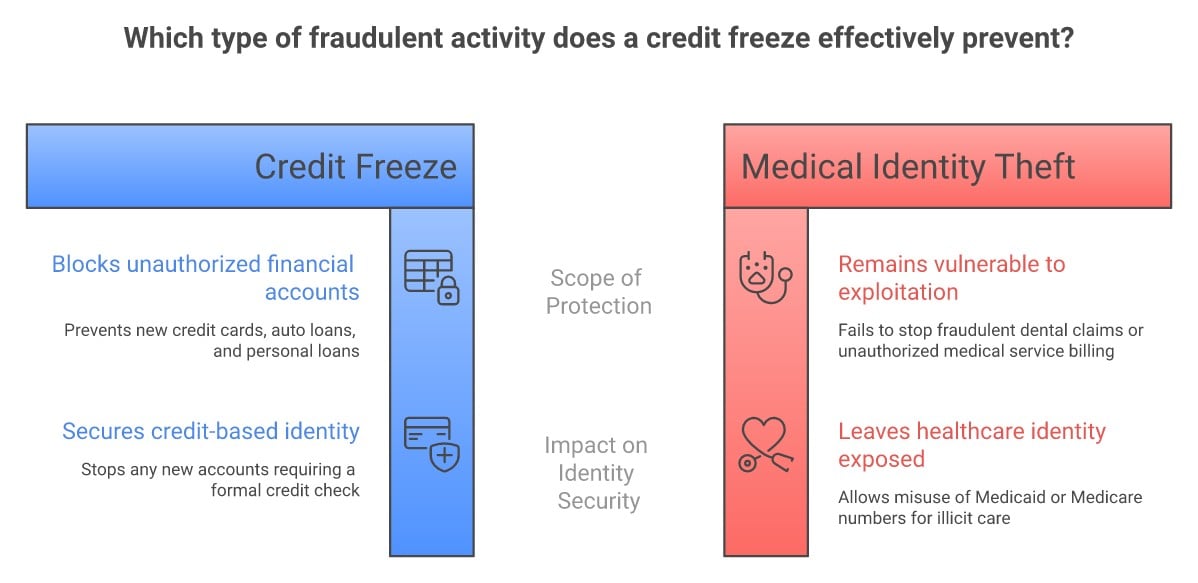
The Reality: A credit freeze is real protection and it’s free — do it. But it only stops someone from opening a new credit account in your name at a lender that checks your credit file. It does nothing to stop someone from using your Medicaid number, your Medicare number, or your dental plan member ID to get treatment, equipment, or prescriptions billed under your identity. Those claims don’t run through a credit check. They run through a health plan’s claims system — the exact system that just got breached.
This is the distinction I’ve watched trip people up for years, going back to running a credit counseling organization: people treat “identity theft” as one thing, and it isn’t. Financial identity theft opens a credit card in your name. Medical identity theft uses your coverage to get services, and the bill that results is a medical bill, generated by a provider’s billing office, sometimes long before it ever crosses paths with anything a credit bureau tracks. By the time it shows up — if it shows up — as a collection account, you’re not disputing a stranger’s purchase. You’re disputing whether you ever received dental care you have no memory of, from a provider you may never have heard of, months after the fact.
That’s the part nobody selling you a credit-monitoring subscription is built to catch. Credit monitoring watches your credit file. It doesn’t watch your claims history with a dental plan.
Things to Consider
Two things get conflated every time a health-data breach hits the news, and getting them backwards will send you down the wrong path.
The Claim: “Medical debt can’t hurt my credit anymore — the government banned it.”
The Reality: That’s not accurate, and the distinction matters here. The Consumer Financial Protection Bureau finalized a rule in January 2025 that would have barred medical debt from credit reports entirely. It never took effect the way it was written — a federal court in the Eastern District of Texas vacated the rule on July 11, 2025, in Cornerstone Credit Union League v. CFPB, finding the CFPB exceeded its statutory authority under the Fair Credit Reporting Act. There is no federal law today that bans medical debt from credit reports.
What is true, and is a completely different thing: Equifax, Experian, and TransUnion — voluntarily, as an industry policy decision, not because a law required it — stopped reporting paid medical collections (as of July 2022) and medical collection debt under $500 (as of April 2023). That voluntary policy could change. It is not a legal protection you can rely on if a fraudulent claim from this breach turns into a collection account above that dollar threshold. I’ve written before about how small medical debts still cause real credit damage in cases that fall outside the bureaus’ voluntary carve-out — don’t assume you’re protected by a rule that got struck down, or a policy the bureaus adopted on their own and could narrow again.
The second thing worth understanding before you write any letters: your HIPAA rights here are two separate tools, not one. Under the right of access (45 CFR §164.524), you can request a copy of your own designated record set from DentaQuest and your dental plan — that includes your claims and billing history, which is where a fraudulent charge would actually show up. Under the separate accounting of disclosures right (45 CFR §164.528), you can request a list of who your health information was shared with outside routine treatment, payment, and operations over the past six years. That second right is worth exercising, but be clear-eyed about what it can and can’t do: a fraudulent claim billed to your plan is, technically, a payment-related disclosure, which is excluded from the accounting-of-disclosures requirement. It’s your claims and treatment records — the right of access — that will actually surface an appointment or a service you never had.
“Identity theft occurs when a person steals another person’s name, address, Social Security number, or other identifying information in order to commit fraud.”
— Neil L. Sobol, Protecting Consumers from Zombie-Debt Collectors (2014)
Sobol’s paper on debt collection was written about credit debt, but the mechanism he describes is identical for medical debt: someone else’s fraud becomes a debt with your name attached to it, and that debt doesn’t announce itself as fraudulent. It looks, to a collector, exactly like a bill you didn’t pay.
What to Think About Doing
Do these roughly in this order. None of them require you to have already received a notification letter — if you’ve ever had DentaQuest coverage, start now.
- Freeze your credit at all three bureaus — it’s free and it’s real protection, just not for this specific risk. Here’s exactly how, and what a freeze does and doesn’t cover. It stops new credit accounts. It won’t stop fraudulent dental claims — that’s the whole point of this post.
- Request your designated record set and your claims history in writing, from DentaQuest and from your dental plan, citing your HIPAA right of access under 45 CFR §164.524. Ask specifically for a claims and treatment history covering at least the past two years. A covered entity has 30 days to respond, extendable once by another 30 days.
- Read every Explanation of Benefits you get for the next several months — and go back and pull recent ones you may have ignored. Look for any provider you don’t recognize, any service you don’t remember receiving, or any date you can’t account for. An EOB is not a bill, but it’s the paper trail that shows you what was billed in your name.
- If you find a claim you don’t recognize, dispute it in writing with both the provider and the plan immediately — before it reaches collections. Once a bad claim becomes a collection account, you’re arguing about a debt instead of correcting a records error, and that’s a much harder, slower fight. Speed matters here more than almost anywhere else in debt.
- Keep DentaQuest’s breach notice. If a fraudulent claim or a collection account does surface months from now, that letter is your documentation of how the fraud likely started — keep it somewhere you can find it later, not in a pile of mail you’re going to recycle.
- If a collector does contact you about a debt you don’t recognize, use your validation rights. Under the Fair Debt Collection Practices Act (15 U.S.C. §1692g), you can demand written proof of the debt before you pay anything or even acknowledge it’s yours, and collection has to stop until they provide it. I’ve laid out what collectors can and can’t do under the FDCPA here, and if the debt does turn out to be a straight identity-theft case rather than a records error, here’s the full identity-theft recovery path, including the FTC’s IdentityTheft.gov — the official federal site that builds you a personalized, step-by-step recovery plan once you report what happened.
Key Takeaways
- DentaQuest’s breach exposed Social Security numbers, Medicaid/Medicare numbers, and dental and vision treatment records for at least 15 million people — not just contact information.
- A credit freeze protects against new credit accounts. It does not protect against someone using your benefits or your medical identity to generate fraudulent dental or health claims.
- There is no federal law banning medical debt from credit reports — the CFPB’s rule was vacated in July 2025. What protects most small medical debts today is a voluntary bureau policy, not a law.
- Your HIPAA right of access (§164.524) — not the accounting-of-disclosures right (§164.528) — is the tool that actually surfaces a fraudulent claim in your name.
- Catching a fraudulent claim before it becomes a collection account is dramatically easier than fighting it afterward.
The Bottom Line
If you just got a letter from DentaQuest — or you’re realizing you might have coverage through them and haven’t heard anything yet — the fear response is to freeze everything and hope that’s enough. It isn’t, and that’s not your fault; nobody tells you that credit protection and medical-identity protection are two different jobs. The reframe is simple: this breach is about your health records and your government ID numbers, so the defense has to be about your health records and claims, not just your credit file. Pull your claims history. Read your EOBs. Move fast if something looks wrong, because a records dispute today beats a collection fight eighteen months from now. I’ve spent decades watching people win fights like this one when they moved early — you have real tools here, use them before someone else uses your identity first.
Frequently Asked Questions
Does freezing my credit protect me after the DentaQuest data breach?
Partially. A credit freeze — free at all three bureaus — stops someone from opening a new credit account in your name. It does not stop someone from using your Medicaid number, Medicare number, or dental plan member ID to receive care or generate a claim billed to your benefits. Since this breach exposed those health-plan identifiers along with Social Security numbers, freezing your credit is one necessary step, not a complete one.
Can medical debt from this breach still hurt my credit score?
Yes, potentially. The CFPB rule that would have banned medical debt from credit reports was vacated by a federal court in July 2025 and never took full effect. Separately, Equifax, Experian, and TransUnion voluntarily stopped reporting paid medical collections and medical collections under $500 — but that’s a bureau policy choice, not a law, and it doesn’t cover every situation.
How do I check whether someone used my DentaQuest benefits fraudulently?
Request your designated record set and claims/treatment history in writing from DentaQuest and your dental plan, using your HIPAA right of access under 45 CFR §164.524. Then read every Explanation of Benefits (EOB) you receive going forward, and pull recent ones you may have set aside, looking for providers or services you don’t recognize.
What’s the difference between the HIPAA right of access and the accounting of disclosures?
The right of access (45 CFR §164.524) gets you a copy of your own records, including billing and claims history — the tool that would actually show you a fraudulent claim. The accounting of disclosures (45 CFR §164.528) gets you a list of who your information was shared with outside routine treatment, payment, and operations, which is a narrower and different kind of record — it generally won’t surface a fraudulent claim, since claims processing is a payment-related disclosure excluded from that accounting.
Is the DentaQuest class action lawsuit proof that DentaQuest did something wrong?
No. A class action complaint contains allegations made by the plaintiff’s attorneys — in this case Amanda Whitlow, in a case filed in the U.S. District Court for the District of Massachusetts. Nothing in a complaint is a finding of fact or liability. DentaQuest has not been found liable for anything by a court as of this writing, and the case is ongoing.
This is what I’m seeing in this breach and what I’d tell my own family to do about it — but you know your own coverage, your own risk tolerance, and your own situation better than I do. Take this as input, not instruction. Only you can decide what makes sense for you.
If someone in your life gets a letter from DentaQuest — or has dental coverage through Medicaid and might not even know they’re affected — send them this. The “just freeze your credit” advice going around right now is incomplete, and knowing that early is the difference between catching a problem in a phone call and fighting it in collections.
Dealing With Debt? Understanding your options is the first step. See how all your debt relief options compare — including ones most sites won’t tell you about. The Find Your Path quiz gives a recommendation based on your actual numbers, and the Scam-O-Meter checks any company’s complaint history before you sign. Federal Reserve Bank of New York research shows bankruptcy filers recover faster than those who don’t file.



