

Quick Answer: A new D.C. law will require hospitals there to affirmatively screen patients for financial assistance instead of waiting to be asked — but its operative rules don’t kick in until six months after D.C. funds it, so even in D.C. you still have to ask today. Outside the handful of states with their own charity-care screening laws, no one has to screen you — but federal tax law (26 U.S.C. §501(r) and the IRS regulations under it) already requires every tax-exempt (501(c)(3)) hospital in America to have a written financial assistance policy, publicize it, cap what an eligible patient can be charged, and hold off on aggressive collections while you apply. Most patients are never told any of this. This post gives you the exact words to say, who to say them to, and the deadlines that protect you — including if the bill is already in collections.
Expert Context: I ran a credit counseling organization from the inside for over a decade, and one thing I saw again and again: people paying medical bills in full, on payment plans, sometimes with a credit card at 22% interest, who had no idea they legally qualified for free or discounted care. Nobody at the hospital ever raised their hand and said “you might not owe this.” The financial assistance policy existed. Nobody told them.
Washington, D.C. just decided that’s not good enough anymore — and passed a law forcing hospitals to actually screen patients instead of hoping they never ask. That’s newsworthy. But the bigger story is what’s already true, right now, in every other state: federal law already requires nonprofit hospitals to have a financial assistance policy, tell you about it, and cap your bill if you qualify. You just have to know to ask. One more federal clock worth knowing about if you were uninsured or self-pay: the $400 and 120-day dispute window.
Key Terms Defined
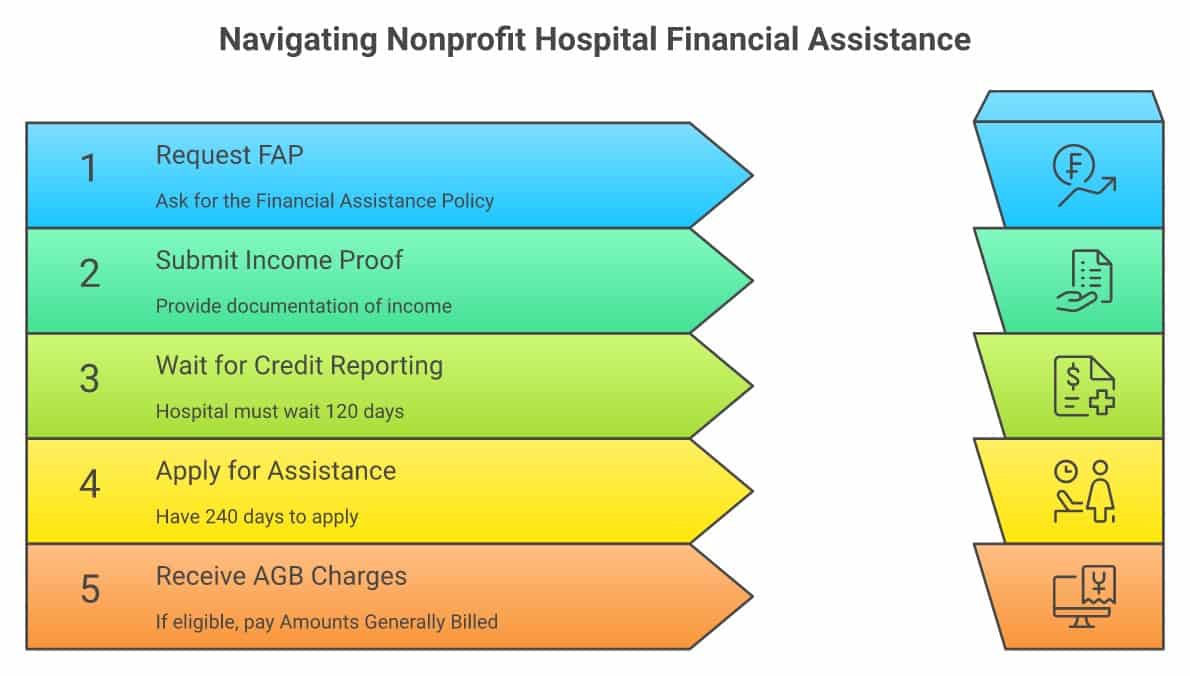
Financial Assistance Policy (FAP): A hospital’s written policy — required by 26 U.S.C. §501(r)(4) for every tax-exempt hospital — that spells out who qualifies for free or discounted care, how amounts are calculated, and how to apply.
Each weekday I send one short email: one money story that caught my attention, why it might matter to you, and one manageable thing you can do with it. A couple of minutes, and a dad joke.
In the latest issue (Oct 15): The ones who need the Social Security raise the most keep the least of it
Free. I sell nothing. Unsubscribe any time.
Amounts Generally Billed (AGB): The most a hospital can charge a FAP-eligible patient for emergency or medically necessary care — capped at what insured patients are generally charged, not the hospital’s inflated “gross charges.” Defined in 26 CFR 1.501(r)-5.
Extraordinary Collection Action (ECA): The aggressive stuff — credit bureau reporting, lawsuits, wage garnishment, liens, selling your debt. Federal regulation bars a nonprofit hospital from using these until it has made “reasonable efforts” to find out if you qualify for financial assistance. Full list in 26 CFR 1.501(r)-6(b).
Application Period: The window during which the hospital must accept and process your financial assistance application — by regulation, at least 240 days after your first post-discharge bill, sometimes longer. Defined in 26 CFR 1.501(r)-1(b)(3).
Free Tool — Wage Garnishment Calculator: Worried about your paycheck being seized? The free Wage Garnishment Calculator shows exactly how much creditors can legally take in your state — and some states prohibit garnishment entirely. Calculate My Risk →
Here’s What You Need to Know: What D.C. Just Did
On August 20, 2026, the District of Columbia’s Medical Debt Mitigation Amendment Act of 2026 (B26-0438) was enacted without the Mayor’s signature after the D.C. Council passed it unanimously (D.C. legislation also passes through a congressional review period before it is final). Among its provisions — reported by Orrick’s InfoBytes — D.C. health care facilities will have to establish financial assistance policies and affirmatively screen patients for eligibility, with payment plans for eligible patients capped at 3% of monthly household income. The law also bans reporting medical debt to credit bureaus, caps interest on medical debt at 3% annually, bars liens on a patient’s primary residence, restricts wage garnishment for anyone under 500% of the federal poverty level, and requires 90 days’ notice before any collection activity begins — with collection itself barred for 180 days after the first bill. It also restricts hospitals from helping patients apply for medical lending products like deferred-interest medical credit cards or requiring upfront payment before emergency care — a practice I’ve written about before when it comes to hospitals demanding payment before treatment.
One honest note before you get too excited if you live outside D.C.: the operative requirements of D.C.’s law don’t kick in immediately. Per Orrick and the Consumer Financial Services Law Monitor, the substantive compliance obligations apply six months after D.C. includes the law’s fiscal effect in an approved budget and financial plan — which pushes practical compliance into 2027. It’s law, but it isn’t fully live yet. I want to be straight with you about that rather than oversell a headline.
What D.C.’s law adds that federal law doesn’t: an affirmative screening requirement. Federal law requires hospitals to have a policy and publicize it — D.C.’s law requires the hospital to actually check whether you qualify, rather than waiting for you to find the fine print. That’s the real innovation, and it’s worth watching whether other states copy it.
Here’s Why You Need to Know It: The Federal Rule Already Covers Most of the Country
Here’s the part almost nobody covers: you don’t need D.C.’s law to have this protection. If your hospital is a nonprofit — and per the American Hospital Association’s 2026 Fast Facts, about 58% of U.S. community hospitals are (2,984 of 5,121) — it has been legally required since the Affordable Care Act added §501(r) in 2010 (with the IRS’s final rules binding for tax years beginning after 2015) to have a written financial assistance policy under 26 U.S.C. §501(r) and the Treasury regulations implementing it. This isn’t a proposal or a state pilot program. It’s a condition of the hospital keeping its tax-exempt status, enforced by the IRS, and it has applied nationwide for over a decade. The IRS’s own guidance confirms that a hospital organization failing to meet these requirements risks losing its 501(c)(3) exemption facility-by-facility.
The Daily Money Brief — Free, at 10 AM
Money you may be owed, scams to dodge, and the fine print decoded — the consumer money news that affects your wallet, every weekday.
I’ve spent 30 years helping people who found out about a legal protection only after the damage was done — after the collection call, after the credit hit, after they’d already sold something or borrowed against a 401(k) to make a hospital bill go away. This is exactly that kind of protection: real, federal, enforceable — and almost invisible to the people it’s supposed to help, because it lives in a “financial assistance policy” document most patients never see and a billing statement most people don’t read past the amount owed.
Here’s Exactly What the Law Requires — and What It Doesn’t
Under 26 CFR 1.501(r)-4, a nonprofit hospital’s written FAP must state who’s eligible, how amounts are calculated, how to apply, and what happens if you don’t pay — and the hospital must “widely publicize” it: on its website, in paper form on request, in the emergency room and admissions areas, and as a plain-language summary offered at intake or discharge and printed on every billing statement.
Under 26 CFR 1.501(r)-5, if you’re FAP-eligible, the hospital can’t charge you more than “Amounts Generally Billed” (AGB) — roughly what insured patients are actually charged after discounts, not the sticker “gross charge” on the bill. And under 26 CFR 1.501(r)-6, the hospital cannot report you to credit bureaus, sue you, put a lien on your property, or garnish your wages — the “extraordinary collection actions” — until it has made “reasonable efforts” to find out if you qualify for assistance. Reasonable efforts means, at minimum, notifying you about the FAP and waiting at least 120 days after your first post-discharge bill before starting any of that.
The Claim: “Financial assistance is only for people with zero income, and the hospital will tell me if I qualify.”
The Reality: Every hospital sets its own income cutoffs — some FAPs cover households well above the federal poverty level, and many offer partial discounts up to several multiples of it. And under federal law, the hospital has to publicize the policy, but nothing requires it to sit down with you and check your eligibility unless a state or local law adds that requirement (as D.C.’s will once it takes effect, and as a handful of states already do). Everywhere else, the burden is on you to ask — which is the entire reason this post exists.
Here’s What to Do — the Exact Script
You don’t need a lawyer to start this. Here’s what to say and who to say it to:
- Who to ask: The hospital’s billing or patient financial services department (sometimes called “financial counseling”). If you’re still receiving care, ask admissions or the ER registration desk — federal regulation requires FAP information to be available there, at a minimum.
- What to say: “I’d like to apply for financial assistance under your hospital’s charity care policy. Can you send me a copy of your financial assistance policy, the plain-language summary, and the application form?” That single sentence invokes the standard §501(r) holds the hospital to — you don’t need to cite the statute, but you can if you want to be taken seriously fast. Then ask one more question: “Which providers who treated me are covered by your policy, and which are not?” The FAP has to list them by name (Treas. Reg. §1.501(r)-4(b)(1)(iii)(F)), and the ER physician group, anesthesiologist and radiologist usually bill separately and usually are not covered — each of those needs its own assistance request.
- What the hospital must give you: The full FAP, a plain-language summary, and the application form — free of charge, in person, by mail, or on its website, and translated if a significant share of the community speaks another language.
- What to submit: Most applications ask for household income documentation (pay stubs or a tax return) or proof you’re enrolled in a means-tested program like Medicaid or SNAP, which can qualify you automatically in many hospitals’ policies.
- The clock that protects you: Once you submit a FAP application, the hospital must suspend “extraordinary collection actions” — credit reporting, lawsuits, liens, wage garnishment, selling the debt — while it’s pending (ordinary bills and phone calls can continue), under 1.501(r)-6(c)(8).
If you’re worried about a debt collector pressuring you while you sort this out, use my free Debt Validation Letter Generator to make any third-party collector prove what’s actually owed before you pay anything.
Free Tool — Debt Validation Letter Generator: Being contacted by a debt collector? The free Debt Validation Letter Generator creates a personalized FDCPA validation letter in seconds — forcing the collector to prove the debt is real before they can continue. Generate My Letter →
If You Already Paid, or It’s Already in Collections
This is the part most people don’t know, and it’s the one that can actually get money back. Federal regulation requires the “application period” — the window during which the hospital must accept a financial assistance application and treat it as timely — to run for at least 240 days after your first post-discharge billing statement, per 26 CFR 1.501(r)-1(b)(3). That’s not a suggestion — it’s the regulatory floor, and some hospitals set it longer.
That means if a bill from a nonprofit hospital is sitting with a collector, or you already made payments on it, you may still be able to apply. And under 1.501(r)-5(d) and -6(c)(6), if you’re later determined FAP-eligible, the hospital is required to refund anything you paid above what a FAP-eligible patient should have owed (unless the amount is under $5). If the hospital sold or referred the debt, the same regulations require its written agreement with the buyer or agency to make sure you never pay more than a FAP-eligible patient owes — but in practice you will have to ask for that money back, so don’t wait on it. If you’ve already been reported to a credit bureau and are later found FAP-eligible, the same regulation contemplates the hospital contacting the bureaus to correct it.
Don’t wait past the window. The 240-day floor is generous, but it’s not unlimited, and while some FAPs give you longer than 240 days, none may give you less. If you’re already in collections, ask the collector or the hospital directly: “What is the deadline to submit a financial assistance application for this account?” Get the answer in writing.
If the Hospital Stonewalls You
One honest limit: §501(r) is a condition of the hospital’s federal tax exemption, enforced by the IRS — it does not give you the right to sue the hospital yourself. So if you’re refused, escalate in this order: (1) file IRS Form 13909, the tax-exempt organization complaint, naming the facility and the financial assistance requirement it ignored; (2) complain to your state attorney general or hospital licensing agency — several states have their own charity-care laws that you can enforce; (3) write to the hospital’s community benefit officer or board, because the charity care it reports on IRS Form 990 Schedule H is public and they know it. Looking up that Schedule H before you call — it shows the income thresholds the FAP uses and how much charity care the hospital wrote off last year — turns “do you have charity care?” into “your own filing says I qualify.”
How to Check Whether Your Hospital Is Nonprofit
Not every hospital is covered — §501(r) applies only to tax-exempt (nonprofit) hospital organizations, not for-profit hospital chains, government-run hospitals that aren’t separately recognized as 501(c)(3) (some are, so check the IRS tool before you assume), or most physician practices billing separately. To check, search your hospital’s exact legal name in the IRS’s own Tax Exempt Organization Search. If it shows up as a 501(c)(3), the §501(r) requirements apply to it. If it’s for-profit, federal law doesn’t require a FAP — but check whether your state has its own charity care law; several states (including the ones I’ve covered on this site’s Medical Debt Complete Guide) impose separate requirements that cover for-profit facilities too.
Here Are Some Things to Consider
- Credit bureau reporting is already less of a threat than it was. The CFPB’s federal rule banning medical debt on credit reports was vacated by a federal court on July 11, 2025, so there’s no active federal ban — though a growing list of states, Colorado, New York and California among them, have passed their own bans on medical debt in credit reports, so check your state’s law. But separately, Equifax, Experian and TransUnion voluntarily agreed to stop reporting paid medical collections (as of July 2022) and medical collections under $500 (as of April 2023), and to wait a full year — not six months — before reporting an unpaid medical collection at all. That’s not law, and it can change, but it’s the practical landscape right now.
- D.C.’s law is ahead of the curve, but not fully in effect yet — and not every state is moving the same direction. Watch for other states or cities copying the affirmative-screening idea; it’s the single biggest gap in how this protection actually reaches people. It also isn’t a one-way street — I’ve covered Oregon hospitals pushing to weaken charity care screening requirements that were already working, so this protection can erode as easily as it can expand.
- “Reasonable efforts” is a low bar for the hospital. Sending a billing statement with a small-print notice about financial assistance can satisfy federal law even if you never actually see or understand it. The protection is real, but it puts real weight on you noticing and asking — which is exactly why D.C.’s affirmative-screening approach matters.
- This doesn’t erase debt you don’t qualify for. If your income is well above the hospital’s FAP thresholds, this process caps what you’re charged at AGB rather than gross charges — it doesn’t mean the bill disappears.
Here Are Some Things You Might Want to Think About Doing
- Pull every hospital bill you have from the last 240 days and check the billing statement for a financial assistance notice — it’s required to be there.
- Call billing and ask for the FAP, the plain-language summary, and the application form, even if you think you make “too much” — many hospitals’ thresholds are higher than people assume.
- If a bill from a nonprofit hospital already went to collections, ask about the application deadline in writing before you pay anything or agree to a payment plan.
- Check your hospital’s nonprofit status in the IRS Tax Exempt Organization Search so you know which rules apply.
- If the math on medical debt is part of a bigger debt picture, use my Get Out of Debt Calculator to see how it fits with everything else you owe, or take the 2-minute bankruptcy quiz if it feels bigger than one hospital bill.
Key Takeaways
- D.C.’s new law will require hospitals there to affirmatively screen patients for financial assistance once it takes effect (likely 2027) — until then, and in most of the country, you still have to ask.
- Federal tax law (§501(r)) already requires every tax-exempt 501(c)(3) hospital in America — about 58% of community hospitals — to have a financial assistance policy, cap what eligible patients are charged, and hold off on aggressive collection while you apply.
- You have at least 120 days before a nonprofit hospital can start credit reporting, lawsuits, liens, or garnishment, and at least 240 days to apply for assistance — even retroactively, even after paying or being sent to collections.
- For-profit hospitals aren’t covered by §501(r) — check your state’s own charity care law instead.
The Bottom Line
If you’re staring at a hospital bill you can’t pay, or you already paid one you probably shouldn’t have had to, you’re not stuck and you’re not the only one this has happened to — it happens because the system is built to make you ask, and most people never know there’s anything to ask for. The reframe is simple: this isn’t charity you have to beg for, it’s a condition of the hospital’s tax exemption written into federal tax law, and the hospital is required to have told you about it whether it made that easy to notice or not. I’ve spent 30 years watching people find real relief the moment they finally asked the right question of the right department — and this is one of the clearest, most concrete rights I’ve come across in a long time. Ask. In writing. Today, if you can. It costs you nothing to find out what you actually owe.
Frequently Asked Questions
Does D.C.’s new medical debt law apply to me if I don’t live in Washington, D.C.?
No — the Medical Debt Mitigation Amendment Act of 2026 applies only to health care facilities in the District of Columbia, and even there its operative requirements don’t fully take effect until D.C. includes the law’s fiscal impact in an approved budget, which pushes practical compliance into 2027. But federal tax law under 26 U.S.C. §501(r) already applies nationwide to every nonprofit hospital, requiring a financial assistance policy regardless of what state you’re in.
How do I find out if my hospital is required to offer financial assistance?
Search your hospital’s exact legal name in the IRS’s Tax Exempt Organization Search. If it’s listed as a 501(c)(3), federal law requires it to have a written financial assistance policy. For-profit hospitals aren’t covered by this federal rule, though some states impose their own charity care requirements.
Can a nonprofit hospital report my bill to credit bureaus or sue me right away?
No — though it can keep billing you, call you, and even hand the account to a collection agency in the meantime; those are ordinary collection, not restricted. Under 26 CFR 1.501(r)-6, a nonprofit hospital cannot take “extraordinary collection actions” — credit reporting, lawsuits, liens, wage garnishment, or selling your debt — until it has made reasonable efforts to determine whether you’re eligible for financial assistance, which requires waiting at least 120 days after your first post-discharge bill and notifying you about the policy.
I already paid my hospital bill in full — can I still apply for financial assistance and get money back?
Possibly. Federal regulation requires hospitals to keep the financial assistance application period open for at least 240 days after your first post-discharge bill, and if you’re later determined eligible, the hospital must refund any amount you paid above what a financial-assistance-eligible patient should have owed (with a small-dollar exception under $5).
Is medical debt still hurting my credit score?
A federal rule that would have banned medical debt from credit reports nationwide was vacated by a court in July 2025, so there’s no active federal ban. But separately, the three major credit bureaus voluntarily stopped reporting paid medical collections and medical debts under $500, and now wait a full year — instead of six months — before reporting an unpaid medical collection at all. Check your credit reports directly to see what’s currently showing.
One last thing, and I say this every time because I mean it every time: this is what I’m seeing and what I’d tell my own family if they called me about a hospital bill tonight. Only you know your actual situation — your income, your state, the specific hospital you’re dealing with — so take this as input, not instruction. Don’t let anyone, including me, tell you what to do with your money. Ask the questions, get the answers in writing, and then decide what’s right for you.
If this helped you make sense of a hospital bill sitting on your kitchen table, send it to someone who’s staring at one of their own. A lot of people are quietly drowning in medical bills they never knew they could fight — sometimes just knowing there’s a real, legal path forward is the thing that changes everything.
Dealing With Debt? Understanding your options is the first step. See how all your debt relief options compare — including ones most sites won’t tell you about. The Find Your Path quiz gives a recommendation based on your actual numbers, and the Scam-O-Meter checks any company’s complaint history before you sign. Federal Reserve Bank of New York research shows bankruptcy filers recover faster than those who don’t file.



