

Fact-checked by Steve Rhode, consumer debt expert since 1994 • Last reviewed September 10, 2026 • Key claims below link to a primary source.
The verdict: Myth. Before your bank or credit union can charge you an overdraft fee on an ATM withdrawal or a one-time debit card purchase, federal law requires it to give you a separate written or electronic notice, provide a real chance to say yes, and obtain your affirmative consent — which can be given in writing, electronically, or by phone, then confirmed to you in writing or electronically. If it never got that yes, that fee shouldn’t have been charged, and you have real grounds to ask for it back. 12 CFR § 1005.17(b) (Regulation E) confirms it.
Well, Actually…
I hear a version of this resignation constantly: “the bank can charge whatever they want, there’s nothing you can do.” It isn’t true, and it hasn’t been true since 2010. A federal rule called Regulation E — specifically 12 CFR § 1005.17 — says your bank cannot assess an overdraft fee on an ATM withdrawal or a one-time debit card purchase unless it first gave you a standalone written or electronic notice, gave you a real chance to say yes, actually got your affirmative consent, and then sent you written or electronic confirmation of that consent that told you about your right to revoke it. If you opened your account before July 1, 2010 and never opted in, the bank has been barred from charging you those specific fees since August 15, 2010. If you opened your account on or after July 1, 2010, the bank had to get your opt-in before it ever charged you the first one.
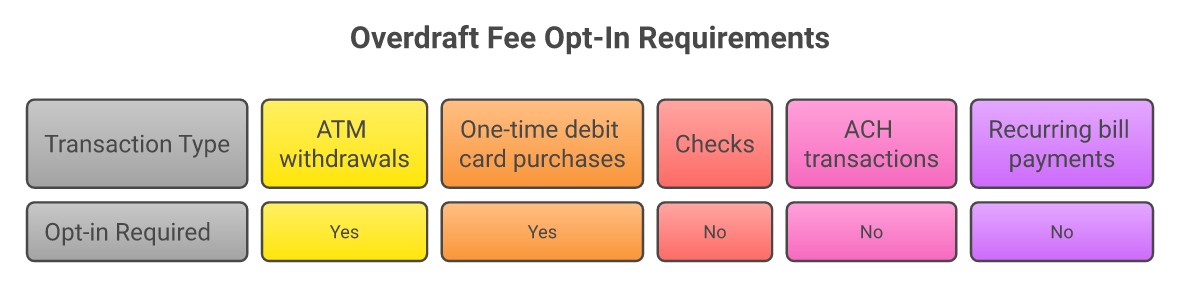
Here’s the part that matters most, and it’s the part almost nobody explains right: the opt-in requirement covers only ATM withdrawals and one-time debit card purchases — your bank can still pay overdrafts on checks, ACH transactions, and automatic/recurring bill payments and charge you a fee for it with no opt-in at all, because the fee ban in § 1005.17(b)(1) is written to reach only “an ATM or one-time debit card transaction” — checks, ACH, and recurring payments were simply never inside it. There’s a related, separate protection worth knowing: § 1005.17(b)(2) forbids your bank from bouncing your checks or ACH payments as punishment for your declining to opt in, and the regulators’ Official Interpretations to that section say it must apply the same pay-or-return criteria to those transactions either way. So the myth, stated exactly as most people believe it — “if my debit card purchase overdraws my account, the bank can just charge me” — is false. But “the bank can never charge me an overdraft fee without asking” is also false. The truth sits precisely in between, and knowing which side of that line your fee fell on is what determines whether you have a real claim. One more wrinkle: even on a debit-card overdraft where no fee is allowed, a sustained or daily overdraft fee can still apply days later if your negative balance is attributable, even partly, to a check or ACH item that posted on top of it — the fee ban follows the transaction type, not the account balance as a whole. The flip side matters too: if your negative balance is attributable solely to an ATM or one-time debit card transaction and you never opted in, that sustained or daily fee is barred right along with the original overdraft fee.
If your debit card purchase overdraws your account, the bank is allowed to charge you a fee, period.
For a one-time debit card purchase or an ATM withdrawal, your bank may not assess an overdraft fee — at all — unless it gave you a segregated written or electronic notice, gave you a real opportunity to opt in, and obtained your affirmative consent to the overdraft service for that specific type of transaction. No opt-in on file means no fee is allowed on those two transaction types, and a fee charged anyway is likely a violation worth challenging — start by asking the bank to produce its record of your opt-in.
12 CFR § 1005.17(b)(1), eCFR (current as of September 8, 2026)
Okay, so if I never opted in, my bank can never charge me an overdraft fee for anything.
The opt-in protection is narrow by design. It covers only ATM withdrawals and one-time debit card purchases, because that’s the exact scope written into the fee ban itself. Your bank is free to pay a check, an ACH debit (think auto-pay for a utility or a loan), or a recurring bill payment that overdraws your account — and charge you the standard overdraft fee for doing it — without ever asking your permission, because those transaction types simply aren’t covered by the rule. A recurring debit card payment (a subscription, for example) is processed the same way as those other transactions for this purpose, not as a “one-time” debit swipe, so it also falls outside the opt-in protection. If most of your overdraft fees come from autopay or checks, this rule doesn’t reach them — though your bank does have to apply the same pay-or-return decision to those either way, whether or not you opted in on your debit card.
12 CFR § 1005.17(b)(1), eCFR (current as of September 8, 2026)
Why You Were Told This
Overdraft and NSF fees are a massive, largely automatic revenue stream for banks, and for years many institutions designed their account-opening paperwork so that opting in to overdraft coverage felt like the default, safe choice — something you’d want, not something separate from your account you were agreeing to pay extra for. That’s not just my read: federal regulators say plainly, in the Official Interpretations to Regulation E (12 CFR Part 1005, Supplement I), that a preprinted acknowledgment on an account-opening signature card, or a pre-checked box on that card, does NOT count as your affirmative consent — a bank has to get a real, separate yes-or-no from you, not bury it in paperwork you had to sign anyway. The Federal Reserve wrote the opt-in requirement into Regulation E specifically because, before 2010, banks could and did charge these fees with no consent at all; the rule exists because the old default was exactly the myth this post is correcting. I’ve also seen a lot of confusion lately because of a DIFFERENT, more recent fight over overdraft fees: in December 2024 the CFPB finalized a rule capping overdraft fees at very large banks, and in spring 2025 Congress voted to kill that rule under the Congressional Review Act — it was signed into law on May 9, 2025, so it never took effect. That repeal is real, but it has nothing to do with the opt-in requirement in this post — § 1005.17 is a separate, older rule (2009–2010) that Congress did not touch, and it is still fully in force today.
I’ve also written about specific banks that settled over specific overdraft practices — two credit unions’ $1.2 million overdraft/NSF settlement and the Country Bank overdraft settlement. Those posts are about lawsuits against particular institutions for particular re-presentment and authorize-positive-settle-negative practices. This post is different: it’s the underlying opt-in right that applies at every bank and credit union in the country on a personal checking or savings account, whether or not that institution has ever been sued. (Business accounts aren’t covered by Regulation E at all.)
What to Actually Do
- Find out whether you actually opted in. Log into your online banking or call your bank and ask directly: “Did I opt in to overdraft coverage for ATM and one-time debit card transactions, and can you show me the proof?” The CFPB has said a bank can be in violation if it can’t produce real proof — a form you signed, a recording of the call, or a secure electronic signature, not just “our records show you opted in.” Banks only have to keep that proof for two years, though, so a very old opt-in may no longer be documented either way.
- If you never opted in and were charged anyway, dispute it in writing. Tell the bank the charge violates 12 CFR § 1005.17(b) and ask for a refund of every ATM or one-time debit card overdraft fee charged without your consent. Keep a copy of what you send. Federal law (15 U.S.C. § 1693m(e)) lets a bank avoid liability for a violation if, before you ever file suit, it notifies you of the failure, fixes it, adjusts your account, and pays your actual damages — which is good news if all you want back is the fee itself, and worth knowing if you’re sitting on a long run of fees, because a bank’s refund-and-cure can also close off any claim for statutory damages or attorney’s fees. If the amount is large or goes back years, talk to a consumer attorney about the order of operations before you write.
- If the bank won’t fix it, file a complaint with the CFPB. Use the CFPB complaint portal — complaints against your specific bank get forwarded directly to it, which generally has 15 days to respond, and the complaint is logged in the CFPB’s public complaint database. If you’d rather have a backup path, or your account is at a credit union, the NCUA’s Consumer Assistance Center handles federal credit unions, the OCC’s Customer Assistance Group handles national banks and federal savings associations (look for “National,” “N.A.,” or “Federal Savings Bank” in the name), and for a state-chartered bank you can go to your state banking regulator, the FDIC (for state banks that aren’t Federal Reserve members), or the Federal Reserve (for state banks that are members).
- Know your legal remedy. A real violation of Regulation E’s opt-in requirement can carry actual damages plus statutory damages of $100 to $1,000 for an individual claim, plus attorney’s fees, under the Electronic Fund Transfer Act — and you generally have one year from the date of the specific violation to bring a claim — though courts are split on whether each improperly charged fee is its own violation with its own one-year clock or the clock runs once from the bank’s original failure to get your opt-in, so a recent fee may still be inside the window even if an older one isn’t; don’t assume that on your own, and ask a consumer attorney how the courts in your circuit have ruled. Class actions work differently: 15 U.S.C. § 1693m(a)(2)(B) caps class-wide statutory damages at the lesser of $500,000 or 1% of the bank’s net worth — actual damages and attorney’s fees sit outside that cap, and most of the largest overdraft class actions are actually pled as breach of contract or state consumer-protection claims that this cap doesn’t reach at all. So a class member’s statutory-damages share can be far smaller than an individual claim would net — though an individual claim means finding and paying a lawyer to chase a $35 fee.
- If you DID opt in and it’s costing you, you can revoke it — any time, for any reason. The bank must honor your revocation “as soon as reasonably practicable,” and after that it can’t charge you an overdraft fee on a future ATM or one-time debit transaction without new consent. Revoking is forward-looking, though — it doesn’t automatically erase fees already charged before your revocation takes effect, so dispute those separately.
- Remember what this rule does NOT fix. If your overdrafts are coming from checks, autopay, or recurring bills, opting out of debit-card overdraft coverage won’t stop those fees. Some banks voluntarily let you opt out of check/ACH overdraft coverage too, even though federal law doesn’t require it — ask. For a look at how two banks got held accountable for specific overdraft practices, see how two recent credit union overdraft/NSF settlements worked, and consider a linked savings account or line of credit as an alternative to overdraft coverage altogether.
Steve’s Take
What gets me about this myth isn’t that it’s wrong — it’s that it’s wrong in a way that makes people stop fighting a fee they never should have been charged. I’ve watched people shrug off $35 here, $35 there, because they assumed the bank was simply entitled to it. It’s not, not for a debit card swipe or an ATM run, and the law has said so since 2010. But I also don’t want anyone reading this and assuming EVERY overdraft fee they’ve ever paid is recoverable — that’s not true either, and I’d rather tell you the honest, narrower version of your rights than a satisfying but wrong bigger one. Check your opt-in status, dispute what shouldn’t have been charged, and if the bank drags its feet, the CFPB complaint portal exists for exactly this.
Frequently Asked Questions
Do I have to opt in to overdraft coverage to keep my debit card working?
No. Under 12 CFR § 1005.17(b)(3), your bank must give you the same account terms, conditions, and features whether or not you opt in — same interest rates, same type of card, same minimum balance rules, same features like online bill pay. The only thing that changes is what happens on an ATM or one-time debit card transaction that would overdraw your account: without your opt-in, your bank usually declines it rather than charge you a fee for paying it.
What happens if I don’t opt in and try to use my debit card for more than I have?
Usually the transaction is simply declined at the register or the ATM, at no cost to you. But the rule doesn’t force your bank to decline it — it forbids the bank from charging you a fee for paying it. Your bank can choose to pay the transaction anyway, and if it does, you’ll owe the negative balance even though no overdraft fee is allowed on that specific transaction. That also happens when a purchase is approved against a balance that looks sufficient at the time and then goes negative once other transactions post.
Can my bank charge me an overdraft fee on a check or automatic bill payment without asking?
Yes. The opt-in requirement in 12 CFR § 1005.17 applies only to ATM withdrawals and one-time debit card purchases. Checks, ACH debits, and recurring/automatic payments are not covered, and your bank can pay those and charge the standard overdraft fee without your consent.
How do I revoke my overdraft opt-in if I already said yes?
Contact your bank the same way you were given to opt in — usually online banking, a phone call, or a written request — and ask to revoke your consent to overdraft coverage for ATM and one-time debit card transactions. The bank must implement it as soon as reasonably practicable.
I was charged an overdraft fee on my debit card and I never opted in. What do I do?
Dispute it in writing with your bank, citing 12 CFR § 1005.17(b), and ask for a refund of every fee charged without your consent. If the bank refuses, file a complaint with the CFPB.
Is there a deadline to sue my bank over an overdraft opt-in violation?
Generally one year from the date of the violation under the Electronic Fund Transfer Act’s civil liability provision, though talk to a consumer attorney about your specific facts before assuming that deadline applies to you.
Did Congress just get rid of overdraft fee protections?
No, not this one. Congress voted in spring 2025 to repeal a separate, newer CFPB rule that would have capped overdraft fees at the largest banks, and it was signed into law on May 9, 2025. The opt-in requirement in this post is a different, older regulation that Congress left untouched and that remains fully enforceable.
This is my read on the law and the facts as I understand them, based on the primary sources linked above — it’s one informed perspective, not legal advice, and you’re the only one who can decide what’s right for your situation. If real money is on the line, a consumer attorney who handles Regulation E claims can tell you exactly where you stand.
The bottom line: Your bank needed your affirmative yes before it could charge you an overdraft fee on an ATM withdrawal or a one-time debit card purchase — and if it never got one, that fee is challengeable. If someone you know still believes the bank can just charge whatever it wants, send them this.
Dealing With Debt? Understanding your options is the first step. See how all your debt relief options compare — including ones most sites won’t tell you about. The Find Your Path quiz gives a recommendation based on your actual numbers, and the Scam-O-Meter checks any company’s complaint history before you sign. Federal Reserve Bank of New York research shows bankruptcy filers recover faster than those who don’t file.



