

I filed Chapter 7 in 1990, and I remember exactly how the word “audit” felt — like the government was about to go through my life with a flashlight looking for a reason to punish me. Thirty-six years and one Department of Justice report later, I can tell you what the actual numbers say. They don’t match the fear.
If you’re weighing bankruptcy right now, there’s a decent chance “what if they audit me?” is somewhere on your list of quiet worries. On September 8, 2026, the U.S. Trustee Program — the Department of Justice division that oversees the bankruptcy system — published its annual public report on debtor audits for Fiscal Year 2025. It’s required by law, it’s a few pages long, and almost nobody reads it. I did. Here’s what’s actually in it, and what it means if audit fear is part of what’s holding you back.
How Many Bankruptcy Filers Actually Get Audited
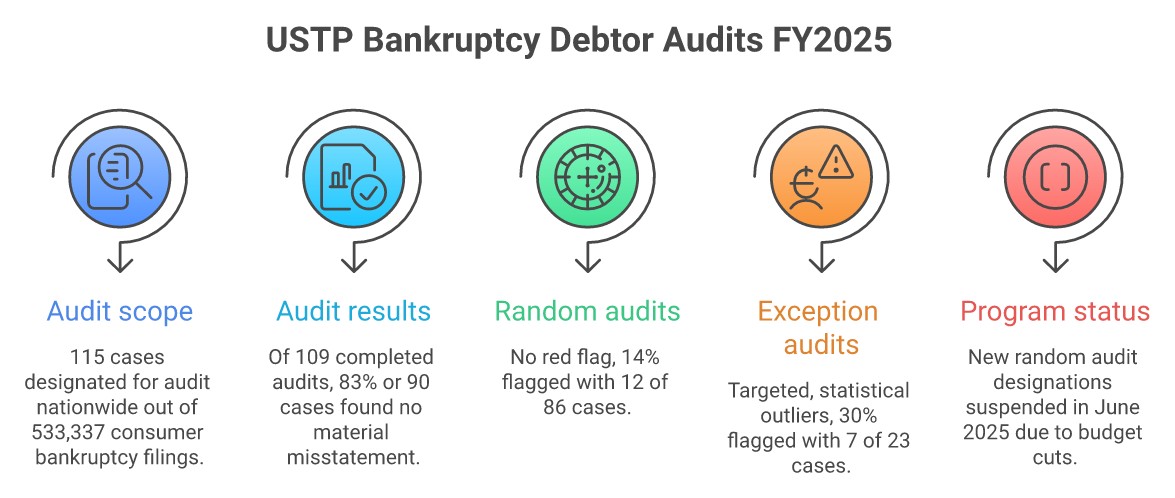
In Fiscal Year 2025 — October 2024 through September 2025 — the U.S. Trustee Program designated 115 cases for audit nationwide. That’s it. Not 115,000. One hundred fifteen, across every federal judicial district the USTP covers (it doesn’t operate in Alabama or North Carolina, which run a separate but similar system).
Compare that to how many people actually filed. The U.S. Courts’ own Judicial Business 2025 report puts nonbusiness (consumer) bankruptcy filings at 533,337 nationwide for the same fiscal year — 201,784 of them Chapter 13 cases, and nearly all of the rest Chapter 7. (The same report’s headline totals for Chapter 7 and Chapter 13 alone — 344,825 and 203,118 — cover every filer, including businesses, so they run higher than the consumer-only figures and don’t add up to 533,337.) Do the math on the USTP’s 115 designated audits against those 533,337 consumer filings, as I did, and you get roughly 1 audit for every 4,600-plus consumer bankruptcy filings that year — and it’s a rough comparison, since 533,337 is a nationwide total that includes Alabama and North Carolina, where the USTP doesn’t operate, while the audit count covers individual Chapter 7 and 13 cases specifically rather than every nonbusiness filer. That’s not an official USTP statistic — it’s my own calculation comparing two separate federal reports — but the two numbers are both real, and put together they tell you something the audit report doesn’t say directly: getting audited is not a normal part of filing bankruptcy. It’s the exception, and a rare one.
Every weekday I read the enforcement actions, filings and fine print the outlets skip, and turn them into the one or two moves that actually improve your position — a rate worth moving for, a fee you can refuse, a deadline to beat before it costs you.
In the latest issue (Oct 9): Does Financial Literacy Make Financial Sense?
I write Your Money Actually most weekdays — actionable money information you will not find anywhere else, and the small decisions that compound. It is free, I sell nothing, and I take no money from any company I write about.
Consumer bankruptcy cases designated for audit nationwide, FY2025 (out of 533,337 filed)
Odds of random audit designation before the USTP suspended new random audits mid-year over budget cuts
Of completed audits (19 of 109) turned up a “material misstatement” — 83% found nothing
That “1 in 3,700” figure is the USTP’s own language, not mine, and it points to something bigger than the audit numbers themselves: Congress didn’t set “1 out of every 250 individual Chapter 7 and Chapter 13 cases per district” as a ceiling on the USTP’s random-audit authority — the law creating this program requires the USTP to randomly audit not fewer than that many cases per district. It’s a floor, not a cap. In FY2025, the program ran random audits at roughly 1 in 3,700 — about 7% of the rate the law requires — before stopping new random designations altogether in June 2025. And in the report’s own words, the USTP “designated about one in 3,700 individual chapter 7 and chapter 13 cases for random audit before the designation of audits was suspended in June 2025 because of budgetary constraints.” Read that again: the government’s own bankruptcy audit program didn’t just decline to use its full authority — it ran below the legal minimum Congress set, then ran out of money to keep even that going, three months before the fiscal year even ended.
The Daily Money Brief — Free, at 10 AM
Money you may be owed, scams to dodge, and the fine print decoded — the consumer money news that affects your wallet, every weekday.
Well, actually… the popular image of a bankruptcy audit is the IRS — someone in a windowless room combing through your life looking for a reason to come after you. That’s not what this is. A bankruptcy audit is performed by an independent CPA or licensed public accountant firm, hired by the USTP through a competitive contract, checking the accuracy of the paperwork you already filed with the court. It’s a document-verification process, not a criminal investigation, and it happens to a tiny fraction of filers.
Random vs. Exception Audits — and Why the Difference Matters
Not every audit works the same way, and the report breaks this out clearly. There are two kinds:
- Random audits are pulled arbitrarily from all consumer bankruptcy cases in a district — no red flag required, just the luck of the draw. In FY2025, 92 of the 115 designated audits were random.
- Exception audits are targeted — designated because a debtor’s reported income or expenses deviated significantly from the statistical norm for that district. There were 23 of these.
Of the 115 cases designated, three were dismissed before an audit firm was ever assigned. Of the 112 that remained, 109 resulted in a completed Report of Audit (86 random, 23 exception) and 3 resulted in a Report of No Audit — meaning the audit firm couldn’t finish, usually because the debtor didn’t produce requested documents or the case was dismissed mid-process.
Here’s the part that matters if you’re honestly filling out your schedules: even among the audits specifically targeted because something looked statistically unusual, 70% still turned up no material misstatement. Among random audits — no red flag at all — 86% came back clean. Looking odd on paper, by itself, is not the same thing as having done something wrong.
Random Audits (86 completed)
14% (12 cases) found at least one material misstatement
86% (74 cases) found nothing
Exception Audits (23 completed)
30% (7 cases) found at least one material misstatement
70% (16 cases) found nothing
What a “Material Misstatement” Actually Means
The report is careful about this term, and so am I. A material misstatement means the audit turned up information that “challenged the accuracy, veracity, or completeness” of what you told the court — generally the understatement or omission of assets, income, or a pre-petition transfer of property. If you are wondering whether giving an asset to someone else before you file puts it out of the trustee’s reach, it usually does not — see why a trustee can still undo a pre-filing transfer. Nationally, income-related misstatements showed up in 47% of the cases that had one, and asset- or transfer-related misstatements showed up in 53%.
To find that, the audit firm requests documents from you (through your attorney, if you have one) and runs at least two searches using commercial and public database services, specifically to look for unreported assets and verify what things are actually worth. This isn’t a guess-and-accuse process — it’s a records check against what you already swore to under penalty of perjury on your petition and schedules.
The built-in safety valve most people don’t know about: before an audit firm ever files a Report of Audit noting a material misstatement with the court, it’s required to contact you — through your attorney if you’re represented — to give you a chance to explain the discrepancy or supply additional information that might resolve it. If you made an honest mistake and can fix it, that conversation is where it usually gets fixed, before it ever becomes a court filing.
What Actually Happens If a Misstatement Gets Reported
Say the explanation doesn’t resolve it, and the audit firm files a Report of Audit noting a material misstatement. What happens next isn’t automatic, and it isn’t uniform. The bankruptcy court gives notice to all creditors in the case. The U.S. Trustee then decides what action, if any, is appropriate — and the report is direct about this: “In many instances, the U.S. Trustee takes no formal action on a material misstatement identified in a Report of Audit.” Declining to act is common when the debtor corrected the error — for example, by filing amended schedules — or when the misstatement clearly wasn’t intentional.
When the U.S. Trustee does act, the tools available include seeking denial or revocation of your discharge, seeking dismissal of the case, or referring the matter to the U.S. Attorney — and which statute applies depends on your chapter. In Chapter 7 those are 11 U.S.C. § 727 and 11 U.S.C. § 707; in Chapter 13 the parallel routes are dismissal under 11 U.S.C. § 1307, denial of plan confirmation, or revocation under 11 U.S.C. § 1328(e) of a discharge already granted. On the flip side of a discharge — see what to do when a creditor won’t stop collecting after a discharge that already stands. Those are real consequences, and I’m not going to soften that — the whole reason the law requires this audit program is to deter people from lying about their finances to a bankruptcy court. But the report’s own language makes clear that formal action is a “may,” decided case by case, not an automatic trigger the moment a discrepancy is flagged.
There’s one more scenario worth knowing about: a Report of No Audit, filed when the audit firm can’t complete its work because you didn’t produce the requested documents. That one can carry real consequences of its own — the U.S. Trustee may seek revocation of a Chapter 7 discharge under 11 U.S.C. § 727(d)(4)(B) if you can’t satisfactorily explain the failure to cooperate. In other words: if you’re ever selected for an audit, respond. Ignoring the request is a bigger risk than the audit itself.
One more thing worth knowing, because “1 in 4,600” can sound like nobody’s checking: the audit program is the smallest of several accuracy checks a bankruptcy case goes through, not the only one. Every Chapter 7 and Chapter 13 filer is examined under oath at the meeting of creditors under 11 U.S.C. § 343, and that examination happens whether or not your case is ever designated for a USTP audit. In a Chapter 7 case, a trustee or creditor can seek denial of your discharge for a false oath under 11 U.S.C. § 727(a)(4); in a Chapter 13 case the tools are different — dismissal, denial of plan confirmation, or revocation of a discharge already granted — but the exposure for lying under oath is real in both. The 115 audits are a small, additional layer on top of that — not the whole system.
By the Numbers — District by District
The full report breaks results out by all 88 federal judicial districts the USTP covers, and I’d caution against reading too much into any single district’s percentage — most districts had just one or two completed audits all year, so a single case can swing a district from 0% to 100%. Nationally, across all 109 completed audits, 90 turned up no material misstatement and 19 (17%) had at least one. That’s the number that matters. The district-by-district table mostly confirms how small this program is everywhere, not that any one part of the country is being targeted.
The bottom line: The government’s own numbers show that a bankruptcy audit is rare — about 1 in 4,600-plus consumer filers, by my calculation comparing the USTP’s 115 designated audits against the 533,337 consumer cases filed that year — and rarer still after June 2025, when the USTP suspended new random-audit designations for lack of funding, a budget call that can reverse the moment Congress funds the program again, so don’t count on it staying this rare. Even among audits, most turn up nothing: 83% of completed audits found no material misstatement at all, including 70% of the audits specifically targeted at statistical outliers. Audits also aren’t the only accuracy check — every filer is examined under oath at the meeting of creditors regardless. If you’ve been honest on your petition and schedules, the odds are overwhelmingly in your favor even in the unlikely event you’re selected. If you weren’t honest, the audit firm runs the same database searches a determined creditor’s attorney could run later anyway — so the safer move is always accuracy up front, not hoping the 1-in-4,600 draw skips you.
Steve’s Take
I’ve been doing this since 1994, and I filed my own Chapter 7 back in 1990. I remember the audit fear firsthand — it’s one of the quiet reasons people put off filing for years, sometimes long enough that the debt does real damage to their retirement, their health, their marriage. What this report tells me is that the fear and the reality are almost completely disconnected. The government designated 115 audits out of half a million-plus filings, and then ran out of budget to keep doing even that. If you’ve been putting off looking seriously at bankruptcy because you’re scared of an audit, that fear is carrying a lot more weight than the actual numbers support. Debt is math wrapped in emotion — and this is a case where the math is genuinely on your side. The bigger risk to your future isn’t a 1-in-4,600 audit. It’s the years you spend not dealing with the debt at all.
None of this changes the one piece of advice that actually matters here: fill out your petition and schedules completely and honestly, whether you think you’ll be one of the 115 or not. The tiny odds of an audit are not a reason to cut corners — they’re a reason not to be afraid of the process in the first place. If you want to understand how the discharge process itself works, start with my Chapter 7 Bankruptcy: The Complete Guide, and if you’re not sure whether your income even qualifies you for Chapter 7, the free bankruptcy means test calculator will tell you in a few minutes.
Free Tool — Bankruptcy Means Test: Wondering if you qualify for Chapter 7 bankruptcy? The free Bankruptcy Means Test checks eligibility based on your state, household size, and income — including state exemptions. Check My Eligibility →
Frequently Asked Questions
How many bankruptcy filers actually get audited?
Very few. In Fiscal Year 2025, the U.S. Trustee Program designated 115 cases for audit nationwide, out of 533,337 consumer (nonbusiness) bankruptcy filings that year, according to the U.S. Courts’ own Judicial Business 2025 report. Comparing those two federal reports puts the odds at roughly 1 in 4,600-plus — a figure I calculated myself, not one either report states directly, but based on two real government numbers.
Who actually performs a bankruptcy debtor audit — is it the IRS?
No. Bankruptcy debtor audits are performed by independent certified public accountants or licensed public accounting firms, hired by the U.S. Trustee Program through a competitive contracting process — not IRS agents and not USTP staff directly. The firms request documents from the debtor and run at least two searches of commercial and public databases to check for unreported assets and verify asset values.
What is a “material misstatement” in a bankruptcy audit?
It means the audit turned up information challenging the accuracy, veracity, or completeness of the debtor’s petition, schedules, or other filed bankruptcy paperwork — generally an understatement or omission of assets, income, or a transfer of property made before filing. In FY2025, 19 of 109 completed audits (17%) found at least one material misstatement; the rest — 83% — found none.
What happens if a bankruptcy audit finds a material misstatement?
The bankruptcy court notifies all creditors in the case, and the U.S. Trustee decides what, if anything, to do about it. Per the USTP’s own FY2025 report, “in many instances, the U.S. Trustee takes no formal action” — especially when the debtor corrected the error (for example, by filing amended schedules) or the misstatement wasn’t intentional. When the U.S. Trustee does act, options include seeking denial or revocation of discharge, seeking dismissal of the case, or referring the matter to the U.S. Attorney — and the governing statute depends on the chapter: 11 U.S.C. § 727 and § 707 in a Chapter 7 case, and dismissal under § 1307 or revocation under § 1328(e) in a Chapter 13 case.
Does being honest on my bankruptcy schedules protect me if I get audited?
The FY2025 data supports that it does. Even among “exception audits” — cases specifically targeted because income or expenses looked statistically unusual for the district — 70% still found no material misstatement. Among random audits with no red flag at all, 86% found nothing. Before an audit firm ever files a finding with the court, it’s also required to give the debtor a chance to explain or provide additional information that might resolve the discrepancy — so an honest mistake, caught and corrected, often never becomes a formal finding at all.
If you know someone who is putting off filing bankruptcy because they are afraid of what an audit might turn up, send them this page. The government’s own FY2025 numbers say 83% of completed audits found nothing at all — the fear is doing far more damage than the audits are.
I’ve been helping people with debt since 1994, and I filed my own Chapter 7 bankruptcy in 1990. Nothing here is legal advice for your specific situation — it’s what the government’s own numbers actually show, so you can make an informed decision instead of an afraid one. If you’re considering bankruptcy, talk to a qualified bankruptcy attorney about your own petition and schedules.
Dealing With Debt? Understanding your options is the first step. See how all your debt relief options compare — including ones most sites won’t tell you about. The Find Your Path quiz gives a recommendation based on your actual numbers, and the Scam-O-Meter checks any company’s complaint history before you sign. Federal Reserve Bank of New York research shows bankruptcy filers recover faster than those who don’t file.



