
Written by Steve Rhode, consumer debt expert since 1994 • Last updated September 10, 2026
Quick Answer: Your state workforce agency didn’t just say you were overpaid — it flagged the overpayment as fraud, meaning it believes you knowingly gave false information or hid facts to get benefits. That single word changes everything: a fraud finding carries a federally required penalty of at least 15% — a floor, not a ceiling, and some states charge more, with California assessing 30% under Unemployment Insurance Code § 1375.1 — and it can disqualify you from future benefits, expose your federal tax refund to interception, and be referred for criminal prosecution. Your fastest path is to appeal the fraud classification itself, because every state draws a line between an overpayment you weren’t at fault for and one it calls willful, and that line is what you are contesting. If your notice uses any of these words — fraud, willful, knowingly, intentional, misrepresentation, concealment, false statement, penalty assessment, or penalty weeks — you are in the right guide. If none of them appear and the notice reads as a straightforward billing or eligibility correction, the ordinary overpayment guide is the better fit. If you are not sure, stay here: over-routing costs you a few minutes of reading, and under-routing costs you a final fraud finding. Don’t wait, and don’t assume a waiver will save you here — it won’t.
What Just Happened — Why “Fraud” Is a Different Case Than an Ordinary Overpayment
If your state simply overpaid you by mistake — a calculation error, an employer reporting wages late, a pandemic-era rule that got reversed — that’s a non-fraud overpayment, and I’ve written a separate guide for that situation, including how to request a waiver. This guide is for something different: your notice says the state believes you intentionally misrepresented something — hours worked, job search status, a return to work, your identity — to get money you weren’t entitled to.
There is no single federal rule that defines fraud for state unemployment programs — each state writes its own definition, its own burden of proof, and its own procedure, which is exactly why the U.S. Department of Labor publishes a state-by-state comparison instead of one national standard. What is common to nearly every state is the line itself. DOL’s 2023 Comparison of State Unemployment Insurance Laws puts it this way: state laws “generally treat overpayments in which the individual is not at fault or is not committing fraud differently to those overpayments in which the individual has committed fraud, engaged in willful misrepresentation, or concealed material facts.” So the first thing to pin down is what your state has to establish and how — some states require proof you knowingly lied, and others let an agency infer intent from a false certification alone. That intent question, whatever your state calls it, is the whole case. It’s also frequently applied wrong. State agencies process millions of claims through automated systems, and a genuine misunderstanding (miscounting hours, not realizing a part-time gig counted as “work,” a translation or literacy barrier) gets coded as fraud far more often than it should. If that’s what happened to you, the finding itself is what you’re appealing — not just the amount.
The Mistake You’re About to Make: Assuming that because it “wasn’t really fraud,” you can just explain yourself informally, pay what you can, or request a hardship waiver like you would for an ordinary overpayment. You can’t. State waiver provisions are written for overpayments that are not the claimant’s fault and do not involve fraud — DOL’s 2023 comparison describes them as waivers of “nonfraud or nonfault” overpayments — so while the fraud label stands there is nothing for a hardship argument to reach. The corollary matters just as much: if you win the appeal, or the agency redetermines your case as non-fraud, waiver becomes available again, which is another reason the appeal, and not the waiver request, is the move. And if you don’t formally appeal the fraud classification before your deadline, that finding generally becomes final — and with it a penalty of at least 15%, possible loss of future benefits, exposure to federal tax-refund interception, and potential referral for criminal prosecution.
Your Options Right Now
What to Do in the Next 48 Hours
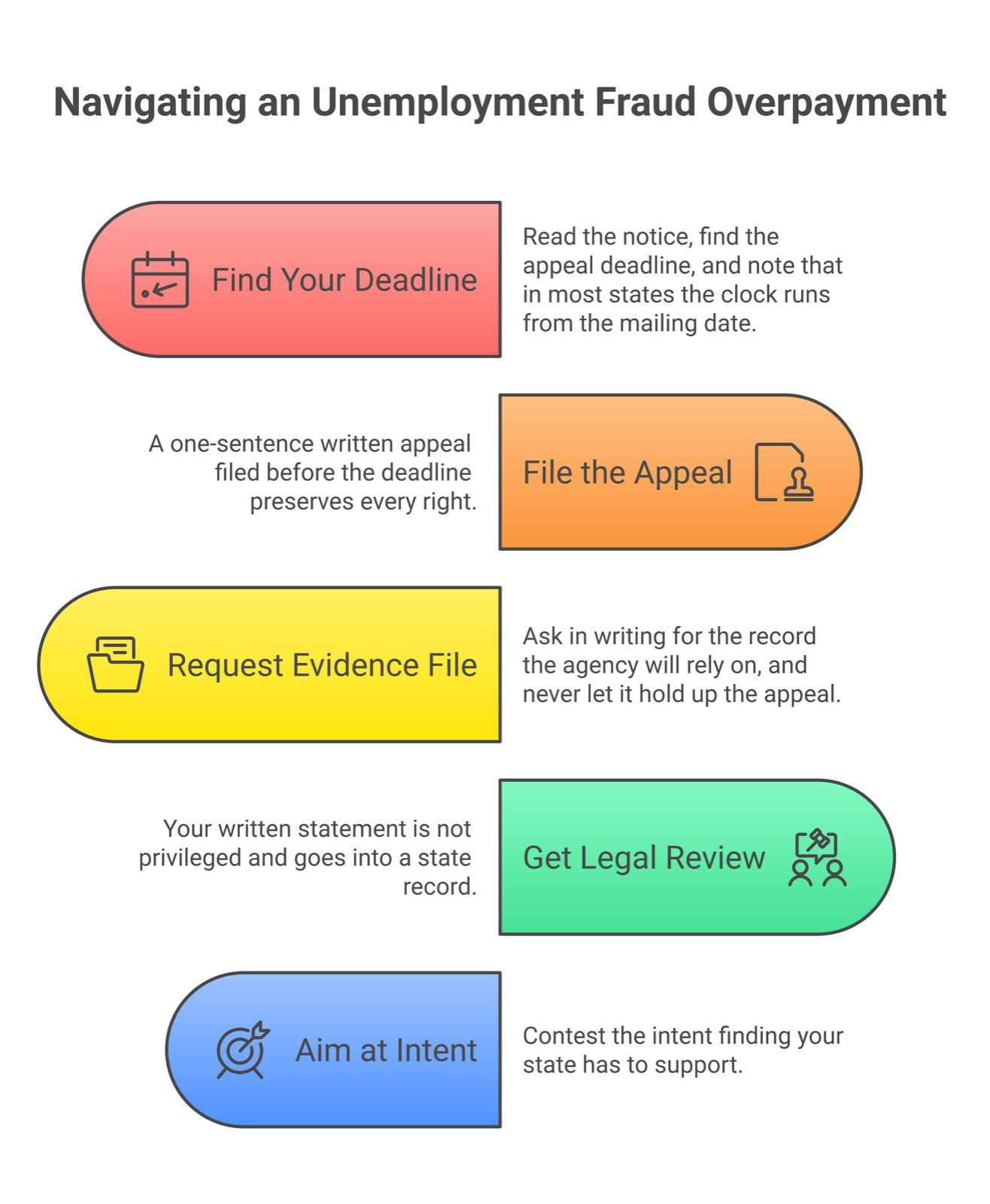
- Find your deadline, and find exactly what the state says you did. A fraud notice should name the specific act it believes was willful — a specific week, a specific answer, a specific certification. Look for the words “appeal by,” “protest deadline,” or “redetermination deadline”; if you can’t find a date, call your state workforce agency and have them read you the exact date. I’m not giving you a national number, because a wrong deadline would be worse than none — but DOL’s 2023 comparison of state appeal rules puts the range at seven to 30 days, and here is the part that catches people: in most states the clock runs from the date the notice was mailed, not the day you opened it, so an envelope that sat unopened for a week has already cost you a week.
- File the appeal first — it can be one sentence — and request the evidence file second. An evidence file can take weeks to arrive and your appeal window may be seven days, so waiting for records is how an honest mistake becomes a final fraud finding. A short written appeal preserves every right you have: “I appeal the fraud determination dated [date]. I did not knowingly or willfully misrepresent anything, I request a hearing, and I will supplement this appeal once I receive my case file.” Send it the way the notice tells you to, keep proof of the date, and then — in the same letter or immediately after — ask in writing for the record the agency intends to rely on. Federal law guarantees you an “opportunity for a fair hearing, before an impartial tribunal” under 42 U.S.C. § 503(a)(3), and that is a hearing right — pre-hearing access to your file is limited and varies by state, which is why you ask early, ask in writing, and never let the request hold up the appeal.
- Before you write a detailed narrative, understand that it is not privileged. This is the most important warning on this page. When you explain, with dates and specifics, what you did and what you believed, that statement goes into a state record — it is not confidential, it is not protected by attorney-client privilege, and in a criminal case it can become the state’s easiest evidence against you. That is not a reason to stay silent, and it is not a reason to skip the appeal. It means this: if the amount is large, or your notice mentions referral for prosecution or investigation, have a lawyer review what you submit before you submit it — and ask whether your hearing should be continued while any criminal matter is pending. The one-sentence appeal in step 2 preserves your deadline without saying anything you cannot take back, which is exactly why it comes first.
- Get free legal help now — this is not a typical civil dispute. A fraud finding carries criminal exposure in most states, and that is precisely why you want a lawyer looking at your words before the state does. Find free legal aid through LSC.gov, find a consumer attorney through NACA, or if bankruptcy may be part of your strategy, find an attorney through NACBA.
- Aim the case at the intent element, not the dollar amount — and don’t rely on a waiver. Once you know what your state must prove and you have seen the file, the appeal is about state of mind: a genuine misunderstanding of a reporting question, an agency instruction you followed, a language or literacy barrier, records showing what you actually believed at the time. Winning on the dollars leaves the fraud finding standing; winning on intent takes the penalty, the disqualification, and the criminal exposure down with it. A waiver is not an alternative route, because state waiver provisions reach only “nonfraud or nonfault” overpayments — beat the label first, and the waiver question can open back up after that.
If your deadline has already passed, file anyway — in writing, today. DOL’s 2023 comparison of state appeal rules notes that many states allow a party to file after the deadline if they can meet the state’s standard for doing so, commonly “good cause” — a notice mailed to an old address, non-receipt, hospitalization, being misinformed by the agency, or a language barrier. Say plainly that you are filing late, state the reason, and state the date you actually learned of the determination. A late appeal that gets refused costs you nothing you had not already lost; not filing guarantees the finding stands.
How to Actually Stop It — Your 4 Paths
- Appeal the fraud classification itself (your fastest path to zero). A fraud finding is a legal conclusion your state has to support under its own definition of fraud or willful misrepresentation — it is not automatic just because money went out that shouldn’t have. If you can show you didn’t knowingly misrepresent anything, a successful appeal doesn’t just reduce your balance — it can eliminate the fraud finding entirely, along with the penalty, the future disqualification, and the criminal exposure. Most people don’t realize the finding itself, not just the amount, is what’s being appealed.
- Bankruptcy — but understand exactly what it does and doesn’t reach. This is genuinely more complicated than for an ordinary overpayment, so get this specific point right; it is information plus a reason to get advice, not a plan. The amount the state says you fraudulently received is the kind of debt 11 U.S.C. § 523(a)(2) can except from discharge. In Chapter 7 that exception is not automatic — the agency generally has to file a complaint, and Federal Rule of Bankruptcy Procedure 4007(c) requires it within 60 days after the first date set for your § 341(a) meeting of creditors, not the date the meeting is actually held, which matters because meetings get continued constantly. Miss that deadline and the fraud-obtained principal can ride the general discharge — but only if you listed the agency in your schedules, because under § 523(a)(3)(B) a creditor you failed to schedule in time to file a claim and request a dischargeability determination is not bound by that deadline at all. In Chapter 13 the analysis is different, and this is where people get it backwards: 11 U.S.C. § 1328(a)(2) excepts debts “of the kind specified in” § 523(a)(2) from a completed-plan discharge, so a Chapter 13 filer should not treat the 60-day deadline as a backstop for the principal. Where Chapter 13 does help is the penalty: the federally required penalty is deposited into the state’s unemployment trust fund rather than reimbursing the state’s loss, which is the usual basis for treating it as a § 523(a)(7) governmental penalty — and § 523(a)(7) is not on the § 1328(a)(2) list, so that piece can be discharged in a Chapter 13 where you complete every plan payment and receive a full § 1328(a) discharge. A hardship discharge under § 1328(b), a conversion, or a dismissal does not give you that result, and whether a particular penalty is a true penalty rather than compensation for the state’s loss is a characterization a court makes, not an automatic label. Finally, the part that hurts people most: bankruptcy discharges the debt, not the finding. It does not erase the fraud determination, the future-benefit disqualification, or your criminal exposure — and under 11 U.S.C. § 362(b)(1) the automatic stay does not stop a criminal prosecution. This is exactly the kind of fact pattern where 30 years of watching people navigate this tells me: talk to a bankruptcy attorney before you assume anything is or isn’t dischargeable. Find one free through NACBA.
- Negotiate before a criminal referral happens, not after. Many states will discuss a repayment arrangement, and being proactive and responsive can matter in whether a case gets referred for prosecution at all. One condition on all of that — if your notice mentions investigation, referral, or prosecution, or the amount is large, do not open this conversation yourself, because agreeing to repay can read as an admission and it is not privileged, so have the lawyer from step 4 handle it. Get any agreement in writing before you pay anything, and never treat an informal payment as a substitute for filing your appeal — paying doesn’t undo a fraud finding on your record.
- What won’t work: hoping it goes away, or a partial explanation over the phone. A verbal explanation to a caseworker is not an appeal and creates no formal record. The clock runs whether you call or not, and once your appeal deadline passes the fraud finding — the penalty, the disqualification, and the referral exposure — generally becomes final, which is why a late written appeal stating your good-cause reason is still worth filing rather than nothing.
What You Need to Know About Fraud vs. Non-Fraud Overpayments
the federal minimum penalty on the overpayment amount — states may charge more, California assesses 30%, and it sits on top of full repayment
state waiver provisions reach only nonfraud or nonfault overpayments, so nothing is waivable while the fraud label is on your file — win the appeal and waiver reopens
disqualification from future benefits — 52 weeks in North Carolina, 52 weeks in California only on a criminal conviction, and in Florida until the overpayment is repaid in full, so check your own state’s rule
the Chapter 7 deadline for the state to contest discharge of the § 523(a)(2) principal, running from the first date set for the creditors’ meeting and only if you listed the agency — the penalty and Chapter 13 work differently
| Question | Non-Fraud Overpayment | Fraud Overpayment |
|---|---|---|
| Can you request a waiver? | Yes — hardship, agency error, or equity-based waivers are available in most states | No — state waiver provisions reach only nonfraud or nonfault overpayments, so nothing is waivable while the fraud label stands |
| Federal penalty | None required | A mandatory minimum of 15% of the overpayment under 42 U.S.C. § 503(a)(11) — states may assess more, and California assesses 30% |
| Future benefits | Generally unaffected once repaid or waived | Disqualification periods that can run 52 weeks or longer, on top of repayment — see the state table below |
| Criminal exposure | None | Possible referral for state or federal criminal prosecution, fines, and in some states jail or prison time |
| How it gets collected | Benefit offset and repayment, and state tax refund offset in many states — and, if the overpayment is attributed to your failure to report earnings, federal tax-refund interception under 26 U.S.C. § 6402(f) as well | Benefit offset and repayment, state tax refund offset, and federal tax-refund interception under 26 U.S.C. § 6402(f) once the debt becomes final under state law — and in many states a longer collection window than a nonfraud debt |
| What the appeal is actually about | Whether the dollar amount or eligibility determination was correct | Whether you acted willfully or knowingly under your state’s own definition — the element that separates a mistake from fraud, and the thing your state has to establish |
Disqualification periods vary sharply by state if fraud is proven — this is on top of, not instead of, repaying the money, and the four rows below are drawn from DOL’s 2023 comparison of state laws and should be confirmed with your own state agency, because several states revised these rules after the pandemic:
| State | If Fraud Is Proven | Source |
|---|---|---|
| Texas (TWC) | Current benefit year canceled — no further benefits until a new benefit year begins | TWC fraud page |
| California (EDD) | 52 weeks of disqualification, and only on a criminal conviction under UI Code § 1263 — an administrative fraud finding alone carries a shorter penalty-week disqualification | DOL 2023 nonmonetary eligibility comparison |
| North Carolina (DES) | 52 weeks of disqualification | DOL 2023 nonmonetary eligibility comparison |
| Florida (DEO) | 1 to 52 weeks, and continuing until the fraudulent overpayment is repaid in full | DOL 2023 nonmonetary eligibility comparison |
If you live in a different state, your disqualification period and penalty structure will differ — the only true nationwide constant is that the federal penalty is at least 15%, and your state may charge more. See the non-fraud overpayment guide for the general appeal-deadline table and links to your state agency.
What Collection Actually Looks Like on a Fraud Overpayment
This is the part most guides leave out, and it is the part that should change what you do this week. A fraud overpayment is not a bill that just sits there waiting for you to get around to it.
- Your federal tax refund. Once a fraud overpayment becomes final under your state’s law, the state can refer it to the U.S. Treasury and your federal refund is reduced to pay it — 26 U.S.C. § 6402(f) defines a “covered unemployment compensation debt” as one for an erroneous payment “due to fraud or the person’s failure to report earnings” that “has become final under the law of a State,” along with “any penalties and interest assessed on such debt” — so note that the earnings clause reaches some overpayments a state never labeled fraud at all. Two things follow from that one word final: a live appeal is what keeps the debt from becoming final, and before the state can take your refund it has to notify you and give you at least 60 days to present evidence that the debt is not legally enforceable. If a Treasury offset notice arrives, that 60 days is a real window and not a formality.
- Your state tax refund, your future benefits, and in some states your lottery winnings or a professional license. DOL’s 2023 comparison lists benefit offset, state tax refund offset, lottery offset, civil action in state court, denial or suspension of professional licenses, and interest on the outstanding balance among the tools states use to collect.
- Wage garnishment — and the mechanics are the thing to check locally. Some states go get a civil judgment in state court first; others hold administrative collection powers that do not require a court date. Ask your state agency or legal aid which one your state uses, and do not assume a hearing in front of a judge is a warning you are guaranteed to get.
- A much longer collection horizon than a nonfraud debt. DOL’s 2023 write-off table — which is how long a state keeps a debt on the books before giving up on it, not a statute of limitations — shows states routinely holding fraud debt about twice as long: Kentucky 5 years nonfraud against 10 years fraud, Ohio 3 against 6, Pennsylvania 4 to 7 against 10, and New York up to 20 years from the date a judgment is filed. Offset and collection rules have moved since the pandemic, so confirm your state’s current rule with your state agency rather than relying on any table, including this one.
If you believe you were wrongly flagged for fraud because someone else used your identity to file a claim, file a report with the FTC at IdentityTheft.gov immediately, notify your state workforce agency in writing, and appeal the fraud classification directly — this is not your fault and it is a common, well-documented pattern. If the agency isn’t giving you proper notice, or is refusing to let you see your file, the levers that actually move a state workforce agency are these: escalate in writing to the agency’s own appeals division or ombudsman, contact your state legislator’s constituent-services office, bring in legal aid, and complain to your state attorney general. Do not burn your deadline in the wrong portal — the CFPB does not supervise state workforce agencies, and a state collecting its own debt is not a debt collector under federal debt-collection law. If a private collection agency is pursuing the debt for the state, that is a different situation and a CFPB complaint can make sense there. If you need legal help but can’t afford an attorney, find free legal aid through LSC.gov.
Steve’s Take
I filed bankruptcy in 1990. I know what it’s like to get an official letter that feels like it’s already decided your guilt. Here’s what 30 years of watching people go through this has taught me: the word “fraud” on a government notice is designed to make you freeze, and freezing is exactly what turns an honest mistake into a permanent record. States process these determinations through systems that flag intent far too broadly — I’ve watched people who simply misunderstood a reporting question get coded the same as someone who lied on purpose. The math matters here more than the shame: a timely appeal that goes after the intent finding is the one move that keeps every other option open, and filing it can be as short as a single sentence. Be careful about what you write beyond that sentence — an appeal statement is a state record, not a private conversation — but do not let that caution curdle into silence, because silence costs you the penalty, a year or more of future benefits, your tax refund, and the chance to explain yourself at all.
Free Tool — Wage Garnishment Calculator: Worried about your paycheck being seized? The free Wage Garnishment Calculator shows exactly how much creditors can legally take in your state — and some states prohibit garnishment entirely. Calculate My Risk →
Frequently Asked Questions
Free Tool — Statute of Limitations Checker: Dealing with old debt? The free Statute of Limitations Checker tells you if the collection clock has expired in your state — including the zombie debt and clock-restarting traps collectors use. Check My Status →
They said my unemployment overpayment was fraud — can I still appeal?
Yes, and you should appeal the fraud classification specifically, not just the dollar amount. Every state’s unemployment law separates an overpayment you weren’t at fault for from one involving fraud or willful misrepresentation, but each state writes its own definition, its own burden of proof and its own procedure — so pin down what your state actually has to establish before you build an argument on it. If you can show you didn’t intentionally misrepresent anything, a successful appeal can remove the fraud label entirely, along with the penalty and the future disqualification.
What’s the difference between a fraud and a non-fraud unemployment overpayment, and why does it matter so much?
A non-fraud overpayment means the state paid you money you weren’t entitled to, but with no intentional misrepresentation on your part — an agency error, a timing issue, a reversed rule. A fraud overpayment means the state believes you knowingly or willfully gave false information. It matters because fraud overpayments carry a federally required penalty of at least 15% under 42 U.S.C. § 503(a)(11) — states may charge more, and California charges 30% — and can disqualify you from future benefits, expose your federal tax refund to interception under 26 U.S.C. § 6402(f), and be referred for criminal prosecution — the penalty, the disqualification and the criminal exposure do not attach to a non-fraud finding at all, though federal refund interception can still reach a non-fraud overpayment that the state attributes to a failure to report earnings.
Can I get a waiver if my overpayment was labeled fraud?
Not while the fraud label stands. State waiver provisions are written for overpayments that are not the claimant’s fault and do not involve fraud — DOL’s 2023 comparison of state laws describes them as waivers of “nonfraud or nonfault” overpayments — so there is nothing for a hardship argument to reach. The corollary is the useful part: if you win your appeal, or the agency redetermines your case as non-fraud, waiver becomes available again. That is why the appeal is the move and the waiver request is not.
Can I go to jail for an unemployment fraud overpayment?
It’s possible, though most cases are resolved administratively. States can and do refer UI fraud for criminal prosecution, and state laws generally provide for fines and imprisonment for willfully misrepresenting facts to obtain benefits. In California, for example, unemployment fraud under Unemployment Insurance Code § 2101 can be charged as a misdemeanor or felony depending on the amount and circumstances. This is exactly why getting legal help early — before a case is referred — matters.
The state says I “intentionally” lied but I just made a mistake — how do I prove that?
Document everything that shows your actual state of mind at the time: what you understood the reporting question to mean, any instructions or guidance you followed, and screenshots or records of what you submitted. File your appeal by the deadline first, then request the state’s evidence file so you know exactly what act they’re calling willful. One warning before you write a detailed explanation — what you submit goes into a state record, it is not privileged, and it can be used against you in a criminal case — so if the amount is large or your notice mentions referral for prosecution, have a lawyer review the statement before you send it and ask whether the hearing should be continued while any criminal matter is pending.
Will a fraud finding stop me from getting unemployment benefits in the future?
It can. States impose disqualification periods on top of repayment when fraud is proven — for example, cancellation of the current benefit year in Texas, 52 weeks in North Carolina, and in California 52 weeks that attaches on a criminal conviction under Unemployment Insurance Code § 1263 rather than on an administrative finding alone. This is separate from, and in addition to, the money you owe. Appealing the fraud finding is the only way to avoid this consequence.
I filed bankruptcy — does that wipe out a fraud unemployment overpayment?
Partly, and the details decide it — so talk to a bankruptcy attorney about your specific case. In Chapter 7, the fraud-obtained amount can be excepted from discharge under 11 U.S.C. § 523(a)(2), but the agency generally has to file a complaint within 60 days after the first date set for your creditors’ meeting under Rule 4007(c) — and that default protection only works if you listed the agency in your schedules, because § 523(a)(3)(B) takes it away from an unscheduled creditor. In Chapter 13, 11 U.S.C. § 1328(a)(2) excepts § 523(a)(2)-type debts from a completed-plan discharge, so don’t count on the 60-day deadline there. The penalty is the piece Chapter 13 can reach: it is a governmental penalty rather than compensation for the state’s loss, § 523(a)(7) is not on the § 1328(a)(2) list, and so it can be discharged if you complete every plan payment and receive a full § 1328(a) discharge — not on a hardship discharge, a conversion, or a dismissal. And bankruptcy discharges the debt, not the finding: it does not erase the fraud determination, the disqualification, or criminal exposure, and under § 362(b)(1) the automatic stay does not stop a criminal prosecution. Find a bankruptcy attorney free through NACBA.
Identity theft flagged as fraud on my unemployment claim — what do I do?
File a report with the FTC at IdentityTheft.gov immediately, notify your state workforce agency in writing that the claim was not yours, and formally appeal the fraud classification. This is a widely documented pattern, especially from the pandemic years, and it is not your fault. Documentation is critical, and free legal aid through LSC.gov can help you through the process.
One more thing — everything I share here is based on 30 years of helping people through exactly this. But my advice is input for your decision, not the decision itself. Only you know your full situation. Talk to an attorney, look at your numbers, and make the choice that serves your future.
Important: This guide is for informational purposes only and is not legal advice. Laws vary by state, and your situation may have details that change what options are available to you. For legal advice specific to your case, consult an attorney licensed in your state. NACBA can help you find a bankruptcy attorney, NACA can connect you with a consumer attorney, or talk to Damon Day for free about your situation.
Key Takeaway: A fraud label on an unemployment overpayment is a legal conclusion your state has to support under its own definition of fraud or willful misrepresentation — it is not automatic, and it is not final while your appeal is alive. Appeal the finding itself, not just the amount, keep the first filing short, and get free legal help this week before you write anything longer. The longer you wait, the more of your future benefits, your tax refund, and your legal options disappear.
The Bottom Line
Getting a fraud notice doesn’t mean you’re a criminal — it means a state computer system or caseworker drew a conclusion about what was in your head at a specific moment, and that conclusion can be wrong. The system created a real, if narrow, path to fight it: contesting the intent finding your state has to support. A timely appeal targeting the intent finding is the only thing that keeps that conclusion open to challenge — silence makes it final, and a final fraud debt is one your federal tax refund can be taken to pay. If someone you know got a “fraud” unemployment notice, send them this page — the appeal window is short, and most people don’t know the fraud finding itself, not just the balance, is what can be appealed. See the Find Your Path quiz for a broader look at your options if this debt is part of a bigger financial picture.
Dealing With Debt? Understanding your options is the first step. See how all your debt relief options compare — including ones most sites won’t tell you about. The Find Your Path quiz gives a recommendation based on your actual numbers, and the Scam-O-Meter checks any company’s complaint history before you sign. CFPB and academic research shows bankruptcy filers recover faster than those who don’t file.
Right now you are dealing with the thing in front of you, and that is exactly where your attention belongs. When it is handled — and it will be — there is a next stage, and it is the one I most enjoy writing about.
In the latest issue (Oct 16): The check that looks like a scam may be real
Each weekday I send one short email: one money story that caught my attention, why it might matter to you, and one manageable thing you can do with it. It is free, I sell nothing, and I take no money from any company I write about.



