

Quick Answer: Concora Credit Inc. has agreed to pay $9,375,000 to settle Seals v. Concora Credit Inc., a federal class action alleging it placed artificial or prerecorded voice calls to cell phones without permission — and the settlement class is specifically people who were not Concora accountholders when the call was placed. If you received a robocall from Concora between May 2, 2021 and May 31, 2026, and were not a Concora, Indigo, Destiny, or Milestone accountholder when that call was placed, you may be eligible for an estimated $250 to $650 per approved claim — but that estimate falls as more people file, and the deadline to file a claim, exclude yourself, or object is October 19, 2026.
Expert Context: I’ve helped people navigate settlement claims since launching GetOutOfDebt.org in 2008, and the mistake I see most with robocall settlements like this one is people assuming that not recognizing a company’s name means they don’t qualify. With this settlement, not recognizing Concora — because you weren’t its accountholder when the call was placed — is what makes you eligible, provided you also received one of the calls at issue on your cell phone during the class period.
Concora Credit Inc., the company that services the subprime Indigo, Destiny, and Milestone Mastercard programs, has agreed to pay $9,375,000 to resolve a federal lawsuit alleging it used an artificial or prerecorded voice to call cell phone numbers that did not belong to any of its own accountholders — without getting permission first.
Key Terms Defined
TCPA (Telephone Consumer Protection Act): The federal law that bars companies from using an artificial or prerecorded voice to call a cell phone without the recipient’s prior express consent. Violations carry statutory damages of $500 per call — up to $1,500 for willful violations — which is why a company facing hundreds of thousands of calls can end up settling for millions rather than risk trial. The TCPA also covers some unwanted text messages, but this particular settlement covers prerecorded and artificial-voice calls only — not texts.
Claiming money you are owed is one good day. What you do over the following year is what actually changes your position.
I write Your Money Actually most weekdays — actionable money information you will not find anywhere else, and the small decisions that compound. It is free, I sell nothing, and I take no money from any company I write about.
Settlement class / non-accountholder: The group of people this settlement covers. Here it is defined narrowly and specifically as people who were NOT a Concora accountholder when Concora placed or caused to be placed a prerecorded call to their cell phone. If you ever had a Concora, Indigo, Destiny, or Milestone account and got a call about that account, this settlement isn’t for you — but if the call was a case of mistaken identity or a wrong number, it likely is.
Claimant ID: A unique identifier printed on the mailed or emailed notice sent to people the settlement administrator could already identify. You need it, along with the Access Code on the same notice, to file online. If you never got a notice, you can still file — see “How to File” below.
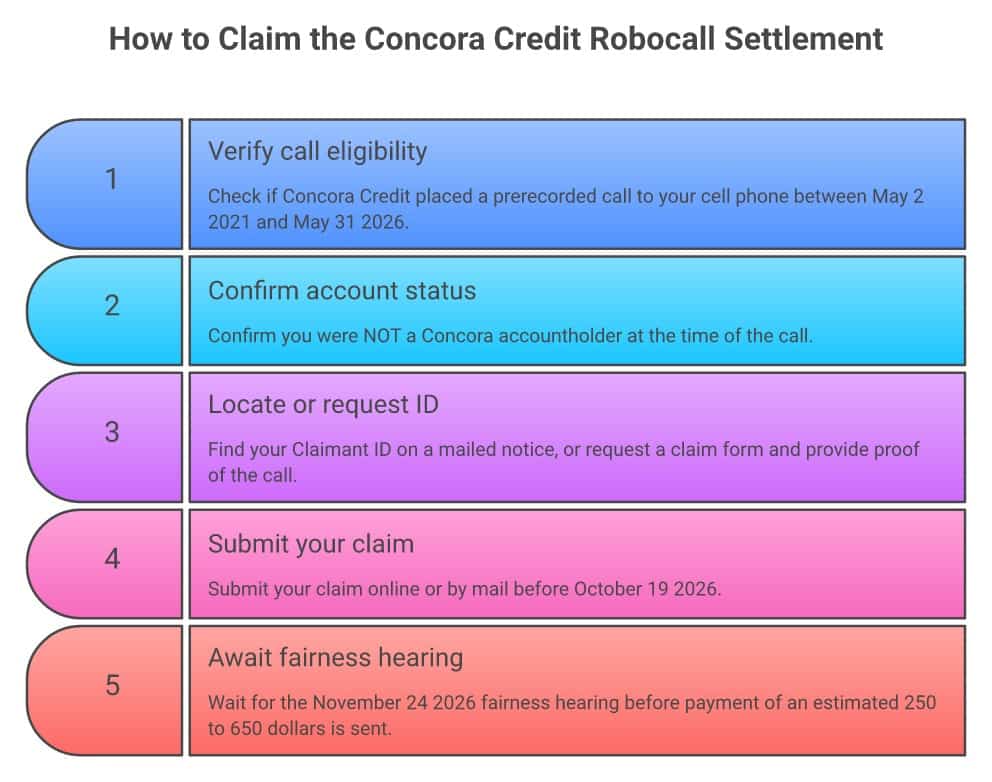
What Concora Is Accused of Doing
According to the class action complaint, named plaintiff Alexis Seals alleged that Concora placed, or caused to be placed, calls using an artificial or prerecorded voice to cell phone numbers that were not assigned to any Concora accountholder — meaning the calls reached people who had no relationship with the company at all. The case, Seals v. Concora Credit Inc., No. 3:25-cv-00728-AN, was filed May 1, 2025 in the U.S. District Court for the District of Oregon before Judge Adrienne Nelson.
The TCPA requires prior express consent before a company can use a prerecorded or artificial voice to call a cell phone. If the calls in this case really did reach people with no Concora account, there was no way those people could have given that consent — which is the theory the lawsuit rests on.
This is a settlement, not a court finding of wrongdoing. Concora has not admitted that it violated the TCPA or any other law. Like most class action settlements, this one resolves the case to avoid the cost, delay, and risk of a trial — the official settlement website says as much directly. The allegations in the complaint remain allegations.
Why Never Having Had a Concora Account Doesn’t Disqualify You — If You Got the Call
This is the part that trips people up, and it’s the whole reason I’m writing about this settlement. Most class actions I cover are limited to a company’s own customers — people who had an account, a loan, or a card with the company being sued. This one is the mirror image. The settlement class is defined as:
“All persons throughout the United States (1) to whom Concora Credit Inc. placed, or caused to be placed, a call, (2) directed to a telephone number assigned to a cellular telephone service, but not assigned to a Concora Credit Inc. accountholder, (3) in connection with which Concora Credit Inc. used, or caused to be used, an artificial or prerecorded voice, (4) from May 2, 2021 through May 31, 2026.”
— Seals v. Concora Credit Inc. Settlement Notice
If you’ve ever gotten a prerecorded call about a credit card account, mentioning a company name you’d never heard of, and hung up assuming it was either a scam or someone else’s problem — this is exactly the situation the TCPA and this settlement exist for. A lot of these misdirected calls happen because a cell number gets disconnected and reassigned to a new person, and the old accountholder’s information keeps getting called anyway — I’ve written before about robocalls meant for someone else being worth real money, and this settlement is the same pattern playing out at scale.
The Daily Money Brief — Free, at 10 AM
Money you may be owed, scams to dodge, and the fine print decoded — the consumer money news that affects your wallet, every weekday.
The Claim: “I never had a Concora, Indigo, Destiny, or Milestone account, so this settlement doesn’t apply to me.”
The Reality: Not having an account is the qualifying fact, not a disqualifying one — but only if you also received a prerecorded or artificial-voice call from Concora on your cell phone during the class period and weren’t its accountholder at the time of that call. Meet both parts and you’re in the group this settlement was built to pay.
Who Qualifies for the Concora Credit Settlement
You’re likely a member of the settlement class if all of the following are true:
- You received a call on your cell phone in the United States that used an artificial or prerecorded voice, placed by or on behalf of Concora Credit Inc.
- The call happened between May 2, 2021 and May 31, 2026
- You did not have a Concora, Indigo, Destiny, or Milestone account at the time of the call
Not sure whether you got a qualifying call? If the settlement administrator already had a record linking your number to a call, you should have received a postcard or email notice with a Claimant ID. If you never got one but believe you received one of these calls, you can still request a claim form — see the next section.
How to File Your Concora Credit Settlement Claim
How you file depends on whether you already received a notice from the settlement administrator, Rust Consulting:
- If you received a postcard or email notice: File online at SealsTCPASettlement.com using the Claimant ID and Access Code printed on your notice, or mail the paper claim form included with it.
- If you never received a notice: Write to the settlement administrator requesting a claim form, and include proof you received an artificial or prerecorded call from Concora on your cell phone between May 2, 2021 and May 31, 2026 (a phone bill showing the number, a screenshot of caller ID and call log, or a voicemail transcript are the kinds of evidence worth including). Mail your request to: Seals v. Concora Credit Inc., Settlement Administrator – 9243, PO Box 2599, Faribault, MN 55021-9599.
- Questions? Call the settlement administrator at 1-866-686-0059.
Every claim, exclusion request, and objection is due on the same date — October 19, 2026 (postmarked, if mailed). That single date covers three different rights: submitting a claim for payment, excluding yourself from the settlement (so you keep your right to sue Concora separately), and objecting to the settlement’s terms. Excluding yourself is the only either/or choice — if you exclude yourself you get no payment and give up the right to object, but you keep your own right to sue Concora separately. Filing a claim and objecting are not mutually exclusive: you can stay in the class, file your claim to protect a potential payment, and still tell the court you think the settlement is unfair. If you do nothing at all, you stay in the class, get no payment, and still give up your right to sue Concora over these calls.
How Much Will You Actually Get?
Concora will pay $9,375,000 total to resolve the case: $8,375,000 goes into a fund to pay class members, and $1,000,000 is a separate, mandatory commitment Concora must spend improving its own TCPA compliance. Out of the $8,375,000, the settlement website discloses that the fund pays for notice and administration costs (capped at $340,000), attorneys’ fees (capped at $3,000,000, subject to court approval), litigation costs (capped at $25,000), and a $10,000 incentive award to Alexis Seals — before whatever remains is divided equally among everyone who filed an approved claim.
The settlement website’s own estimate is $250 to $650 per approved claimant — and that range is not a guarantee. The actual number depends entirely on how many people file valid claims. More claimants means a smaller individual share; fewer claimants means a larger one. Nobody, including me, can tell you your exact payout before the claims window closes and the court grants final approval.
Key Dates for the Concora Credit TCPA Settlement
- August 5, 2026: Court entered the order preliminarily approving the settlement
- September 4, 2026: Notice sent to the settlement class
- October 19, 2026: Deadline to submit a claim, request exclusion, or file an objection
- November 24, 2026, 1:00 p.m.: Final fairness hearing, U.S. District Court for the District of Oregon (Mark O. Hatfield United States Courthouse, Portland)
- After final approval: Payments sent to approved claimants — timing depends on whether the approval is appealed
This isn’t the only wrong-number robocall settlement I’ve covered — I wrote about a similar case involving Norton and LifeLock’s parent company paying $9.95 million for the same kind of calls. These settlements are becoming a pattern, not a one-off.
A Different Case: The Concora / Indigo Credit Reporting Lawsuit
If you’ve seen my earlier coverage of a consumer’s FCRA lawsuit against Concora Credit / Indigo, don’t confuse the two. That case concerns a completely different legal theory — allegations under the Fair Credit Reporting Act about how Concora reported account information to the credit bureaus. This TCPA robocall settlement is a separate matter, with its own case number, its own class, and its own claims process. Being part of one doesn’t make you part of the other, and filing a claim in this settlement has no effect on that separate case.
Key Takeaways
- Concora Credit agreed to pay $9,375,000 to settle allegations it robocalled cell phones that did not belong to its own accountholders — without admitting wrongdoing
- You qualify because you received a qualifying call and were not a Concora, Indigo, Destiny, or Milestone accountholder at the time of the call — the missing account is what makes you eligible, not what disqualifies you
- Estimated payout is $250–$650 per approved claim, and it shrinks or grows based on how many people file
- Claim, exclusion, and objection deadlines are all the same date: October 19, 2026
- No notice in the mail doesn’t mean no claim — request a form and provide proof of the call
The Bottom Line
If you’ve ever hung up on a robocall from a company you’d never heard of and assumed there was nothing to be done about it, this settlement is proof that assumption is often wrong. Concora Credit agreed to pay $9,375,000 to resolve allegations that it used a prerecorded voice to call cell numbers that weren’t its own accountholders’ — without admitting it did anything wrong — and simply reaching the wrong person doesn’t, by itself, excuse a prerecorded call, though a caller that queried the FCC’s Reassigned Numbers Database and got back inaccurate information has a limited safe harbor — a defense that goes to the merits of a lawsuit, not to whether you can file a claim in this settlement. You don’t need to have been anyone’s customer to make a claim here; you need a prerecorded or artificial-voice call to your cell phone from Concora between May 2, 2021 and May 31, 2026, on a number that wasn’t a Concora accountholder’s. Checking your call history costs nothing — but filing does carry one real obligation: these claim forms are typically signed under penalty of perjury, so only file if you genuinely meet that description.
Frequently Asked Questions
Do I qualify for the Concora Credit settlement if I never had an account with them?
Yes, but only together with the call requirement — the settlement class is people who received an artificial or prerecorded voice call from Concora on their cell phone between May 2, 2021 and May 31, 2026 and who were not a Concora, Indigo, Destiny, or Milestone accountholder at the time; never having had an account doesn’t qualify you by itself, but with the call, it’s the thing that makes you eligible rather than disqualifying you.
How do I file a claim in the Concora Credit robocall settlement?
If you received a postcard or email notice, file online at SealsTCPASettlement.com using your Claimant ID and Access Code, or mail the included paper form. If you never received a notice, write to the settlement administrator, Rust Consulting, at Seals v. Concora Credit Inc., Settlement Administrator – 9243, PO Box 2599, Faribault, MN 55021-9599, and include proof of the call (a phone bill, screenshot of your call log, or voicemail). All claims are due by October 19, 2026.
How much money will I get from the Concora Credit settlement?
The official settlement website estimates each approved claimant will receive between $250 and $650. That figure is not fixed — it depends on how many people submit valid claims, because the net fund is divided equally among everyone approved. There’s no way to know the exact amount until after the October 19, 2026 claims deadline and the November 24, 2026 final approval hearing.
What’s the deadline for the Concora Credit TCPA settlement?
October 19, 2026 is the deadline for three separate things: filing a claim for payment, excluding yourself from the settlement, and objecting to its terms. All three share the same date. The final fairness hearing, where the court decides whether to approve the settlement, is November 24, 2026.
Is this the same lawsuit as the Concora Credit / Indigo credit reporting case?
No. This is a separate matter. This settlement, Seals v. Concora Credit Inc., resolves Telephone Consumer Protection Act robocall claims. A different case I covered involves Fair Credit Reporting Act allegations about how Concora reports account data to credit bureaus. They have different case numbers, different legal theories, and different claims processes.
One more thing before you go: everything above is what I’m seeing in this settlement and what I’d tell a family member who called me asking whether it’s worth their time. But you know your own call history and your own situation better than I do — decide for yourself whether filing makes sense, and don’t let anyone, including me, pressure you into handing over information you’re not comfortable sharing. Take this as input, not instruction.
Dealing With Debt? Understanding your options is the first step. See how all your debt relief options compare — including ones most sites won’t tell you about. The Find Your Path quiz gives a recommendation based on your actual numbers, and the Scam-O-Meter checks any company’s complaint history before you sign. Federal Reserve Bank of New York research shows bankruptcy filers recover faster than those who don’t file.



