

Written by Steve Rhode, consumer debt expert since 1994 • Last updated September 14, 2026
Quick Answer: You sent money to a debt collector who was never entitled to collect it — the debt was fake, already paid, or not legally theirs to chase. What happens next depends almost entirely on how you paid: a credit card gives you the best odds of getting it back (dispute it in writing within 60 days under Regulation Z), while gift cards, wire transfers, and P2P apps like Zelle depend on how fast you call and whether the money has already been pulled out. Call whoever you paid through today, then report the scam itself to the FTC and CFPB. Don’t pay anyone who calls promising to get your money back — that’s almost always a second scam.
What Just Happened
Someone contacted you claiming to be a debt collector. They may have known your name, an old account number, or even your Social Security number, and used it to sound legitimate. They pressured you — threats of arrest, wage garnishment, a lawsuit, or a call to your job or family — and you paid to make it stop. Now you’ve realized the debt was fake, already paid off years ago, or being collected by someone with no legal right to it, and you want your money back.
This is not rare, and it is not a sign you were careless. The FTC’s November 2024 case against Global Circulation, Inc. and its owner, Kenneth Redon III — who operated under names like Consumer Impact Recovery, Total Mediation Solutions, and Total Consumer Solutions — alleged the company collected more than $7.6 million from consumers by threatening jail time and harassing their family members over debts that, according to the FTC’s complaint, “either don’t exist at all or are not debts GCI can legally collect,” often demanding payment by credit or debit card on the same phone call (FTC press release, Nov. 2024). A court froze the company’s assets, and in May 2025 GCI and Redon agreed to a stipulated order permanently banning them from the debt collection industry, with a $9,684,338 judgment suspended once they turned over what assets they had left (FTC, May 2025). That’s what phantom debt collection looks like at scale — and it’s exactly the kind of operation that may have taken your money.
If you haven’t paid anything yet, read this myth-debunk on why a name and a dollar amount don’t make a debt real first — it explains how to spot this before you send a dime. And if a debt collector is calling you right now about something else entirely, here’s what to do about that call. This guide is for the moment after: the money is already gone, and you want it back.
The Mistake You’re About to Make: Hiring someone who calls, emails, or advertises promising to “recover your scam losses” for an upfront fee. The FTC is blunt about this: “Never pay upfront for a refund or help with a refund” — scammers buy and sell lists of people who’ve already lost money, specifically because a person who was scammed once is an easy second target (FTC, Refund and Recovery Scams). The people who actually get money back are the ones who go straight to their own bank, card issuer, or the payment app itself — not a stranger who found them.
Free Tool — Wage Garnishment Calculator: Worried about your paycheck being seized? The free Wage Garnishment Calculator shows exactly how much creditors can legally take in your state — and some states prohibit garnishment entirely. Calculate My Risk →
Your Options Right Now
What to Do in the Next 24 Hours
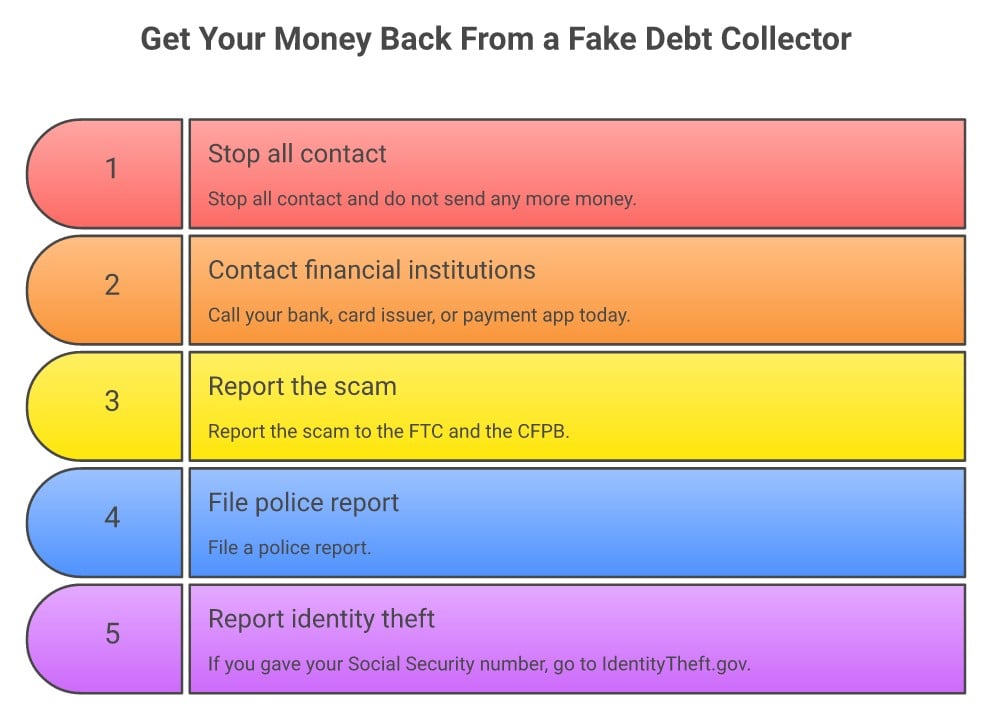
- Stop all contact and don’t send anything else. If they call again demanding a “processing fee” or a second payment to “finish clearing” the account, that’s not how any legitimate collector operates. Hang up.
- Contact whoever handled the payment — today, not this week. Which company you call depends on how you paid; see the payment-by-payment breakdown below. Speed is the single biggest factor in whether you get anything back, especially for gift cards, wires, and P2P apps.
- Report the scam itself to the FTC at ReportFraud.ftc.gov and file a complaint with the CFPB. This doesn’t get your money back by itself, but it’s what lets investigators connect your case to others — which is how operations like GCI get shut down.
- File a police report for your own records. Some banks and card issuers may ask for one, or at least a case number, before they’ll process a fraud claim — but don’t let waiting for an appointment delay your call to the bank or issuer. It also documents the crime if the “debt” or your information resurfaces later.
- If you gave them your Social Security number, bank account number, or a photo of your ID, go to IdentityTheft.gov now — see the section below on exactly why and what it does for you.
How to Get Your Money Back — It Depends on How You Paid
There is no single deadline or single phone call that covers every case. The FTC’s own guidance for scam victims breaks it down by payment method, and your legal protections vary just as much — strongest for a credit card, thinner or nonexistent for gift cards, wires, and crypto. Find how you paid below and start there.
- Credit card — your best odds. Call the number on the back of the card and tell the issuer you paid a scammer. Then put the dispute in writing within 60 days after the issuer sent the first statement showing the charge, to preserve your rights under Regulation Z, 12 CFR § 1026.13(b)(1). A payment you authorized yourself isn’t automatically a Reg Z “billing error,” so this dispute isn’t a guaranteed legal right — but many issuers reverse it through a chargeback anyway, and if the issuer does treat it as a billing error, you don’t have to pay the disputed amount or have it reported delinquent while it investigates (12 CFR § 1026.13(d)). Keep paying the undisputed part of your bill on time either way. The FTC’s own advice matches this: “Report it to the credit card issuer immediately”.
- Debit card — call your bank immediately, and get it in writing too. Regulation E’s notice-of-error window is the same 60 days as a credit card (12 CFR § 1005.11(b)(1)) — the deadline isn’t what’s less forgiving. What is: Reg E’s strongest liability cap ($50) only applies if you report within 2 business days of noticing a lost or stolen card (12 CFR § 1005.6(b)); wait longer and your exposure can climb to $500 or more, and whether a payment you willingly sent to someone who tricked you even counts as an “unauthorized” error under Reg E is genuinely unsettled — banks handle it case by case. Once you report it, your bank has up to 10 business days to investigate — 20 for a newer account, and up to 45 days (90 for new accounts, point-of-sale debit, or transfers initiated outside the U.S.) if it provisionally credits your account in the meantime (12 CFR § 1005.11(c)). Don’t assume either way — just call today and ask them to open a fraud claim, not a routine dispute.
- Bank transfer, Zelle, Venmo, Cash App, or another payment app. These move money almost instantly to a real account the scammer controls, and there’s no federal law that guarantees a refund once you’ve authorized the transfer yourself. Still call your bank or the app immediately and ask them to reverse it — the FTC’s guidance is the same for both: “Report it to your bank or credit union immediately. Ask them to reverse the payment” for a transfer, and “Report it to the payment app immediately” for Venmo/Cash App/PayPal. Your only real chance is catching it before the scammer withdraws the money, which is usually within hours.
- Wire transfer. Contact the wire company (the bank or service you sent it through) immediately and tell them it was fraud — ask them to recall or reverse it. Wires are designed to move money fast and permanently, so this is the payment method with the lowest odds of recovery once a day or two has passed.
- Gift cards. Call the number on the back of the card — not a number the scammer gave you — and tell the issuer you were scammed. The FTC’s guidance: “The faster you contact any gift card company to report a gift card scam, the better the chance of getting your money back” (FTC, 2023). Whether you get anything back depends on whether the funds are still frozen on the card or the scammer has already spent them — keep the physical card and your receipt. Gift cards are such a common demand in this exact scam that a gift card payment demand is itself one of the biggest red flags — no legitimate creditor collects that way.
- Cryptocurrency. Contact the exchange or ATM operator you used immediately and report it as fraudulent; ask them to reverse the transaction if possible. In practice, crypto sent directly to a scammer’s wallet is the hardest of all these methods to recover once the transaction confirms — report it anyway, both to preserve any chance of recovery and because it helps investigators trace the operation.
What You Need to Know About Your Rights
from your first statement showing the charge, to dispute a credit card payment in writing under Regulation Z
from your bank statement, to report a debit card error under Regulation E
from receiving a real collector’s validation notice, to dispute the underlying debt in writing under the FDCPA
the amount the FTC alleged one phantom debt operation collected from consumers before it was shut down
| Payment method | Best chance of recovery | Notes |
|---|---|---|
| Credit card | Highest odds | 60-day written dispute deadline under Reg Z; issuers often reverse it as fraud, and if it’s treated as a billing error, you don’t owe the disputed amount while it’s pending |
| Debit card | Moderate | Reg E error-resolution rights apply, but the strongest liability caps are written for a stolen card, not a self-sent payment — call immediately and ask for a fraud claim |
| Bank transfer / Zelle / Venmo / Cash App | Low, and time-critical | No federal guarantee once you’ve authorized it yourself; recovery depends on catching it before the scammer withdraws the funds, often within hours |
| Wire transfer | Low | Designed to be fast and final; report immediately and ask for a recall, but odds drop quickly after a day or two |
| Gift card | Possible if caught fast | Call the number on the back of the card immediately; depends on whether the balance is still frozen |
| Cryptocurrency | Very low | Report to the exchange anyway — helps investigators even when the funds themselves are gone |
Separately from getting your money back, the underlying debt itself has its own rules. If the caller was a real debt collector (not a pure fabrication) and you still get contacted about the balance, a written validation notice must go out within 5 days of first contact, and you have 30 days after you receive it to dispute the debt in writing and force them to stop and verify it — 15 U.S.C. § 1692g. Use the free Debt Validation Letter Generator and send it certified mail.
Free Tool — Debt Validation Letter Generator: Being contacted by a debt collector? The free Debt Validation Letter Generator creates a personalized FDCPA validation letter in seconds — forcing the collector to prove the debt is real before they can continue. Generate My Letter →
If You Gave Them Your Social Security Number or Bank Account Details
Phantom collectors often use real personal information — sometimes your actual Social Security number, an old account number, or your employer’s name — to sound credible. If you confirmed or handed over your SSN, bank account and routing numbers, or a photo of your driver’s license during the call, treat this as identity theft, not just a payment dispute. Go to IdentityTheft.gov and file a report — it’s free, and it generates a personalized, step-by-step recovery plan along with pre-filled letters you can send to your bank, credit reporting agencies, and creditors. Also place a free fraud alert or credit freeze with the three credit bureaus so nobody can open new credit in your name using what you shared.
Watch for the Second Scam: People Who Promise to Get Your Money Back
Once you’ve been scammed once, you become a target for a second scam — someone who contacts you claiming they can recover what you lost, for a fee. The FTC’s warning is direct: “Never pay upfront for a refund or help with a refund” and “scammers buy, sell, and trade” lists of people who’ve already lost money, expecting they’re good targets to be scammed again (FTC, Refund and Recovery Scams). They may claim to be with a government agency, a law firm, or even the FTC itself — it’s not. No legitimate agency charges you a fee to help you recover money you already lost, and none of them will ever call you first offering to do it.
Will This “Debt” Come Back?
Sometimes — and the answer depends on which situation you were actually in. If the debt was completely fake, or you’d already paid it off, and it resurfaces later under a different name or company, you’re in the same position as before: you still don’t owe it, and you have the same right to dispute it in writing under the FDCPA — the same resurfacing pattern happens with debts you genuinely paid off. But if the underlying debt was real and the problem was that the party demanding it had no legal right to collect it, paying the wrong party doesn’t automatically satisfy a debt you genuinely owed — the actual creditor or an authorized collector may still come after that balance later. Either way, demand written validation before you pay anyone again, and keep every piece of proof from this experience — screenshots, statements, the payment record, any letters — in one folder. If a debt shows up again, that proof is what lets you shut it down fast, or shows a legitimate collector you already paid, instead of starting from scratch.
If a collector keeps contacting you after you’ve disputed a debt, file a complaint with the CFPB and your state attorney general. If you need legal help but can’t afford an attorney, find free legal aid through LSC.gov.
Steve’s Take
I filed bankruptcy in 1990, and I know what it feels like to be scared about money and to make a decision under pressure that you’d never make with a clear head. That’s exactly what a phantom debt collector is counting on — fear moves faster than fact-checking. Sending them money doesn’t make you gullible; it makes you human, and it makes them criminals. The math here isn’t about shame, it’s about speed: the people who call their bank the same day get more of their money back than the people who spend a week feeling foolish about it first. Make the call today.
Frequently Asked Questions
I paid a fake debt collector with my credit card — can I still get it back?
Often, yes — a credit card gives you the best odds of any payment method. Call your card issuer, then send a written dispute within 60 days of the first statement that showed the charge (12 CFR § 1026.13(b)) to preserve your rights. Many issuers reverse a scammer’s charge as fraud even though a payment you authorized yourself isn’t automatically a Reg Z “billing error” — if the issuer agrees it is one, you don’t have to pay the disputed amount while it investigates (12 CFR § 1026.13(d)). Keep paying the rest of your bill on time either way.
I sent the money through Zelle or Venmo — is it gone for good?
Not necessarily, but the odds are much lower than with a credit card. There’s no federal law guaranteeing a refund once you’ve authorized a transfer yourself, so speed is everything — call your bank or the app the moment you realize what happened and ask them to reverse it. Waiting even a day can be the difference between getting it back and not.
Someone called saying they can get my scam money back for a fee — should I hire them?
No. The FTC is explicit: never pay an upfront fee to anyone promising to recover scam losses. This is a second, extremely common scam that specifically targets people who were just scammed, and it will cost you more money, not get you any back.
Do I still need to worry about the “debt” itself, or just the money I lost?
Both. Getting your payment back and shutting down the phantom debt are two separate problems. Even after you recover what you can, keep your proof on file — the same fake or already-paid debt can resurface later from a different company using a different name. If that resurfacing debt comes with a scripted voicemail claiming a lawsuit is already being filed and reciting a case number, see my guide on a debt you already settled coming back with a fake “pretrial division” threat.
I gave them my Social Security number when I called to “verify” the debt — what now?
Treat it as identity theft. Go to IdentityTheft.gov, file a free report, and follow the personalized recovery plan it generates, including placing a fraud alert or freeze with the credit bureaus.
Should I report this even if I don’t think I’ll get my money back?
Yes. Report it to the FTC at ReportFraud.ftc.gov and file a complaint with the CFPB regardless of whether you expect a refund. That’s how operations get investigated and stopped before they take money from someone else — a federal court, at the FTC’s request, froze the assets of one such operation in 2024 that allegedly took more than $7.6 million from consumers, and permanently banned it from debt collection in 2025.
How do I know if the debt collector calling me now is real or another phantom operation?
A real debt collector must send you a written validation notice within 5 days of first contacting you, and must identify itself as a debt collector. If a caller demands immediate payment by gift card, wire, or crypto, refuses to send anything in writing, or already has personal details they use to pressure you instead of prove the debt, treat it as a red flag. Read this guide on phantom debt red flags before you pay anything else.
One more thing — everything I share here is based on 30 years of helping people through exactly this. But my advice is input for your decision, not the decision itself. Only you know your full situation. Talk to an attorney, look at your numbers, and make the choice that serves your future.
Important: This guide is for informational purposes only and is not legal advice. Laws vary by state, and your situation may have details that change what options are available to you. For legal advice specific to your case, consult an attorney licensed in your state. NACBA can help you find a bankruptcy attorney, NACA can connect you with a consumer attorney, or schedule a free consultation with Damon Day, an independent debt coach and my podcast co-host — I receive no payment for this referral.
Key Takeaway: How you paid determines your best move, but every path starts with the same first call: contact your bank, card issuer, or the payment app today, not next week. Report the scam to the FTC and CFPB regardless of what you recover, and never pay anyone who calls promising to get your money back for a fee.
The Bottom Line
You’re not the first person this has happened to, and you won’t be the last — a federal court, at the FTC’s request, froze the assets of one such operation in 2024 that allegedly took more than $7.6 million this way, and permanently banned it from debt collection in 2025. Being scared into paying doesn’t make you careless; it makes you a target of people who do this for a living. The people who recover the most money are the ones who call their bank the same day instead of waiting to feel less embarrassed about it. If someone you know just told you they paid a debt collector who felt off, send them this page — the payment-method breakdown above is the part most people don’t know to look for.
Dealing With Debt? Understanding your options is the first step. See how all your debt relief options compare — including ones most sites won’t tell you about. The Find Your Path quiz gives a recommendation based on your actual numbers, and the Scam-O-Meter checks any company’s complaint history before you sign. CFPB and academic research shows bankruptcy filers recover faster than those who don’t file.
Right now you are dealing with the thing in front of you, and that is exactly where your attention belongs. When it is handled — and it will be — there is a next stage, and it is the one I most enjoy writing about.
In the latest issue (Oct 16): The check that looks like a scam may be real
Each weekday I send one short email: one money story that caught my attention, why it might matter to you, and one manageable thing you can do with it. It is free, I sell nothing, and I take no money from any company I write about.



