

Fact-checked by Steve Rhode, consumer debt expert since 1994 • Last reviewed September 15, 2026 • Key claims below link to a primary source.
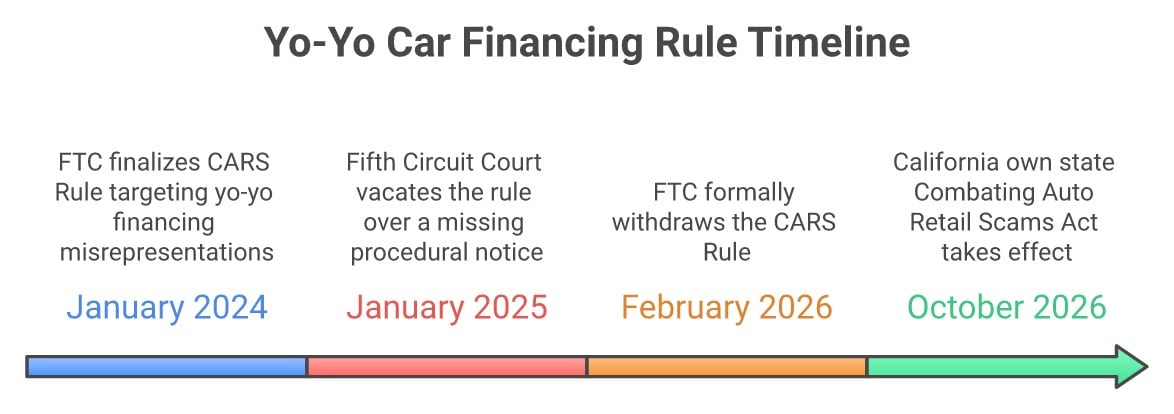
The verdict: Myth. The FTC did write a rule in January 2024 targeting “yo-yo” financing — where a dealer lets you drive off, then calls days later saying financing “fell through” and demands a worse deal or the car back. But it never took effect: the Fifth Circuit vacated it in January 2025 because the FTC skipped an advance notice of proposed rulemaking — a step the FTC’s own rules require, and one the court held was not harmless — without ever ruling on whether the protections themselves were justified, and the FTC formally withdrew it in February 2026. There is no comprehensive federal rule banning yo-yo financing today. The FTC’s own February 2026 withdrawal notice confirms it.
Well, Actually…
I still see people say some version of “the government cracked down on that, dealers can’t pull that anymore.” I understand why — the FTC really did publish a rule in January 2024 (announced the month before) that, among other things, targeted the yo-yo tactic, and it got a lot of press. It was called the Combating Auto Retail Scams Trade Regulation Rule — the CARS Rule — and its main focus was actually hidden junk fees and bait-and-switch pricing. But buried inside it were two provisions aimed squarely at yo-yo financing, § 463.3(h) and (i): they made it illegal for a dealer to misrepresent whether your deal was final, or to misrepresent that it could keep your cash down payment or trade-in, charge you fees, or take legal action if the deal wasn’t finalized. (The FTC was explicit that these are anti-misrepresentation rules, not a flat ban on a dealer ever keeping a deposit — if there’s no misrepresentation, there’s no violation.) Still, that’s the yo-yo/spot-delivery tactic, named and addressed, in the actual regulatory text.
Here’s the part almost nobody heard about: it never went into effect. Car dealer trade groups sued before the rule’s effective date ever arrived, and on January 27, 2025, the Fifth Circuit Court of Appeals vacated the entire rule in a 2–1 decision — not because a majority of the court found the underlying prohibitions unjustified (it explicitly declined to reach that question), but because the FTC skipped a step its own rules of practice require before it writes a trade regulation rule — an advance notice of proposed rulemaking, called an ANPRM. It never issued one, and the court held that omission was not harmless. (The wrinkle: Congress, in the Dodd-Frank Act, had actually relieved the FTC of the statutory ANPRM requirement for rules about car dealers — but the FTC’s own regulations, 16 C.F.R. § 1.10, still required one, and an agency has to follow its own rules.) One procedural miss killed the whole rule, including the yo-yo provisions buried inside it. The FTC then made it official: on February 12, 2026, it published a final rule formally withdrawing the CARS Rule. So today, in 2026, there is no federal trade regulation rule that specifically bans yo-yo financing. That’s the myth, corrected.
The FTC banned yo-yo/spot-delivery car financing scams — there’s a federal rule against it now.
The FTC’s CARS Rule, published January 4, 2024, did prohibit dealers from misrepresenting whether a deal was final and from misrepresenting that it could keep your down payment or trade-in, or charge fees, if a yo-yo deal fell through. But the Fifth Circuit vacated the entire rule on January 27, 2025, and the FTC formally withdrew it effective February 12, 2026. It was never enforced against a single dealer because it never took effect.
Fine — so a court decided the rule was a bad idea and threw it out.
Not quite. The 2–1 majority never actually ruled on whether the yo-yo protections were a good idea — it vacated the rule solely because the FTC skipped a required procedural step, and said explicitly it was declining to reach the dealers’ separate argument that the rule itself was arbitrary and capricious. It was the dissenting judge, Stephen Higginson, who took on that question directly — writing that the FTC had “ample evidence of unfair and deceptive trade practices” and calling it “regrettable” that the rule was being set aside anyway. So one judge, in dissent, thought the rule deserved to survive on the merits. The court as a whole never decided that question at all — it died on the procedural miss alone.
Why You Were Told This
This one isn’t a case of someone profiting from your confusion — it’s a case of the announcement getting far more coverage than the reversal. The FTC’s December 2023 press release and the January 2024 final rule made headlines because yo-yo financing is a genuinely awful, common tactic; the FTC’s own rulemaking record includes a consumer-group comment citing a Department of Defense data summary in which military counselors named yo-yo financing among the most frequent auto-lending abuses affecting servicemembers. But a federal appeals court vacating a rule a year later, on a procedural ground that doesn’t get the same headlines, doesn’t get anywhere near the same coverage. Add in that the FTC’s own formal withdrawal didn’t happen until February 2026 — more than a year after the court ruling — and you get a long stretch where the rule was legally dead but the public record still looked unresolved. I’ve written before about the FTC’s other auto dealer enforcement activity and state settlements against dealers for bait-and-switch pricing — those are real, live, enforceable actions. The CARS Rule’s yo-yo provisions were not; they’re a rule that existed on paper for about a year and never got the chance to protect anyone.
What Actually Protects You Now
Losing the CARS Rule doesn’t mean you’re unprotected — it means the protection you have is a patchwork instead of one clean federal rule, and it’s worth knowing what’s actually still standing.
- The FTC’s general authority against unfair and deceptive practices didn’t go anywhere. Vacating the CARS Rule killed that specific trade regulation, not Section 5 of the FTC Act itself. The FTC can still act case-by-case against dealers for unfair or deceptive practices — in March 2026, separate from the CARS Rule, it sent warning letters to 97 auto dealership groups over hidden pricing, alongside pending cases against individual dealers.
- Get your own financing pre-approved before you shop, in writing, from a bank or credit union — not the dealer. The classic yo-yo setup only works because the dealer controls whether financing is “approved.” Walking in with your own pre-approved loan removes that leverage entirely.
- If you do finance through the dealer, read the contract for a financing-contingency or “seller’s right to cancel” clause before you sign. Most dealer-financed contracts have one, so expect to be asked to sign one — and instead of arguing over that, ask exactly how many days the dealer has to secure final approval, and what happens to your down payment and trade-in if it doesn’t. Get the answer in writing, and don’t treat “approved” as final until that window has closed.
- Check whether your state has its own law. Some states regulate spot delivery directly — California is one I’ve verified, though its rules are narrower than they first look. California Civil Code § 2982.9 covers the specific case where you arranged financing yourself, without the dealer’s help, and the dealer knew it — if that financing falls through, the deal is automatically rescinded and both sides have to return what they got, no demand required. Separately, California’s own Combating Auto Retail Scams (CARS) Act (SB 766), signed in October 2025 and taking effect October 1, 2026, bans a dealer from misrepresenting your financing approval status or misrepresenting that it will keep your down payment or trade-in if a deal falls through — picking up most, though not quite all, of the federal rule’s yo-yo protections. It also creates something the federal rule never had (and replaces California’s current, paid two-day contract-cancellation option for used cars under $40,000, Veh. Code § 11713.21, which SB 766 repeals on the same date): buyers of a used vehicle priced at $50,000 or less get a genuine 3-day right to cancel the deal for any reason — subject to a 400-mile limit and a restocking fee the statute allows — and if you use it, the dealer must return your down payment and trade-in within 48 hours.
- If it happens to you anyway, know your leverage — and your obligations. If a dealer calls demanding the car back or a worse deal, don’t sign anything new on the spot. Get the cancellation in writing and insist on the return of your down payment and trade-in before or at the same time you return the vehicle. If your contract has a valid financing-contingency clause, you may genuinely be required to give the car back — but the dealer is required to give back what you paid, and refusing to negotiate under pressure is not the same as refusing to comply with a valid contract term. If the dealer threatens repossession outside that process, understand your actual rights before and during a repossession before you agree to anything.
- File a complaint even without a federal rule. Report the dealer to the FTC (Section 5 enforcement is still live), your state attorney general, and your state’s DMV or motor vehicle licensing board, which often has direct authority to discipline a dealer’s license.
Steve’s Take
What bothers me about this one isn’t that the myth is wrong — it’s that believing it makes people LESS careful at exactly the moment they need to be more careful. If you think a federal rule already has your back, you’re less likely to get your own financing pre-approved, less likely to read the fine print about whether your deal is contingent, and less likely to push back when a dealer calls you back three days later with a worse offer. The truth is less comforting: the rule that would have protected you on paper never got the chance to protect anyone in practice. That means the burden is back on you — walk in with financing already lined up, get the finality of the deal in writing, and know that at least one state (California) has written its own version of the protection the federal rule never delivered, effective October 1, 2026. I’d rather you know that than assume a rule is watching your back that isn’t.
Free Tool — Contract Decoder: Have a contract from a debt relief company? The free Contract Decoder analyzes it for red flags, hidden fees, and problematic terms — before you sign anything. Decode My Contract →
Frequently Asked Questions
What is yo-yo financing, exactly?
It’s when a car dealer lets you take the vehicle home believing your financing is final, then calls you back days later — sometimes claiming your loan application was rejected by the bank — and pressures you to accept worse loan terms, pay more money, or return the car, even though you already signed paperwork treating the deal as done. It’s also called “spot delivery.”
Is there a federal law against yo-yo financing right now, in 2026?
No comprehensive one. The FTC’s CARS Rule would have prohibited the core yo-yo misrepresentations, but the Fifth Circuit vacated the rule in January 2025 and the FTC formally withdrew it in February 2026. The FTC’s general authority to police “unfair or deceptive acts or practices” under Section 5 of the FTC Act still applies to auto dealers, but there’s no rule written specifically for yo-yo financing anymore.
Why did the court kill the CARS Rule if yo-yo financing is a real problem?
The 2–1 majority didn’t rule on whether the yo-yo protections were justified at all — it vacated the rule because the FTC skipped a required procedural step (an advance notice of proposed rulemaking) before finalizing it, and expressly declined to reach the dealers’ separate argument that the FTC’s findings were arbitrary and capricious. It was the dissenting judge who addressed the merits, writing that the FTC had “ample evidence of unfair and deceptive trade practices” and calling it “regrettable” that the rule was set aside anyway — but that was one judge’s dissent, not the court’s holding.
Could the FTC just fix the paperwork problem and try again?
It could, in theory — nothing in the court’s ruling permanently bars the FTC from regulating yo-yo financing, and the defect was self-inflicted: the court faulted the FTC for skipping the advance notice its own rules (16 C.F.R. § 1.10) require, so the cure is an ANPRM or a change to its own procedures, not an act of Congress. But as of this writing, the FTC’s February 2026 action withdrew the rule entirely rather than restarting it, so there’s no active federal rulemaking on this specific issue.
Does any state ban yo-yo financing?
California comes close. Existing California Civil Code § 2982.9 requires automatic rescission and return of both sides’ money if financing you arranged yourself, without the dealer’s help, falls through. A new law — the California Combating Auto Retail Scams (CARS) Act, SB 766, signed October 2025 and taking effect October 1, 2026 — bans dealers from misrepresenting financing approval status or misrepresenting that they’ll keep your down payment or trade-in if a deal isn’t finalized, and gives buyers of used vehicles priced at $50,000 or less a genuine 3-day right to cancel with a 48-hour refund requirement. Check your own state’s vehicle sales and consumer protection statutes, since protections vary widely.
What should I do if a dealer tries yo-yo financing on me?
Don’t sign new paperwork on the spot. Get any cancellation in writing, insist on the return of your down payment and trade-in at the same time you return the car (not after), and file complaints with the FTC, your state attorney general, and your state’s dealer licensing board. Getting your own financing pre-approved before you ever go to the lot is the single best way to avoid the situation entirely.
This is my read on the law and the facts as I understand them, based on the primary sources linked above — it’s one informed perspective, not legal advice, and you’re the only one who can decide what’s right for your situation. If you’re dealing with a dealer right now, a consumer attorney who handles auto fraud can tell you exactly where you stand.
The bottom line: The federal rule that would have targeted yo-yo car financing never took effect — it was vacated for skipping a required rulemaking step and formally withdrawn in February 2026. Protect yourself the old-fashioned way: get financing pre-approved before you shop, and know exactly what your contract says happens if the dealer’s financing falls through before you sign. If someone you know still thinks the government already banned this, send them this.
Dealing With Debt? Understanding your options is the first step. See how all your debt relief options compare — including ones most sites won’t tell you about. The Find Your Path quiz gives a recommendation based on your actual numbers, and the Scam-O-Meter checks any company’s complaint history before you sign. Federal Reserve Bank of New York research shows bankruptcy filers recover faster than those who don’t file.



