

Written by Steve Rhode, consumer debt expert since 1994 • Last updated September 15, 2026
Quick Answer: The moment you filed, the automatic stay went into effect — a federal court order under 11 U.S.C. § 362(a) that stops ordinary wage garnishment, lawsuits, phone calls, and bank levies immediately, with no judge needed to activate it — though it does not stop criminal proceedings or most child-support and alimony enforcement (§ 362(b)). If a creditor is still collecting, put your case number and filing date in writing to the specific person or department doing the collecting today — payroll if it’s a garnishment, the creditor’s attorney if it’s a lawsuit. If it doesn’t stop, a willful violation entitles you to actual damages, attorney’s fees, and in some cases punitive damages under § 362(k). Don’t just call and hope — document everything, because you can’t prove a violation you never wrote down.
What Just Happened
The automatic stay isn’t something you have to ask for, wait on, or pay a fee to activate. Under 11 U.S.C. § 362(a), filing your bankruptcy petition itself “operates as a stay, applicable to all entities,” of nearly every collection action against you — lawsuits, wage garnishment, bank levies, repossession, and “any act to collect, assess, or recover a claim against the debtor.” It attaches the instant the case is filed. Not when a notice arrives. Not when the creditor gets around to updating their file. The moment the petition hits the court’s docket, every creditor on that debt is legally required to stop.
So why is one still calling, billing, or garnishing? Almost always it’s a paperwork gap, not a legal loophole. The court mails notice to every creditor you listed, but that notice can take a week or more to arrive, and it can take longer still for a big company’s internal systems — payroll, a collections desk, a law firm handling the lawsuit — to actually act on it. Sometimes the account was sold to a new collector who never checked the bankruptcy court’s public record before sending a bill. None of that makes the continued collection legal. It makes it a stay violation, and the same court that’s hearing your bankruptcy case has the power to make it stop and, in some cases, make the creditor pay you for the trouble.
This is a different protection than the one that arrives at the END of your case. The automatic stay (§ 362) protects you starting the day you file and lasts until your case is closed, dismissed, or your discharge is entered — whichever comes first (§ 362(c)(2)). The discharge injunction (11 U.S.C. § 524(a)) is a separate, permanent order that starts the moment your discharge order is entered — which in a Chapter 7 can happen while the case is still technically open. If your case has already been discharged and a creditor is still after you, you’re dealing with a discharge injunction problem, not a stay problem — see my guide for that situation instead, because the remedy (contempt of the discharge order) is slightly different from the one below.
The Mistake You’re About to Make: Calling the creditor, telling them “I filed,” and assuming that’s the end of it. A phone call leaves no record. If the collection continues and you eventually need to prove a willful violation to get damages under § 362(k), “I told them on the phone” is much weaker evidence than a dated letter, email, or fax with your case number attached. Get it in writing, to the right department, and keep a copy of what you sent and when.
Your Options Right Now
What to Do in the Next 48 Hours
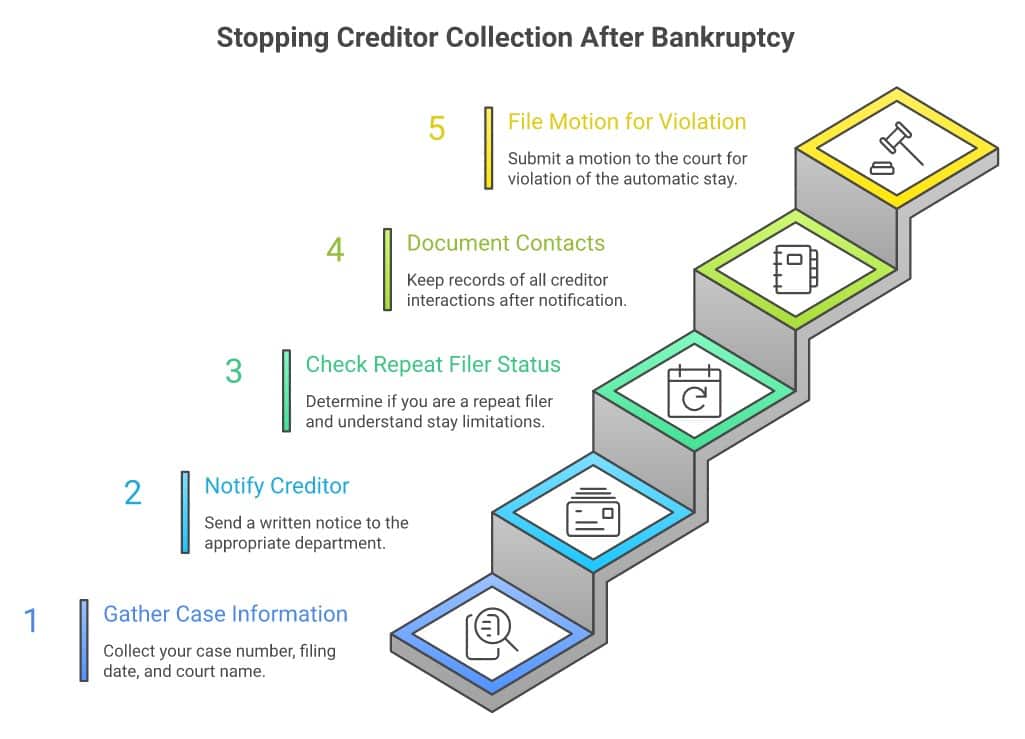
- Get your case number, filing date, and the name of your bankruptcy court in one place. You’ll need to cite all three in writing to whoever is still collecting — write them on a sticky note if you have to, because you’re about to use them repeatedly.
- Before you send anything, confirm you’re not a repeat filer (step 3 below) — if you had two or more cases dismissed in the past year, the stay may not be in effect and a notice citing it won’t help. Then put your bankruptcy filing in writing, to the specific department that’s actually collecting — not just “the company.” If it’s wage garnishment, that notice goes to your employer’s payroll or HR department, in writing, the same day, with your case number and filing date — unless the withholding is for child support or alimony, which § 362(b)(2) lets continue. (Federal bankruptcy courts take this mechanism seriously enough that some maintain their own standing order form specifically to tell an employer to stop withholding.) If it’s a lawsuit, the notice goes to the court and the creditor’s attorney. If it’s a phone or mail collector, a short written notice citing 11 U.S.C. § 362(a) and your case number is often all it takes to stop a good-faith mistake within days.
- Check whether you’re a repeat filer — this is the detail almost everyone misses. If you had a bankruptcy case dismissed within the last year, your new stay may only last 30 days unless a judge extends it before that window closes (§ 362(c)(3)). If you had two or more cases dismissed in the past year, the stay may not go into effect at all unless you ask the court to impose it, and that request has to be made within 30 days of your new petition (§ 362(c)(4)). If either applies to you, talk to your attorney about filing a motion immediately — don’t assume the stay is protecting you by default.
- Document every contact that happens AFTER you’ve given written notice. Date, time, who contacted you, what they said or sent, and how. This is the evidence that turns “they made a mistake” into “they knew and did it anyway” — which is the legal definition of willful that § 362(k) damages require.
- Contact your bankruptcy attorney, or free legal aid if you don’t have one, about filing a Motion for Violation of the Automatic Stay (or, in some courts, an adversary complaint) in your EXISTING case. You do not open a new bankruptcy case to fix this — the motion is filed inside the case you already have. Under § 362(k)(1), a willful violation entitles you to actual damages, attorneys’ fees, and costs, and in appropriate circumstances, punitive damages. If you want to talk through your whole situation first, schedule a free consultation with Damon Day, an independent debt coach and my podcast co-host. I receive no payment for this referral.
Free Tool — Wage Garnishment Calculator: Worried about your paycheck being seized? The free Wage Garnishment Calculator shows exactly how much creditors can legally take in your state — and some states prohibit garnishment entirely. Calculate My Risk →
How to Actually Stop It — Your 4 Paths
- Written notice to the right department (fastest). A large share of continued-collection cases are a good-faith paperwork gap, not defiance — a dated letter or email citing § 362(a) and your case number, sent to the department actually doing the collecting (payroll, the litigation desk, the collector), often resolves it within days without ever going near a courtroom.
- A Motion for Violation of the Automatic Stay, filed in your OPEN case. This is where the money is, if there’s money to be had. Under § 362(k)(1), a debtor injured by a willful violation “shall recover actual damages, including costs and attorneys’ fees, and, in appropriate circumstances, may recover punitive damages.” Courts don’t require proof the creditor intended to break the law — only that they knew about your bankruptcy and intended the act that violated the stay. One Rhode Island bankruptcy court used exactly that standard in 2017 when a credit card company sent two more collection letters after the debtor’s filing: the court awarded him $2,518.16 — $30 in lost income, $500 for emotional distress, and $1,988.16 in attorney’s fees — but denied punitive damages because the conduct, while willful, wasn’t extreme enough, and denied the claim entirely against a second company the debtor couldn’t actually prove had violated the stay. That’s the realistic range: real money, tied closely to documented harm, not a windfall for a single mistaken letter.
- Free legal help if you don’t have a bankruptcy attorney. Many bankruptcy attorneys will take a stay-violation motion because § 362(k) shifts the attorney’s fee to the creditor if you win — you’re often not paying out of pocket for this specific fight. LSC.gov can connect you to free legal aid, and NACBA can help you find a bankruptcy attorney.
- What WON’T work: filing a brand-new bankruptcy case, or just arguing on the phone. A second filing doesn’t “reset” enforcement of the stay you already have — you’re still in your existing case, and the remedy lives inside it. And a verbal promise from a phone rep with nothing in writing gives you nothing to show a judge if the collection doesn’t actually stop.
What You Need to Know About Your Legal Protections
what it costs you, by law, to make a good-faith stay violation stop
how long a NEW stay lasts if a prior case was dismissed in the past year, unless extended before that window closes — § 362(c)(3)
of stay protection if 2+ prior cases were dismissed in the past year — you must ask the court to impose it — § 362(c)(4)
The automatic stay is federal law under 11 U.S.C. § 362, and it applies “to all entities” the moment a petition is filed — there’s no waiting period and no separate court order required to make it effective, according to the U.S. Courts’ own explanation of Chapter 7 bankruptcy basics, which describes filing a petition as something that “‘automatically stays’ (stops) most collection actions against the debtor or the debtor’s property.” Certain actions are carved out under § 362(b) even after you file — criminal proceedings, most domestic support enforcement, and a handful of other narrow categories — but ordinary debt collection is not one of the exceptions.
| When | What Protects You | Notes |
|---|---|---|
| Before you file | General debt collection law (FDCPA) | Limits how a collector can contact you, but doesn’t stop them from trying to collect |
| The moment you file (this guide) | Automatic stay — 11 U.S.C. § 362(a) | Stops collection immediately; identical in every state — this protection doesn’t vary by where you live |
| If you’re a repeat filer | 11 U.S.C. § 362(c)(3) / (c)(4) | Stay may run only 30 days, or may not start at all without a motion |
| After your case is discharged | Discharge injunction — 11 U.S.C. § 524(a) | A separate, permanent order — see the post-discharge guide if this is your situation |
Unlike a homestead exemption or a state wage-garnishment cap, the automatic stay doesn’t change based on what state you filed in — it’s identical whether your case is in Alabama or Alaska. If you want to see where state law does change your protections, see my complete guide to the automatic stay for the full mechanics of how it works from filing day forward.
If a creditor keeps collecting after you’ve given them written notice of your bankruptcy filing, file a complaint with the CFPB and your state attorney general. If you need help enforcing the stay and can’t afford an attorney, find free legal aid through LSC.gov.
Steve’s Take
I filed bankruptcy in 1990, and the day my attorney filed the petition, the phone stopped ringing. Not gradually — immediately. That’s what the automatic stay is supposed to feel like. So when a reader tells me a creditor is STILL calling after they filed, I know exactly how disorienting that is — you did the one thing that was supposed to make it stop, and it didn’t. Most of the time it’s a sold account or a slow payroll department, not a creditor daring you to do something about it. Either way, this isn’t a shame problem, it’s a paperwork problem, and paperwork responds to being put in writing. Document it, and let the law — not your patience — do the talking.
Frequently Asked Questions
I just filed bankruptcy last week and a collector called me — can they do that?
No, not once your petition is filed. Under 11 U.S.C. § 362(a), the automatic stay stops “the commencement or continuation… of an action… to recover a claim against the debtor” the moment your case is filed — there’s no waiting period. If it’s happening anyway, it’s usually a notice lag while the creditor’s system catches up, not a deliberate choice. Put your case number and filing date in writing to them today.
My wages are still being garnished even though I filed — how do I stop it?
Send written notice of your bankruptcy filing — case number, filing date, court name — directly to your employer’s payroll or HR department, not just to the creditor — unless the garnishment is for child support or alimony, which the stay generally does not stop (§ 362(b)(2)). Payroll is often the last link in the chain to hear about a filing, and garnishment can continue for a pay period or two simply because nobody told the right desk. If it doesn’t stop after written notice, that’s a stay violation your attorney can raise with the court.
Can I actually get money out of this, or just make them stop?
Both are possible, but the money isn’t automatic or huge for a single slip-up. Under 11 U.S.C. § 362(k)(1), a willful violation entitles you to actual damages, attorney’s fees, and costs, and in appropriate circumstances, punitive damages. In one 2017 Rhode Island case, a bankruptcy court awarded a debtor $2,518.16 after a credit card company sent two collection letters post-filing — but denied punitive damages because the conduct wasn’t extreme, and denied the claim entirely against a second creditor the debtor couldn’t prove had actually violated the stay. Expect the damages to track your documented, provable harm, not a windfall.
Do I have to file a whole new bankruptcy case to make this stop?
No. The remedy is a Motion for Violation of the Automatic Stay filed inside your EXISTING, already-open case — not a second bankruptcy filing. Talk to your bankruptcy attorney, or contact free legal aid through LSC.gov if you don’t have one.
I had a bankruptcy case dismissed last year and just filed again — am I protected?
Maybe only partially, and this is the detail most people never check. If you had one case dismissed in the year before this filing, your new stay may last only 30 days unless a judge extends it before that window closes (11 U.S.C. § 362(c)(3)). If you had two or more cases dismissed in the past year, the stay may not go into effect automatically at all — you have to ask the court to impose it (§ 362(c)(4)). Ask your attorney about this immediately if you’ve filed before.
What’s the difference between this and the protection I get when my case is discharged?
The automatic stay (11 U.S.C. § 362) protects you from the day you file until your case is closed, dismissed, or your discharge is entered, whichever comes first. The discharge injunction (11 U.S.C. § 524(a)) is a separate, permanent order that starts the moment your discharge order is entered — which in a Chapter 7 can happen while the case is still technically open. If your discharge has already been entered and a creditor is still collecting, see my guide to post-discharge collection instead — the remedy there is contempt of the discharge order, not a stay-violation motion.
The creditor says they didn’t know about my bankruptcy — does that matter?
It matters for whether the violation counts as “willful” under § 362(k), which is what you need to recover damages. Courts have generally held that a willful violation doesn’t require the creditor to have intended to break the law — only that they knew the stay was in effect and intended the act that violated it. That’s why written, dated proof that you notified them matters so much: once you can show they knew, the burden shifts hard against them.
One more thing — everything I share here is based on 30 years of helping people through exactly this. But my advice is input for your decision, not the decision itself. Only you know your full situation. Talk to an attorney, look at your numbers, and make the choice that serves your future.
Important: This guide is for informational purposes only and is not legal advice. Laws vary by state, and your situation may have details that change what options are available to you. For legal advice specific to your case, consult an attorney licensed in your state. NACBA can help you find a bankruptcy attorney, NACA can connect you with a consumer attorney, or schedule a free consultation with Damon Day, an independent debt coach and my podcast co-host — I receive no payment for this referral.
Key Takeaway: A creditor still collecting after you’ve filed is almost always a paperwork gap, not a legal loophole — but it’s YOUR job to close that gap in writing, because the law only helps you enforce what you can prove. Talk to your bankruptcy attorney this week if written notice doesn’t stop it. The longer it continues undocumented, the harder it is to prove it was willful.
The Bottom Line
You didn’t do anything wrong by filing bankruptcy, and a creditor who keeps collecting anyway didn’t expose a flaw in your decision — they exposed a gap in their own paperwork. The automatic stay is one of the strongest consumer protections in American law, and the readers who documented everything and put it in writing fast were, in my experience, the ones who got it resolved fastest. If someone you know just filed and is still getting calls, send them this page — the five steps above are the difference between a week of frustration and a motion that actually pays for itself. For the full mechanics of how the stay works from day one, see the complete automatic stay guide, or take the 2-minute bankruptcy quiz if you haven’t filed yet and want to know if it’s the right move.
Dealing With Debt? Understanding your options is the first step. See how all your debt relief options compare — including ones most sites won’t tell you about. The Find Your Path quiz gives a recommendation based on your actual numbers, and the Scam-O-Meter checks any company’s complaint history before you sign. CFPB and academic research shows bankruptcy filers recover faster than those who don’t file.
Right now you are dealing with the thing in front of you, and that is exactly where your attention belongs. When it is handled — and it will be — there is a next stage, and it is the one I most enjoy writing about.
In the latest issue (Oct 16): The check that looks like a scam may be real
Each weekday I send one short email: one money story that caught my attention, why it might matter to you, and one manageable thing you can do with it. It is free, I sell nothing, and I take no money from any company I write about.



