

Written by Steve Rhode, consumer debt expert since 1994 • Last updated September 16, 2026
Quick Answer: A judgment creditor just froze money in your business checking account — and whether it was even allowed to depends on who the judgment names. If you’re a sole proprietor, there’s no legal line between your business and personal money, so it’s fair game. If you run an LLC or corporation and the judgment is against you personally, the entity’s own account may be off-limits — most states limit a creditor of an individual member to a charging order against your ownership interest, not direct access to entity funds. Call your bank’s levy department today, notify it in writing if the account holds money the law treats as someone else’s (withheld payroll taxes, collected sales tax, a client’s escrow), and check your state’s claim-of-exemption deadline — as short as 15 days in California. Filing bankruptcy stops it instantly under the automatic stay. Don’t wait — it gets worse, not better.
What Just Happened to Your Business Account
Somewhere — often without you fully realizing it — a creditor got a court judgment (frequently a default judgment because a lawsuit notice went to an old address or got missed in the daily mail) and then served your bank with a writ of execution, garnishment, or levy. The bank had no choice but to freeze the funds in the account named in that order the moment it was served; banks don’t evaluate whether freezing hurts your payroll run or your ability to pay a supplier, they just comply.
The part almost nobody explains clearly: the judgment has to be against the actual legal person who owns the account. If you operate as a sole proprietorship or a single-member LLC that never opened a separate account titled to the LLC under its own EIN, your business bank account may legally still be titled to you personally — which makes it identical to your personal savings account in a creditor’s eyes. If you operate as a properly separated LLC, S-corp, or C-corp, the account belongs to the entity, and a judgment against you as an individual generally cannot reach it directly. The reverse is also true: a judgment against your business generally can’t touch your personal accounts if you kept things separate. Which situation you’re in decides almost everything else in this guide.
The Mistake You’re About to Make: Wiring what’s left in the account to a personal account, a family member, or a new bank the moment you hear a levy is coming. It feels protective. It’s the opposite. Under 11 U.S.C. § 548(a)(1)(A), a bankruptcy trustee can unwind any transfer made in the two years before you file if it was made “with actual intent to hinder, delay, or defraud” a creditor — and most states have a nearly identical rule outside of bankruptcy. Moving money to dodge a known levy is the textbook example. Paying rent, suppliers and employees in the ordinary course from money that arrives after the levy is not the problem; sending money to a relative, a friend’s account, or a new entity to keep it away from a judgment you know about is. One exception to check: in New York, if a restraining notice was served on you (not just the bank), CPLR § 5222(b) forbids you from transferring any non-exempt property at all, ordinary course or not, until the judgment is paid or a court says otherwise — get a lawyer before the next payroll run. It can get the transfer clawed back, jeopardize a later bankruptcy discharge, and hand the creditor’s attorney exactly the bad-faith argument they were hoping for. Read your actual options below before you touch what’s left in that account.
Free Tool — I'm Being Sued for Debt Guide: Being sued by a creditor or debt collector? The free I'm Being Sued Guide gives you a personalized action plan — deadlines, defenses, and options based on your state. Most states require a response within 20–30 days. Get My Action Plan →
Your Options Right Now
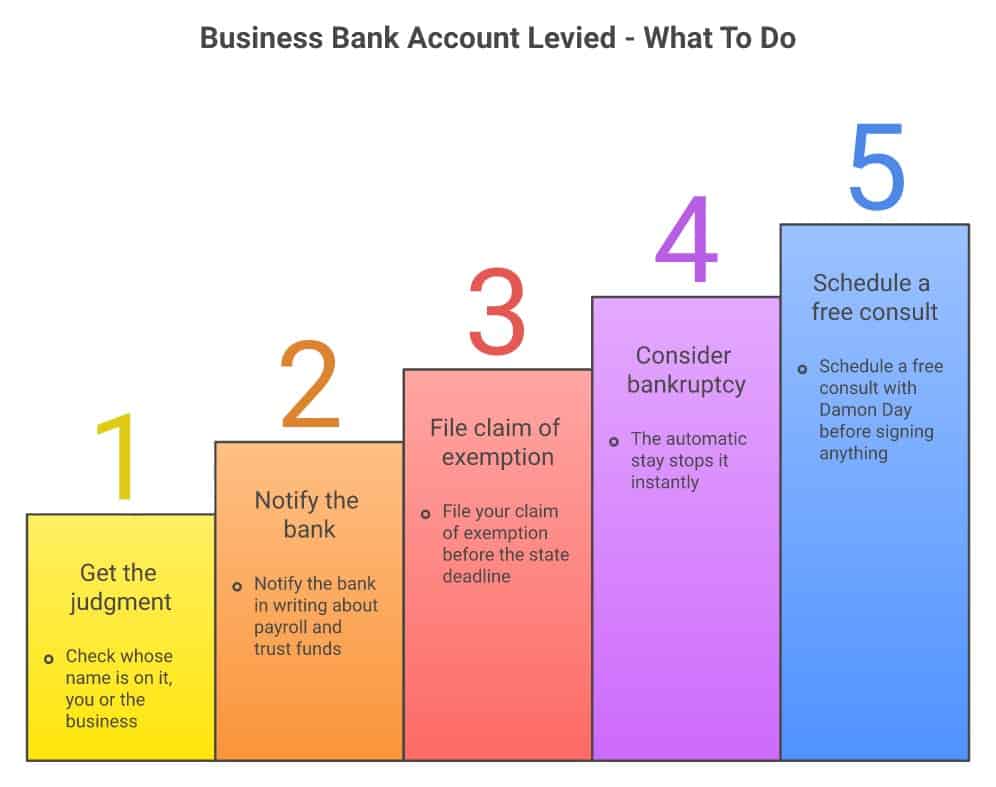
What to Do in the Next 48 Hours
- Get the judgment and read the caption. Call the court clerk or your bank’s levy department and get the actual judgment and writ, not just the bank’s notice. Look at whose name is on it — you personally, your LLC, your S-corp — and compare that to whose name is on the frozen account. That mismatch, if it exists, is your strongest and fastest argument.
- Put trust-fund money in writing immediately. If the account holds money the law treats as belonging to someone else — payroll taxes you withheld from employees’ checks (federal law calls those a fund held in trust for the United States, 26 U.S.C. § 7501), sales tax you collected for the state, or a client’s escrow or retainer held under a specific trust rule — notify the bank’s levy department and the creditor’s attorney in writing today. Ordinary wages you owe employees are a debt of the business, not trust money; the creditor doesn’t have to yield for them, which is exactly why you should pay payroll first from money that comes in after the levy. State trust-fund rules on exactly how this gets resolved vary, so follow up with an attorney fast — but the notice itself needs to go out now, before the money moves.
- File your claim of exemption before the deadline — it is short. If any part of what got frozen is exempt (a benefit deposit, earnings in states that extend the wage exemption to the self-employed, a state-specific exemption), you generally have to assert it in writing within days, not weeks. California gives you 15 days if personally served, 20 days if by mail (Cal. Civ. Proc. Code § 703.520). In New York the creditor must serve the bank with an exemption notice and claim forms, the bank mails them to you, and you have 20 days from the postmark to serve your claim on the bank and the creditor’s attorney (CPLR § 5222-a). Every state’s form and deadline differ — find yours immediately.
- Consider bankruptcy — the automatic stay stops this the moment you file. Under 11 U.S.C. § 362(a), filing a Chapter 7 or Chapter 13 petition immediately stops “any act to collect…a claim against the debtor” and any “act to obtain possession of…or exercise control over property of the estate.” Not weeks later — the moment the petition is filed. Sole proprietors and single-member LLC owners file personal Chapter 7 or Chapter 13 cases routinely. Chapter 7 eligibility sits in 11 U.S.C. § 109(b); Chapter 13 sits in § 109(e), which limits it to individuals with regular income under a debt ceiling that has moved more than once in the last few years (see my coverage of the current Chapter 13 debt limit for the number in force today). One caution: in Chapter 7 the trustee takes control of everything you own as of the filing date — including your ownership interest in an LLC — especially a single-member LLC — (11 U.S.C. § 541(a)) — and can sell or wind the company down. If you need the business to keep operating, Chapter 13 (if you have regular income) or Subchapter V is usually the conversation to have with the attorney first. Subchapter V of Chapter 11 exists specifically for small businesses that need to reorganize. NACBA can connect you with a bankruptcy attorney who handles business cases, and my 2-minute bankruptcy quiz can help you think through whether it fits.
- Schedule a free consultation with Damon Day. Before you sign anything with the creditor’s attorney, schedule a free consultation with Damon Day, an independent debt coach (not an attorney) and my podcast co-host. I receive no payment for this referral.
Free Tool — Contract Decoder: Have a contract from a debt relief company? The free Contract Decoder analyzes it for red flags, hidden fees, and problematic terms — before you sign anything. Decode My Contract →
How to Actually Stop It — Your 4 Paths
- Bankruptcy, if the debt load is bigger than this one levy. The automatic stay under 11 U.S.C. § 362 halts the levy the instant you file, and in some cases a bankruptcy trustee can recover funds already seized through a turnover action. Federal Reserve Bank of New York research finds filing is associated with a faster financial recovery.
- Challenge whether the account was even reachable. If you kept your LLC or corporation properly separated — its own EIN, its own bank account, its own books, no personal bills paid from the business account — and the judgment names you personally, your attorney may be able to get the levy released outright because the entity’s funds were never the judgment debtor’s property to take. This is exactly the kind of state-law-specific question that needs a local business attorney fast, because courts treat single-member LLCs less consistently than multi-member ones on this point, and a history of commingling personal and business funds in that account can undo the protection entirely (courts can pierce the liability shield when the entity was never really operated separately).
- Negotiate a release for a payment plan. Creditors would often rather get paid on a schedule than force you out of business entirely, which also ends their chance of collecting anything further. Get any release agreement in writing before you assume the freeze is lifted, and never rely on a verbal promise from the creditor’s attorney.
- What won’t work: just opening a new account somewhere else. It’s legal, and it can keep the business running today — but it does nothing to stop the same creditor from levying the new account next month once they find it. A new account buys you time to fix the actual problem; it isn’t the fix. Use it for ordinary business — payroll, supplier payments, client receipts. Wiring the frozen balance into it is the same transfer the warning above is about.
What You Need to Know About Federal Benefit Protection and IRS Levies
federal benefit lookback protection under 31 CFR Part 212
the IRS holds levied bank funds before sending them to itself
California’s claim-of-exemption deadline
when the bankruptcy automatic stay takes effect
If Social Security, VA, federal retirement, or Railroad Retirement benefits were direct-deposited into that account in the two months before the freeze, 31 CFR Part 212 requires your bank to review the two months before the freeze and automatically protect the lesser of the benefits deposited in that window or the account balance — the bank cannot freeze that protected amount and you don’t have to assert an exemption to get it (31 CFR § 212.6(a)). But read the definitions carefully: the regulation protects an “account holder,” defined as a natural person whose name appears on the account (31 CFR § 212.3). If your business account is titled to an LLC or corporation rather than to you individually, this specific federal protection may not apply the way it would to a personal account — another reason how the account is titled matters as much as what’s inside it.
An IRS levy runs on a completely different, faster clock than a private judgment creditor. The IRS doesn’t need to sue you first — under 26 U.S.C. § 6331(a), it can levy after you neglect or refuse to pay within 10 days of notice and demand, and it must give you 30 days’ advance notice of your right to a Collection Due Process hearing under 26 U.S.C. § 6330 before the first levy in most cases. Once the IRS levies a bank account, the bank must hold the funds for 21 days before sending them to the IRS (26 U.S.C. § 6332(c)) — that window exists specifically so you can request a release or work out payment terms. This one paragraph only scratches the surface; see my complete guides on what to do about an IRS levy and the IRS tax lien process for the full picture.
If you’re being ignored or misled by the creditor or its attorney, file a complaint with the CFPB and your state attorney general. If you need legal help but can’t afford an attorney, find free legal aid through LSC.gov.
Is this actually your situation? This guide covers a judgment creditor levying a self-employed person’s own business operating account. If it’s your personal checking account that was frozen, see My Bank Account Was Just Frozen. If a merchant cash advance company froze the account through a confession of judgment or a Deposit Account Control Agreement, see A Merchant Cash Advance Company Froze My Bank Account. If a debt collector (not a court judgment yet) is behind the levy, see Bank Levy by a Debt Collector. And if the real problem is a business loan you personally guaranteed, see My Business Failed and I Personally Guaranteed the Loan.
Steve’s Take
I filed bankruptcy in 1990 after my own real estate business collapsed, and I remember exactly what it feels like to watch money you need for tomorrow disappear because of something you signed or ignored months earlier. Business owners carry an extra layer of shame here — you feel like you failed not just yourself but the people counting on your paychecks. You didn’t fail. Debt is math wrapped in emotion, and the math on a frozen account is fixable: figure out whose name is on the judgment, hit your state’s deadline, and stop treating “the business” as a separate person from “you” if the law doesn’t. Thousands of self-employed people have been through exactly this. The ones who acted in days, not weeks, kept more of their business intact.
Frequently Asked Questions
My business bank account was levied — can they take payroll or a client’s money that’s sitting in it?
Not automatically, but you have to say something. Money you’re holding for someone else — payroll taxes you withheld from employees’ checks (26 U.S.C. § 7501 calls that a fund held in trust), sales tax you collected for the state, a client’s escrow or retainer held under a trust rule — is arguably not “your” property even though it’s sitting in your account. Ordinary wages you owe employees are different: that’s a debt of the business, not trust money, and the levy doesn’t have to yield for it. State rules on how this gets resolved vary, so notify the bank and the creditor’s attorney in writing immediately and get an attorney involved fast; don’t assume the bank will sort this out on its own.
The judgment is against my LLC, not me personally — can they still take my personal bank account?
Generally no, if you kept the LLC’s finances genuinely separate from your own. The reverse of this guide’s main scenario is also true: a judgment against the entity typically can’t reach your personal accounts unless a court finds you personally guaranteed the debt or treated the LLC as your personal piggy bank (commingling), which can lead a court to disregard the separation entirely.
I opened a new business bank account at a different bank — am I safe now?
Only temporarily. It’s legal, and it keeps you operating today, but it does nothing to stop the same creditor from serving a new levy on the new account once they locate it — usually by pulling your next tax return, a UCC filing, or simply asking you in discovery. Use the time it buys to fix the underlying judgment, not to assume the problem is solved.
Does Social Security or another federal benefit deposited into my business account get the same protection as a personal account?
The federal regulation that automatically protects two months of federal benefit deposits, 31 CFR Part 212, defines the protected “account holder” as a natural person. If the account is titled to you individually, it should apply the same way it would to any personal account. If it’s titled to an LLC or corporation, that specific automatic protection may not clearly apply — ask your bank directly which name is on the account and raise this with your attorney.
How fast does filing bankruptcy stop a business account levy?
Immediately. The automatic stay under 11 U.S.C. § 362(a) takes effect the moment your petition is filed — not after a hearing, not after the creditor is notified. It stops the continuation of the collection action and any further act to control property of the estate. If money hasn’t been disbursed to the creditor yet, your attorney can sometimes get it returned through a turnover motion.
Can I be held personally liable even though I run a single-member LLC?
Yes, in several situations: you personally guaranteed a loan or lease, you personally signed a contract, you commingled personal and business funds so a court disregards the LLC entirely, or the debt is a type the law treats as personal regardless of entity (like unpaid payroll taxes you were responsible for withholding). Forming an LLC reduces liability risk — the SBA is explicit that it does not eliminate it in every situation.
What’s the deadline to fight the levy where I live?
It’s short everywhere and different in every state. California requires a claim of exemption within 15 days if you were personally served, 20 days if served by mail (Cal. Civ. Proc. Code § 703.520). In New York the creditor serves the bank with an exemption notice and two claim forms alongside the restraining notice, the bank mails them to you, and you have 20 days from the postmark to serve a completed form on the bank and on the creditor’s attorney (CPLR § 5222-a). Call your court clerk today — don’t assume you have weeks.
Is an IRS levy on my business account different from a regular creditor’s levy?
Completely. The IRS doesn’t need to sue you or get a court judgment first — it can levy under 26 U.S.C. § 6331 after 10 days’ notice and demand, though it must generally give you 30 days’ notice of your right to a Collection Due Process hearing first under 26 U.S.C. § 6330. Once it levies your bank account, the funds sit for 21 days before the bank sends them to the IRS (26 U.S.C. § 6332(c)) — use that window. See my complete guide on IRS collection action for the full process.
One more thing — everything I share here is based on 30 years of helping people through exactly this. But my advice is input for your decision, not the decision itself. Only you know your full situation. Talk to an attorney, look at your numbers, and make the choice that serves your future.
Important: This guide is for informational purposes only and is not legal advice. Laws vary by state, and your situation may have details that change what options are available to you. For legal advice specific to your case, consult an attorney licensed in your state. NACBA can help you find a bankruptcy attorney, NACA can connect you with a consumer attorney, or schedule a free consultation with Damon Day, an independent debt coach and my podcast co-host — I receive no payment for this referral.
Key Takeaway: Whether a creditor could legally reach your business bank account depends entirely on who the judgment names and how carefully you kept business and personal money separate. Figure that out today, hit your state’s exemption deadline, and talk to an attorney this week — the longer this sits, the more of it becomes irreversible.
The Bottom Line
Running your own business and still ending up here doesn’t mean you failed at anything except paperwork most people never get taught. The law actually drew real lines between what a creditor can and can’t touch — you just have to find out which side of them you’re on, fast. The self-employed people who came through this fastest were the ones who read the judgment caption, hit their deadline, and got a real attorney or Damon Day’s free take in the first week, not the fourth. If you know another self-employed person dealing with a frozen account, send them this page — the deadlines move faster than the panic does. See the complete Crisis Guide library and take the Find Your Path quiz for a recommendation based on your actual numbers.
Dealing With Debt? Understanding your options is the first step. See how all your debt relief options compare — including ones most sites won’t tell you about. The Find Your Path quiz gives a recommendation based on your actual numbers, and the Scam-O-Meter checks any company’s complaint history before you sign. Federal Reserve Bank of New York research shows bankruptcy filers recover faster than those who don’t file.
Right now you are dealing with the thing in front of you, and that is exactly where your attention belongs. When it is handled — and it will be — there is a next stage, and it is the one I most enjoy writing about.
In the latest issue (Oct 8): A parent's nursing home bill can become yours
I write Your Money Actually most weekdays — actionable money information you will not find anywhere else, and the small decisions that compound. It is free, I sell nothing, and I take no money from any company I write about.



