

On September 16, 2026, NPR reported on data the U.S. Department of Education published from its late-May 2026 run: at 500 colleges, at least 4 in 10 recent federal student loan borrowers aren’t making their payments. I went and pulled that data directly from the Department’s own file rather than take anyone’s word for it — and the number that matters to you isn’t the school-level headline. It’s what happens to your paycheck, your tax refund, and your credit if you’re one of the people inside those numbers.
Debt is math wrapped in emotion. This data is math about schools — but if you’re behind on a loan from one of them, the emotion is all yours to deal with, and I want you to have the whole picture before you decide what to do next.
What the Education Department Actually Published
This isn’t a leak or an advocacy group’s analysis. The Department’s own Federal Student Loan Portfolio data center posted a spreadsheet called “Nonpayment Rates by Institution,” run in late May 2026. I downloaded it myself. Here’s the Department’s own definition, word for word, from the file’s Definitions tab:
Nonpayment Rate — “Percentage of ‘Total Borrowers Evaluated’ who have open Direct Loans that entered repayment between January 2020 and May 2025, that are greater than 90 days delinquent (including default) at the time of the data run.”
Each weekday I send one short email: one money story that caught my attention, why it might matter to you, and one manageable thing you can do with it. A couple of minutes, and a dad joke.
In the latest issue (Oct 16): The check that looks like a scam may be real
Free. I sell nothing. Unsubscribe any time.
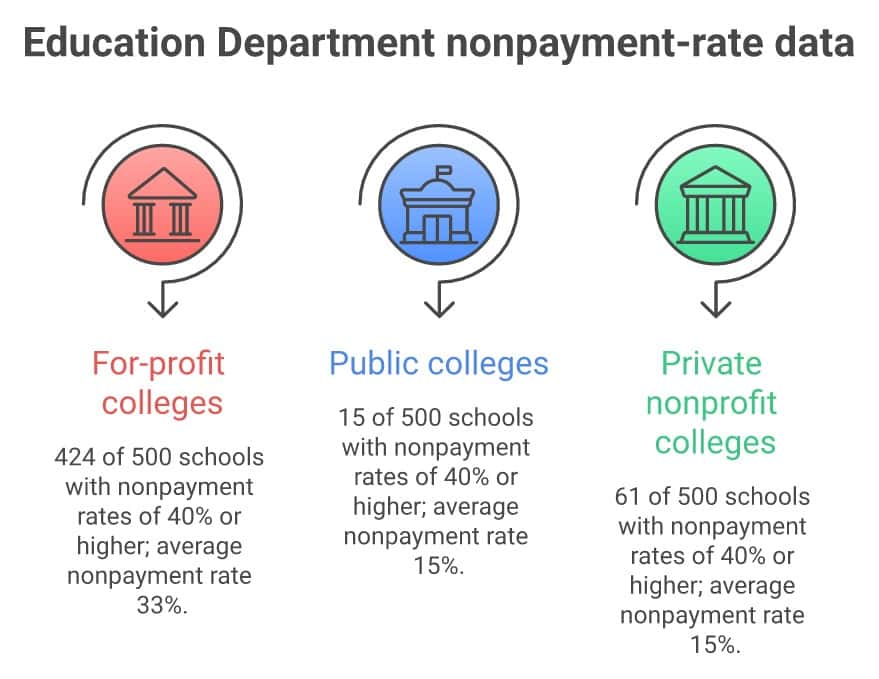
That’s roughly 17 million borrowers across every school in the country. Of those, the Department flagged 500 schools where at least 40% of evaluated borrowers are more than 90 days behind. According to the school-level breakdown in that same file, 424 of those 500 are for-profit colleges, 15 are public institutions, and the rest — about 61 — are private nonprofit schools. The Department’s own February 2026 press release on this same framework says more than 1,800 institutions nationwide are at or above 25%. Under Secretary Nicholas Kent put it this way: “With nonpayment rates rising at hundreds of colleges and universities across the country, institutions must do more to support successful loan repayment outcomes.”
The averages by school type, straight from the Department’s own tab: public colleges 16%, private nonprofit colleges 15%, for-profit colleges 33%. This isn’t a partisan talking point — it’s where federal loan dollars went out the door and aren’t coming back on schedule, and for-profit schools carry roughly double the nonpayment rate of everyone else.
The Daily Money Brief — Free, at 10 AM
Money you may be owed, scams to dodge, and the fine print decoded — the consumer money news that affects your wallet, every weekday.
Named Schools, and What the Department’s Own File Actually Shows
I checked the specific schools NPR named against the raw file instead of just repeating the article. Here’s what the Department’s own numbers say, by OPE ID, from the May 2026 run:
- Florida Career College — 28,000 borrowers evaluated, 61% nonpayment. This is the same school the Department moved in April 2023 to cut off from federal aid after finding staff manipulated the “ability to benefit” test used to admit students without a high school diploma.
- Miller-Motte College (Tennessee) — 37,000 borrowers evaluated, 50% nonpayment.
- Tulsa Welding School — 19,700 borrowers evaluated, 54% nonpayment.
- UEI College — two California campus IDs in the file, roughly 12,500 and 19,400 borrowers, at 56% and 54% nonpayment respectively — combined, close to the 32,000 borrowers and roughly 55% NPR cited.
- Legends Barber College (Texas) — 100 borrowers evaluated, 81% nonpayment. It’s a tiny school, but that’s four out of five of its federal borrowers who entered repayment in that window.
Myth vs. Reality: Does This List Change Anything About Your Loan?
Myth: “My school is on this list, so something about my loan just changed.”
Reality: Nothing about your individual loan changes because your school’s nonpayment rate got published. This data is an institutional accountability tool. It’s the Department’s early-warning system for a separate, more serious measure — the school’s official Cohort Default Rate (CDR), which only counts borrowers who hit 270 days past due and formally default. A school loses access to all federal student aid if its CDR hits 40% in a single year, or 30% or higher for three years running (34 CFR § 668.206). Nonpayment rate is the smoke; CDR and losing Title IV eligibility is the fire. Neither one changes what you personally owe, what your interest rate is, or your options.
What does matter is whether you personally are inside that 90-day-delinquent bucket right now — because that’s the same population this whole story is about, and the clock on your loan doesn’t care whether your school makes the news.
If You’re Actually Behind: What’s Real Right Now
Ninety days delinquent gets you counted in this data. Two hundred seventy days delinquent — nine months — is federal default, and that’s when the government’s collection tools turn on. Here’s exactly what’s live today, September 2026, sourced straight from the Department and the statutes, not from what “everybody knows”:
- Treasury tax refund offset (31 U.S.C. § 3720A): the mechanism the government uses to intercept your federal tax refund and apply it to a defaulted federal loan.
- Administrative wage garnishment (20 U.S.C. § 1095a): up to 15% of your disposable pay, taken directly from your paycheck without a court order — but only after 30 days’ written notice and your right to request a hearing.
- Both are currently paused. The Department announced on January 16, 2026 that it was delaying “Administrative Wage Garnishment (AWG) and the Treasury Offset Program (TOP).” As of my check today, that release is still standing — the Department itself last reviewed the page on August 27, 2026 — with no restart date announced.
What that pause does NOT say: nowhere in the Department’s own announcement does it name Social Security benefits. The rules on what’s protected are more layered than most people assume, and I’m not going to guess at something this important. I cover exactly what is and isn’t currently at risk, in detail, in They Said No Creditor Can Ever Touch My Social Security — Except the Government Can. If you’re on a fixed income and behind on a federal student loan, read that before you assume you’re covered by this pause.
And a pause on collections is not a pause on the loan reporting to your credit file — defaults still get reported to the credit bureaus while all of this is delayed. “Nothing’s happening right now” is not the same as “nothing’s happening.”
Free Tool — Wage Garnishment Calculator: Worried about your paycheck being seized? The free Wage Garnishment Calculator shows exactly how much creditors can legally take in your state — and some states prohibit garnishment entirely. Calculate My Risk →
The Ways Out — What’s Actually Free and Live in 2026
Here’s the part almost nobody explains clearly: a very low monthly payment, if you actually pay it, keeps your loan out of this nonpayment bucket entirely. It’s the missed or skipped payment that counts against you in this data — not the size of the payment. That changes the math on what to do next.
If you’re current or just falling behind
- RAP (Repayment Assistance Plan): the new federal income-driven plan, live since July 1, 2026 under P.L. 119-21 § 82001. Payments are based on your income, with a mandatory $10-a-month floor — even at zero income, there’s no $0 payment — and any monthly interest your on-time payment doesn’t cover isn’t charged to you. I go through exactly why in They Said Zero Income Means a Zero Student Loan Payment. Under RAP, You Still Owe $10 a Month.
- IBR (Income-Based Repayment): the older plan that survived the SAVE litigation, still open and still granting forgiveness. See The SAVE Plan Is Ending — You Have 90 Days to Avoid a Bigger Bill for the full 2026 plan landscape.
- Applying for either is free, directly at StudentAid.gov. Anyone who wants to charge you an upfront fee to “enroll” you is running a scam.
If you’re already in default
- Rehabilitation (34 CFR § 685.211(f)): 9 voluntary, on-time, reasonable-and-affordable payments within 20 days of the due date, spread across 10 consecutive months. Complete it and the default comes off your credit history — not just your loan status.
- Consolidation (34 CFR § 685.220): rolling your defaulted loan into a new Direct Consolidation Loan pays off the old loan and gets you out of default fast, often in weeks rather than the 10 months rehabilitation takes. You have to make “satisfactory repayment arrangements” first — three consecutive on-time payments on the defaulted loan, or agreeing to repay the new loan under an income-driven plan (§ 685.220(d)) — and it doesn’t erase the default from your credit history the way rehabilitation does.
When the School Is the Reason — Not You
Some of the schools in this data didn’t just fail to prepare their students for the job market. Some of them broke federal rules on the way in. If that’s your situation, “pay it off” isn’t the only path — discharge might be:
- Borrower defense to repayment (34 CFR § 685.206(c)–(e) / § 685.222): if the school misrepresented something material — job placement rates, program outcomes, accreditation, whether credits transfer — and you relied on it and were harmed, you can assert that as a defense against repaying the federal loan. The exact standard depends on when your loan was first disbursed — § 685.206(c), (d) and (e) each cover a different disbursement window, and Congress suspended the 2022 rewrite for loans made before July 1, 2035 (P.L. 119-21 § 85001), so a loan first disbursed in July 2020 or later is generally judged under the (e) standard — ask your servicer or a counselor to confirm which applies to you. This process currently has a real backlog and can take a long time to resolve, and I won’t pretend otherwise — but there’s no fee to file.
- Closed school discharge (34 CFR § 685.214): if the school closes while you’re enrolled — or within 120 days after you withdrew (Congress suspended the 2022 rule’s longer 180-day window for loans made before July 1, 2035, P.L. 119-21 § 85002) — and you didn’t finish your program elsewhere, the loan tied to it can be wiped out entirely.
- False certification discharge (34 CFR § 685.215): this is built for exactly what happened at Florida Career College. The Department’s own investigation found staff helped students answer — or answered for them — the “ability to benefit” test used to admit people without a high school diploma. If a school falsely certified that you were eligible to borrow when you weren’t, this section exists to discharge that debt.
And student loans are not the un-dischargeable debt the industry likes to imply. They can discharge two ways: an undue-hardship showing in bankruptcy, or — separately, for some private loans — falling outside the narrow legal definition of a “qualified education loan” entirely, no hardship showing required. If a private loan funded a program at one of these schools, that second route is worth a real look. I cover it in They Said Only Federal Loans Can Be Discharged for School Fraud. Some Private Loans Can Too.
What’s Coming: The “Do No Harm” Earnings Test
If you’re currently enrolled at one of these schools, there’s a newer accountability layer worth knowing about even though its first consequences are still years out. On June 29, 2026 the Department issued its final “STATS and Earnings Accountability” rule, implementing the earnings test Congress wrote into P.L. 119-21 § 84001: an undergraduate program must show its graduates earn more than a typical high-school-diploma holder, and a graduate program more than a typical bachelor’s-degree holder. A program that fails that test in two out of three consecutive award years loses access to federal Direct Loans — and the Department says the rule reaches nearly every program and sector, whatever the credential level, separate from anything about the school’s overall nonpayment rate. The Department has said the first program-level earnings data will be published in 2027, which puts the earliest loss of loan eligibility at 2028 (Inside Higher Ed’s timeline). Nothing about this changes your loan today if you’re already enrolled or already graduated, but if you’re choosing a program right now, it’s a reason to ask the school directly what its graduates actually earn — and to verify the answer against outside data before you sign anything.
Free Tool — Contract Decoder: Have a contract from a debt relief company? The free Contract Decoder analyzes it for red flags, hidden fees, and problematic terms — before you sign anything. Decode My Contract →
A Worked Example
Say you went to a school on this list for a 10-month career program. You graduated, worked for a while, then lost hours and fell behind. You’re 5 months — about 150 days — past due. You’re not in default yet, but you’re squarely inside the population the Department just counted as “nonpayment.” Here’s what the next 30 days actually look like:
- Log into StudentAid.gov and write down your servicer and the exact number of days you are past due.
- Apply for RAP or IBR — free, and it takes minutes.
- Ask the servicer, in writing, how the delinquent months will be handled once the plan is approved, and ask for a forbearance to cover the wait if the application is backlogged. Servicers have commonly applied a forbearance to bring an account current at enrollment, but ask rather than assume — one payment on its own does not erase 150 days of delinquency.
- Put day 270 on your calendar. That is the day this becomes a formal default.
Key Takeaway: Log into StudentAid.gov this week and confirm your loan servicer and exact status. Apply for RAP or IBR — it’s free and takes minutes — and get the servicer to bring the account current when the plan is approved; from then on, your RAP payment — as low as $10 — made on time keeps you out of the delinquent bucket. If your program made promises about job placement or earnings that didn’t hold up, or if you were admitted without a diploma through a test you didn’t really take yourself, ask whether borrower defense or false certification discharge applies to your loan. In that example you have 120 days to day 270 — the default date. AWG and TOP stay paused until the Department says otherwise; default still hits your credit. That’s a real window — use it.
Frequently Asked Questions
What is a student loan “nonpayment rate,” exactly?
It’s the percentage of a school’s borrowers, out of everyone who entered repayment between January 2020 and May 2025, whose federal loans are more than 90 days past due — including anyone already in full default. It’s the Department’s own early-warning number, run against its National Student Loan Data System, separate from the official Cohort Default Rate.
Does my school being on this list change anything about my loan?
No. Your interest rate, balance, and options are unchanged. This is an institutional accountability signal aimed at the school, not a change to your individual loan terms.
Is wage garnishment or a tax refund seizure actually happening to me right now if I’m behind?
As of my check today, both Administrative Wage Garnishment and the Treasury Offset Program are paused under the Department’s January 16, 2026 announcement, with no restart date given. That pause does not mention Social Security benefits by name, so don’t assume your benefit check is protected — and a pause on collections doesn’t stop your default from being reported to the credit bureaus.
What if my school lied to me or broke federal rules — can I get my loan discharged?
Possibly, through borrower defense to repayment, closed school discharge, or false certification discharge, depending on what happened. None of these are instant, and borrower defense in particular has a real backlog right now, but there’s no fee to apply for any of them.
What is the “do no harm” earnings test, and does it affect me if I’m enrolled now?
It’s the Department’s June 2026 final rule that compares a program’s graduate earnings against a high-school-graduate benchmark (a bachelor’s-degree benchmark for graduate programs); a program that fails in two of three consecutive award years loses federal Direct Loan access. The first data are expected in 2027, so no program can lose loans before 2028. It doesn’t change anything about a loan you already have, but it’s worth asking any school you’re currently considering what its graduates actually earn.
One more thing — everything above comes from the Department’s own data and the actual regulations, because that’s what I’d want if this were my family. But I don’t know your specific loan, your servicer’s file, or your state’s rules. Take this as input, not instruction, and talk to your servicer or a nonprofit student loan counselor about your specific numbers before you decide anything.
Important: This post is for informational purposes only and is not legal advice. Federal student loan rules change quickly, and your situation may have details that change what applies to you. For advice specific to your case, consult an attorney or a nonprofit student loan counselor. NACBA can help you find a bankruptcy attorney, and NACA can connect you with a consumer attorney.
If someone you know went to a career school and has been avoiding the mail about their loan, send them this. The 90-day mark doesn’t feel like a deadline until the 270-day mark arrives — and by then, the options are fewer.
Dealing With Debt? Understanding your options is the first step. See how all your debt relief options compare — including ones most sites won’t tell you about. The Find Your Path quiz gives a recommendation based on your actual numbers, and the Scam-O-Meter checks any company’s complaint history before you sign. Federal Reserve Bank of New York research shows bankruptcy filers recover faster than those who don’t file.



