

Debt is math wrapped in emotion. Today the Fed moved a number on a screen in Washington, and within a billing cycle or two it’s going to move a number on your statement. No advance letter, no phone call, no law broken — the new number simply shows up.
Quick answer: The Fed raised its target rate a quarter point today (Sept. 16, 2026), 12–0, to 3.75%–4.00%. If your credit card carries a variable APR — and nearly every consumer card does — your rate is built as an index (usually the prime rate) plus a margin your issuer set when you opened the account. When the index moves, your rate moves with it, and federal law does not require your card company to send you a 45-day change-in-terms notice first. The dollar cost of today’s quarter point alone is small. What it does to the plan a lot of people are running — “I’ll deal with this card once rates come down” — is the part worth reading past the headline for.
Update (Sept. 30, 2026): Two weeks after this hike, the government’s inflation report showed prices cooling, yet mortgage rates kept rising. Here is why cooler inflation didn’t make mortgages cheaper.
Update (Oct. 2, 2026): The September jobs report came in weak, at 29,000 jobs, and the odds of another October hike fell. That is not a rate cut. Here is what the weak jobs report means for your card rate, your savings and your paycheck.
Each weekday I send one short email: one money story that caught my attention, why it might matter to you, and one manageable thing you can do with it. A couple of minutes, and a dad joke.
In the latest issue (Oct 15): The ones who need the Social Security raise the most keep the least of it
Free. I sell nothing. Unsubscribe any time.
What Actually Happened at 2 O’Clock Today
I’ve heard some version of the same sentence from three different people this month: they’re carrying a balance in the low-to-mid 20s in APR, and they’re waiting for the Fed to start cutting before they get serious about paying it down. Today’s announcement is the opposite of what that plan needed.
The Federal Open Market Committee approved its statement for release by a 12–0 vote: “The Committee decided to raise the target range for the federal funds rate by 1/4 percentage point to 3-3/4 to 4 percent, in support of the Federal Reserve’s dual mandate.” The statement is blunt about why: “Inflation remains elevated. Today’s policy action will support a timelier return to the Committee’s 2 percent goal.” (Federal Reserve press release, Sept. 16, 2026.)
The Daily Money Brief — Free, at 10 AM
Money you may be owed, scams to dodge, and the fine print decoded — the consumer money news that affects your wallet, every weekday.
That’s a hike, not a cut, and it landed in a year where a lot of the coverage people read primed them to expect the opposite. I wrote about that exact whiplash in July, when the headlines said a rate hike was coming and the data said the opposite, and again a few weeks later when the Fed’s own dot plot told everyone rates might go higher, not lower. Then, two weeks ago, mortgage rates hit a one-year high while the Fed’s target range still sat where the July meeting had left it. Today the Fed didn’t hold. It moved, in the direction that makes carrying a balance more expensive, not less.
Your Card’s Rate Isn’t Set by the Fed — It’s Set by a Formula That Includes the Fed
Almost nobody I’ve talked to over the years can quote their own card’s actual formula, even though it’s printed on the account agreement they signed. Nearly every consumer credit card runs on a variable rate: an index, most often the prime rate, plus a fixed margin your issuer attached to your account based on your credit profile when you applied. The index moves with the market. The margin almost never moves at all — it’s the part you agreed to once and then forgot about. I broke down where credit card rates near record highs actually came from back when this trend started, and the mechanism hasn’t changed since — only the numbers have gotten worse.
Banks aren’t required to move prime by exactly what the Fed moves, but they typically do, on roughly the same day or two. If that pattern holds this time, I’d expect prime to move from 6.75% to something like 7.00% — and you’ll find out it happened by reading your own next statement, not from a press release with your name on it.
Myth: “My card company has to warn me 45 days before my interest rate goes up.”
Reality: That 45-day change-in-terms notice is real, but it doesn’t cover this. Federal regulation carves out exactly this situation. Under 12 CFR § 1026.55(b)(2), a card issuer may increase your APR when “the annual percentage rate varies according to an index that is not under the card issuer’s control and is available to the general public,” and “the increase in the annual percentage rate is due to an increase in the index.” And under 12 CFR § 1026.9(c)(2)(v)(C), notice is specifically not required “when the change is an increase in a variable annual percentage rate in accordance with a credit card or other account agreement that provides for changes in the rate according to operation of an index that is not under the control of the creditor and is available to the general public.” Your account agreement’s own variable-rate clause is the only notice the law requires — and you already got it, the day you opened the account.
What Today’s Quarter Point Actually Costs You
Here’s the arithmetic, and it’s smaller than the headline makes it feel: a quarter-point rate increase on a $6,000 balance runs about $15 a year in additional interest. That’s real money, but it’s not the story.
The math: $6,000 × 0.25% = $15/year in additional interest from today’s move alone. On its own, that’s not what breaks a budget. What does: $6,000 × 22.15% ≈ $1,329/year to carry that same balance before today’s quarter point adds anything.
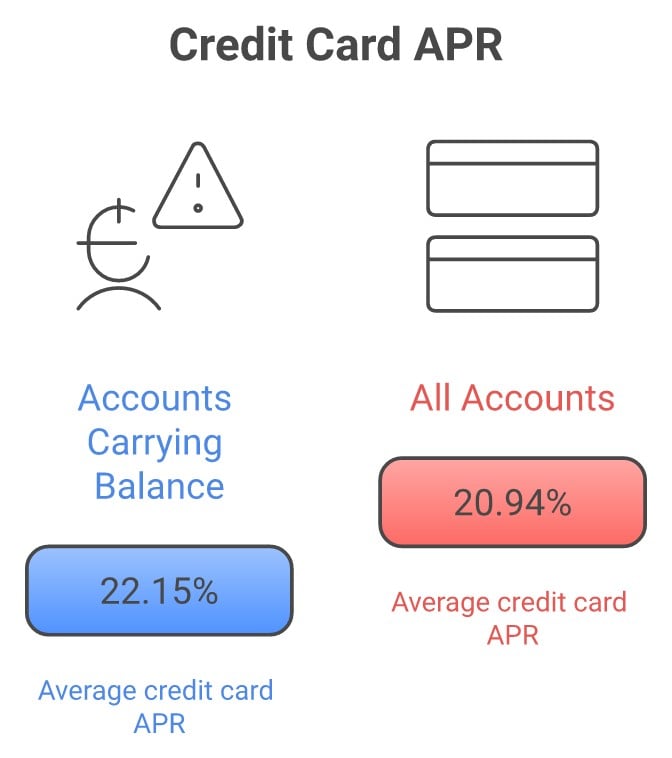
The story is what the average card APR already was before today. The Federal Reserve’s own G.19 data puts the average rate at 20.94% across all credit card accounts and 22.15% on accounts that are actually carrying a balance and being charged interest (Federal Reserve G.19, Consumer Credit). LendingTree’s tracker of roughly 220 cards from more than 50 issuers had the average new-card offer even higher — 23.82% as of this month. A quarter point stacked on top of a rate that’s already north of 20% doesn’t change the arithmetic much. What it does is add another data point to a rate that has been parked above 20% for the better part of three years, through every index move in between — and push back the date when “wait for the Fed to fix this” becomes a plan that actually works.
The Lever Nobody Renegotiates
What I’ve watched play out in the years since 1994 that I’ve been doing this is that people fixate on the part of their rate they can’t control — the Fed, the index, the headline — and never once question the part they agreed to and can sometimes actually move: the margin. The margin is the number your issuer picked based on your credit file the day you applied. It’s baked into your account agreement, it very rarely changes on its own, and it’s also the one piece of the formula an issuer will sometimes adjust if asked by a customer with a solid payment history — not guaranteed, but the people I’ve watched get a lower rate got it by asking about the margin, not by waiting for the index.
The index is going to do whatever the index does. Chasing a rate cut that may or may not come, on a schedule the Fed controls and you don’t, has kept people I’ve talked to sitting on balances at 22%+ for years longer than they needed to. The margin is boring and it’s yours, and it’s worth a second look before the next Fed meeting decides it for you again.
Key takeaway: Today’s hike will most likely move your variable APR by roughly a quarter point, and by law your card issuer doesn’t have to warn you first — the notice you already got was the account agreement’s own variable-rate clause. The bigger number is the one that was already true before today: the average card carries an APR north of 20%. A plan built on rates coming down just got pushed further out, with no date attached.
Bottom line: A quarter-point Fed hike is a small direct cost and a large indirect signal. If your plan for a high-APR card balance depends on rates falling, today’s vote pushed that plan further out — and the part of your rate you can actually influence isn’t the Fed’s number, it’s the margin you agreed to years ago.
Frequently Asked Questions
Did the Fed raise or cut rates today?
Raised. The FOMC voted 12–0 on Sept. 16, 2026, to increase its target range by a quarter point, to 3.75%–4.00%, citing inflation that “remains elevated.” That’s the opposite of the rate cuts a lot of coverage has been signaling for most of the year.
Will my credit card’s interest rate go up because of this?
If your card has a variable APR — the words “variable rate” or “prime rate plus” in the account agreement or on the last statement are the tell — then yes, it’s likely to reprice within a billing cycle or two, once your issuer’s index (usually the prime rate) itself moves. A fixed-rate card isn’t directly affected by this move, and neither is a promotional 0% balance during the promo period — though the rate it reverts to when the promo ends usually is variable, and that one will move.
Doesn’t my card company have to warn me before my rate changes?
Not for this kind of change. The 45-day advance-notice rule that most people have heard of doesn’t apply to a variable rate moving because its underlying public index moved — 12 CFR § 1026.9(c)(2)(v)(C) specifically exempts it, and 12 CFR § 1026.55(b)(2) is the rule that lets the increase happen in the first place. The notice you already received was in your account-opening disclosures, when you agreed to a variable rate in the first place.
How much will today’s hike actually cost me?
On a $6,000 balance, a quarter-point increase runs about $15 a year in additional interest — small on its own. The bigger cost is context: the average card APR was already 20.94% to 22.15% by the Fed’s own numbers before today’s move, so today’s quarter point lands on top of a rate that was already expensive.
What can actually bring my card’s rate back down?
Three things, realistically: the Fed cutting its target rate (which moves the index your card is priced against), your issuer agreeing to lower your margin if you ask and have a solid payment history, or moving the balance off that card entirely — a 0% balance-transfer offer (usually a 3%–5% upfront fee), a fixed-rate consolidation loan (which only helps if you qualify for a rate below your card’s), or, if the math has stopped working altogether, bankruptcy, which — unlike cashing out a 401(k) to pay the card, the move I see people reach for first — leaves most retirement accounts untouched: an employer 401(k) or pension isn’t part of the bankruptcy estate at all, and your own IRA is protected up to a federal cap. It discharges the balance, at the cost of a filing on your credit file for years. None of those wait on the Fed’s calendar the way “hope for a cut” does.
This is what I’m seeing in the numbers today, and what I’d tell my own family — but you know your balances, your issuer, and your timeline better than any Fed statement or any article I write. Take this as input, not instruction. Don’t let me, or anyone else, tell you what to do with your money.
If this untangled what a rate hike actually does to a credit card bill, send it to someone who’s been telling themselves they’ll deal with their balance once rates come down. Knowing the real mechanism — and the real law behind the “no warning” part — is worth passing along before the next statement arrives.
Dealing With Debt? Understanding your options is the first step. See how all your debt relief options compare — including ones most sites won’t tell you about. The Find Your Path quiz gives a recommendation based on your actual numbers, and the Scam-O-Meter checks any company’s complaint history before you sign. Federal Reserve Bank of New York research shows bankruptcy filers recover faster than those who don’t file.



