

Fact-checked by Steve Rhode, consumer debt expert since 1994 • Last reviewed September 17, 2026 • Every statutory claim below links to the law or rule itself.
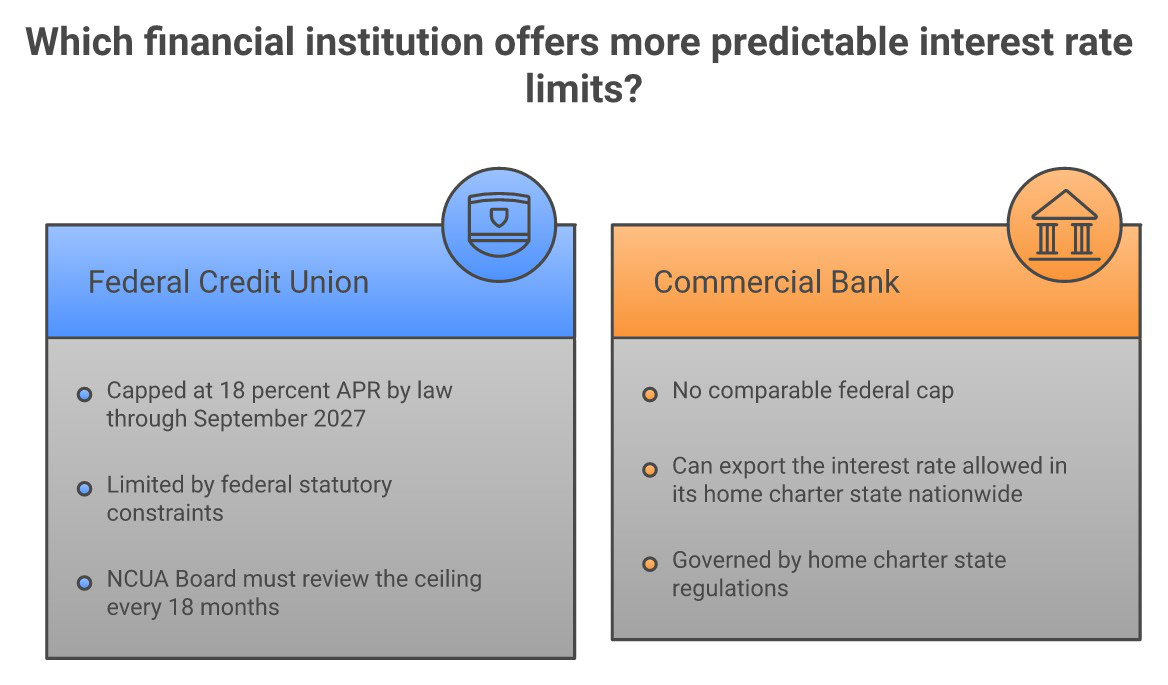
The verdict: Myth — for federally chartered credit unions. (State-chartered credit unions follow a different rule, covered below — check which kind yours is.) A federally chartered credit union is legally capped at 15% interest under the Federal Credit Union Act, and the NCUA Board has temporarily raised that ceiling to 18% through September 10, 2027. A bank has no comparable federal usury cap: under long-standing law it can generally charge the rate its home state allows, no matter which state you live in. NCUA’s February 6, 2026 press release confirms the current ceiling and its expiration date.
I have to tell you about this. I keep hearing a version of the same assumption, usually from someone comparing a credit union offer against a bank offer: “they’re both just lenders, so whoever quotes the lower number today wins — the rate cap stuff doesn’t actually mean anything.” It sounds practical. It also skips something that actually matters:
Every weekday I read the enforcement actions, filings and fine print the outlets skip, and turn them into the one or two moves that actually improve your position — a rate worth moving for, a fee you can refuse, a deadline to beat before it costs you.
I write Your Money Actually most weekdays — actionable money information you will not find anywhere else, and the small decisions that compound. It is free, I sell nothing, and I take no money from any company I write about.
“Credit unions and banks are basically the same when it comes to interest rates — both can charge whatever rate the market and your credit will allow, so it doesn’t matter which one you borrow from.” — a belief I hear repeated whenever people compare loan offers
I couldn’t let that sit, because there’s a real, legally enforced ceiling on one side of that comparison and not the other — and knowing which side you’re on can be worth real money.
Well, Actually…
Here’s the part that gets lost: Congress put an actual number in the law for federal credit unions, and no equivalent number exists for banks. The Federal Credit Union Act says a federal credit union “may not exceed 15 per centum per annum on the unpaid balance inclusive of all finance charges” — but it also lets the NCUA Board raise that ceiling, for up to 18 months at a time, if money-market rates have climbed enough to threaten credit unions’ safety and soundness. The Board first used that power in December 1980, setting the temporary ceiling at 21% — then lowered it to 18% in May 1987, and NCUA’s own history counts 24 separate votes since then to keep renewing that same 18% figure, in periods of up to 18 months at a time. As of the action NCUA announced February 6, 2026, the ceiling remains 18% and is extended through September 10, 2027. Whatever the number is at any given moment, it is a real, published, legally binding maximum — a federal credit union that knowingly exceeds it forfeits the entire interest on that loan, under the same statute.
A bank runs on a completely different rulebook. The National Bank Act — 12 U.S.C. § 85 — lets a national bank charge “interest at the rate allowed by the laws of the State… where the bank is located.” In Marquette Nat’l Bank v. First of Omaha Service Corp., 439 U.S. 299 (1978), the Supreme Court held that a Nebraska-based national bank could charge its Minnesota credit-card customers the higher rate Nebraska law allowed, even though Minnesota’s own usury law was lower — because for purposes of § 85, the bank is “located” in the state where it’s chartered, not where its customer lives. That’s a major reason so many national credit-card issuers are headquartered in states like South Dakota and Delaware, which have no generally applicable numerical usury cap on bank credit-card interest: a bank chartered there can export that rate environment to every cardholder in the country. There’s no general federal usury cap on what a bank can charge the way there is for a federal credit union — the one federal exception is the Military Lending Act’s 36% rate cap, which protects active-duty servicemembers and their dependents specifically, not the general public — so outside that narrow group, it’s whatever ceiling exists (or doesn’t) in the state where the bank itself is chartered.
There’s no legal difference in how much interest a credit union versus a bank can charge you — it’s whatever the market and your credit will bear.
A federally chartered credit union is legally capped, right now, at 18% interest (inclusive of all finance charges) on most loans — a temporary ceiling the NCUA Board must review and re-justify at least every 18 months, and can only raise above the 15% written into the statute if rising money-market rates are genuinely threatening credit unions’ safety and soundness. A bank isn’t subject to any comparable general federal cap. Under Marquette, a national bank can generally charge the rate allowed in the state where it’s chartered, no matter where its customer lives — which is why a bank-issued credit card can legally carry a rate well above 18% while a federal credit union legally cannot.
NCUA Board Extends Loan Interest Rate Ceiling (Feb. 6, 2026)
So my credit union is capped at 18%, period, no matter which one I use.
That 15%/18% ceiling in the Federal Credit Union Act binds federally chartered credit unions — the ones with “Federal” in their name (Navy Federal, Pentagon Federal, and thousands of others), or whose charter you can confirm on their disclosures. NCUA’s own insurance rule spells out which lending requirements automatically extend to federally insured, state-chartered credit unions, and the interest-rate ceiling in 12 CFR § 701.21(c)(7) is not on that list — a state-chartered credit union instead follows its own state’s usury law, which can be higher, lower, or tied to the federal rate depending on the state. Before you assume any credit union is automatically capped at 18%, check whether it’s federally or state chartered — most disclosures say so plainly.
Why You Were Told This
Nobody sits down and explains bank regulation to you before you shop for a loan — you find out the rates, not the reasons behind them. And on the surface, a credit union and a bank really do look interchangeable: both take deposits, both make loans, both advertise an APR. What doesn’t show up in the marketing is that one of them answers to a federal interest-rate ceiling reviewed by regulators every 18 months, and the other answers to whatever usury law exists in whatever state it happened to charter itself in — which, for the biggest national card issuers, is often a state that chose not to have one. That gap isn’t a secret exactly, but it’s not something either side has a reason to advertise: credit unions don’t lead with “we’re capped,” and banks don’t lead with “we’re not.” I’ve written before about how the lack of a real federal ceiling plays out on the credit-card side specifically — see what a proposed 10% credit card rate cap would actually change.
What to Actually Do
- Confirm the charter type before you assume the cap applies. Look for “Federal Credit Union” in the name, or check the account disclosures — a federally chartered credit union is bound by the 15%/18% ceiling; a state-chartered one follows its state’s own usury law instead.
- Compare the actual quoted APR, not just which type of institution is offering it. The rate cap tells you the legal ceiling, not the rate you’ll actually be offered — shop both, and read the full APR, including fees, before you sign anything. If you’re shopping personal loans specifically, see how to tell when a personal loan actually helps your situation and when it doesn’t before comparing rates.
- If you’re looking at a small-dollar loan, ask specifically about a Payday Alternative Loan. Federal credit unions can charge up to 10 percentage points above the standard ceiling — 28% today — on Payday Alternative Loans (PALs): $200–$1,000 for one to six months under the original program, or up to $2,000 for up to 12 months under the newer PALs II version. Either way, no more than three PALs to any one borrower in a rolling six-month period, and never more than one outstanding at a time. It’s still a real cost, but it’s typically a fraction of what a storefront payday lender charges.
- Don’t assume a lower advertised rate today means a lower rate always. The NCUA’s temporary ceiling is reviewed roughly every 18 months and has moved before — check NCUA’s newsroom for the current number rather than relying on a figure you read once.
- Read your own state’s usury law if you’re comparing a state-chartered credit union. It’s the actual ceiling that applies to that lender, and it isn’t necessarily 18%.
Steve’s Take
I’ve watched people pick a lender purely on which one calls itself friendlier, without ever asking who’s actually allowed to charge them what. That’s backwards. The rate ceiling on a federal credit union isn’t a marketing claim — it’s a number in a federal statute that regulators have to formally reconsider every year and a half, and a credit union that knowingly breaks it forfeits the entire interest under the same law. A bank operates under no such general federal cap, and the Supreme Court settled almost 50 years ago that a bank can export its home state’s rules to you no matter where you live. That doesn’t make credit unions automatically cheaper — state-chartered ones follow a different rulebook entirely, and a well-run bank can still beat a poorly run credit union on the actual number. But “there’s no legal difference” is flatly untrue for federally chartered credit unions, and it’s the kind of untrue that costs people real money when they stop comparing and just assume every lender is regulated the same way.
Free Tool — Contract Decoder: Have a contract from a debt relief company? The free Contract Decoder analyzes it for red flags, hidden fees, and problematic terms — before you sign anything. Decode My Contract →
Frequently Asked Questions
What’s the current interest rate cap on a federal credit union loan?
18% APR on most loans, as a temporary ceiling the NCUA Board extended through September 10, 2027. The underlying statutory cap in the Federal Credit Union Act is 15%; the Board can temporarily raise it, in increments of up to 18 months, when it finds money-market rates have risen enough to threaten credit unions’ safety and soundness.
Is there a similar federal cap on what a bank can charge?
No. Under 12 U.S.C. § 85, a national bank can generally charge the interest rate allowed in the state where it’s chartered — not where you live — a principle the Supreme Court confirmed in Marquette Nat’l Bank v. First of Omaha Service Corp., 439 U.S. 299 (1978). Some states have no generally applicable numerical usury cap on bank credit-card interest, which is a major reason national credit-card rates can run well above 18%.
Does the 18% cap apply to every credit union?
Only to federally chartered credit unions. A federally insured, state-chartered credit union instead follows its own state’s usury law — NCUA’s rule at 12 CFR § 741.203 does not extend the federal interest-rate ceiling to state-chartered credit unions. Check your credit union’s charter type before assuming which cap applies.
Are there any exceptions where a federal credit union can charge more than 18%?
Yes, one narrow category: Payday Alternative Loans (PALs). The original PALs I is $200–$1,000 for one to six months; a newer PALs II version allows up to $2,000 for up to 12 months. Either way, no more than three per member in a rolling six months, and both can carry a rate up to 10 percentage points above the standard ceiling — 28% today — under 12 CFR § 701.21(c)(7)(iii)–(iv).
Why doesn’t every bank just charge whatever it wants if there’s no federal cap?
Market competition and each bank’s own risk model still limit what it charges in practice — a bank that priced every loan at the legal maximum would lose customers to competitors. The point isn’t that banks always charge more; it’s that there’s no federal ceiling forcing them to stop, the way there is for federal credit unions.
Does this rate cap mean a federal credit union loan is always cheaper than a bank loan?
Not automatically — it means a federal credit union has a hard legal ceiling a bank doesn’t have. Always compare the actual quoted APR on both, including fees, rather than assuming one type of lender is cheaper by default.
One more thing — everything here is based on more than three decades of helping people navigate exactly this kind of comparison. But my advice is input for your decision, not the decision itself. Only you know your full financial picture, and a specific credit union’s or bank’s actual rate can differ from the legal ceiling in either direction. Confirm the current rate and charter type directly with the lender before you sign anything.
The bottom line: A federally chartered credit union is legally capped at 18% interest through September 10, 2027 — a bank isn’t bound by any comparable federal number and can generally export its home state’s rate to you nationwide. If someone you know is picking a lender by gut feel instead of checking which rules actually apply, send them this first.
Dealing With Debt? Understanding your options is the first step. See how all your debt relief options compare — including ones most sites won’t tell you about. The Find Your Path quiz gives a recommendation based on your actual numbers, and the Scam-O-Meter checks any company’s complaint history before you sign. Federal Reserve Bank of New York research shows bankruptcy filers recover faster than those who don’t file.



