

“Debt is math wrapped in emotion. A credit report is supposed to be the math — the one place a lender is required to get it right. When the report itself is wrong, somebody else’s mistake becomes your interest rate.”
Quick Answer: TransUnion has agreed to pay $8.31 million to settle Brooks v. Trans Union, LLC, a class action alleging it sold consumer reports that carried a “bankruptcy” remark on a credit account (a tradeline) even though the same report showed no matching bankruptcy in the public records section — either because the bankruptcy was more than 10 years old or because no bankruptcy could be located at all. If TransUnion sold a report about you to a third party between January 6, 2020 and January 31, 2023 that fits that description, you’re likely in the class, and you have until October 30, 2026 to file a claim, exclude yourself, or object. Payments run from an automatic $100 up to an estimated $1,000 for the smaller “No Bankruptcy” group, but the larger “Aged Bankruptcy” group gets an estimated $350 only if a claim is filed — and $0 if not. Start at the official, court-authorized settlement site — not a search-engine ad.
Expert Context: I filed bankruptcy myself in 1990 after my real estate business collapsed, and I’ve spent the years since 1994 reading other people’s credit reports line by line — first running a credit counseling organization, then answering reader questions about exactly this kind of error. I know the difference between the public record section of a credit report and the tradeline remarks sitting next to it, because I’ve had to explain that difference to people who were denied a mortgage over it.
TransUnion just agreed to pay for something I’ve watched happen inside real credit files for more than 30 years: the word “bankruptcy” outliving the bankruptcy itself.
Claiming money you are owed is one good day. What you do over the following year is what actually changes your position.
In the latest issue (Oct 8): A parent's nursing home bill can become yours
I write Your Money Actually most weekdays — actionable money information you will not find anywhere else, and the small decisions that compound. It is free, I sell nothing, and I take no money from any company I write about.
The case is Brooks v. Trans Union, LLC, Civil Action No. 2:22-cv-00048-KSM, in the U.S. District Court for the Eastern District of Pennsylvania, in front of Judge Karen Spencer Marston. Plaintiff William Norman Brooks, III alleges TransUnion violated the Fair Credit Reporting Act, 15 U.S.C. § 1681e(b), by failing to follow reasonable procedures to keep credit reports accurate. TransUnion denies it violated the FCRA or did anything wrong, and the court has not ruled on who’s right — but both sides agreed to settle rather than keep fighting. I’ve read the official FAQ and the full settlement agreement directly from the court-authorized notice site so I could get every number and date right before writing this.
Key Terms Defined
Bankruptcy remark: A note attached to a specific account (a “tradeline”) on your credit report saying that account was included in a bankruptcy — separate from the public record section.
Public record section: The part of a credit report that lists an actual, verifiable court filing — like a bankruptcy case number and filing date pulled from court records.
Tradeline: An individual account entry on your credit report — a credit card, loan, or line of credit — reported by the creditor that holds it.
Reinvestigation: The process a credit bureau must run when you dispute an error, under 15 U.S.C. § 1681i — generally within 30 days of your dispute.
What You Need to Know — Who’s Covered and What You’ll Get
The Settlement Class, as defined on the notice site, covers everyone residing in the U.S. or its territories to whom TransUnion sold a consumer report, between January 6, 2020 and January 31, 2023, that included a bankruptcy remark on a tradeline with no matching public-record bankruptcy entry within the prior 10 years. That single class actually splits into two very different groups, and which one you’re in changes what you have to do.
The No Bankruptcy Group
Roughly 21,000 people fall into this group. For them, a search of public records tied to their Social Security number found no bankruptcy filing at all — meaning TransUnion’s own tradeline remark may have referenced a bankruptcy that, as far as the court-ordered search could tell, never happened. If you’re in this group, you don’t have to lift a finger to get paid: an automatic $100 check goes out if the settlement gets final court approval. File a claim instead, and the estimated payment rises to around $1,000.
The Aged Bankruptcy Group
The larger group — about 36,000 people — did have a real bankruptcy on file, just one filed more than 10 years before the TransUnion report in question. TransUnion argues it was still accurate to keep reporting it; the court hasn’t decided that question. The notice says members of this group must file a claim to get anything — an estimated $350 — and get $0 if they do nothing. My read is that the claim-required structure reflects the weaker legal footing here, since TransUnion has an argument to make; that’s my inference, not something the notice says.
Key Dates
- October 30, 2026 — deadline to file a claim, exclude yourself, or object
- November 18, 2026 — deadline to notify the court you intend to speak at the hearing
- December 2, 2026, 10:00 a.m. — Final Approval Hearing at the James A. Byrne U.S. Courthouse, 601 Market Street, Philadelphia
- Payment timing — no check goes out until the court grants final approval and any appeals are resolved, so a claim filed this fall is a claim for money that arrives in 2027 at the earliest, not next month.
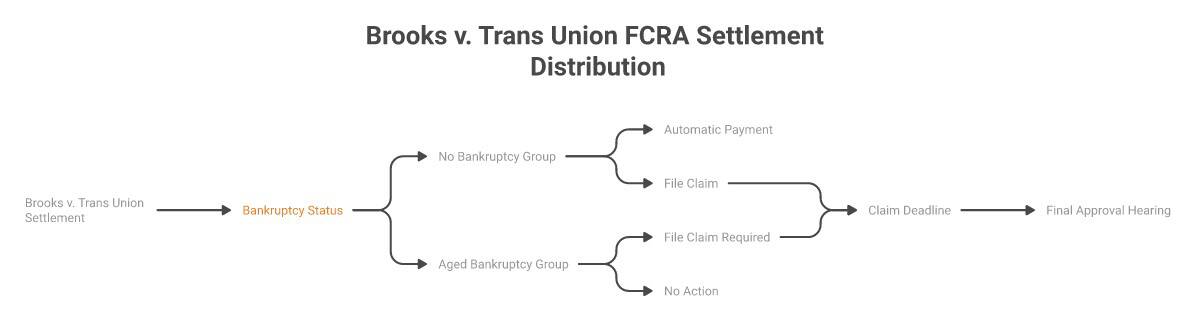
To find out which group you’re in, or to file at all, you need the unique Claim Number and PIN from the notice the settlement administrator mailed or emailed to you in May or June 2025. If you can’t find that notice but believe you belong in this class, don’t assume you’re out of luck — the notice site says to contact the settlement administrator directly at (888) 279-4003 rather than guess.
The Daily Money Brief — Free, at 10 AM
Money you may be owed, scams to dodge, and the fine print decoded — the consumer money news that affects your wallet, every weekday.
Why You Need to Know This — The Report Can Outlive the Record on Purpose or by Mistake
The Claim: “Once my bankruptcy falls off the public record section of my credit report, the word ‘bankruptcy’ is gone from my file.”
The Reality: That’s how it’s supposed to work under federal law — but a credit report has more than one place bankruptcy can appear. 15 U.S.C. § 1681c(a)(1) bars a bureau from reporting a bankruptcy case anywhere on the report more than 10 years after it was filed. The fight in this case is over a tradeline “remark” — the note attached to an individual account saying it was included in a bankruptcy. TransUnion’s position is that a remark is a separate piece of data from the bankruptcy itself; the lawsuit’s position is that the remark is still reporting the case. Nobody got a ruling — they settled. This lawsuit alleges that for tens of thousands of people, the remark stuck around even after the public record entry aged off, or attached itself to accounts with no bankruptcy behind it at all.
That second part is the detail I want you to sit with. The No Bankruptcy Group isn’t people whose old bankruptcy overstayed its welcome — it’s people the class notice describes as having no locatable bankruptcy filing at all, based on a search of public records tied to their Social Security number. If that’s accurate for even a fraction of those roughly 21,000 people, it means TransUnion’s tradeline remark told lenders “included in bankruptcy” about accounts where, as far as anyone can verify, no bankruptcy court was ever involved.
I’ve spent a career making the opposite argument to people scared of filing — that bankruptcy is not the disaster the industry markets it as. Research from the Consumer Financial Protection Bureau found that median credit scores rise steeply for Chapter 7 filers in the first few years after they file, and Federal Reserve Bank of New York research found that staying informally insolvent instead of filing is associated with worse financial outcomes — less access to new credit and lower credit scores — than filing itself. Bankruptcy is supposed to be a fresh start with a clock on it. A remark that doesn’t respect that clock, or that shows up on an account when there’s no bankruptcy behind it, undermines the entire point of that law.
Things to Consider
A settlement check is compensation for a snapshot of your credit file from 2020–2023. It is not proof your current report is clean. If TransUnion’s remark practices produced an inaccurate file for you three years ago, there’s no guarantee the same account isn’t still carrying a stale or mismatched remark today — settlements resolve past harm, they don’t automatically fix the file going forward.
If the Settlement gets final approval and you don’t exclude yourself, you give up the right to sue TransUnion separately over the bankruptcy-remark reporting this case covers — that’s true whether you file a claim or do nothing. (Separately, the No Bankruptcy Group still gets its automatic $100 whether or not it files.) Excluding yourself (opting out) keeps your right to sue on your own, but means you get nothing from this settlement — and for most people in this class, opting out preserves very little: the FCRA’s time limit is the earlier of two years from when you discovered the violation or five years from when it happened (15 U.S.C. § 1681p), so for reports sold before roughly September 2021 the five-year outer limit has already run — but for reports sold later in the class period it hasn’t, and if you first learned of the remark from the 2025 notice, the two-year discovery clock may still be open into 2027. That is exactly who the exception is for: someone with documented damages — a mortgage or job denial that turned on that remark. If that’s you, talk to an FCRA attorney before October 30, not after; an attorney can also tell you whether the class action paused your clock. To opt out you have to write to the settlement administrator by the same October 30, 2026 deadline (Brooks v. Trans Union, LLC, c/o Settlement Administrator, P.O. Box 16, West Point, PA 19486) with your name, contact information, and the unique identifier from your notice.
The fund also covers real administrative costs before any money reaches class members: up to $2,770,000 in attorneys’ fees, up to $308,000 in litigation expenses, and up to $50,000 as a service award to the named plaintiff, William Norman Brooks, III, all subject to the court’s approval at the December 2 hearing. None of that comes out of your pocket — it comes out of the $8.31 million fund before the per-person payments are calculated, which is also why the final per-person amounts are estimates that depend on how many people actually file.
Watch for: This settlement has a real toll-free number — (888) 279-4003 — and a real website at brooksbankruptcyclassaction.com. The notice explicitly says not to contact TransUnion or the court for information. If you get a call, text, or email asking you to “verify” your Social Security number or pay a fee to release your settlement payment, that’s not how this settlement works — hang up and go straight to the official site yourself.
What to Think About Doing
- Search your email and physical mail from May or June 2025 — the notices are now about 15 months old — for a notice from Trans Union LLC or a settlement administrator. Look for a Claim Number and PIN — you’ll need both to log in.
- File your claim at the official claim form before October 30, 2026. If you’re in the No Bankruptcy Group, filing turns your automatic $100 into an estimated $1,000. If you’re in the Aged Bankruptcy Group, filing is the only way to get paid at all.
- If you can’t find your notice but think you qualify, call the settlement administrator at (888) 279-4003 before assuming you’re out of the class.
- Separately — and regardless of this settlement — pull all three of your credit reports for free at AnnualCreditReport.com and check every tradeline for a bankruptcy remark. Compare it against the public records section. If a remark doesn’t match an actual filing, or your bankruptcy is more than 10 years old and still showing anywhere, dispute it in writing using the CFPB’s sample letters — the bureau generally has 30 days to reinvestigate under § 1681i and must delete anything it can’t verify. Two things I’d add from experience: the account itself usually has its own clock — a collection or charged-off account generally can’t be reported more than seven years after it went bad (15 U.S.C. § 1681c(a)(4)), so an old “included in bankruptcy” tradeline can often be disputed whole, not just the remark — and I’d send the dispute to the creditor that reported it as well as to the bureau, because a remark disputed only at the bureau has a way of being “verified” right back onto the file.
- If you’re genuinely weighing whether bankruptcy makes sense for you right now, that’s a separate decision from this settlement — see how your options actually compare before you decide anything.
My own bankruptcy filing sits on a public record from 1990 — decades past any reporting window, federal or otherwise. If a lender pulled my file today and it still carried a “bankruptcy” remark on some account, I’d dispute it the same afternoon, settlement or no settlement. This isn’t the only recent case letting people sue TransUnion over what’s actually in their credit files, and TransUnion’s own data has separately confirmed things I saw firsthand inside credit counseling — this is a bureau that, by its own numbers and by the lawsuits it keeps paying to settle, gets the file wrong often enough that I’d treat checking my own report as routine maintenance, not an errand.
Key Takeaways
- TransUnion agreed to pay $8.31 million over bankruptcy remarks on tradelines with no matching public-record bankruptcy — either aged past 10 years or, for one group, no bankruptcy located at all.
- Two groups, two outcomes: the No Bankruptcy Group gets $100 automatically or ~$1,000 by claim; the Aged Bankruptcy Group gets nothing unless they file, then an estimated $350.
- You need the Claim Number and PIN from a 2025 notice to file — or a call to (888) 279-4003 if you never got one but believe you qualify.
- The claim, opt-out, and objection deadline is October 30, 2026; the Final Approval Hearing is December 2, 2026.
- A settlement check doesn’t fix your current file — pull your reports and dispute any bankruptcy remark that doesn’t match an actual, current public record.
The Bottom Line
If you’ve ever filed bankruptcy — or, it turns out, even if you never did — and a lender pulled your TransUnion report between 2020 and 2023, you may be owed money for a mistake you never made. That’s worth five minutes of checking. But the deeper point is the one I’ve been making since 1994: a fresh start is supposed to have an expiration date on the shame attached to it, and when a credit bureau lets the word “bankruptcy” outlive the record, it’s not protecting anyone — it’s just making someone else’s paperwork problem your interest rate. I rebuilt everything after my own filing. The system is supposed to let you do the same, on schedule, whether or not you ever collect a settlement check.
Frequently Asked Questions
Do I have to have filed bankruptcy to be part of this settlement?
No. The “No Bankruptcy Group” specifically covers people the notice describes as having no locatable bankruptcy filing at all, based on a public-records search tied to their Social Security number, whose TransUnion report still carried a bankruptcy remark on an account.
How do I know which group I’m in?
Your Notice — mailed or emailed to you in May or June 2025 — names your group underneath your unique Claim Number and PIN. You can also log into the settlement website with that Claim Number and PIN to check.
What if I never received a notice but think I qualify?
Contact the settlement administrator at (888) 279-4003 rather than guessing. The claim form specifically instructs people who believe they’re Settlement Class Members but never received a notice to reach out before filing.
Will filing a claim cost me anything?
No. There’s no cost to file, no proof-of-purchase requirement (this settlement is about your credit file, not a product you bought), and Class Counsel is being paid from the settlement fund, not by class members.
What happens if I do nothing?
If you’re in the No Bankruptcy Group, you still receive the automatic $100 payment as long as the settlement is finally approved. If you’re in the Aged Bankruptcy Group, doing nothing means you receive $0 from the settlement. Either way, doing nothing also means giving up your right to sue TransUnion separately over the claims this settlement resolves.
This is what I’m seeing after reading credit reports for a living and filing my own bankruptcy in 1990. Take it as one informed perspective — but only you know your full situation, and only the settlement administrator can tell you your exact group and payment. The deadline is real and checking your own report is free, so there’s little downside to doing both. Use this as input for your decision, not a directive. Nobody gets to tell you what to do with your money — including me.
One more thing: if you’ve ever filed bankruptcy, or you know someone who has, send them this. Most people who get a class action notice in the mail assume it’s junk and throw it away — and most people never think to check whether the word “bankruptcy” is still sitting on their credit file long after it should have expired.
Dealing With Debt? Understanding your options is the first step. See how all your debt relief options compare — including ones most sites won’t tell you about. The Find Your Path quiz gives a recommendation based on your actual numbers, and the Scam-O-Meter checks any company’s complaint history before you sign. Federal Reserve Bank of New York research shows bankruptcy filers recover faster than those who don’t file.



