

Written by Steve Rhode, consumer debt expert since 1994 • Last updated September 21, 2026
Quick Answer: A private student loan company suing you means it filed a civil lawsuit, usually in state court, not a federal collection action — and unlike federal loans, a private lender can’t garnish your wages or freeze your bank account without first winning a judgment, and it can’t intercept a federal tax refund directly either — both are administrative powers federal law reserves to the Department of Education and federal loan guaranty agencies alone (20 U.S.C. § 1095a for wage garnishment; the Treasury Offset Program under 31 U.S.C. § 3720A for tax refunds). Your state’s answer deadline is already running from the day you were served; miss it and the plaintiff can ask the court to enter a default judgment against you — and if your summons names a date to appear in court, you must show up that day, because in some courts a mailed answer alone is not enough. Make the plaintiff prove it owns your loan. Filing bankruptcy stops the lawsuit immediately for most filers, and some private loans discharge with no hardship showing at all if the loan fails a specific tax-code test — whether yours does is a question to put to a bankruptcy attorney.
Part of the Crisis Guide Series: If you’re being sued for debt generally — not specifically a private student loan — start with I Was Just Served with a Debt Lawsuit. Already missed your deadline? See I Didn’t Respond to My Debt Lawsuit in Time. And this guide is about the lawsuit itself — if you’re wondering whether bankruptcy could wipe the loan out entirely regardless of how the case goes, see My Private Student Loans Might Not Survive Bankruptcy the Way I Was Told.
What Just Happened to You
A bank made your private student loan — Sallie Mae Bank and Discover Bank have historically been two of the biggest originators (Discover stopped taking new private student loan applications in February 2024). What happens to the loan after that varies a lot. Sallie Mae mostly still services its own loans in-house, though it also sells billions of dollars of loans to outside investors. Discover sold its roughly $10.1 billion private student loan portfolio in 2024 to investment funds managed by Carlyle and KKR, with Firstmark Services, a division of Nelnet, now servicing it. Navient — spun off from Sallie Mae in 2014 — still owns about $15.6 billion in private loans, a mix of older loans from that split and newer loans it originates itself; it handed day-to-day servicing of most of its portfolio to MOHELA in October 2024, though Navient’s own site notes defaulted loans — the ones most likely to end up in a lawsuit — are a common exception. Many older private loans from the 2000s and early 2010s were sold into trusts with names like National Collegiate Student Loan Trust (NCSLT) that most borrowers have never heard of. That’s often the first thing that panics people: the name on the summons doesn’t match the name you remember borrowing from, and it may be an owner — a trust or an investment fund — rather than a familiar loan company at all. It doesn’t mean the lawsuit is fake — loan ownership changes hands, sometimes more than once, and that’s normal. But it does mean the plaintiff has to prove, with actual paperwork, that it’s the one entitled to collect from you.
Because there’s no federal administrative process for private loans, the lender or trust has to sue you — usually in your local state or county court — and win a judgment before it can touch your paycheck or bank account. Even after winning, a private lender can’t intercept a federal tax refund directly the way a defaulted federal loan holder can; that power belongs only to the federal government. That’s different from what happens with a defaulted federal loan, and it’s the reason you’re looking at a summons and complaint instead of a garnishment notice out of nowhere.
The Mistake You’re About to Make: Throwing the summons away because you don’t recognize the plaintiff’s name, or calling the number on the letter to argue about the debt before you’ve filed anything with the court. Neither one stops the clock. Ignoring it lets the plaintiff ask the court for a default judgment against you for the full amount, often with added interest and court costs — and once that’s entered, undoing it usually means a hard-to-win motion to vacate, not a second chance to raise the defenses you never got to make. In many states, making a payment or signing a written acknowledgment of the debt can restart your state’s statute of limitations — a phone call alone is less likely to, but you don’t control what a collector writes down about that call afterward. Read your options below, then respond to the court in writing — not the phone.
Your Options Right Now
What to Do in the Next 48 Hours
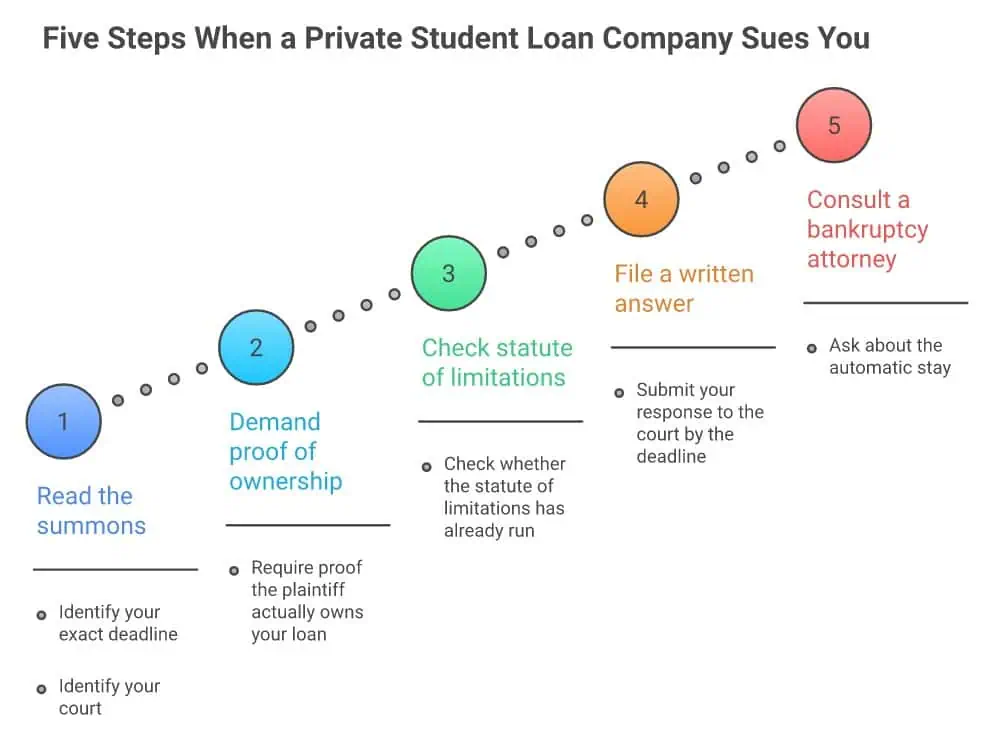
- Read the summons for your exact deadline and court. Answer deadlines are set state by state and commonly run 20 to 30 days from the date you were served — California gives 30, Florida runs closer to 20, and some courts are shorter still (a Texas justice court can be as little as 14). Don’t guess from a number you saw somewhere else; the date on your paperwork controls.
- Make the plaintiff prove it owns your loan. This is the single strongest defense in a private student loan lawsuit, and it isn’t a stall tactic — the CFPB ordered Transworld Systems, the debt collector for National Collegiate Student Loan Trusts, to pay $2.5 million in a 2017 consent order over allegations that it filed false or misleading affidavits and sued consumers when it couldn’t prove the debt was actually owed. If you don’t recognize the plaintiff, your written answer should specifically deny that it owns the debt and demand proof: the original promissory note, a complete chain of assignment showing how it ended up with your loan, and your full payment history.
- Check whether the statute of limitations has already run. The clock starts from your last default or last payment, not from when you originally borrowed — and it varies by state. See Private Student Loan Statute of Limitations: Am I Safe? for how that clock actually works before you say or pay anything that could restart it.
- Check your promissory note for an arbitration clause. Some private student loan notes — especially older, NCSLT-era notes — let you elect individual arbitration (AAA or JAMS) instead of court, and consumer arbitration rules often put most of the fee burden on the business, not you. That can be real leverage against a plaintiff that’s already struggling to prove ownership. But electing arbitration doesn’t pause the clock on your summons: you still have to file a written answer or a motion to compel arbitration — something — by your court deadline, or you risk a default judgment anyway. Raise this with an attorney before that date, not instead of meeting it.
- File a written answer with the court by the deadline, even if you think you owe the money — and list your defenses by name. Read your summons first: if it sets a hearing or appearance date, be there in person as well, because some courts treat a no-show as a default even when an answer is on file. Don’t file a bare general denial. Spell out the specific defenses you’re raising, including standing (the plaintiff hasn’t proven it owns your loan) and the statute of limitations if it applies — in many states, a defense you leave out of your answer can be waived later, even if it would have won the case. A timely, complete answer is what keeps the case from ending in a default judgment against you; it isn’t a guarantee against everything that could go wrong afterward, which is exactly why you name your defenses now instead of assuming you can raise them later. And if you already answered, had your hearing, and the court still ruled against you, here’s what your post-judgment options actually look like — they’re narrower than what’s described above. Most courts have a self-help center or a fillable answer form; check your court’s website.
- Talk to a bankruptcy attorney about the automatic stay — and don’t assume your private loan can’t discharge. Filing bankruptcy triggers the automatic stay under 11 U.S.C. § 362, which stops the lawsuit the moment you file — not weeks later — for most filers (if you had a bankruptcy case dismissed in the past year, different rules can shorten or remove the stay, which is one more reason to talk to an attorney first). And “private student loans never discharge” isn’t true: they can discharge through an undue hardship showing, or — for a private loan that doesn’t meet the tax code’s “qualified education loan” definition and wasn’t funded through a government or nonprofit program — with no hardship showing at all. See the full test here. NACBA can help you find a bankruptcy attorney.
- Talk to Damon Day. Schedule a free consultation with Damon Day, an independent debt coach (not an attorney) and my co-host on the Get Out of Debt Guy podcast, to sort out where this lawsuit fits into your whole financial picture. I receive no payment for this referral.
How to Actually Stop It — Your Four Paths
- Bankruptcy. For most filers, the automatic stay stops the lawsuit the moment you file, not weeks later, and it doesn’t just pause the case — if the loan qualifies, bankruptcy can discharge it permanently. Federal Reserve Bank of New York research is associated with bankruptcy filers recovering faster financially, even when some debts survive.
- Challenge standing and demand proof of ownership. Private student loan debt changes hands through sales and securitizations more than almost any other consumer debt. If the plaintiff can’t produce the note and a clean chain of assignment, that can be a complete defense — not a technicality, a real one, with federal enforcement history behind it.
- Negotiate — but only after you’ve checked standing and the statute of limitations, and only in writing. Settling before you know whether the plaintiff can even prove the debt, or whether the clock has already run, means giving up leverage you didn’t know you had. Get any agreement in writing before you send a dollar.
- What won’t work: ignoring the summons and hoping it goes away, or paying an upfront fee to a debt settlement company that promises to “make them stop suing you” without you ever filing a written answer. Settlement is a negotiation, not a legal defense, and it does nothing to protect the deadline that’s already running.
What You Need to Know About Your Rights
Typical window to file a written answer after being served (sometimes as few as 14), though the exact number is set by your state and court
CFPB penalty against Transworld Systems in 2017 over allegations it sued borrowers and filed affidavits it couldn’t back up with proof the debt was owed
Ways a private lender can garnish your wages without first winning a judgment in court
Federal law gives the Department of Education and federal loan guaranty agencies the power to garnish wages on a defaulted federal loan without ever going to court, under 20 U.S.C. § 1095a. Intercepting a tax refund runs through a separate mechanism — the Treasury Offset Program, under 31 U.S.C. § 3720A — which is also limited to federal debts. Neither power extends to private lenders, trusts, or debt buyers: they have to file a lawsuit and win before they can touch your paycheck or bank account, and even after winning, they still can’t intercept your tax refund directly through that federal program. (Once a refund lands in your bank account, though, it’s ordinary money like any other deposit — a private lender holding a judgment can potentially reach it through a bank levy, subject to whatever your state’s exemptions allow.) That gives you real, court-enforced due process a defaulted federal borrower doesn’t automatically get: the right to be properly served, the right to answer, and the right to make the other side prove its case.
| Question | Federal student loans | Private student loans |
|---|---|---|
| Can the lender garnish wages without suing first? | Yes — administrative wage garnishment under 20 U.S.C. § 1095a | No — a lawsuit and a court judgment are required first |
| Bankruptcy discharge | Undue hardship showing required, always | Undue hardship, OR no hardship showing if the loan fails the “qualified education loan” test and wasn’t funded through a government or nonprofit program |
| Who’s suing you | N/A — not usually a court case | The loan’s owner — the original bank, Navient, an investment fund, or a trust that purchased the loan — or a servicer or collector acting on the owner’s behalf |
If you live in a state with unusually short answer windows or aggressive collection rules, the deadline on your own summons still controls — check your specific court’s self-help resources for local filing procedures, since some courts require in-person filing and others accept e-filing or mail.
If the plaintiff is misrepresenting who owns your loan, using false affidavits, or suing after the statute of limitations has run, file a complaint with the CFPB and your state attorney general. If you need legal help but can’t afford an attorney, find free legal aid through LSC.gov.
Steve’s Take
I filed bankruptcy in 1990, and one of the worst parts wasn’t the debt — it was not knowing who was actually calling the shots on the other side of it. Private student loan lawsuits are full of that same confusion by design: loans get sold, resold, and bundled into trusts most borrowers never hear about until a summons shows up with an unfamiliar name on it. You’re not paranoid for questioning it, and you’re not obligated to just take the plaintiff’s word for it. Debt is math wrapped in emotion, and the math here says: read the deadline, demand proof, and don’t let embarrassment about not recognizing a name keep you from answering. The people who respond in writing do better than the ones who don’t — almost always.
Free Tool — Wage Garnishment Calculator: Worried about your paycheck being seized? The free Wage Garnishment Calculator shows exactly how much creditors can legally take in your state — and some states prohibit garnishment entirely. Calculate My Risk →
Frequently Asked Questions
A company I’ve never heard of is suing me for a private student loan — is this even real?
Probably. Private student loans get sold, securitized into trusts, and reassigned to new servicers regularly, so the plaintiff’s name may not match who you remember borrowing from. That doesn’t make the lawsuit fake — but it does mean the plaintiff has to prove it actually owns your loan, and your written answer should demand that proof rather than assume it exists.
Can a private student loan company garnish my wages before taking me to court?
No. Only the Department of Education and federal loan guaranty agencies have that administrative wage-garnishment power, and only for federal loans, under 20 U.S.C. § 1095a. A private lender, servicer, or trust has to sue you and win a judgment first — it cannot garnish your wages or freeze your account on its own. It also can’t intercept a federal tax refund directly through the Treasury Offset Program (31 U.S.C. § 3720A), which is limited to federal debts too — but once a refund is deposited into your bank account, it becomes ordinary funds that a judgment creditor can potentially reach, subject to your state’s exemptions.
I was just served with the lawsuit — how do I actually stop it?
File a written answer with the court by your deadline. See I Was Just Served with a Debt Lawsuit for the full step-by-step on responding, and don’t skip the step that demands proof the plaintiff owns the loan — that’s the defense unique to private student loan cases.
Free Tool — I'm Being Sued for Debt Guide: Being sued by a creditor or debt collector? The free I'm Being Sued Guide gives you a personalized action plan — deadlines, defenses, and options based on your state. Most states require a response within 20–30 days. Get My Action Plan →
I missed my deadline — is it over?
Not necessarily. A default judgment isn’t always permanent; courts can vacate them for good cause, especially if you were never properly served. See I Didn’t Respond to My Debt Lawsuit in Time for how that process works and what deadlines apply to fixing it.
If I file bankruptcy, how fast does it stop this lawsuit?
For most filers, immediately. The automatic stay under 11 U.S.C. § 362 takes effect the moment you file — not weeks later — and it stops the lawsuit, along with essentially all other collection activity, while your case is open. If you had a bankruptcy case dismissed in the past year, the stay can be shortened or not apply automatically, which is exactly the kind of detail to raise with your attorney before you file.
Will bankruptcy actually get rid of this private student loan, or just pause the lawsuit?
It can do more than pause it. “Private student loans never discharge” is not accurate — they discharge through an undue hardship showing, or with no hardship showing at all if the loan fails the tax code’s “qualified education loan” test and wasn’t funded through a government or nonprofit program. See the full test and how to check your loan.
Is there a statute of limitations on my private student loan?
Yes, and it varies by state, but it runs from your last default or last payment — not from when you originally borrowed. See Private Student Loan Statute of Limitations: Am I Safe? before you say or pay anything that could restart it.
Should I just call the number on the lawsuit paperwork and try to work it out?
Not before you’ve filed your written answer. A phone conversation doesn’t stop the court clock, and in many states, a payment or a signed written acknowledgment of the debt can restart the statute of limitations. A call alone is less likely to reset the clock, but you don’t control what a collector writes down about it afterward. Get your answer filed first, then negotiate in writing if that’s the right move for you.
One more thing — everything I share here is based on more than 30 years of helping people through exactly this. But my advice is input for your decision, not the decision itself. Only you know your full situation. Talk to an attorney, look at your numbers, and make the choice that serves your future.
Important: This guide is for informational purposes only and is not legal advice. Laws vary by state, and your situation may have details that change what options are available to you. For legal advice specific to your case, consult an attorney licensed in your state. NACBA can help you find a bankruptcy attorney, NACA can connect you with a consumer attorney, or schedule a free consultation with Damon Day, an independent debt coach and my podcast co-host — I receive no payment for this referral.
Key Takeaway: Being sued by a private student loan company is serious, but you have real rights a defaulted federal borrower doesn’t automatically get — the right to answer, and the right to make the plaintiff prove its case. File your answer by the deadline, demand proof of ownership, and check whether bankruptcy could resolve this entirely. The 2-minute bankruptcy quiz is a good place to start thinking through your bigger picture.
The Bottom Line
You didn’t do anything wrong by not recognizing the name suing you — private student loan debt changes hands more than almost any other kind, and that confusion is common, not a sign you’re missing something obvious. The people who read their deadline, filed an answer, and demanded proof did better than the ones who threw the summons away. If someone you know just got served with a private student loan lawsuit, send them this page — the deadline on their summons is already running whether they open the envelope or not. See the complete comparison of debt relief options or take the Find Your Path quiz for a recommendation based on your actual numbers.
Dealing With Debt? Understanding your options is the first step. See how all your debt relief options compare — including ones most sites won’t tell you about. The Find Your Path quiz gives a recommendation based on your actual numbers, and the Scam-O-Meter checks any company’s complaint history before you sign. CFPB and academic research shows bankruptcy filers recover faster than those who don’t file.
Right now you are dealing with the thing in front of you, and that is exactly where your attention belongs. When it is handled — and it will be — there is a next stage, and it is the one I most enjoy writing about.
In the latest issue (Oct 16): The check that looks like a scam may be real
Each weekday I send one short email: one money story that caught my attention, why it might matter to you, and one manageable thing you can do with it. It is free, I sell nothing, and I take no money from any company I write about.



