

Quick Answer: As of September 21, 2026, the Bankruptcy Threshold Adjustment Act — H.R. 7730 — is not law. It passed the U.S. House of Representatives by voice vote on September 16, 2026, and moved to the Senate the next day. If it eventually is signed, it would raise the Chapter 13 debt ceiling to a single combined $2,750,000 (replacing today’s separate $526,700 unsecured / $1,580,125 secured limits) and permanently restore the Subchapter V small-business bankruptcy limit to $7,500,000 (up from today’s $3,424,000). The changes would only apply to bankruptcy cases filed on or after whatever date the bill is actually enacted.
Expert Context: I filed bankruptcy myself in 1990 after my real estate business collapsed, and I’ve spent the decades since helping people figure out whether Chapter 13 is even an option for them — which starts with a debt ceiling most people have never heard of until it locks them out.
The House just passed a bill that would change who qualifies for Chapter 13 bankruptcy — and it’s a bigger deal for a specific group of people than the headline suggests.
I covered this bill back in March, when it was a Senate proposal with a reasonable shot at going nowhere, like most reasonable bills do. That post explained what it would do, and my Chapter 7 bankruptcy guide covers how Chapter 13 fits alongside it if you’re weighing your options. This one is about what actually happened: on September 16, 2026, the House passed its own version — H.R. 7730 — by voice vote, and sent it to the Senate the next day. That’s real movement. It is still not law.
Each weekday I send one short email: one money story that caught my attention, why it might matter to you, and one manageable thing you can do with it. A couple of minutes, and a dad joke.
In the latest issue (Oct 16): The check that looks like a scam may be real
Free. I sell nothing. Unsubscribe any time.
Well, Actually — This Bill Doesn’t Touch Most People’s Bankruptcy Math
Here’s the assumption I want to knock down first: this is not a bill about whether debt-crisis Americans can file bankruptcy. The overwhelming majority of people reading this have nowhere close to $1.5 million in mortgage debt or $500,000 in unsecured debt. For most readers, nothing about your Chapter 13 eligibility changes if this becomes law.
Where it matters is narrower and, if it applies to you, genuinely important: homeowners with large mortgages in expensive housing markets, and small-business owners — sole proprietors, contractors, LLC members who personally guaranteed a loan — whose combined debt sits in that multi-million-dollar gap between “too much for the current limits” and “not big enough to justify full Chapter 11.”
The Daily Money Brief — Free, at 10 AM
Money you may be owed, scams to dodge, and the fine print decoded — the consumer money news that affects your wallet, every weekday.
Key Terms Defined
Chapter 13 bankruptcy: A court-supervised repayment plan (3–5 years) that lets you keep your home and other assets while catching up on arrears and restructuring debt — but only if your total debt falls under the statutory ceiling in 11 U.S.C. §109(e).
Subchapter V: A streamlined, faster, cheaper version of Chapter 11 reorganization created for small businesses under 11 U.S.C. §1182 — built for owners who want to keep the business running, not liquidate it.
Aggregate debt limit: The statutory dollar ceiling Congress sets for who is even allowed to file under a given chapter. Exceed it and the door is closed, no matter how strong your repayment plan would otherwise look.
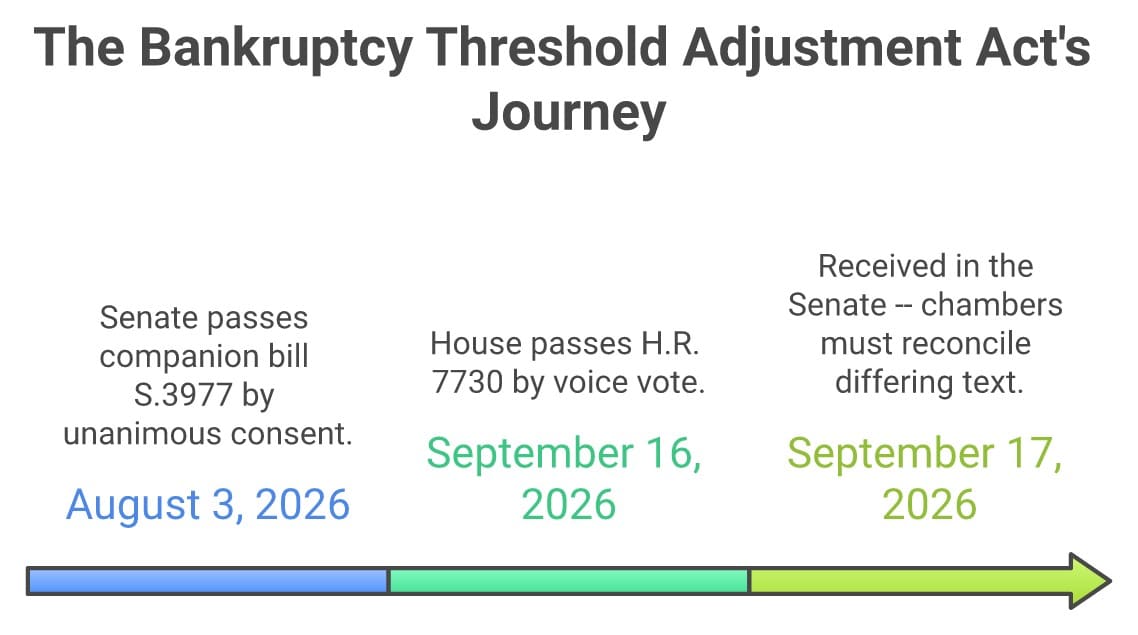
What Actually Happened on September 16
H.R. 7730 — the House companion to the Senate’s S. 3977, which passed the Senate by unanimous consent back on August 3, 2026 — went through the House Judiciary Committee, was reported out (amended) on August 27, and passed the full House under a suspension-of-the-rules vote on September 16, with forty minutes of debate and a voice vote. No recorded roll call was needed, which in Congress usually signals broad, non-controversial agreement rather than a fight. It was received in the Senate on September 17.
Here’s the detail that matters if you’re trying to figure out your own timing: the House didn’t just pass the Senate’s bill as-is. It passed its own version, with a slightly different short title. That means the two chambers have not yet agreed on one identical piece of text — the step that has to happen before a bill gets enrolled and sent to the President’s desk. It could get resolved quickly. It could sit. I’ve watched “quick, non-controversial fixes” take a year in Congress before, and I’ve watched them die entirely. Bipartisan support — Grassley and Durbin leading in the Senate, Cline leading in the House — is a good sign. It is not a signature.
What this bill does NOT do: It doesn’t change Chapter 7 eligibility, doesn’t change what debts get discharged, and doesn’t touch the 3-to-5-year repayment structure once you’re inside Chapter 13. It only changes who is allowed to walk through the door. And the effective-date language in the House-passed text is explicit: any new limits apply only to cases filed on or after the bill is actually enacted — not retroactively.
Who This Actually Helps If It Becomes Law
Homeowners in expensive markets who are stuck between two bad options. Under today’s rule, your secured debt (mostly your mortgage) and your unsecured debt (credit cards, medical bills) are measured against two separate ceilings — $1,580,125 and $526,700. Go over either one and Chapter 13 is closed to you. That doesn’t mean bankruptcy itself is off the table — Chapter 7 liquidation has no debt ceiling and remains available regardless of how much you owe, subject to the means test, and it can still discharge qualifying unsecured debt fast. What Chapter 7 doesn’t do is let you catch up mortgage arrears on a payment plan and keep the house the way Chapter 13 does. If keeping the home is the goal, today’s reorganization option is individual Chapter 11 — not limited to corporations, but built for much larger cases, with quarterly U.S. Trustee fees, heavier reporting, and legal costs that routinely make it impractical for an individual family. A single combined $2,750,000 ceiling — no split — means a homeowner with a $2 million mortgage and modest credit card debt, who is shut out of Chapter 13 today, would qualify.
Self-employed people and small-business owners with personal guarantees. If your business failed and you personally guaranteed the equipment loans, the line of credit, or the lease, that liability doesn’t disappear with the business — I wrote about exactly this scenario in a farm business closure and a self-employed bank levy case this year. Only debts that are noncontingent and liquidated as of your filing date count toward any of these ceilings — a personal guarantee the lender hasn’t actually called on often doesn’t count yet — so don’t assume you’re over a limit from a rough mental total; that’s a calculation for an attorney, not a guess. And you may not need to wait on Congress at all: if at least half of your combined debt came from the business (personal guarantees count) and the total is under today’s $3,424,000 Subchapter V limit, you may already qualify for Subchapter V’s faster, cheaper reorganization right now. Above that number, or if the business-activity test doesn’t fit your situation, individual Chapter 11 is the option that exists today.
Small businesses with $3.4–7.5 million in debt. This is the group that already lost ground once — twice, actually. Congress set both this exact $7.5 million Subchapter V limit and this exact $2,750,000 combined Chapter 13 limit back in 2022, in the Bankruptcy Threshold Adjustment and Technical Corrections Act. Both were written as temporary, and both sunset on the same day, June 21, 2024 — dropping Subchapter V back to the general small-business-debtor threshold (now $3,424,000 after the April 2025 inflation adjustment) and Chapter 13 back to today’s split $1,580,125/$526,700 ceilings. Since then, businesses above $3,424,000 have been pushed back into full Chapter 11, or into expensive stopgaps like the merchant cash advances I’ve written about, instead of a real reorganization tool. H.R. 7730 isn’t proposing new territory — it’s restoring numbers Congress already used once, this time with no expiration date attached. Making $7.5 million permanent, rather than repeatedly re-extending it as an emergency patch, would be the structural fix this specific problem needed — if the bill becomes law.
I’ve watched Congress treat the Subchapter V limit like a light switch — flip it up during a crisis, let it flip back down when nobody’s paying attention. A permanent number would be a different kind of decision. It would say the problem was never temporary.— Steve Rhode
Free Tool — Bankruptcy Means Test: Wondering if you qualify for Chapter 7 bankruptcy? The free Bankruptcy Means Test checks eligibility based on your state, household size, and income — including state exemptions. Check My Eligibility →
If You’re Near the Ceiling Right Now, the Timing Question Is Real
This is the question my March post couldn’t answer, because there was nothing yet to time against. Now there is, and it’s worth being honest about it: nobody — not me, not your attorney, not anyone reading a voice-vote tally — can tell you when, or whether, this bill clears the Senate and gets signed. What I can tell you is what the bill itself says: the new limits apply only to cases filed on or after the date of enactment. File a week too early under today’s law, and today’s $1,580,125 / $526,700 split is what applies to you, full stop.
That cuts against just waiting indefinitely. If you’re in genuine crisis — foreclosure sale scheduled, a lawsuit closing in, a levy already hitting your account — the math of waiting on Congress rarely favors you. A bankruptcy attorney who is actually watching this bill can tell you whether your specific numbers make a short, deliberate delay worth the risk, or whether you need to move now under the rules that exist today. That’s a conversation for a real person who has read your file, not a blog post.
Find an attorney who handles this: The National Association of Consumer Bankruptcy Attorneys (NACBA) maintains a directory of consumer bankruptcy attorneys who can run your actual numbers — including whether you’re realistically near either ceiling — and talk through timing with you directly.
Don’t let a “too much debt for Chapter 13” rejection push you toward a debt settlement company. If you’re told today’s ceiling disqualifies you, that’s a reason to talk to a bankruptcy attorney about Chapter 11, Subchapter V, or the timing question above — not a reason to sign up for a debt settlement program instead. Settlement doesn’t give you the automatic stay or a court-ordered discharge a bankruptcy filing does, it won’t cure mortgage arrears the way a Chapter 13 plan can, and creditors can still sue you while you’re enrolled and saving up.
If you’re not sure where your own numbers stand relative to any of this, the 2-minute bankruptcy quiz is a reasonable starting point before you ever call an attorney.
Key Takeaways
- The House passed H.R. 7730 by voice vote on September 16, 2026 — this is real progress, not a done deal. The House passed its own bill, not the Senate’s S. 3977; one identical version still has to pass both chambers and be signed by the President before this becomes law.
- If enacted, Chapter 13 would move from two separate limits ($1,580,125 secured / $526,700 unsecured) to one combined $2,750,000 ceiling.
- Subchapter V’s small-business limit would permanently return to $7.5 million, up from today’s $3,424,000 — with no sunset clause this time.
- Any new limits would apply only to cases filed on or after the bill’s actual enactment date — filing early under today’s rules locks you into today’s numbers.
- Most readers’ Chapter 13 eligibility is unaffected either way. This matters most to homeowners with large mortgages and small-business owners with significant personal-guarantee debt.
The Bottom Line
If you’ve been told you have “too much debt” for Chapter 13, that number was never a verdict on your character. The two separate ceilings you ran into do get adjusted for inflation every three years — but Congress already tried a single, higher combined limit once, this exact $2,750,000 figure, from 2022 to 2024, and let it lapse. This bill is Congress trying to restore what it already knew worked, not inventing something new. Whether or not it survives the rest of the legislative process, the fix you actually need doesn’t wait on Washington: talk to a real bankruptcy attorney about your real numbers today. I filed in 1990 not knowing any of this — I just knew I needed a fresh start, and I got one. Whatever Congress does next, that part is still true for you.
Frequently Asked Questions
Has the Bankruptcy Threshold Adjustment Act become law?
No. As of September 21, 2026, the House has passed H.R. 7730 (September 16, 2026, by voice vote), and the Senate has passed a different bill, S. 3977 (August 3, 2026) — the House did not pass the Senate’s text. One identical bill still has to pass both chambers and be signed by the President before it takes effect.
What would the new Chapter 13 debt limit be, and how does that compare to today?
Today, Chapter 13 uses two separate ceilings: $526,700 in unsecured debt and $1,580,125 in secured debt. The bill would replace both with a single combined limit of $2,750,000, eliminating the secured/unsecured split entirely.
What would change for small-business owners under Subchapter V?
The Subchapter V debt limit — currently $3,424,000 after a pandemic-era $7.5 million limit expired in June 2024 — would be permanently set at $7,500,000, with no expiration date built into the new text.
If my debt is near today’s limit, should I file now or wait for this bill?
Talk to a bankruptcy attorney about your specific numbers now. The bill’s new limits would only apply to cases filed on or after the date it’s actually signed into law, and nobody can reliably predict Congress’s timeline — a real attorney can help you weigh that uncertainty against your actual deadlines, like a foreclosure sale or pending lawsuit.
Where can I find a bankruptcy attorney to talk about this?
The National Association of Consumer Bankruptcy Attorneys (NACBA) maintains a directory of consumer bankruptcy attorneys who can review your numbers and explain your realistic options, including whether either debt ceiling — current or proposed — actually affects you.
This is what I’m watching as someone who’s tracked bankruptcy policy for decades and filed my own case in 1990. Take it as one informed perspective — you know your full situation better than any blog post can. Use this as input for your decision, not a directive. Nobody gets to tell you what to do with your money. Not me, not anyone.
If you know someone who’s been told they have “too much debt” for Chapter 13 — a friend with a big mortgage, a former business owner still carrying a personal guarantee — send them this. They may not know the ceiling is even up for debate in Congress right now, and that alone might be worth a conversation with an attorney they hadn’t planned on having.
Dealing With Debt? Understanding your options is the first step. See how all your debt relief options compare — including ones most sites won’t tell you about. The Find Your Path quiz gives a recommendation based on your actual numbers, and the Scam-O-Meter checks any company’s complaint history before you sign. Federal Reserve Bank of New York research shows bankruptcy filers recover faster than those who don’t file.



