
Written by Steve Rhode, consumer debt expert since 1994 • Last updated September 23, 2026
Quick Answer: You showed up, made your case, and the judge ruled against you — through a hearing, a trial, or a granted motion for summary judgment. That’s very different from a default judgment, where nobody ever looked at the facts. Once a judge has actually decided the merits, most courts won’t let you re-argue them — the two exceptions this guide covers are California small claims court (CCP § 116.770) and a Texas justice-court debt claim case (TRCP 506.3), where the appeal itself is a brand-new trial — but don’t assume your own state’s small claims court works the same way; some only review the record, and some don’t allow an appeal at all. Everywhere else, your real options are a strict-deadline appeal (only for a legal error), a faster motion for a new trial or to vacate, or accepting the judgment and managing what comes next. Filing bankruptcy can pause collection the day you file (11 U.S.C. § 362), but the judgment is void as your personal debt only if that debt is actually discharged (§ 524(a)(1)) — filing alone doesn’t erase it, and a recorded judgment lien generally needs its own § 522(f) motion. Don’t panic — but figure out which kind of court you were in today, because both your deadline and your options depend on it.
What Just Happened: You Went to Court and the Judge Ruled Against You
There’s a real legal difference between losing a lawsuit and having a default judgment entered against you. A default judgment happens when you never respond — the creditor wins because nobody showed up to disagree, and a court never actually weighs the facts. What happened to you is different: you answered the lawsuit, and then either a judge or jury heard testimony and evidence at a trial, a judge ruled on the case at a hearing, or the judge granted the other side’s motion for summary judgment after reviewing the paperwork both sides filed and decided there was nothing left for a jury to decide. Either way, someone with legal authority actually looked at your side of the story and ruled against you.
That difference matters enormously for what you can do next. Because the merits were already decided, most courts will not simply let you come back and re-explain your position. The tools available to you now are narrower and faster than the ones available to someone fighting a default judgment: a formal appeal to a higher court (limited to claims that the trial judge made a legal error — not a chance to retell your story), a motion for a new trial or to vacate the judgment in the same court (narrow grounds, very short deadline), or accepting the judgment and dealing with its real-world consequences, including through bankruptcy. If you’re actually dealing with a default judgment — one entered because you never responded or were never properly served — that guide covers your very different, and generally more forgiving, options.
One important wrinkle: in two courts this guide covers, an appeal is a brand-new trial: California small claims (CCP § 116.770) and a Texas justice-court debt claim case (TRCP 506.3). Don’t assume your state’s small claims court works that way — some review only the record, and some don’t allow an appeal at all. Ask the clerk whether your appeal is a new trial, a review for errors, or not available, and how many days you have. See “Which Court Was Your Case In?” below for more.
One framing note before you read further: most debt lawsuits are filed in state court, not federal court, so your own state’s rules — not the federal rules occasionally cited below for illustration — control your actual deadlines and what happens next. Confirm every number in this guide against your own court before you rely on it.
The Mistake You’re About to Make: Assuming you can call the court and just explain your side again, or that filing an appeal automatically pauses collection while it’s pending. Neither is true, and whether — and for how long — collection is paused depends entirely on which court entered your judgment. Most debt lawsuits are filed in state court, not federal court, so your state’s rules control, and they vary sharply. In federal court, Federal Rule of Civil Procedure 62(a) automatically pauses enforcement for the first 30 days (“execution on a judgment and proceedings to enforce it are stayed for 30 days after its entry”). Some states build in a similar short wait — Texas, for example, blocks execution on a judgment for 30 days after it’s signed (Tex. R. Civ. P. 627). Other states have no automatic pause at all: in California, “a judgment is enforceable under this title upon entry” (Cal. Code Civ. Proc. § 683.010) — collection can start the same day. To actually pause collection on a California money judgment while you appeal, you generally have to post an undertaking (bond) for double the judgment amount, or one and a half times if bonded by an admitted surety insurer (Cal. Code Civ. Proc. § 917.1) — except in California small claims court, where no bond is needed at all: enforcement “is automatically suspended, without the filing of a bond by the defendant,” first until the time to appeal runs out and then while the appeal is pending (Cal. Code Civ. Proc. § 116.810). Do not assume your state works like the last one you read about — ask the court clerk or a consumer attorney the same day you decide to appeal exactly when collection can start and what it takes to pause it.
Your Options Right Now
What to Do in the Next 48 Hours
- Get three key dates: when the judgment was signed, when it was entered, and when notice of entry was served or mailed. Ask the clerk for all three — different deadlines run from different dates, depending on your court. Many post-judgment deadlines are jurisdictional, meaning the court cannot extend them even for a good reason. Don’t assume every post-judgment motion works the same way or runs on the same clock.
- Figure out what kind of court handled your case, then talk to a consumer or appellate attorney about your appeal and new-trial deadlines — the same day. Small claims court, a Texas justice court “debt claim case,” a limited-jurisdiction court, and a general-jurisdiction court all run on different clocks — some as short as 14 days. See “Which Court Was Your Case In?” below, then confirm your exact deadline with the clerk or an attorney. Whether you actually have grounds to appeal, and by when, is a legal judgment call that has to come from an attorney, not a search engine. NACA can connect you with one.
- If you’re appealing, ask about a stay in the same filing — and don’t assume you have any automatic cushion. Whether collection pauses at all, and for how long, depends on your court. Federal judgments get an automatic 30-day pause under FRCP 62(a); some states (Texas, for example) build in a similar short wait; other states (California, for example) let collection start the moment the judgment is entered, with no automatic pause at all. Ask the clerk or a consumer attorney the same day: without a bond or a separate stay order, the creditor can garnish or levy while your appeal is still pending — and winning the appeal later won’t automatically undo money already taken. Getting money back after the fact is a separate, harder process, which is exactly why a stay matters up front.
- Consider filing bankruptcy — and understand exactly what it does and doesn’t undo. The automatic stay under 11 U.S.C. § 362 takes effect the instant you file — not weeks later — but your employer and bank generally still need to be formally notified before they’ll actually stop withholding wages or holding funds, so tell your attorney to get that notice out immediately. If the underlying debt is dischargeable, 11 U.S.C. § 524(a)(1) goes further: discharge voids the judgment to the extent it’s a determination of your personal liability for that debt. A judgment lien the creditor recorded, or one that attached automatically, against your home or other property, though, generally survives discharge — removing it takes a separate motion under 11 U.S.C. § 522(f)(1)(A), and only to the extent it impairs an exemption you’re entitled to. Bankruptcy can also require turning over non-exempt property. Find a bankruptcy attorney through NACBA.
- Talk to Damon Day about the practical decision. Schedule a free consultation with Damon Day, an independent debt coach and my co-host on the Get Out of Debt Guy podcast — I receive no payment for this referral. His lane is the budget side of paying vs. filing — what you can actually afford and whether negotiating the judgment down beats bankruptcy; the decision to file belongs with a bankruptcy attorney. Whether you have real appeal grounds, and by when you have to file, is a legal question — that has to come from an attorney too, not from him.
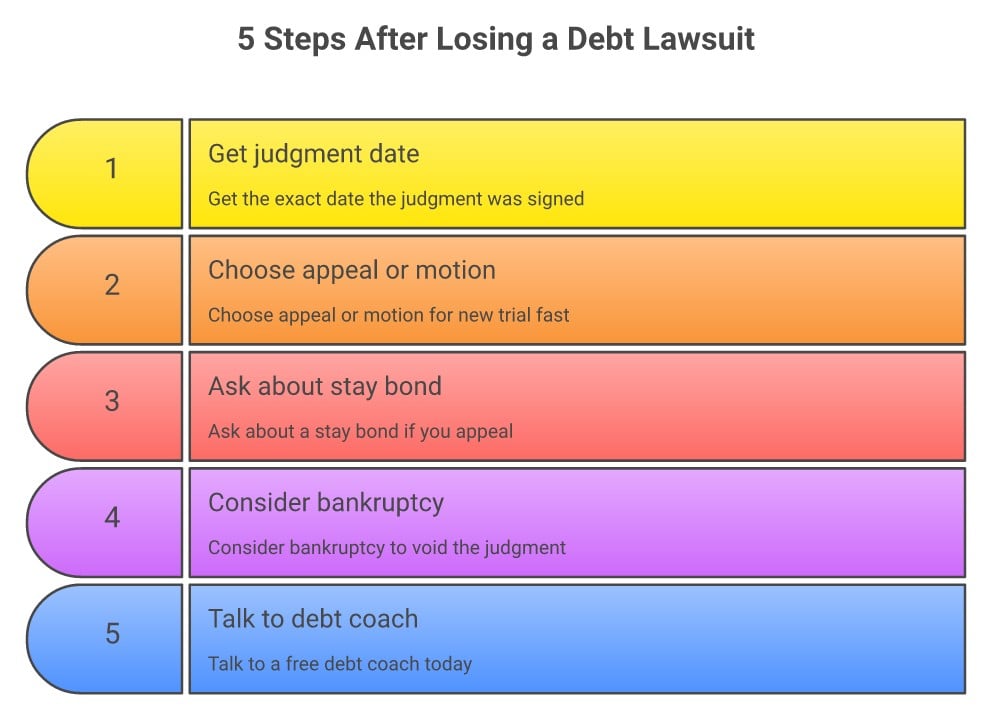
How to Actually Handle This — Your 5 Paths
- File for bankruptcy — understand exactly what it does and doesn’t undo. Discharge doesn’t just stop future collection — under 11 U.S.C. § 524(a)(1), it “voids any judgment at any time obtained, to the extent that such judgment is a determination of the personal liability of the debtor” on a discharged debt. For an ordinary consumer debt judgment — credit card, medical bill, personal loan — that voids the judgment as a personal obligation against you. It does not automatically erase a judgment lien the creditor recorded, or one that attached automatically, against your home or other property — that generally survives discharge and can only be removed by a separate motion under 11 U.S.C. § 522(f)(1)(A), to the extent the lien impairs an exemption you’d otherwise be entitled to; ask a bankruptcy attorney about lien avoidance. Bankruptcy can also require turning over non-exempt property to the trustee. (Judgments based on fraud or willful and malicious injury can be excepted from discharge entirely — an attorney can tell you if that applies to your case.) Philadelphia Fed research tracking actual filers’ credit files found that both Chapter 7 and Chapter 13 filers “returned roughly to their previous risk score levels… within about one year after filing” — a real recovery, but back to where they already were, not a clean slate (Federal Reserve Bank of Philadelphia). Find a bankruptcy attorney at nacba.org.
- Appeal — only if there was a real legal error, and only within your court type’s deadline. An appeal is not a retrial in most courts — the exceptions covered in this guide are California small claims court and a Texas justice-court debt claim case, where the appeal is heard as a brand-new trial (don’t assume your own state’s small claims court works the same way — ask the clerk). Everywhere else, you (or your attorney) have to identify a specific legal mistake the trial judge made — misapplying the law, excluding evidence that should have come in — not just disagreement with who the judge believed. Appeal deadlines in this guide run from 21 days (a Texas justice-court debt claim case) to 60 days (a California unlimited civil case); new-trial and vacate motions run on a separate, often shorter clock — see “Which Court Was Your Case In?” and the table below to find yours.
- Ask the same court to reconsider, grant a new trial, or vacate the judgment (narrower, faster, rarely granted, but sometimes exactly right). If the judge overlooked evidence, misapplied the law, or you have genuinely new evidence that could not have been discovered in time for trial, this may fix the problem without a full appeal. Deadlines are typically shorter than an appeal’s — as little as 14 days in a Texas justice court debt claim case (TRCP 505.3(c)), the shortest deadline in this guide; 15 days in California (CCP § 659 for a new trial, § 663a to vacate) or Florida (Fla. R. Civ. P. 1.530(b)); and 28 days in federal court (FRCP 59(b)). This is not a vehicle for re-arguing facts the judge already heard and rejected.
- Negotiate a settlement, set up a payment plan, or pay it off and get it satisfied. Creditors and judgment collectors will often accept a lump sum for less than the full balance, or agree to a payment plan, especially once they see you’re engaged rather than avoiding them. Get any agreement in writing before you pay. Once you pay a judgment in full, some states require the creditor to file an “acknowledgment of satisfaction of judgment” with the court — in California, for example, the creditor must file one immediately (CCP § 724.030), and if they don’t, you can send a written demand that gives them 15 days to comply or face penalties (CCP § 724.050; California’s self-help guide walks through the process); other states differ, so check your own court’s process. A settlement for less than the full balance can also trigger a 1099-C for the forgiven amount, so ask about tax consequences before you sign.
- What’s usually a weaker strategy here: waiting it out, or appealing without a stay. Unlike some default-judgment situations, “wait and see if they even try to collect” is often a weaker approach after a contested judgment — you already went through the process, so the creditor knows exactly what they have and may move on garnishment or a bank levy relatively quickly. That said, waiting isn’t automatically wrong: if your income and property are largely exempt from collection, you may be judgment-proof, and a deliberate wait-and-monitor strategy can be rational rather than avoidance. What doesn’t work is filing an appeal by itself, without a bond or stay order, and assuming that stops collection — it doesn’t. Read the mistake warning above again before you decide what to do.
What You Need to Know About Deadlines and What the Judgment Now Allows
14 days (your state’s can be shorter)
The shortest new-trial deadline in this guide — a Texas justice court “debt claim case” gives you just 14 days after the judgment is signed to move for a new trial (TRCP 505.3(c))
0 days
How long some state courts make you wait before a judgment can be enforced — in California, a judgment is enforceable “upon entry,” with no automatic pause at all (Cal. Code Civ. Proc. § 683.010) — except California small claims, where enforcement is automatically suspended with no bond needed while an appeal is filed and pending (CCP § 116.810). Federal court is different — FRCP 62(a) gives 30 automatic days — but most debt suits are in state court.
5%/yr
California’s post-judgment interest rate for most readers of this guide: 5% applies to a personal (consumer) debt judgment of $50,000 or less, or a medical debt judgment of $200,000 or less, entered on or after January 1, 2023 (CCP § 685.010). The general rate for larger or older judgments is 10% — check which applies to yours, and check your own state’s rate.
Void (as personal liability)
What happens to a money judgment once the underlying dischargeable debt is discharged in bankruptcy (11 U.S.C. § 524(a)(1)) — a judgment lien the creditor recorded, or one that attached automatically, generally survives and needs its own removal motion under § 522(f)(1)(A)
An appeal deadline is not the same as a motion-for-new-trial deadline, and mixing them up costs people their case. In federal court, a motion for a new trial under FRCP 59(b) must be filed within 28 days of judgment. Filing certain post-judgment motions on time can also extend your deadline to file a notice of appeal — in a Texas county or district court, for example, the notice-of-appeal deadline extends from 30 to 90 days after the judgment is signed “if any party timely files: (1) a motion for new trial; (2) a motion to modify the judgment… or (3) a motion to reinstate” (TRAP 26.1(a)). And the trial court itself keeps power to change its judgment for 30 days after signing, longer if a timely post-judgment motion is filed (TRCP 329b). These interactions are exactly why a consumer attorney — not a search engine — should confirm your specific deadline.
A judgment you lost on the merits is much harder to undo than a default judgment. Vacating a judgment after a real hearing or trial requires narrow grounds — under the federal model, FRCP 60(b) allows relief only for mistake or excusable neglect, newly discovered evidence, fraud by the other side, a void judgment, a judgment already satisfied, or “any other reason that justifies relief” — and the first three grounds must be raised “within a reasonable time — and… no more than a year after the entry of the judgment” (Rule 60(c)(1)). Rules vary by state — ask your court clerk or an attorney the same day what your state’s equivalent rule requires and what number it’s filed under. “I don’t think the judge was fair” or “I have more to say” are not grounds. This is why the appeal — not a request to relitigate — is usually the real path if you believe the outcome was wrong.
Free Tool — I'm Being Sued for Debt Guide: Being sued by a creditor or debt collector? The free I'm Being Sued Guide gives you a personalized action plan — deadlines, defenses, and options based on your state. Most states require a response within 20–30 days. Get My Action Plan →
Which Court Was Your Case In?
Every deadline in this guide depends on which kind of court actually heard your case — and unlike a lot of legal distinctions, this one is easy to check: look at the case caption on your paperwork, or call the clerk and ask. Four kinds of courts hear most debt cases, and they run on very different clocks:
- Small claims court. Informal, no attorneys required, and — critically — the defendant may appeal a small claims judgment, but the plaintiff may not (Cal. Code Civ. Proc. § 116.710, as one example). An “appeal” here is really a full do-over.
- A Texas justice court “debt claim case.” A specific procedural track for claims up to $20,000 brought by an assignee, a financial institution, a debt collector, or another party primarily in the business of lending money (TRCP 500.1(b)) — which describes most companies suing over consumer debt in Texas justice courts.
- A limited-jurisdiction civil court (California calls this “limited civil,” for claims up to $35,000 under CCP § 85). Many states have an equivalent tier between small claims and full civil court.
- A general-jurisdiction civil court — county, district, or “unlimited civil” court, with no dollar cap. This is the court type most legal articles (including the federal examples in this guide) assume by default, and it’s often the WRONG assumption for a debt case that started small.
If you’re not sure which one applies to you, that uncertainty is normal — ask the clerk directly which set of rules governs your case before you rely on any deadline below.
Most debt lawsuits are filed in state court, not federal court — the federal row in the table below is included as a reference point because its rules are well-documented, not because it’s where your case likely is. Find your own state and court type below, or its specific rule if it isn’t listed.
| Court Type | Deadline to Appeal | New Trial / Vacate Motion | Notes |
|---|---|---|---|
| California — Small Claims | 30 days after the clerk delivers or mails notice of entry of judgment; defendant only — the plaintiff has no right to appeal (CCP § 116.750; § 116.710) | Not applicable — the appeal itself is the new proceeding | The appeal “shall consist of a new hearing before a judicial officer other than the judicial officer who heard the action” (CCP § 116.770) — a new hearing, not a review of the old one |
| California — Limited Civil (up to $35,000, CCP § 85) | 30 days after notice of entry is served, or 90 days after entry, whichever is earliest (Cal. Rules of Court, Rule 8.822) | 15 days from notice of entry, or 180 days after entry, whichever is earliest (CCP § 659 new trial; § 663a to vacate) | Covers most California debt lawsuits |
| California — Unlimited Civil | 60 days after notice of entry, 180 days after entry, whichever is earliest (Cal. Rules of Court, Rule 8.104) | Same 15-day / 180-day rule as limited civil (CCP §§ 659, 663a) | — |
| Texas — Justice Court “Debt Claim Case” (up to $20,000, TRCP 500.1(b)/508) | 21 days after judgment is signed, or after a timely post-judgment motion is denied — by bond, cash deposit, or a Statement of Inability to Afford Payment of Court Costs (TRCP 506.1(a)) | 14 days after judgment is signed (TRCP 505.3(c)) | Tried de novo in county court — “a new trial in which the entire case is presented as if there had been no previous trial” (TRCP 506.3) |
| Texas — County or District Court | 30 days after judgment signed; 90 days if a timely post-judgment motion is filed (TRAP 26.1) | 30 days for a motion for new trial (TRCP 329b) | Standard civil appeal, not a new trial |
| Florida — County and Circuit Civil | 30 days from rendition — jurisdictional (Fla. R. App. P. 9.110) — unless a timely, authorized motion for new trial or rehearing delays rendition (Fla. R. App. P. 9.020(h)) | 15 days after the judgment is filed in a non-jury case, or after the verdict in a jury case (Fla. R. Civ. P. 1.530(b)) | A timely rehearing/new-trial motion tolls the appeal clock. Florida small claims cases have their own separate rules — ask the clerk. |
| Federal Courts (rare for consumer debt — shown for reference) | 30 days after entry of judgment, when the U.S. is not a party (FRAP 4(a)(1)(A)) | 28 days for a new trial (FRCP 59(b)) | — |
Find your own state’s deadline — don’t rely on this table alone. Once you know your court type, search “[your state] rules of appellate procedure notice of appeal” or “[your state] rules of civil procedure motion for new trial,” or simply call your court clerk and ask what deadline applies to your case type. A consumer or appellate attorney can confirm it in one phone call — and given how unforgiving these deadlines are, that call is worth making today, not after you’ve done your own research.
If the creditor or their attorney is misrepresenting what the judgment allows, adding fees the court never awarded, or otherwise violating debt collection law while enforcing it, file a complaint with the CFPB and your state attorney general. If you need legal help but can’t afford an attorney, find free legal aid through LSC.gov.
Steve’s Take
I filed bankruptcy in 1990. I know the specific sting of losing a fight you actually showed up for — it’s a different kind of gut-punch than a default judgment, because you told your side and the system still ruled against you. It’s easy to spiral into “the whole thing is rigged” or “there’s nothing left to do.” Neither is true. What I’ve seen over more than 30 years is that the people who move fast on the narrow options that actually exist — checking the real appeal deadline, talking to an attorney about whether bankruptcy would void the judgment as a personal debt — end up in a fundamentally different place than the people who spend those same weeks stewing over how unfair it was. Debt is math wrapped in emotion. The emotion is real and it’s earned. But the math is what gets you out.
If you never got the chance to go to court at all because you were incarcerated when the case was filed, that’s a different situation with different options — see I Just Got Out and There Are Judgments Against Me I Didn’t Know About. Here’s What to Do Right Now..
Frequently Asked Questions
I went to court and lost — is that the end of it?
Not necessarily, but your options are narrower and faster-moving than most people expect, and how narrow depends on your court. If the judge made a genuine legal error, you can appeal — but only within your state and court’s strict deadline. Appeal deadlines in this guide run from 21 days (a Texas justice-court debt claim case) to 60 days (a California unlimited civil case); a new-trial or vacate motion is often a separate, shorter deadline — as little as 14 days in a Texas justice court. These are measured from signing, entry, or service of notice of entry, depending on your court — check your row in the table and confirm the trigger date with the clerk. The exception: in California small claims court and a Texas justice-court debt claim case, the appeal itself is a brand-new trial — but don’t assume your own state’s small claims court works the same way; some only review the record, and some don’t allow an appeal at all, so ask the clerk. If you don’t have grounds for an appeal, you still have real options: negotiating the judgment, setting up a payment plan, or filing bankruptcy, which under 11 U.S.C. § 524 can void the judgment as your personal liability if the debt is dischargeable.
What’s the difference between this and a default judgment?
A default judgment is entered because you never responded to the lawsuit — no judge ever looked at the facts. What you’re facing is a judgment on the merits: you answered, and a judge or jury actually heard the case, or the judge granted summary judgment after reviewing both sides’ evidence. Default judgments can often be undone more easily, on grounds like improper service or excusable neglect. A judgment on the merits generally can’t be undone just because you disagree with it — the tools are an appeal (for legal errors) or the very narrow grounds under rules like FRCP 60(b) (fraud, newly discovered evidence, a void judgment). If you’re actually dealing with a default judgment, read that guide instead — your options there are meaningfully different.
Can I appeal just because I don’t agree with the judge’s decision?
Usually no. In most courts, an appeal exists to correct legal errors — the trial judge misapplied the law, made a procedural mistake, or excluded evidence that should have been admitted. It is not a chance to retell your story to a new judge or argue that the first judge should have believed you instead of the creditor. The exception: in California small claims court and a Texas justice-court debt claim case, the appeal itself is a brand-new trial — a full do-over, not just an error review. Don’t assume your own state’s small claims court works the same way, though; some only review the record and some don’t allow an appeal at all — ask the clerk. Outside these two, if you don’t have a specific, identifiable legal error, an appeal is unlikely to succeed, and a consumer attorney can tell you honestly whether you have one before you spend the time and filing fees.
How long do I have to appeal?
It depends entirely on your state, your court type, and your case, and the deadlines are strict and generally cannot be extended. In California, it’s 30 days from notice of entry in small claims (defendant only) or limited civil (or 90 days after entry, whichever is earliest, for limited civil), and 60 days from notice of entry (180 days outer limit) in unlimited civil. In Texas, a justice court debt claim case gives you 21 days, filed by bond, cash deposit, or a free Statement of Inability to Afford Payment of Court Costs if you can’t afford the other two; a county or district court gives 30 days, extended to 90 if a timely post-judgment motion was filed. Florida gives 30 days, jurisdictional, unless a timely new-trial or rehearing motion delays that clock. See the full table above for citations, and find your own state’s rule immediately — call the court clerk or a consumer attorney today, not next week.
If I file bankruptcy, does it erase a judgment I already lost in court?
For most ordinary consumer debt — credit cards, medical bills, personal loans — it voids the judgment as a personal obligation, which is close to “erase” but not quite the same thing. Under 11 U.S.C. § 524(a)(1), a bankruptcy discharge “voids any judgment at any time obtained, to the extent that such judgment is a determination of the personal liability of the debtor” on the discharged debt. That’s stronger than simply stopping collection — the judgment stops existing as a personal obligation. But a judgment lien the creditor recorded, or one that attached automatically, against your home or other property before you filed generally survives that discharge — removing it takes a separate motion under 11 U.S.C. § 522(f)(1)(A), and only to the extent the lien impairs an exemption you’re entitled to. Some judgments — for example, those based on fraud or willful and malicious injury — can also be excepted from discharge entirely; a bankruptcy attorney can tell you if either exception applies to your case. Find one through NACBA.
Does filing an appeal stop the creditor from collecting while it’s pending?
Not automatically, and this trips up a lot of people — and the real answer depends entirely on which court entered your judgment. Federal judgments get an automatic 30-day pause unless the court orders otherwise (FRCP 62(a)). Most debt lawsuits are filed in state court, though, and state rules vary widely. Texas holds off execution for 30 days after the judgment is signed (TRCP 627). California judgments, by contrast, can be enforced right away — a judgment is enforceable “upon entry” (Cal. Code Civ. Proc. § 683.010) — and pausing collection on a California money judgment during an appeal generally requires posting an undertaking (bond) for double the judgment amount, or one and a half times if bonded by an admitted surety insurer (Cal. Code Civ. Proc. § 917.1) — except in California small claims court, where no bond is needed: enforcement is automatically suspended while the time to appeal runs and while the appeal is pending (CCP § 116.810). Ask your court clerk or a consumer attorney the same day you decide to appeal what your own state requires — if you file an appeal without addressing the stay, the creditor can garnish your wages or levy your bank account while your appeal is still working its way through the court.
Can they still garnish my wages or freeze my bank account after I lost?
Usually, depending on your state — this is not automatic everywhere. Most states allow wage garnishment and bank account levies once a judgment is entered, subject to federal and state exemption limits. But several states cut off wage garnishment for ordinary debt almost entirely: Texas’s constitution bars garnishing “current wages for personal service” except for court-ordered child support or spousal maintenance (Tex. Const. art. XVI, § 28) — though that protection does not stop federal collection; federal law lets the government garnish wages for a defaulted federal student loan “notwithstanding any provision of State law” (20 U.S.C. § 1095a(a)). Pennsylvania (42 Pa.C.S. § 8127) largely bars ordinary wage garnishment too, and South Carolina bars it specifically for “a debt arising from a consumer credit sale, a consumer lease, a consumer loan, or a consumer rental-purchase agreement” (S.C. Code § 37-5-104) — an ordinary medical bill may not fall under that definition, so don’t assume it’s covered. North Carolina protects earnings when they’re shown to be necessary to support a family — a conditional protection, not an absolute bar (N.C.G.S. § 1-362). Even in a state that bars wage garnishment, a bank levy or a property lien may still be possible, so don’t assume you’re fully protected — see the dedicated guides on wage garnishment and a frozen bank account, and the guide on a judgment lien against your house if that’s what happened. If your income and property are largely exempt, you may also be judgment-proof — worth reading before you assume the worst.
Free Tool — Wage Garnishment Calculator: Worried about your paycheck being seized? The free Wage Garnishment Calculator shows exactly how much creditors can legally take in your state — and some states prohibit garnishment entirely. Calculate My Risk →
I can’t afford an attorney for an appeal — what do I do?
Start with LSC.gov, which connects you to federally funded legal aid programs. Appeals are technical, and even a single consultation with a consumer or appellate attorney can tell you honestly whether you have real grounds before you spend time or money on a filing that’s unlikely to succeed. If an appeal isn’t realistic, a bankruptcy attorney’s consultation is often free and can tell you whether discharge would resolve the underlying debt — find one through NACBA.
One more thing — everything I share here is based on over 30 years of helping people through exactly this. But my advice is input for your decision, not the decision itself. Only you know your full situation. Talk to an attorney, look at your numbers, and make the choice that serves your future.
Important: This guide is for informational purposes only and is not legal advice. Laws vary by state, and your situation may have details that change what options are available to you. For legal advice specific to your case, consult an attorney licensed in your state. NACBA can help you find a bankruptcy attorney, NACA can connect you with a consumer attorney, or schedule a free consultation with Damon Day, an independent debt coach and my podcast co-host — I receive no payment for this referral.
Key Takeaway: Losing a debt case you fought is not the end of the road, but the clock on your best options is short — measured from signing, entry, or service of notice of entry, depending on your court, so check your row and confirm the trigger date with the clerk. Confirm your court type, then your state’s exact appeal and new-trial deadlines, today. Don’t assume filing an appeal alone stops collection. If the numbers don’t work no matter what a court does, bankruptcy can void the judgment as your personal liability for the debt — though a judgment lien the creditor recorded, or one that attached automatically, generally needs its own removal step. Use the Find Your Path quiz to see what makes sense for your situation.
The Bottom Line
You showed up, you fought, and the court still ruled against you — that’s not a reflection of your worth, and it’s not necessarily the final word on the debt. The system gives you a small number of fast, narrow tools: an appeal for real legal errors (or, in California small claims and a Texas justice-court debt claim case specifically, a genuine do-over — check your own court, since small claims rules vary widely by state), a quick motion for reconsideration or a new trial, or a fresh start through bankruptcy that can void the judgment as a personal debt, with its own separate rules for any judgment lien the creditor recorded, or one that attached automatically, on your property. The people who move on those options quickly almost always end up in a better place than the ones who spend the same weeks replaying the hearing in their head. If someone you know just lost a debt case in court, send them this page — knowing which of these tools actually applies to them is the first step. Start with the Find Your Path quiz or see all your debt relief options to see what’s realistic for your situation.
Dealing With Debt? Understanding your options is the first step. See how all your debt relief options compare — including ones most sites won’t tell you about. The Find Your Path quiz gives a recommendation based on your actual numbers, and the Scam-O-Meter checks any company’s complaint history before you sign. Federal Reserve Bank of New York research shows bankruptcy filers recover faster than those who don’t file.
Right now you are dealing with the thing in front of you, and that is exactly where your attention belongs. When it is handled — and it will be — there is a next stage, and it is the one I most enjoy writing about.
In the latest issue (Oct 8): A parent's nursing home bill can become yours
I write Your Money Actually most weekdays — actionable money information you will not find anywhere else, and the small decisions that compound. It is free, I sell nothing, and I take no money from any company I write about.



