

Quick Answer: Damon Day — the debt advisor I recommend more than anyone else, and the guy I started The Penny Stupid Project with back in 2022 — grossed $141 in about three hours on what he calls a slow Tuesday night, by keeping three gig apps running at once instead of picking one and waiting. The number that matters more than the $141 is 49: that’s how many miles it took him to get there, and once you run the honest math on those miles, the picture looks different than the headline.
Debt is math wrapped in emotion — and so is the moment an app throws you a crappy order and you’re tempted to take it anyway because you need the money tonight. Watch what happens when a driver has built himself enough room to just say no.
If you’ve read my earlier write-ups of Damon’s gig-work videos — including Day 4 of his $500 weekly challenge, where a pre-set $40-an-hour rate floor kept him from chasing junk offers — you know the drill. If this is your first one: Damon and I started something called The Penny Stupid Project together in 2022, a public, no-BS test of side hustles where neither of us sold anything. My half was retail arbitrage and Amazon FBA. Damon’s half was gig delivery, and he’s run with it since — his channel is still called The Penny Stupid Project on YouTube, and its own description links first to his site, damonday.com. I tell you I helped start it every time I feature his videos, and I receive no payment for featuring them or for recommending him to you. You deserve to know where I stand before you take my recommendation.
His newest video, posted September 23, 2026, carries a title built around an hourly number — I’m not repeating it here, and you’ll see why in a minute. What the video actually shows is narrower and more useful than a rate: three delivery and shopping apps running at the same time, one stacked order accepted while another was still in progress, and a driver who says his acceptance rate stays under 10% on purpose. That’s the new piece I want to dig into. I already covered his rate-floor discipline in the Day 4 post linked above; this one is about the mechanics of the juggling itself, and about a psychological point buried near the end of the video that has more to do with debt than gig work.
Every weekday I read the enforcement actions, filings and fine print the outlets skip, and turn them into the one or two moves that actually improve your position — a rate worth moving for, a fee you can refuse, a deadline to beat before it costs you.
In the latest issue (Oct 8): A parent's nursing home bill can become yours
I write Your Money Actually most weekdays — actionable money information you will not find anywhere else, and the small decisions that compound. It is free, I sell nothing, and I take no money from any company I write about.
Two Kinds of Multi-Apping, and Damon Only Does One of Them
In the Day 4 post, I described Damon treating Instacart and Walmart Spark as “anchor apps” that tend to produce bigger single orders, with DoorDash and Uber Eats filling the gaps. This video adds a distinction he draws himself: there’s a lighter version of multi-apping — turn on three or four apps, wait for one good offer, then switch your attention to just that order until it’s done — and there’s what he actually does, which is leave every app running and active the entire time, accepting a new stacked order while he’s still in the middle of shopping or delivering a different one. He’s upfront that the lighter version is a perfectly reasonable strategy and easier to manage. His version pays better precisely because it’s more demanding — more decisions per hour, less downtime, and a genuine risk of one order interfering with another if the timing goes wrong.
Tonight, that meant Walmart Spark, Instacart, DoorDash, and Uber Eats were all open on his phone the entire evening, even though DoorDash never actually produced an order. Walmart Spark did the heavy lifting — four separate shop-and-deliver orders over the course of the night — with one Instacart shop and one Uber Eats delivery layered in around them. I also wrote about the low Walmart Spark offers Damon turned down, and the math behind that.
The Daily Money Brief — Free, at 10 AM
Money you may be owed, scams to dodge, and the fine print decoded — the consumer money news that affects your wallet, every weekday.
The Night, Order by Order
Here’s the sequence, walking through what he describes happening, in order:
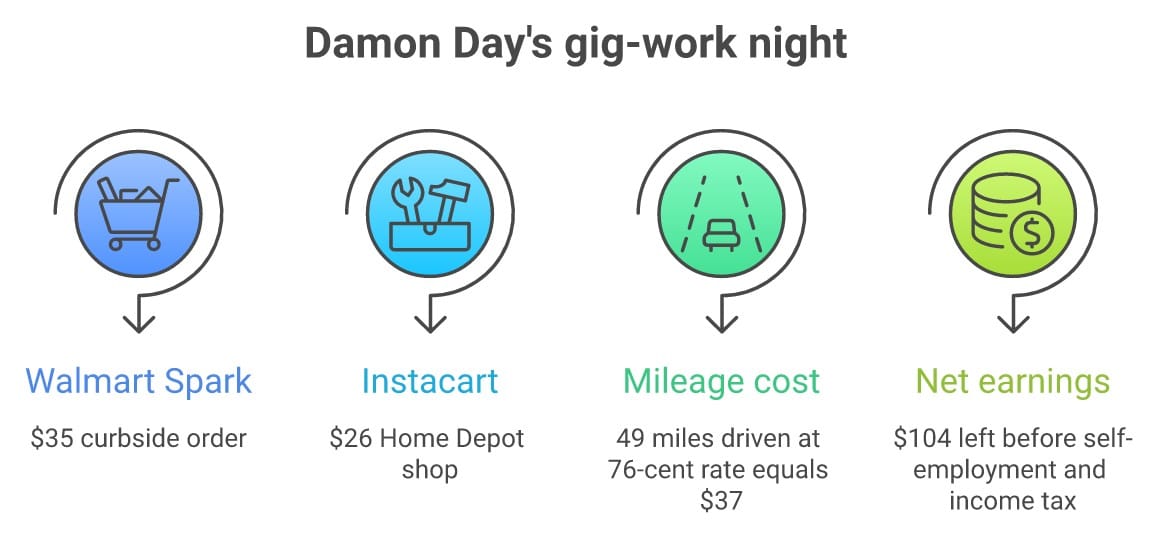
- 7:30 p.m., a $35 Walmart Spark curbside order, 6 miles, three stops. He was at home, apps on, not planning to drive — the store was 2.5 miles away, and this offer was what got him off the couch.
- A second order stacked on top before he’d even reached the store. While driving to Walmart, Instacart offered him a $26 shop at Home Depot — four items, four miles away, with the Home Depot itself roughly a mile from the Walmart he was already headed to. Because a Walmart Spark curbside order gives more time flexibility than a tightly timed DoorDash run, he accepted it. He now had $60 committed — a $35 order in progress and a $26 order stacked on top — before he’d shopped for either one.
- The Home Depot shop, in and out in five minutes. He grabbed the four items, delivered them four miles away, and got back to finishing the Walmart order — a total detour of about 15 minutes to fit the second order into the first.
- The Walmart order completed: $60 in just over an hour. He finished the three-stop delivery about two minutes past the one-hour mark he’d been unofficially chasing.
- A second Walmart offer on the way home, in the low-to-mid $20s, for a short curbside run. He took it rather than drive straight home.
- A third Walmart offer right after: $21 for one stop, about two miles. He calls this one a no-brainer and takes it without hesitation. By his own rough count — and he stumbles over the mental math out loud in the video — he’s now around two hours in and roughly $100 total.
- A $10 Uber Eats order, three miles, picked up almost as an afterthought. He’d headed back toward Walmart on the chance something else would come through, and while he was there, Uber Eats offered a quick $10 delivery. He took it mostly out of curiosity about whether the night had more in it.
- A final Walmart shop, four or five items, delivered two doors down from his own neighborhood. In and out in five minutes, with a drop-off literally on his own street.
Total for the night: four Walmart Spark shop-and-deliver orders, one Instacart shop, and one Uber Eats delivery, for $141 gross. He gives two slightly different times for how long it took — three hours and ten minutes near the start of the video, three hours and fifteen minutes near the end — so call it a little over three hours. He drove 49 miles total.
Gross earned across roughly 3 hours, one Tuesday night
Total miles driven for the whole night
Orders completed: 4 Walmart Spark, 1 Instacart, 1 Uber Eats
His typical acceptance rate on every app, by his own account
Figures are what one driver logged on one night in one market — not typical gig-work pay, an average, or a promise of what your area or your night would look like.
What the 49 Miles Actually Cost
The IRS’s business standard mileage rate has been 76 cents a mile since July 1, 2026 — a figure built from what gas, maintenance, tires, insurance, and depreciation actually cost per mile, not a guess. Run that against Damon’s 49 miles and you get roughly $37 in real vehicle cost before he ever sees a dollar of profit. $141 minus that $37 leaves about $104 — and self-employment tax, currently 15.3% on top of ordinary income tax, still comes out of whatever’s left. None of that shows up on the number he says out loud in the video. It comes out of his gas tank, his tires, his brakes, and eventually his tax return.
Why He Doesn’t Care About His Acceptance Rate
Every gig platform tracks how often a driver accepts the offers it sends. Damon says his own acceptance rate sits under 10% on nearly every app, nearly all the time — meaning he turns down at least nine out of every ten orders he’s shown. He explains why that’s not a problem: acceptance rate is a rolling measure of your last roughly 100 offers, so a handful of good orders taken in a row on a busy night can visibly bump the percentage up even though his long-run average stays low. The platforms present acceptance rate as a quality signal worth protecting. Damon treats it as a number that doesn’t matter to him, because he’s not depending on any single app’s goodwill — he’s comparing every offer against his own bar and letting the ones that don’t clear it go to someone else.
That’s the same discipline I wrote about in the Day 4 post, applied to a different lever. There, it was a $40-an-hour rate floor he wouldn’t drop below. Here, it’s a willingness to decline the overwhelming majority of what four apps put in front of him and trust that enough good ones will still show up. Both only work because he isn’t desperate for the next order to say yes to.
This Is a Debt Story, Not Just a Gig-Work Story
Near the end of the video, Damon says something that has nothing to do with delivery apps and everything to do with what I’ve watched happen to people in debt for more than 30 years. He describes what happens when a driver depends on gig income to survive — to make rent, with no other money coming in. That’s when the crappy orders start looking acceptable, because something feels better than nothing, even when the math says the order isn’t worth the miles. His view is blunt: that dependency is exactly what these apps count on, feeding a driver in that position the orders nobody else wants because desperation makes them hard to turn down. The moment you don’t need the next order — when saying no doesn’t threaten anything — is the moment you’re actually free to make better decisions.
I’ve watched the identical pattern play out with debt settlement offers, “limited time” balance transfers, and payday loans for 30 years. A person with a cushion looks at a bad offer and walks away. A person with no cushion and a bill due tomorrow takes the bad offer, because refusing it feels like refusing the only option on the table. The offer didn’t get better. The person’s ability to say no got worse. That’s not a character flaw — it’s what happens to decision-making under financial pressure, whether the pressure is a gig app’s queue of low-paying orders or a collector’s settlement deadline.
- The cushion is what buys you the ability to decline. Whether it’s a rate floor on a delivery app or a real emergency fund before you touch debt relief, the leverage comes from not needing the next dollar immediately.
- An acceptance rate — or a credit score, or a settlement percentage — is a number the other side wants you to protect. It’s worth protecting only to the extent it actually serves you, not because a platform or a creditor frames it as important.
- Gig income and debt relief income both look like a lifeline in the moment you’re desperate. They work best as a planned piece of a strategy, run on a calm day, not as the decision you make while under stress with a deadline attached.
- Track your own real numbers — miles, hours, fees, terms — the way Damon tracks his. A gross number without the costs subtracted is marketing, whether it’s a gig app’s headline or a debt settlement pitch.
Is Gig Work a Real Tool When You’re Behind on Bills?
I get some version of this question often, and my honest answer is the same one I give about most financial choices on this site: it depends on your own numbers, not on one driver’s one good night. Gig work can be a legitimate way to generate quick cash when you need money now and don’t have savings to draw on — you can often start the same day and get paid within days, which matters if you’re closing a short-term gap like a car payment or a shutoff notice. But before you count on it as steady income, run your own version of the math Damon runs in this video:
- Decide your floor before your shift, not during it. Whether it’s a dollar-per-hour rate or a mileage limit, set it on a calm afternoon so a tired, frustrated version of you isn’t the one deciding whether to take a bad order.
- Subtract mileage before you believe the gross number. The IRS mileage rate is 76 cents a mile as of July 1, 2026 — every mile you drive carries that real cost whether or not you ever claim it on a tax return.
- Set money aside for self-employment tax. Gig platforms pay you as an independent contractor. Nobody withholds anything for you, no matter how many apps you’re running or how good the night felt.
- Running several apps at once has real trade-offs, not just upside. Cascading cancellations, insurance coverage that may not follow you between apps, and more 1099s to reconcile at tax time are all real costs a highlight-reel video won’t show you. Check your own policy and each platform’s terms before you multi-app the way Damon does.
“Run your own numbers before you count on it” isn’t a cop-out. It’s the same advice I’d give about any debt option on this site. Gig work is a tool, not a rescue plan, and it works best as one piece of a bigger decision — never the whole strategy.
What He Works Through On Camera
YouTube’s auto-generated captions garble names and numbers badly enough that I won’t put them in quotation marks and call them his words. So what follows is my paraphrase of the beats in the video, not a transcript. Watch it above for what he actually says.
Opening with the total, then backing into how he got there. Damon starts by naming his gross and the rough time it took, then spends the rest of the video walking back through the night order by order to show the actual math behind the number, not just the headline.
Explaining the two flavors of multi-apping. He draws a clear line between the easier version — wait for a good offer, then focus on just that one — and his own version, where every app stays live and accepting new orders while he’s still working an existing one.
Naming why he leans on Walmart Spark and Instacart. He describes these as the apps that tend to hand him bigger single orders, with DoorDash and Uber Eats there to fill in when the anchors go quiet — though DoorDash didn’t produce anything for him this particular night.
Doing rough math out loud, and correcting himself. More than once he stumbles over exactly how much he’d made or how long he’d been out — visibly doing arithmetic on the fly rather than reading off a script — before landing on his final numbers.
Explaining why his low acceptance rate doesn’t bother him. He walks through how the rate is calculated on a rolling basis and why a string of good orders on one night can make the number look better than his real long-run average.
Closing on the psychology, not the math. He describes what happens to a driver who depends on this income to survive versus one who’s using it purely as extra money, and argues the second position is what actually lets you make better decisions and, eventually, more money.
More From the Side Hustle Archive
Damon and I have been writing about the honest math of side hustles and gig work since The Penny Stupid Project started in 2022. A few from the archive that pair well with this video:
- Damon Day Made $138 Multi-Apping in 3 Hours — the earlier piece on his rate-floor discipline
- Damon Day Made $565 Driving New Year’s Eve. In 2023, It Was $1,000. — what a genuinely high-demand night looks like by comparison
- The Original Introduction to The Penny Stupid Project — how this whole experiment started in 2022
- Quick Cash for Bills: Myth vs Reality — the honest boundaries of using gig income to close a gap
- Side Hustle Income Fear: Myth vs Reality — the flip side of tonight’s lesson about not depending on the money
Key Takeaway
Damon Day grossed $141 in about three hours on an ordinary Tuesday night by running Walmart Spark, Instacart, DoorDash, and Uber Eats simultaneously — accepting a stacked order while another was still in progress, rather than waiting for one good offer and focusing on it alone. He drove 49 miles to get there, which carries roughly $37 in real vehicle cost at the IRS mileage rate before self-employment tax comes out of what’s left. He also deliberately declines the large majority of what these apps offer him, and says the real advantage isn’t the app strategy — it’s not needing any single order badly enough to take a bad one. That’s one driver’s one night, not a typical rate or a promise of what your market would produce.
This is what I’ve seen after more than 30 years of helping people with money and debt. This is one video, one driver, one specific night — take it as input for your thinking, not a directive. Only you know your own vehicle, your own market, and your own numbers. Nobody gets to tell you what to do with your money. Not me, not Damon, not anyone.
If you know someone who takes every offer that comes their way because saying no feels riskier than it actually is, send this to someone who needs to see the real math instead of a headline number.
Dealing With Debt? Understanding your options is the first step. See how all your debt relief options compare — including ones most sites won’t tell you about. The Find Your Path quiz gives a recommendation based on your actual numbers, and the Scam-O-Meter checks any company’s complaint history before you sign. Federal Reserve Bank of New York research shows bankruptcy filers recover faster than those who don’t file.
Free Tool — Contract Decoder: Have a contract from a debt relief company? The free Contract Decoder analyzes it for red flags, hidden fees, and problematic terms — before you sign anything. Decode My Contract →
Common Questions
Who is Damon Day, and why does Steve feature his videos?
Damon Day is a debt advisor I’ve worked with and mentored for years, and the debt advisor I recommend to readers most often, because he builds solutions around a person’s actual situation rather than a one-size-fits-all script. Read the full explanation in Why Do You Recommend Damon Day as a Debt Advisor? His own debt-advice site is damonday.com, listed first in the description of his Penny Stupid Project YouTube channel. I receive no payment for featuring his videos.
What’s the difference between “light” multi-apping and what Damon actually does?
Light multi-apping means turning on several gig apps, waiting for one good offer, and then focusing on that single order until it’s done. Damon’s version keeps every app running and accepting the entire time, including taking a new stacked order while he’s still shopping or delivering a different one. His version pays better but requires more constant attention and carries more risk of one order colliding with another.
How much did Damon make in this video, and what did it cost him?
He grossed $141 across about three hours, driving 49 miles between four Walmart Spark orders, one Instacart shop, and one Uber Eats delivery. At the IRS’s 76-cent business mileage rate, those 49 miles represent roughly $37 in real vehicle cost, leaving about $104 before self-employment tax and income tax come out of what’s left.
Is $141 in about three hours typical gig-work pay?
No — it’s what one driver logged on one specific night, in one market, on whichever offers that night’s apps happened to hand him. Gig pay varies enormously by city, time of day, platform demand, and plain luck in what shows up on the screen. Don’t treat any single video’s total as an average or a guarantee.
Why doesn’t Damon worry about his gig-app acceptance rate?
He says his acceptance rate stays under 10% on nearly every app, because he declines almost everything that doesn’t clear his own bar. Acceptance rate is calculated on a rolling basis over roughly the last 100 offers, so a good streak on one night can temporarily push the percentage up — but his long-run average stays low by design, because he isn’t trying to please the algorithm, he’s comparing offers against his own numbers.
What’s the lesson here for someone dealing with debt, not gig work?
Damon says the real advantage isn’t any app strategy — it’s not depending on the next order badly enough to take a bad one. The same pattern shows up in debt: someone with a financial cushion can walk away from a bad settlement offer or a predatory loan pitch, while someone with no cushion and a bill due tomorrow often can’t afford to say no, even when the terms are worse. Building any kind of cushion is what buys back the ability to decline.
Enjoyed This? If this look at the real math behind gig work was useful, share it with someone weighing a side hustle as part of their debt payoff plan — and check out the rest of the Penny Stupid Project series for the videos you missed.



