

Written by Steve Rhode, consumer debt expert since 1994 • Last updated September 24, 2026
Quick Answer: If a debt buyer sued you and hasn’t shown the signed agreement, statements, or bill of sale proving they own your account, you don’t have to take their word for it. Once you respond, the collector has to prove to the court the debt is valid, per the CFPB. Respond exactly as the summons requires by your deadline, deny what’s wrong, and demand the bill of sale in discovery where your court allows it. Filing bankruptcy stops the suit once your petition is filed, via the automatic stay (11 U.S.C. § 362) — unless you had a bankruptcy case dismissed in the past year, then the stay can be limited or may not start at all (11 U.S.C. § 362(c)(3)–(4)), so file your Answer anyway. If you skip responding, you lose by default even when their proof is thin. Responding is what stops that.
What Just Happened to Your Case
A “debt buyer” isn’t the company you originally borrowed from. It’s a company — Midland, LVNV, Portfolio Recovery, Cavalry, or one of hundreds of others — that bought your charged-off account, often as part of a bundle of thousands of accounts, for pennies on the dollar. And here’s the part most people never learn until they’re already served: the FTC’s own study of nine of the largest debt buyers found that for most portfolios, buyers received no documents at all at the time of purchase, and after purchase, payment history documents and affidavits were each obtained for less than 1% of accounts — in a sample of about 1.48 million accounts the FTC analyzed.
So when a debt buyer sues you, it’s genuinely possible — common, even — that the company suing you never had your signed agreement, never had your statements, and has to go back to the original creditor (or a chain of two or three prior buyers) just to try to put together proof you owe anything. If you haven’t yet been sued and this is your first letter demanding payment, that’s a different clock and a different letter — see my full breakdown of how debt validation works before a lawsuit is filed. This guide picks up after you’ve already been served and the company still hasn’t shown you the paperwork.
The Mistake You’re About to Make: Assuming that because they can’t prove it, you don’t need to respond. That’s backwards. The FTC has reported that 90% or more of people sued in debt collection lawsuits never show up to defend themselves — and a default judgment is usually granted on the plaintiff’s own paperwork, without anyone ever testing it. The other version of this mistake: admitting facts in your Answer that you should instead say you lack knowledge to admit or deny. Read your options below before you do either.
Your Options Right Now
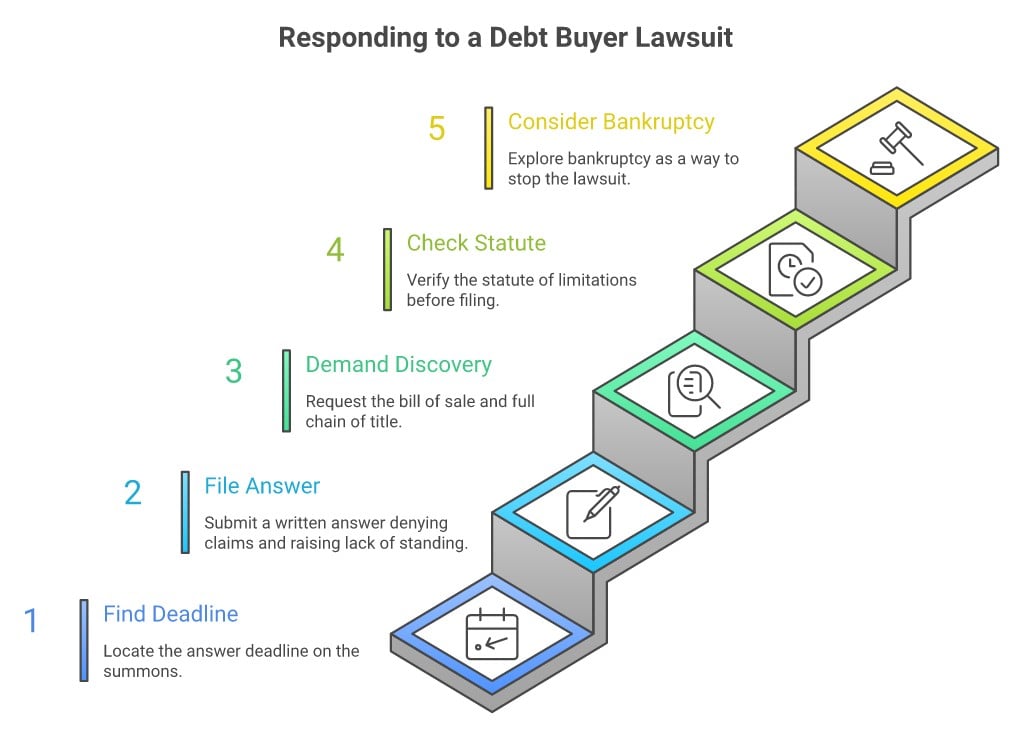
What to Do in the Next 48 Hours
Your real deadline is on the summons — and it may be sooner than 48 hours.
- Find your deadline and how you’re required to respond. The clock started when you were served, not when you opened the envelope. Read the summons carefully — it tells you whether you must file a written Answer, appear in person on a court date, or both, and whether you have to mail a copy to the plaintiff’s lawyer. If there’s a filing fee you can’t afford, ask the court clerk for a fee-waiver form. How much time you get and how you must respond both vary by state and court, so don’t guess the deadline from this page. While you’re at it, run the debt through my free Statute of Limitations Checker.
- Respond in whatever form your court requires, and don’t admit what you can’t confirm. Deny allegations that are wrong, and for anything you can’t verify — like whether this plaintiff actually owns your account or the amount claimed — state that you lack knowledge sufficient to admit or deny it. Raise “lack of standing” and “failure to state a claim” as defenses in your Answer (or at your first appearance, if your court doesn’t use written Answers); in some states, a standing defense is waived if you don’t raise it early. Don’t just show up and agree the debt is yours — once you respond, the law puts the burden back where it belongs: on the plaintiff.
- Where your court allows discovery, demand the bill of sale and the full chain of title. Ask, in writing, for the document that transferred your specific account — not just “a portfolio” — from the original creditor to the plaintiff, every assignment in between, the original account statements, and the signed agreement if one exists. Discovery rules, timing, and availability vary by court — small-claims and other limited-jurisdiction courts often restrict or simplify it, so check with your court’s self-help center. As the numbers above show, there’s a real chance this paperwork was never purchased in the first place.
- If you genuinely owe the debt and can’t pay it, look at bankruptcy — it stops the case once you actually file. Filing bankruptcy triggers the automatic stay under 11 U.S.C. § 362 — effective the moment your petition is filed, not weeks later. Until it’s actually filed, your Answer deadline keeps running, so don’t let it lapse while you decide — and once you file, make sure the court and the plaintiff’s lawyer get notice. If you’ve had a bankruptcy case dismissed within the past year, the stay can be limited to 30 days or may not take effect at all (11 U.S.C. § 362(c)(3)–(4)) — ask a bankruptcy attorney before you count on it. NACBA can connect you with a bankruptcy attorney, and my Find Your Path quiz can tell you whether it fits your numbers.
Free Tool — Statute of Limitations Checker: Dealing with old debt? The free Statute of Limitations Checker tells you if the collection clock has expired in your state — including the zombie debt and clock-restarting traps collectors use. Check My Status →
How to Actually Handle This — Your 4 Paths
- File bankruptcy. If the debt is real and you can’t pay it regardless of whether they can prove it, this is the fastest way out. The automatic stay stops the lawsuit the instant you file — not after a hearing, not after negotiation. (If you’ve had a case dismissed in the past year, that stay can be limited or unavailable — see the note in Step 4 above.) Research on bankruptcy outcomes shows filers recover credit faster and face fewer foreclosures than people who remain in financial distress without filing.
- Force them to prove standing and authenticate the records. Deny the allegations you can’t confirm, send discovery demanding the bill of sale and chain of title where your court allows it, and at trial, object to any affidavit or witness who can’t show personal knowledge of how the original creditor’s records were kept. Federal Rule of Evidence 602 only lets a witness testify to what they actually know firsthand, and the business-records hearsay exception (FRE 803(6)) still requires someone who can speak to how those records were actually made and kept (or a sworn certification) — and many courts accept debt-buyer affidavits, so don’t count on this objection alone. Most states have an equivalent evidence rule, though the exact wording and how strictly courts enforce it varies — and small-claims or other informal courts often relax or skip formal evidence rules entirely, so ask your court’s self-help center what actually applies in your case.
- Negotiate now that you have leverage — but get it in writing. If you genuinely recognize the debt but the buyer is struggling to authenticate its file, that’s real leverage for a lower settlement. Debt buyers often settle thin files cheap rather than risk a dismissal. Never agree to anything, or make a payment, based on a phone call alone. And don’t send even a partial payment or sign anything acknowledging the debt before a lawyer tells you it won’t restart the statute of limitations in your state — in some states it can. Get any deal in writing after you’ve answered.
- What won’t work: ignoring it because you assume they can’t win. They can. A no-show gets a default judgment regardless of what’s in the file — the court never gets a chance to ask for proof if you never show up to make them provide it.
What You Need to Know About Who Has to Prove What
Payment-history documents and affidavits were each obtained after purchase for under 1% of accounts — FTC 2013 sample of about 1.48 million.
of people sued in debt collection lawsuits never show up to defend themselves, per the FTC — and a default judgment is usually granted on the plaintiff’s own paperwork, without anyone ever testing it.
If a debt collector violated the FDCPA, a consumer who wins that claim can recover attorney’s fees from them, under 15 U.S.C. § 1692k(a)(3) — why many consumer attorneys will take a look at cases like this.
Most debt collection lawsuits, including debt buyer suits, are filed in state court, and the FTC’s own report notes that “most complaints filed to collect on debts are filed in state courts, and, therefore, state laws, regulations, and rules largely govern” what a debt buyer has to show. That means the exact proof standard in your case depends on your state’s civil procedure and evidence rules — not one nationwide formula.
| Stage | What the Law Generally Requires | What You Do |
|---|---|---|
| Before any lawsuit — letters or calls | 15 U.S.C. § 1692g gives you 30 days to send a written dispute; the collector must then verify before continuing collection | See how pre-suit debt validation works — this guide picks up after you’ve already been sued |
| After you respond | Per the CFPB, once you respond, “a debt collector has to prove to the court that the debt is valid” | Deny what’s wrong, state you lack knowledge to admit or deny what you can’t verify, raise lack of standing as a defense, and send discovery (where your court allows it) demanding the bill of sale and chain of title |
| At trial or summary judgment | Business records generally need a witness with personal knowledge, or a sworn certification (FRE 602; the hearsay exception is FRE 803(6)) — most states have an equivalent rule, though enforcement varies, many courts accept debt-buyer affidavits, and small-claims courts often relax or skip formal evidence rules | Object to any affidavit or witness who can’t show they actually know how the original creditor’s records were kept, but don’t count on this objection alone |
| Some states — extra pleading rules | North Carolina law bars a debt buyer from suing “without (i) valid documentation that the debt buyer is the owner of the specific debt instrument or account at issue and (ii) reasonable verification of the amount of the debt” (N.C.G.S. § 58-70-115). Maryland requires a debt-buyer plaintiff seeking judgment by affidavit to submit a chronological chain-of-title listing and a certified bill of sale for every transfer (Md. Rule 3-306(d)) | Check whether your state has a similar rule — a local consumer attorney or your court’s self-help center can tell you |
If you live in North Carolina, Maryland, or a state with similar rules, cite them directly in your Answer or discovery requests — courts don’t always volunteer this. And everywhere else, general rules of evidence and civil procedure still put the burden of proof on the plaintiff once you respond; you just may not have a state statute spelling out the exact documents required.
If the debt buyer keeps pushing a case with no real documentation, or you suspect an FDCPA violation, file a complaint with the CFPB and your state attorney general. If you need legal help but can’t afford an attorney, find free legal aid through LSC.gov. If the collector violated the FDCPA, a consumer who wins that claim can recover reasonable attorney’s fees from the collector (15 U.S.C. § 1692k(a)(3)) — which is why many consumer attorneys will look at cases like this. NACA’s attorney directory is a good place to look for a consumer lawyer; ask any attorney up front how they’re paid.
If you want to talk through your overall finances — not legal strategy for this lawsuit — Damon Day, an independent debt coach (not an attorney) and my co-host on the Get Out of Debt Guy podcast, offers a free session. Calendar the summons deadline first — this call is not a response to the lawsuit. Schedule at DamonDay.com — I receive no payment for this referral.
Steve’s Take
I filed bankruptcy in 1990. Companies sue people over debt constantly without solid proof — proof is expensive, and volume debt buying banks on people assuming the paperwork exists anyway. That’s not a loophole; the plaintiff has to prove its case here, same as in any lawsuit. Don’t let shame talk you into agreeing to a debt you never actually confirmed. Deal with the facts in front of you, not the fear of being sued, and you’ll come out ahead of the people who just signed whatever was put in front of them.
Frequently Asked Questions
A debt buyer sued me and won’t send me the original contract — do I still have to pay?
Not automatically. Once you respond to the lawsuit, the collector has to prove to the court that the debt is valid, according to the CFPB. A missing contract, missing statements, or a bill of sale that doesn’t specifically identify your account are all things you can use to challenge their case — but you have to actually respond and raise it; the court won’t do it for you. If this is your first letter and you haven’t been sued yet, start with my guide on how pre-suit debt validation works.
What’s the difference between disputing the amount I owe and challenging whether they own my debt?
They’re different defenses. Disputing the amount says “I owe something, but not that much” — my guide on being served with a debt lawsuit covers that scenario. Challenging standing and chain of title says “you haven’t proven you’re even the right party to collect from me at all,” regardless of the amount. You can raise both defenses in the same Answer if both apply to your case.
Free Tool — I'm Being Sued for Debt Guide: Being sued by a creditor or debt collector? The free I'm Being Sued Guide gives you a personalized action plan — deadlines, defenses, and options based on your state. Most states require a response within 20–30 days. Get My Action Plan →
What actually happens if the debt buyer can’t produce the bill of sale or assignment?
It depends on your court and judge, so I can’t promise one outcome. Common results include the case being dismissed (sometimes voluntarily by the plaintiff before a hearing rather than risk losing on the merits), the court granting the plaintiff more time to get documents from a prior owner, or — if the case is dismissed without prejudice and the statute of limitations hasn’t run out — the debt buyer trying again later with better paperwork. A dismissal isn’t always the end of the underlying debt, but it does mean this particular case didn’t succeed on the proof it had. If instead of a real refiled case you just keep getting calls or a scripted voicemail claiming one is “in the process of being filed,” that’s a different problem — see my guide on a fake “pretrial division” lawsuit threat chasing an old settled debt.
Can I lose this case even if they never prove they own the debt?
Yes — if you don’t respond by your deadline. The FTC has reported that 90% or more of people sued in debt collection lawsuits never show up to defend themselves, and a default judgment is usually granted on the plaintiff’s own paperwork, without anyone ever testing it. Responding is what activates your right to demand proof.
I filed bankruptcy — how fast does it stop this lawsuit?
The automatic stay takes effect the moment your bankruptcy petition is filed (11 U.S.C. § 362), not weeks later — but it only kicks in once you actually file, so make sure the court and the plaintiff’s lawyer get notice of your filing. If you’ve had a bankruptcy case dismissed within the past year, the stay can be limited to 30 days or may not apply at all (11 U.S.C. § 362(c)(3)–(4)); ask a bankruptcy attorney if that’s your situation.
The debt is old — does that matter here?
It can, but it isn’t automatic. The statute of limitations is an affirmative defense you have to raise and prove yourself — courts don’t dismiss a time-barred case on their own. Separately, federal debt collection rules prohibit the collector from suing you on a time-barred debt in the first place: Regulation F, 12 CFR § 1006.26(b), which implements the FDCPA, states that “a debt collector must not bring or threaten to bring a legal action against a consumer to collect a time-barred debt.” Whether a debt buyer counts as a “debt collector” for this rule isn’t automatic, either — in Henson v. Santander Consumer USA (2017), the Supreme Court held that simply owning and collecting a debt you purchased doesn’t by itself make you a “debt collector” under the FDCPA’s “owed another” definition, but courts have often found that debt buyers whose principal business is collecting debts still qualify under a separate definition the Court didn’t address — an attorney can tell you whether yours does. Whether the debt is actually time-barred, and how long your state’s statute of limitations is, is a state-law question — and if there’s any real chance the debt is old, raise the statute-of-limitations defense in your Answer regardless of what the checker below says; leaving it out can waive it even if the debt turns out to be time-barred. Run your debt through my free Statute of Limitations Checker before you file your Answer.
Do I need a lawyer, and can I actually afford one?
You don’t need one to respond to a lawsuit, but it helps, especially for discovery and objecting to evidence at trial. If the debt buyer violated the FDCPA, the law lets a consumer who wins that claim recover reasonable attorney’s fees from the collector (15 U.S.C. § 1692k(a)(3)) — sometimes raised as a counterclaim in the same case, sometimes as a separate lawsuit, and FDCPA claims generally must be filed within one year of the violation (15 U.S.C. § 1692k(d)), so ask an attorney quickly. Ask any attorney up front how they’re paid. NACA’s attorney directory is a good place to start, and LSC.gov can connect you to free legal aid if you qualify.
Does my state require the debt buyer to prove the chain of title before they can win?
A handful of states — North Carolina and Maryland among them — have specific statutes or court rules spelling out exactly what documentation a debt buyer must produce. Most states don’t have a rule that explicit, but that doesn’t mean you have no rights: general rules of evidence and civil procedure still put the burden of proof on the plaintiff everywhere once you respond. Check with a local consumer attorney or your state court’s self-help center for what applies where you live.
I already missed my deadline to respond — is it too late to challenge their proof?
It’s harder, but not always over. If you missed your window, see my guides on what to do if you didn’t respond in time and what to do once a default judgment has been entered. If you already went to court and lost, I cover that separately in I Went to Court and Lost My Debt Case, and if collectors keep calling even though you have nothing they can legally take, see what to do when you’re judgment-proof but collectors won’t stop. None of those situations mean you’re out of options.
One more thing — everything I share here is based on 30 years of helping people through exactly this. But my advice is input for your decision, not the decision itself. Only you know your full situation. Talk to an attorney, look at your numbers, and make the choice that serves your future.
Important: This guide is for informational purposes only and is not legal advice. Laws vary by state, and your situation may have details that change what options are available to you. For legal advice specific to your case, consult an attorney licensed in your state. NACBA can help you find a bankruptcy attorney, NACA can connect you with a consumer attorney, or schedule a free consultation with Damon Day, an independent debt coach and my podcast co-host — I receive no payment for this referral.
Key Takeaway: Being sued by a debt buyer who hasn’t shown you proof is serious, but it’s not automatically a loss — it’s an opportunity to make them prove what they’re legally required to prove. Run your debt through my debt relief options calculator, talk to an attorney this week, and respond exactly as your summons requires, by the deadline, no matter what. The longer you wait, the fewer options you have.
The Bottom Line
Getting sued doesn’t mean you did something wrong, and it definitely doesn’t mean the company suing you has its paperwork in order. The system gives you the right to make them prove it — the people who use that right consistently do better than the people who panic and sign whatever’s put in front of them. If someone you know just got served by a debt buyer and is scared to open the envelope, send them this page — the deadline to respond is the one thing that can’t wait. See my guide on being served with a debt lawsuit for the broader response checklist, or take my Find Your Path quiz to see what fits your numbers.
Dealing With Debt? Understanding your options is the first step. See how all your debt relief options compare — including ones most sites won’t tell you about. The Find Your Path quiz gives a recommendation based on your actual numbers, and the Scam-O-Meter checks any company’s complaint history before you sign. CFPB and academic research shows bankruptcy filers recover faster than those who don’t file.
Right now you are dealing with the thing in front of you, and that is exactly where your attention belongs. When it is handled — and it will be — there is a next stage, and it is the one I most enjoy writing about.
In the latest issue (Oct 9): Does Financial Literacy Make Financial Sense?
I write Your Money Actually most weekdays — actionable money information you will not find anywhere else, and the small decisions that compound. It is free, I sell nothing, and I take no money from any company I write about.



