

Quick Answer: Attorneys general from 44 states, D.C., and three U.S. territories have secured roughly $96.5 million from six generic drug manufacturers — Glenmark, Lannett, Bausch Health, Apotex, Heritage Pharmaceuticals, and Heritage’s parent company Emcure — to settle claims that they illegally conspired to fix the prices of generic prescription drugs. The U.S. District Court for the District of Connecticut has just given preliminary approval to the states’ plan for returning that money to consumers. If you bought a generic drug on the settlement’s list between May 1, 2009 and December 31, 2019, you may be owed money. Right now, the site’s own legal notice tells you to register at AGGenericDrugs.com or by calling 1-866-290-0182 so you’re notified the moment a claim form opens — New York’s attorney general has separately cited March 8, 2027 as the deadline to actually submit a claim once it does, though the official claim notice controls if it ends up setting a different date.
More open settlements I’ve covered: the $35 million QVAR inhaler settlement and the $5.55 million Metformin contamination settlement — two completely different cases, both still open.
Expert Context: I founded Debt Counselors of America back in 1994 and I’ve been helping people navigate debt-relief and settlement claims since I launched GetOutOfDebt.org in 2008. In three decades of doing this work, medical costs — and prescription costs specifically — are the single most common thing I see quietly driving people into credit card debt. So when state attorneys general say a company conspired to keep prescription prices artificially high, that isn’t an abstract legal story to me. It’s money that came directly out of the households I’ve spent my career trying to help.
This settlement won’t make anyone rich, and I want to be straight with you about that from the start. But it’s real money, set aside by a federal court, for medicine you already paid for — and the people who need it most are exactly the ones least likely to hear about it before the window closes. Let me walk you through who qualifies, what “register” actually means right now, how to find your own pharmacy records if you don’t have them, and why I’d rather you claim a small check than leave it on the table.
Claiming money you are owed is one good day. What you do over the following year is what actually changes your position.
In the latest issue (Nov 13): The shelf price isn't always what you pay
Each weekday I send one short email: one story that caught my attention, why it might matter to you, and one manageable thing you can do with it.
Free. I sell nothing. Unsubscribe any time.
Key Terms Defined
Preliminary approval: The judge has signed off on the general shape of the settlement and how it will be distributed — not the final word. A Final Approval Hearing is scheduled for November 5, 2026 in Hartford, Connecticut.
Register vs. file a claim: Registering puts your contact information on file so the court-appointed administrator can notify you when the actual claim form opens. Filing a claim is the step that gets you paid. Right now, registering is the action the settlement’s own legal notice describes — see the section below.
Restitution fund: The portion of a settlement actually set aside to pay consumers, separate from the fund that covers the cost of administering the settlement and the states’ litigation costs.
Non-settling defendant: A company still named in the states’ lawsuits that has not agreed to a settlement. Nothing has been proven against these companies in this specific case, and the litigation against them is ongoing — though two of them, Taro and Sandoz, admitted federal criminal price-fixing conduct in a separate matter (see below).
What the States Say Happened
This traces back to a series of antitrust lawsuits Connecticut and a coalition of nearly every other state and territory started filing in 2016, all now consolidated in the U.S. District Court for the District of Connecticut. The core case is State of Connecticut, et al. v. Aurobindo Pharma USA, Inc., et al., No. 16-cv-02056, along with two related actions against additional manufacturers. The states allege that generic drug manufacturers and their executives ran a coordinated scheme to fix prices, rig bids, and avoid competing with each other on dozens of common generic drugs — according to the settlement’s own court notice, the alleged conspiracy touched more than 100 different drugs.
According to New York Attorney General Letitia James’s announcement, the states allege the companies’ executives met at industry dinners, “girls’ nights out,” lunches, cocktail parties, and golf outings, and used phrases like “fair share,” “playing nice in the sandbox,” and “responsible competitor” to coordinate who would raise prices and when. The New Jersey and Oregon attorneys general cited that same “fair share”/“playing nice in the sandbox” language independently in their own announcements. James’s office says the coordinated increases were sometimes more than 1,000%, and points to Digoxin, a heart medication manufactured by Heritage, as an example where the price reportedly tripled.
Six manufacturers have settled so far, for a combined total of approximately $96.5 million: Glenmark Pharmaceuticals, Inc., USA; Lannett Company, Inc.; Bausch Health US, LLC and Bausch Health Americas, Inc.; Apotex Corp.; Heritage Pharmaceuticals, Inc.; and Emcure Pharmaceuticals, Ltd. (Emcure is Heritage’s parent company). Every one of those companies settled without admitting wrongdoing — the settlement’s own FAQ is explicit that “the Defendant drug manufacturers deny they did anything wrong.” Settling a lawsuit is a business decision to end costly litigation, not a court finding of guilt, and I want to be careful to say it that way.
The Claim: “My generic drug is part of a price-fixing lawsuit — it must not be safe.”
The Reality: This has nothing to do with drug safety or effectiveness. The settlement’s own notice says so directly: “The lawsuits are not about – and do not question – the safety or effectiveness of any of the drugs at issue.” This is entirely about price — whether you paid more than you should have because competitors allegedly agreed not to compete. Don’t stop taking a medication because of this settlement. Talk to your doctor about any medication decision, full stop.
Who Can File a Claim
Generally, according to the settlement’s official notice, you’re included if:
- You bought — or paid a copay, coinsurance, or the full cash price for — a generic prescription drug on the settlement’s list, in the United States, and not for resale.
- Your purchase happened sometime between May 1, 2009 and December 31, 2019.
- You currently live in one of 44 participating states, plus the District of Columbia, Puerto Rico, the U.S. Virgin Islands, or the Northern Mariana Islands (48 jurisdictions total) — the notice lists them in full. A handful of states, including Texas, Louisiana, Missouri, and Alabama, are not part of this coalition.
You’re not included if you bought the drugs outside the U.S., bought them for resale or distribution, or you’re an employee of one of the defendant companies or its parent/subsidiary/affiliate. If your purchase was through insurance, you can still be eligible — the copay or coinsurance you personally paid counts, even if your insurer paid the rest.
The Drugs on the List
The full drug list runs to hundreds of line items by name, dosage, and form — the official Drug List page at AGGenericDrugs.com is the one to check, not this summary. To give you a sense of how ordinary these medications are, here’s a small, representative sample pulled directly from that list:
- Digoxin (Lanoxin, Digitek) — heart failure and atrial fibrillation
- Doxycycline hyclate (Vibramycin, Doryx, Acticlate) — bacterial infections, severe acne
- Prednisone (Deltasone) — inflammation, allergies, arthritis, asthma flares
- Fluoxetine HCl (Prozac) — depression, OCD, panic disorder
- Estradiol (Estrace, Vivelle-Dot) — menopause symptom management
- Amitriptyline (Elavil) — depression, anxiety, chronic nerve pain
The list also covers antibiotics, contraceptives, blood pressure medications, and drugs treating diabetes, epilepsy, multiple sclerosis, and HIV, among others. If you or anyone in your household filled a generic prescription from 2009 through 2019, it’s worth five minutes to check the list — the drug doesn’t have to sound dramatic to qualify.
“Register” vs. “File a Claim” — What to Actually Do Right Now
The process runs in four steps: Step 1, register your contact information now. Step 2, wait for the court-ordered notice that a claim form has opened — the site says that notice hasn’t gone out yet. Step 3, file your claim once it does — New York’s attorney general has cited March 8, 2027 as the outside date, but the official claim notice controls if it sets something different. Step 4, receive payment from the fund after the settlement is finalized.
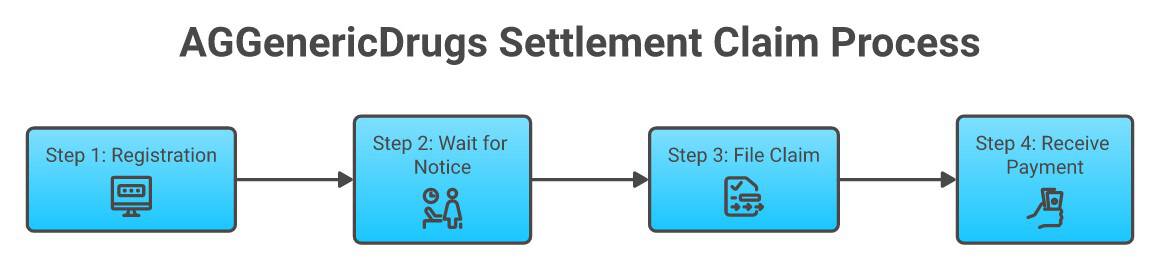
Here’s where I need to be exact, because the language coming from different sources doesn’t line up perfectly, and I’d rather explain the gap than paper over it. The settlement site’s own legal notice — the document that governs your actual rights — lays out your options in a chart, and as of this writing it says the claims period has not yet begun: “In order to receive a payment, you must file a valid claim form before the claims period ends. The claims period has not yet begun. A notice about the claims process will be made at a future date ordered by the Court.” Its advice right now is to register — online at the settlement site or by calling 1-866-290-0182 — so the administrator has your contact information and can notify you the moment a claim form is available.
At the same time, multiple state attorneys general — including New Jersey, Oregon, Nebraska, and New York — issued announcements on September 22, 2026 telling residents to “submit a claim,” with New York’s office citing March 8, 2027 as the deadline to do so. I want to be straight about the gap rather than paper over it: the two sources don’t match yet; the court-ordered claim notice will control. As of this writing, that notice says you can’t file yet. Do both, and you can’t lose:
- Go to AGGenericDrugs.com right now and register — or call 1-866-290-0182 — so you’re on file no matter which timeline turns out to be accurate.
- While you’re there, check whether a claim form is live. If it is, fill it out. If it isn’t yet, registering makes it more likely the administrator will try to notify you when it does.
- Treat March 8, 2027 as the outside date New York’s attorney general is citing for submitting a claim — but the official claim notice controls if it ends up setting a different date, so check back at the site periodically.
Two other dates that matter even if you plan to file a claim later: If you want to formally exclude yourself from the settlement (opt out) or object to its terms, your request must be, in the notice’s own words, “completed online or postmarked no later than October 15, 2026.” The court’s Final Approval Hearing is November 5, 2026 in Hartford, Connecticut. Unless you opt out by October 15, 2026, your claims against the six settling companies are released whether or not you register. Registering doesn’t pay you and doesn’t opt you out — you’ll still need to file a claim when the form opens.
How to Get Your Pharmacy Purchase History
The claim form and its documentation rules haven’t been published yet, so nobody — including me — can tell you exactly what proof you’ll need to submit. What I can tell you is that having records rarely hurts and often helps in settlements like this, so it’s worth gathering what you can now, while it’s easy, rather than scrambling once the form opens. Here’s how I’d go about pulling records for a decade-old purchase:
- Call your pharmacy directly. Most chain pharmacies (CVS, Walgreens, Walmart, grocery chains) can pull a full purchase history tied to your name or loyalty account, often going back several years, sometimes for free or a small fee.
- Check your pharmacy’s app or website. Many now let you download a purchase history or tax-year prescription summary directly.
- Request an Explanation of Benefits (EOB) history from your insurer if you had prescription coverage — insurers typically keep claims records for several years and can often go back further on request.
- Check old tax returns if you ever itemized medical expenses — a prior year’s medical expense worksheet can jog your memory on what you were taking and when.
- Ask anyway, even for 2009. Many pharmacies and insurers only retain detailed purchase records for seven to ten years, so records from the early end of the eligible window may genuinely no longer exist. That’s worth knowing going in — but it costs nothing to ask, and a partial history is still useful.
Honest Math: What Will You Actually Get
I’m not going to pretend I know your check amount, and anyone who tells you a specific dollar figure right now is guessing. Here’s what I can tell you plainly: this is a big-sounding number spread across a potentially enormous number of claimants, and the settlement notice itself says as much — “it is unknown how much each Eligible Consumer who submits a valid claim will receive, as this will depend on numerous factors, in particular the number and amount of timely, eligible claims filed.” For context, according to the settlement’s own FAQ, one piece of the fund — the Glenmark settlement alone, about $29.6 million — breaks down as roughly $20.7 million set aside to actually pay consumers and about $8.9 million earmarked for administering the settlements and reimbursing the states’ litigation costs. That pattern — a meaningful slice going to administration before anything reaches a consumer’s mailbox — is normal for settlements like this, and it’s one more reason not to expect a windfall.
None of that is a reason to skip it. It costs you nothing but a few minutes to register and, later, to file. If your share turns out to be a small check, it’s still money that came out of your pocket for medicine you needed, and it’s still yours to claim.
The Companies That Haven’t Settled — Nothing Is Proven Against Them
Only six of the many companies named in these cases have settled. The states’ lawsuits continue against a long list of non-settling defendants, including Actavis, Amneal, Aurobindo, Dr. Reddy’s, Lupin, Mylan, Par Pharmaceutical, Perrigo, Pfizer, Sandoz, Sun, Taro, Teva, Wockhardt, and Zydus, among others. I want to be precise here: in this case, these are companies the states allege were part of the conspiracy. None of them has settled this case, and none has been found liable by a court here; several deny wrongdoing. If the litigation against them produces future settlements or a trial verdict, additional money could eventually be added to the fund — registering now with this settlement doesn’t create a claim to that future money, but it does make it more likely you’ll hear about any future settlement when one happens.
One footnote worth knowing, because it’s the kind of thing worth being straight about: the Justice Department announced on October 1, 2021 that Taro, Sandoz and Apotex — Apotex is one of the six companies that settled this case — had previously entered deferred prosecution agreements with its Antitrust Division to resolve related federal criminal charges. According to that announcement, Taro paid a $205.6 million criminal penalty and “admitted to conspiring with two other generic drug companies to fix prices on certain generic drugs”; Sandoz paid $195 million and admitted to conspiring with four other companies; and Apotex paid $24.1 million and “admitted to conspiring to increase and maintain the price on pravastatin” (pravastatin is on this settlement’s drug list). That was a separate federal criminal matter, not this states’ case. Apotex settled this civil case with no admission of liability here, and in this case nothing has been proven against Taro or Sandoz. This isn’t a complete list of related Justice Department criminal resolutions in generic-drug pricing — see justice.gov for the full record.
Never pay anyone to file this claim for you. Whenever a settlement like this makes news, copycat sites and “claim filing services” show up offering to file on your behalf — sometimes for a fee, sometimes just to collect your personal information. Filing directly at AGGenericDrugs.com costs nothing. If any site asks for payment, a cut of your payout, or more personal information than your name, address, and purchase details, close the tab.
Why This Matters If You’re Already Carrying Debt
Prescription costs are one of the quiet drivers of consumer debt I’ve watched for thirty years, and it rarely looks dramatic from the outside. It looks like putting a copay on a credit card because the checking account is already thin. It looks like splitting a pill in half to stretch a 30-day supply into 45. It looks like a $40-a-month maintenance medication that, financed on a card at 24% interest because there was no other way to pay it that month, ends up costing a lot more than $40 by the time it’s paid off. When state attorneys general allege that a group of manufacturers coordinated to keep those prices artificially high for a decade, that isn’t an abstract corporate story — it’s money that came directly out of households that were already stretched thin.
Claiming a share back won’t erase a debt load. But if prescription costs, medical bills, or any other debt are keeping you up at night, you have more real options than most people realize, and I’ve laid them out in my complete guide to fighting and negotiating medical debt. Start with the Find Your Path quiz for a recommendation based on your actual numbers — no company trying to sell you anything on the other end.
Key Takeaways
- Six generic drug manufacturers — Glenmark, Lannett, Bausch Health, Apotex, Heritage, and Emcure — have settled state antitrust price-fixing claims for a combined $96.5 million, without admitting wrongdoing.
- You may qualify if you bought a listed generic drug between May 1, 2009 and December 31, 2019.
- Right now, the official action is to register at AGGenericDrugs.com or 1-866-290-0182 so you’re notified when the claim form opens; New York’s attorney general cites March 8, 2027 as the claim deadline, but the official claim notice controls if it sets a different date.
- Unless you opt out by October 15, 2026, your claims against the six settling companies are released whether or not you register. Registering doesn’t pay you and doesn’t opt you out — you’ll still need to file a claim when the form opens. The claim form’s documentation rules aren’t published yet, so start gathering pharmacy or insurer purchase history now, just in case.
- Dozens of other companies, including Teva and Pfizer, are still named in the ongoing litigation — nothing has been proven against them in this case, and they have not settled.
- Never pay a third party to file this claim for you — it’s free at the official site.
The Bottom Line
If you’ve ever stretched a prescription further than the label said you should because money was tight, this one is for you. Nobody is getting rich off this settlement, and I won’t pretend otherwise — but it’s real money the states say you were overcharged, sitting behind a form that takes five minutes and costs nothing. I’ve spent thirty years watching the people who need this kind of money most be the last ones to hear it exists, and I don’t want that to be you. Register today, keep an eye out for the claim form, and forward this to the person in your life who’s been quietly rationing a prescription — because that’s exactly who this was written for.
Frequently Asked Questions
Do I need to do anything right now, or can I wait?
Register now. It takes a few minutes at AGGenericDrugs.com or by calling 1-866-290-0182, so the administrator can try to notify you the moment a claim form opens. New York’s attorney general has cited March 8, 2027 as the deadline to actually submit a claim — but the official claim notice controls if it sets a different date — and there’s no reason to wait until then to register your contact information.
What’s the difference between registering and filing a claim?
Registering puts your name and contact information on file so you’re notified when the claims process opens — it doesn’t get you paid by itself. Filing a claim is the actual form that determines your payment. As of this writing, the settlement’s own notice says the claims period hasn’t formally begun, even though New York’s attorney general has pointed people toward a March 8, 2027 claim deadline. Registering now protects your spot in line either way.
Do I need a receipt or pharmacy record to file?
The claim form hasn’t been published yet, so the documentation rules aren’t public either — nobody can tell you for certain right now. What’s true of most settlements like this: proof of purchase (a pharmacy printout, an insurance Explanation of Benefits, or a receipt) tends to strengthen a claim, and most pharmacies and insurers can pull years of purchase history on request. Gather what you can in the meantime, and don’t assume records from 2009 still exist — ask anyway.
Is this the same as the Metformin or QVAR inhaler settlements?
No — different drugs, different lawsuits, different defendants. The Metformin settlement involved contamination allegations against three companies. The QVAR settlement involved Teva allegedly blocking generic competition for one brand-name inhaler. This settlement covers a much broader list of generic drugs and alleges the manufacturers colluded with each other on pricing. You can be eligible for more than one if your purchases match.
Companies like Teva and Pfizer are named in news coverage of this case — does that mean they did something wrong?
Not necessarily — being named isn’t proof. Teva, Pfizer, and a long list of other manufacturers are named as defendants in the states’ ongoing lawsuits, but none of them has settled this case, and nothing has been proven against them in court here. Only Glenmark, Lannett, Bausch Health, Apotex, Heritage, and Emcure have agreed to settlements in this case, and even they settled without admitting wrongdoing on it.
How much money will I actually receive?
Nobody knows yet, including the settlement administrator — the amount depends on how many people file valid claims and how much of the $96.5 million fund is left after administrative and legal costs. Based on how similar settlements have played out, expect a modest amount rather than a windfall. It’s still worth five minutes of your time to register and, later, to file.
This is what I’d tell my own family if they filled a listed generic between May 2009 and December 2019 — not a recent refill — register today, and take a clear-eyed look at any prescription or medical debt while you’re at it. But you know your situation better than I do, so treat my take as input, not instruction. Nobody decides what you do with your money but you.
If this saved you five minutes of digging, do one more thing: send it to the person you know who’s on a maintenance medication and has been for years. They’re the one most likely to qualify, and the least likely to have heard this exists.
Dealing With Debt? Understanding your options is the first step. See how all your debt relief options compare — including ones most sites won’t tell you about. The Find Your Path quiz gives a recommendation based on your actual numbers, and the Scam-O-Meter checks any company’s complaint history before you sign. Federal Reserve Bank of New York research shows filers recover faster than those who don’t file.



