

Written by Steve Rhode, consumer debt expert since 1994 • Last updated September 25, 2026
Quick Answer: The VA sent you a letter saying it paid you more disability, pension, or other benefits than you were entitled to, and it wants the difference back. This is an overpayment debt, and the VA is allowed to recover it — usually by withholding your future benefit checks. You have 30 days from the date of your first debt letter to submit a written dispute, waiver request, or hearing request and keep offset from starting, under 38 CFR § 1.912a, and a full year to request a waiver under 38 U.S.C. § 5302. This is a different process than a private debt collector reaching your VA disability check — the VA is the one owed the money here, and it has its own dispute, waiver, and payment-plan rules. Don’t ignore the letter. Read it, find your deadline, and act this week.
What Just Happened
The VA’s Debt Management Center (DMC) determined you were paid more in benefits than you should have received, and sent you a letter establishing the debt. This happens for reasons that usually have nothing to do with doing anything wrong: your disability rating was reduced or a retroactive decision changed your effective date, a dependent came off your award (a child turned 18, a divorce, a death) and you didn’t update it in time, you returned to work while rated for Individual Unemployability, or the VA simply made a processing error and paid you on the wrong schedule. This guide focuses on the most common type — compensation and pension overpayments. Education (GI Bill) and home loan guaranty debts run through some of the same DMC process but have their own specific rules; if that’s your situation, the steps below still apply to disputing and requesting a waiver, but check the VA’s debt-type-specific guidance for details unique to that program.
Whatever the cause, the letter starts two separate clocks running at the same time: a short one to stop collection from starting, and a longer one to ask the VA to forgive the debt entirely. Missing either one narrows your options — but neither deadline is the end of the road if you’ve already let time pass.
The Mistake You’re About to Make: Assuming the VA will just start deducting from your check and there’s nothing you can do about the amount or the timing. Under 38 CFR § 1.912a(b)(5), if you don’t respond in writing within 30 days of your debt notice, the VA can begin collecting by offsetting — withholding — your benefit payments. Veterans’ legal aid groups report the VA commonly withholds your entire monthly payment until the debt is repaid (Swords to Plowshares). If you’re living on that check, losing it entirely can mean no VA income at all for months. Filing a written dispute, waiver request, or hearing request within 30 days — even an imperfect one — is what stops full withholding before it starts. A payment plan request can reduce what comes out of your check each month, but on its own it does not pause offset the way a timely dispute, waiver, or hearing request does.
Your Options Right Now
What to Do in the Next 48 Hours
- Read the letter and find the date. Your 30-day window to submit a written dispute, waiver request, or hearing request — the only things that stop offset from starting — runs from the date on your first debt letter, not from today. Write that date down.
- Decide: do you think the debt itself is wrong, or is it accurate but you can’t afford it? These are two different tools. If you think the VA made an error — wrong dates, a dependent who was actually still eligible, a rating change that shouldn’t apply retroactively — you dispute the debt in writing. If the debt is accurate but repaying it would be unfair or a hardship, you request a waiver. You can do both.
- Send your dispute or waiver request in writing before the 30-day mark. Submit online through Ask VA, or mail a letter to U.S. Department of Veterans Affairs, Debt Management Center, PO Box 11930, St. Paul, MN 55111. State exactly why you think the amount or the debt itself is wrong, or why collecting it would be unfair to you. A timely dispute, waiver request, or hearing request made within 30 days of your notice keeps offset from starting while the VA reviews it, under 38 CFR § 1.912a(c).
- If you disagree with the underlying VA decision that created the debt — for example, a retroactive rating reduction you believe was wrong — that’s a separate track from disputing the debt amount. You can file a Supplemental Claim, request a Higher-Level Review, or a Board Appeal on the decision itself. Learn about the VA decision review options. If you’ve filed for bankruptcy, the automatic stay under 11 U.S.C. § 362 generally stops collection of debts that existed before you filed — and VA’s debt regulations (38 CFR § 1.913(b)) direct staff to get legal advice on the stay’s applicability once they learn you’ve filed. But VA may treat withholding from the same benefit that caused the overpayment as a “recoupment,” which the stay may not halt the way it halts other collection. Notify the DMC of your bankruptcy in writing, don’t assume your check resumes until DMC confirms it, and ask your bankruptcy attorney specifically about this benefit. NACBA can connect you with a bankruptcy attorney.
- If you’re still inside the 30-day window, file your written dispute, waiver request, or hearing request first — then call about a payment plan. DMC’s number is 800-827-0648 (TTY: 711), Monday through Friday, 7:30 a.m. to 7:00 p.m. ET. If you can repay the debt in less than 5 years, you can set up a plan by phone, online, or mail with no extra form — VA Form 5655 is required only for a plan of 5 years or more, or for a waiver or compromise offer. A payment plan can reduce what comes out of your check each month, but by itself it does not pause offset from starting.
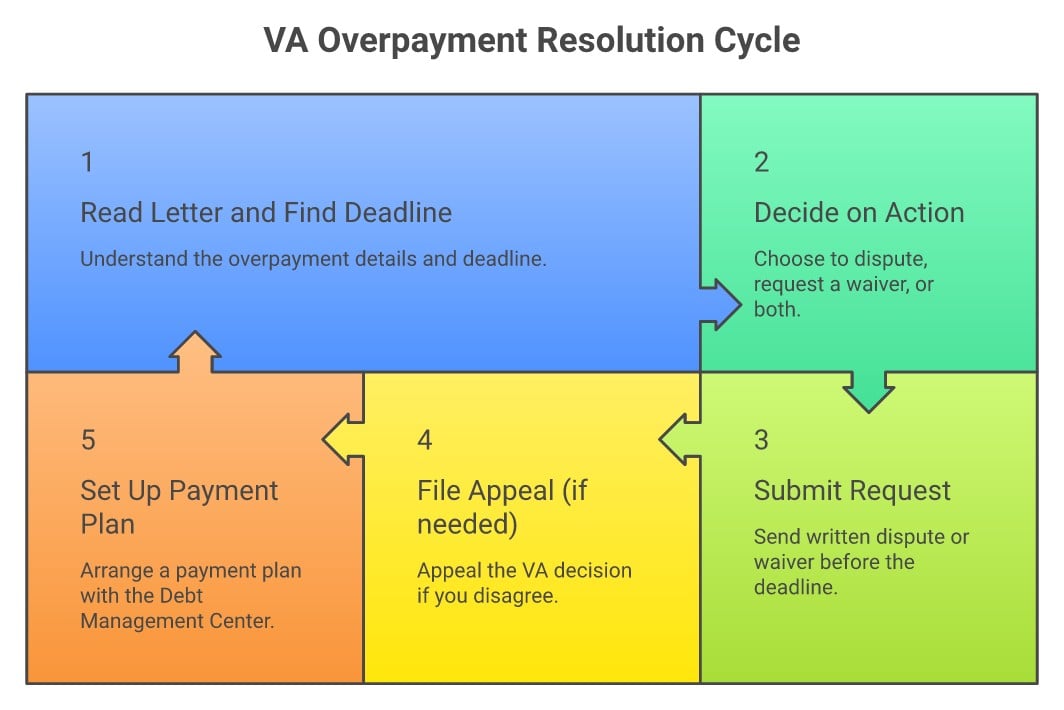
How to Actually Stop It — Your 4 Paths
- Dispute the debt (fastest path to owing nothing). If the VA’s calculation is wrong — wrong dates, a dependent who was actually eligible, an effective date applied incorrectly — a written dispute filed within 30 days challenges whether you owe the money at all, and pauses offset while it’s reviewed under 38 CFR § 1.912a(c)(1). If you disagree with the VA decision that caused the debt, you can also appeal that decision separately through a Supplemental Claim, Higher-Level Review, or Board Appeal.
- Request a waiver (you may owe nothing, even if the debt is accurate). Under 38 U.S.C. § 5302(a)(1) and 38 CFR § 1.963, the VA must waive an overpayment if there’s no indication of fraud, misrepresentation, or bad faith on your part, and recovery would be “against equity and good conscience.” 38 CFR § 1.965 lists what the VA weighs: whether the debt was your fault versus the VA’s, whether repaying it would leave you unable to afford basic necessities, whether taking the money back would defeat the purpose the benefit was meant to serve, and whether you changed your position in reliance on the payments. You must apply within one year of your first notice of indebtedness — submit VA Form 5655 (Financial Status Report), online or by mail to the DMC address above.
- Negotiate a payment plan or a compromise offer. A payment plan spreads repayment over time — usually structured to pay the debt off in 3 years or less under 38 CFR § 1.914(b), though 5-year and longer plans (with VA Form 5655) are available. A compromise offer asks the VA to accept less than the full balance as payment in full — also via Form 5655. Get any agreement in writing before you start paying.
- What won’t work: ignoring the letter. Once your 30 days pass with no dispute, waiver request, or hearing request on file, the VA can begin offsetting your current or future benefit payments — and veterans’ legal aid groups report that commonly means your entire monthly check until the debt is repaid (Swords to Plowshares). Debts left unpaid for more than 180 days can also be referred to the Treasury Offset Program for interception of federal payments like your tax refund. Silence accelerates this. It never stops it.
What You Need to Know About the Legal Rules
30 days
from your first debt letter to dispute, request a waiver, or request a hearing and pause offset (38 CFR § 1.912a)
1 year
from your first notice of indebtedness to request a waiver (38 U.S.C. § 5302; 38 CFR § 1.963)
3 years
the target repayment period VA regulations set for an installment plan — ask for one before offset starts (38 CFR § 1.914(b))
$0
you could owe after a successful waiver, even if the VA’s calculation of the debt was correct
The waiver standard — “against equity and good conscience,” with no fraud, misrepresentation, or bad faith on your part — comes directly from 38 U.S.C. § 5302(a)(1), which states: “There shall be no recovery of payments or overpayments… whenever the Secretary determines that recovery would be against equity and good conscience,” if you apply within a year of notice. The offset process and your 30-day window to stop it before it starts are set out in 38 CFR § 1.912a. Your dispute, waiver, and appeal rights generally are listed in 38 CFR § 1.911(c). A denied waiver can itself be appealed to the Board of Veterans Appeals under 38 CFR § 1.958.
| Tool | What it does | Deadline |
|---|---|---|
| Dispute the debt | Challenges whether you owe it, or the amount | 30 days to pause offset while reviewed |
| Waiver | Asks VA to forgive the debt even if accurate, no fault/fraud on your part | 1 year from first notice |
| Appeal the underlying decision | Challenges the VA benefit decision that caused the overpayment (e.g. a rating reduction) | Governed by standard decision-review deadlines |
| Payment plan / compromise | Spreads repayment or reduces the balance instead of full offset | No stated deadline — ask before offset starts |
If you’re an identity theft or fraud victim — someone else’s actions on your account caused the overpayment — that goes to the fault analysis under the waiver standard directly, since fraud or bad faith has to be yours to block a waiver. Document everything and say so explicitly in your dispute and waiver request.
If the VA is not following its own notice or dispute requirements, you can raise it with the VA Office of Inspector General hotline, file a complaint with the CFPB if a private collector is separately involved, and contact your state attorney general. If you need legal help but can’t afford an attorney, find free legal aid through LSC.gov, or contact your local Veterans Service Organization for free, accredited help with VA claims and debt disputes.
Steve’s Take
I filed bankruptcy in 1990. I know what it feels like to open a government letter that says you owe money you don’t have. Here’s what I’ve watched happen with veterans in exactly this spot: the ones who read the letter, found the deadline, and got something — anything — in writing to the VA within 30 days kept far more control over their monthly income than the ones who froze and let the VA withhold the whole check. You earned that benefit. A calculation error or a reporting delay on the VA’s side doesn’t erase your right to dispute it or ask for a waiver. Math beats shame here. File something this week, then worry about getting it perfect.
Frequently Asked Questions
The VA says I was overpaid — do I actually have to pay it back?
Maybe — but not necessarily the full amount, and not necessarily at all. You have two separate tools: dispute (challenge whether the debt or its amount is correct) and waiver (ask the VA to forgive it because it wasn’t your fault and recovery would be unfair, even if the debt is accurate). Under 38 U.S.C. § 5302(a)(1), the VA must waive the debt if there’s no fraud, misrepresentation, or bad faith on your part and recovery would be against equity and good conscience. The letter is not the final word.
How long do I have to dispute a VA benefit overpayment?
You have 30 days from the date of your first debt letter to dispute the debt, request a waiver, or request a hearing and keep the VA from starting to withhold your benefits while it reviews your request, under 38 CFR § 1.912a(c). You separately have a full one year from that same notice date to file a waiver request under 38 U.S.C. § 5302 — filing after 30 days just means offset may already have started while it’s decided.
Can the VA take my entire disability or pension check?
Often, yes. Under 38 CFR § 1.912a, the VA can begin collecting an overpayment by offsetting — withholding — your current or future benefit payments once your 30-day window passes. Veterans’ legal aid groups, including Swords to Plowshares, report that the VA commonly withholds your entire monthly check until the debt is repaid. Requesting a payment plan before offset starts, or as soon as it does, is how you get that reduced to an amount that fits your budget.
What’s the difference between disputing my debt and appealing the VA decision that caused it?
A dispute challenges whether the debt itself is calculated correctly — dates, amounts, whether a dependent was actually still eligible. An appeal (Supplemental Claim, Higher-Level Review, or Board Appeal) challenges the underlying benefit decision that created the overpayment in the first place, such as a retroactive rating reduction. You can pursue both, and VA’s decision review page explains which option fits your situation.
Is this the same as a private debt collector coming after my VA disability?
No — and this matters. This guide covers the VA recovering its own overpayment, which it does mainly by withholding your future benefit payments under its own regulations. A private collector chasing an unrelated debt (a credit card, medical bill) generally cannot touch VA disability compensation once it’s in your bank account, under 38 U.S.C. § 5301. If that’s your situation instead, read my guide on debt collectors and VA disability — it’s a different agency relationship with different protections.
I filed for bankruptcy — does that wipe out a VA overpayment debt?
Often, if it isn’t fraud-based. Non-fraud VA benefit overpayments can often be discharged as ordinary unsecured debt in bankruptcy, the same as most other consumer debts. A fraud-based overpayment could be excepted from discharge under 11 U.S.C. § 523(a)(2) — but only if the VA actually files and wins a separate fraud proceeding in your bankruptcy case. The automatic stay under 11 U.S.C. § 362 generally stops collection of debts that existed before you filed — but VA may treat withholding from the same benefit that caused the overpayment as a “recoupment,” which the stay may not halt the same way. Notify the DMC in writing that you’ve filed, don’t count on your check resuming until DMC confirms it, and ask your bankruptcy attorney about this specific issue. NACBA can connect you with a bankruptcy attorney.
My 30-day window already passed — is it too late to do anything?
No. You still have up to a year from your first notice to request a waiver under 38 U.S.C. § 5302, and you can still dispute the debt or request a payment plan at any time — you’ve just lost the automatic pause on offset while a late request is reviewed. Call the Debt Management Center at 800-827-0648 and ask what’s still available for your specific debt.
Can I get free help figuring out my options?
Yes. Contact an accredited Veterans Service Organization (VSO) for free help with VA claims and debt disputes, find free legal aid through LSC.gov, or find a consumer attorney through NACA if a separate creditor issue is involved. You can also schedule a free consultation with Damon Day, an independent debt coach and my podcast co-host, about your overall financial picture. I receive no payment for this referral.
One more thing — everything I share here is based on over 30 years of helping people through exactly this. But my advice is input for your decision, not the decision itself. Only you know your full situation. Talk to an attorney or accredited VSO, look at your numbers, and make the choice that serves your future.
Important: This guide is for informational purposes only and is not legal advice. Laws and VA procedures can change, and your situation may have details that change what options are available to you. For advice specific to your case, consult an accredited Veterans Service Organization or an attorney. NACBA can help you find a bankruptcy attorney, NACA can connect you with a consumer attorney, or schedule a free consultation with Damon Day, an independent debt coach and my podcast co-host — I receive no payment for this referral.
Key Takeaway: A VA overpayment letter is serious, but you have real rights: 30 days to dispute or pause collection, a full year to request a waiver, and the option of a payment plan instead of losing your whole check. Use this tool to see all your debt relief options. Get help from an accredited VSO or free legal aid this week. The longer you wait, the more of your check the VA can take.
The Bottom Line
Getting a VA overpayment letter doesn’t mean you did anything wrong — rating changes, dependent updates, and VA processing errors cause this constantly, and the VA’s own rules built in a dispute window and a waiver process because they know it. The veterans who act fast — who read the letter, find the deadline, and put something in writing within 30 days — keep far more control over their monthly income than the ones who freeze. If you know a veteran dealing with one of these letters, send them this page — most have no idea the VA can withhold their entire check until the debt is repaid, or that a waiver could mean they owe nothing at all. See the Find Your Path quiz for a broader look at your debt options.
Dealing With Debt? Understanding your options is the first step. See how all your debt relief options compare — including ones most sites won’t tell you about. The Find Your Path quiz gives a recommendation based on your actual numbers, and the Scam-O-Meter checks any company’s complaint history before you sign. Federal Reserve Bank of New York research shows bankruptcy filers recover faster than those who don’t file.
Right now you are dealing with the thing in front of you, and that is exactly where your attention belongs. When it is handled — and it will be — there is a next stage, and it is the one I most enjoy writing about.
In the latest issue (Nov 9): Check your power bank and your French press
Each weekday I send one short email: one story that caught my attention, why it might matter to you, and one manageable thing you can do with it. It is free, I sell nothing, and I take no money from any company I write about.



