

Written by Steve Rhode, consumer debt expert since 1994 • Last updated September 25, 2026
Quick Answer: A debt you settled and paid off more than a decade ago has come back — texts and voicemails naming a debt and an amount, nothing in the mail, and a scripted voicemail claiming to be from a “pretrial division” with a fake case number and a threat to serve you at work. Federal law bars a collector from threatening legal action it doesn’t actually intend or can’t legally take, and from using any false or deceptive means to collect (15 U.S.C. § 1692e(5) and (10)), and a debt collector isn’t even allowed to place a debt it knows or should know was already paid or settled for collection in the first place (Regulation F, 12 CFR § 1006.30(b)(1)). Don’t call the number they left you. Keep saving the messages, pull your old settlement paperwork and proof the creditor was actually paid, and check with the court yourself — in your home county and any court they named — before you believe any of it.
Where this topic came from: Conversations in my free Ask Steve chat keep raising situations like this — a debt someone settled and paid off years ago resurfacing as new collection calls, sometimes paired with a scripted “you’re being sued” voicemail. I’m not giving away any personal information here — I never do — but when real questions show me a gap worth covering, I write the answer for everyone. If something like this is happening to you, ask me about it in the chat. It’s free, it’s private, and I’m not selling anything.
What Just Happened to Your Old Settled Debt
Years ago, you finished a debt settlement program — every enrolled account negotiated down, and you paid what the program told you to pay. The settlement company itself is long gone out of business now. Your credit reports today show nothing owed on that account, which is consistent with the debt being closed — but a clean credit report isn’t proof by itself. Most negative accounts drop off a credit report roughly seven years after the original delinquency whether or not they were ever actually paid (15 U.S.C. § 1681c(a)(4)), so an old account can look clean for reasons that have nothing to do with whether it was settled. The real proof is the paperwork: your settlement confirmation or “paid in full” letter for that specific account, and a bank or card statement showing the settlement payment actually cleared. That distinction matters here, because settlement companies that later went out of business — like the one in this situation — sometimes collected a consumer’s payments and fees without forwarding every payment to every enrolled creditor. Finishing the program isn’t automatically the same thing as every account being paid. Check the paperwork for each account before assuming this one is included.
And now it’s back — not as a letter, but as texts and voicemails naming a debt and a dollar amount, and a second, scripted voicemail claiming to be from a “pretrial division,” saying a complaint “is in the process of being filed,” reciting a case number, and threatening to have you served at work or at home. This is a recognizable shape, not a one-off. Old, already-resolved accounts get resold or re-assigned for pennies on the dollar years after they should have died, sometimes as an honest records failure and sometimes deliberately dressed up to sound like a lawsuit already exists when it doesn’t. The Federal Trade Commission has brought repeated enforcement actions against operations that impersonate law firms or invented “legal” divisions, use fabricated case numbers, and threaten arrest or a lawsuit to pressure people into paying on the spot — see the FTC’s own guidance on fake and abusive debt collectors and its record of enforcement against these operations, summarized by the FDIC. None of that makes what you’re dealing with less unsettling. It does mean you’re not imagining a pattern that regulators recognize too.
The Mistake You’re About to Make: Calling the number left in the text or the “pretrial division” voicemail to “sort this out.” That number belongs to whoever is contacting you — it is not the courthouse, and a scripted threat is designed to get you talking, confirming your identity, or paying before you’ve checked anything independently. The FTC’s own guidance on imposter scams is blunt about this: “Don’t click on links or call phone numbers in unexpected messages… Contact the organization in question using a phone number, website, or email address you know is real. Don’t use the contact information in the unexpected message” (FTC, How To Avoid Imposter Scams). If a real court case existed, you can confirm it by looking up that court’s own clerk’s office or public docket yourself — never by dialing back the number that just threatened you.
Your Options Right Now
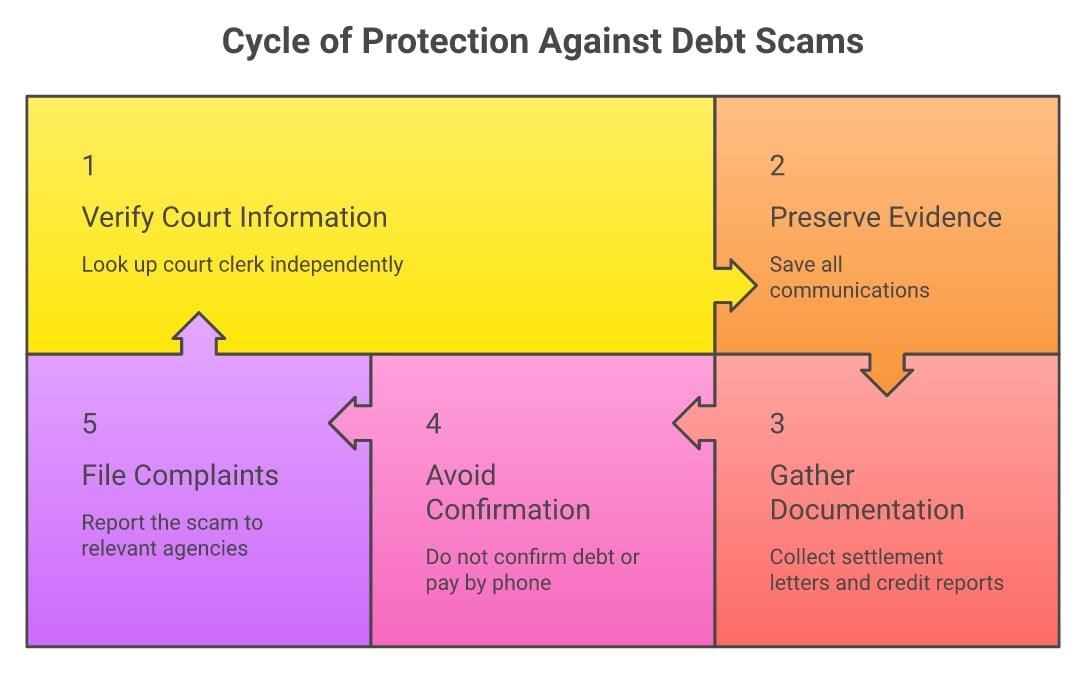
What to Do in the Next 48 Hours
- Do not call the number in the texts or the voicemail. Instead, look up the clerk’s office or online case-search portal for your home county’s court yourself — and for any specific court the caller actually named — and search your name directly. A genuine court case is public record; a case number recited in a voicemail is not proof one exists. A clean search today only covers the court or courts you checked, on that day — so if the contact keeps coming, search again, and check more than one jurisdiction if you’ve lived elsewhere recently.
- Keep doing exactly what you’ve started — save everything. Screenshots of every text, recordings or transcriptions of every voicemail, caller ID numbers, and the date and time each one came in. That record is the first thing a regulator or a consumer attorney will ask for, and it’s also what shows a pattern of repeat contact rather than one confused call.
- Pull your old settlement paperwork for this specific account. Your settlement confirmation or “paid in full” / “settled in full” letter, and a bank or card statement showing that settlement payment actually clearing — that’s the real proof this account was paid. A free copy of all three credit reports from AnnualCreditReport.com is worth pulling too, but on its own it proves nothing: most negative accounts fall off a credit report roughly seven years after the original delinquency whether they were ever paid or not (15 U.S.C. § 1681c(a)(4)). The paperwork for this specific account is what actually settles the question.
- Do not confirm the debt is yours, and do not pay anyone by phone or text to make it stop. A phone call or a text reply creates no record, and paying — even a small “settlement to close it out” — teaches whoever is calling that pressure works. Texts and emails count as writing, and a validation notice can be delivered electronically, not just mailed (12 CFR § 1006.34, read with § 1006.42) — so if any of the texts or emails you received included a link, a claim number, or a notice, a validation period may already be running. You can send a written dispute to any mailing address, email, or portal the collector has actually given you, using the free Debt Validation Letter Generator, and disputing costs nothing. Just don’t click a link inside one of those messages to do it — confirm the collector’s real contact information yourself first, the same way you’d verify the court, instead of trusting anything that arrived in the same suspicious message.
- File complaints even before anything else happens. Report it to the CFPB, your state attorney general, and the FTC at ReportFraud.ftc.gov. If the contact keeps escalating, or if you ever do get served with real court papers, get help before you respond on your own — NACA connects you with a consumer attorney, and you can talk to Damon Day for free about the overall situation. He’s an independent debt coach and my co-host on the Get Out of Debt Guy podcast, reachable at DamonDay.com, and I receive no payment for this referral.
Free Tool — Debt Validation Letter Generator: Being contacted by a debt collector? The free Debt Validation Letter Generator creates a personalized FDCPA validation letter in seconds — forcing the collector to prove the debt is real before they can continue. Generate My Letter →
How to Actually Stop It — Your 4 Paths
- Check the court directly (fastest, costs nothing). A genuine lawsuit is a matter of public record at the courthouse where it was supposedly filed. Look up your home county’s court, and any specific court the caller named, using a clerk’s phone number or docket-search tool you find yourself — never a number a caller gave you — and search your own name. A clean result only tells you nothing has been filed there as of today, not that nothing ever will be — if the contact keeps coming, check again. And if a real case ever does turn up, the emergency becomes the answer deadline printed on the summons, not the phone call that first warned you about it.
- A written dispute, once there’s a real address to send it to. If a collector’s actual name and mailing address ever surface, a written dispute under 15 U.S.C. § 1692g(b) forces them to stop collecting until they mail you verification. A collector can send verification even on an account that was genuinely paid — verification just documents what they have on file about the debt’s origin and amount. It doesn’t revive a debt that’s already been paid, and if you’ve actually been served with a lawsuit, verification doesn’t pause or end that case either — only responding to the suit itself does that. Your own proof of payment is what actually settles the question. And if this account really was paid or settled, continuing to demand money on it runs into two separate FDCPA provisions once you’ve shown them proof: falsely representing “the character, amount, or legal status of any debt” is barred outright (15 U.S.C. § 1692e(2)(A)), and so is “the collection of any amount… unless such amount is expressly authorized by the agreement creating the debt or permitted by law” (15 U.S.C. § 1692f(1)) — a debt you’ve already paid isn’t authorized or permitted anymore. Separately, Regulation F bars a debt collector from selling, transferring, or placing that same debt for collection at all once it knows or should know it was paid, settled, or discharged in bankruptcy (12 CFR § 1006.30(b)(1)) — that provision stops the debt from being handed off to someone new, it doesn’t by itself stop the collector already holding it from continuing to collect. It’s §§ 1692e(2)(A) and 1692f(1) that make continuing to collect itself the violation once you’ve shown them proof.
- Regulatory pressure — file the complaints even if nobody answers you. The CFPB, your state attorney general, and the FTC all track this exact pattern. Complaints don’t just document your case — they’re how these operations eventually get shut down.
- What WON’T work: paying to make it stop, or confirming the debt over the phone before you’ve checked your own paperwork. If this account really was paid, a new payment doesn’t buy you out of anything — it just funds whoever is calling and signals you’re willing to pay under pressure. And ignoring it silently isn’t the answer either: keep the documentation moving, and confirm what you actually paid, in case this ever needs to go to a regulator or an attorney.
What You Need to Know About Your Rights
the cost to check a court’s own public docket or call the clerk’s office yourself
how quickly a real debt collector must send you a validation notice — in writing, on paper or electronically — after first contacting you, or give you that same information out loud during that first call (Regulation F, 12 CFR § 1006.34(a)(1))
from receiving a real validation notice, to dispute in writing and force a genuine collector to stop until they verify
the ceiling on statutory damages in an individual FDCPA lawsuit — your actual losses are recoverable on top, and if you win, the collector pays your attorney’s fees
“Already paid or settled” is not the same legal problem as “time-barred,” and the difference matters for how you respond. A lot of debt-collection guidance lumps these together. They aren’t the same thing, and the rule that protects you is different for each:
| Situation | What the Law Says | What It Means |
|---|---|---|
| Debt already paid or settled — if you can prove it | Continuing to collect a paid or settled debt is barred by 15 U.S.C. § 1692e(2)(A) (falsely representing a debt’s amount or legal status) and § 1692f(1) (collecting any amount not authorized by the agreement or permitted by law). Regulation F separately bars selling, transferring, or placing that debt for collection once the collector knows or should know it was paid, settled, or discharged in bankruptcy — 12 CFR § 1006.30(b)(1) | With real proof that this creditor was paid or the account was settled, there’s nothing left to collect on that account. Without that proof in hand yet, treat the account as unresolved until you find it. |
| Time-barred debt (statute of limitations expired) | Under federal rules, a debt collector “must not bring or threaten to bring a legal action against a consumer to collect a time-barred debt” — 12 CFR § 1006.26(b) | Under federal law the debt can still technically be owed and collected outside of court — the collector just can’t sue or threaten to sue over it. Some states go further and restrict collection activity itself once a debt is time-barred, not just lawsuits, so check your state’s rules too. |
| Fabricated or invented debt (no such debt exists at all) | Falsely representing “the character, amount, or legal status of any debt” is barred outright — 15 U.S.C. § 1692e(2)(A) | There was never a valid debt to begin with. |
The “pretrial division” voicemail script itself runs into a specific set of federal rules. Threatening to have you served or sued when that isn’t actually intended, or can’t legally happen, is barred by 15 U.S.C. § 1692e(5) — “the threat to take any action that cannot legally be taken or that is not intended to be taken.” More broadly, § 1692e(10) bars “the use of any false representation or deceptive means to collect or attempt to collect any debt or to obtain information concerning a consumer” — which covers an invented case number and a scripted claim that a complaint is already being filed. If you ever receive an actual document — mailed, emailed, or texted — dressed up to look like a real court filing when it isn’t, that runs into a separate provision: falsely representing or implying that documents are legal process is barred by § 1692e(13). A voicemail alone, with nothing sent in writing, doesn’t reach that specific provision — but it’s still squarely covered by (5) and (10) above.
There’s also a validation problem sitting underneath all of it: texts and voicemails naming a debt and an amount, with nothing ever sent in the mail, may mean no one has actually given you the validation information the law requires at all. A real debt collector must provide that information — the debt collector’s name and address, the current creditor, the amount, and your dispute rights — either in writing, on paper or electronically, within five days of first contacting you, or out loud during that first call (12 CFR § 1006.34(a)(1)). Electronic delivery has its own requirement: a notice sent electronically must be sent “in a manner that is reasonably expected to provide actual notice, and in a form that the consumer may keep and access later” (12 CFR § 1006.42(a)(1)). If neither ever happened, that’s its own compliance failure, on top of everything else. And if a text or email you got did include something that reads like that notice, don’t assume it’s fake just because it arrived electronically — verify the sender through contact information you look up yourself, never through a link inside the message.
If you never get anything legitimate in writing and the contact keeps happening, file a complaint with the CFPB and your state attorney general. If you need legal help but can’t afford an attorney, find free legal aid through LSC.gov.
Steve’s Take
I filed bankruptcy in 1990, and I’ve been doing this work since 1994 — long enough to watch the same old, closed-out debts get dug up and resold as if they were new, sometimes dressed up with a fake “legal division” and a made-up case number to make the fear land harder. You finished a settlement program and paid what it told you to pay. If your paperwork backs that up for this specific account, it’s not a debt sitting out there waiting to be collected — it’s a paperwork ghost, and the people calling are counting on you not checking. If you can’t find that paperwork yet, that’s the first thing to track down, not a reason to pay again out of fear. You already did two smart things: you didn’t call back, and you started saving the messages. Don’t let a scripted voicemail rewrite what actually happened. Go check the court yourself, pull your paperwork, and make them prove something you have real reason to doubt.
Free Tool — Statute of Limitations Checker: Dealing with old debt? The free Statute of Limitations Checker tells you if the collection clock has expired in your state — including the zombie debt and clock-restarting traps collectors use. Check My Status →
Frequently Asked Questions
I settled and paid this debt more than a decade ago — can a collector still legally come after me for it?
Not if you can show it was genuinely paid or settled. Once you can prove that, a collector who keeps demanding money on it is violating the FDCPA directly — falsely representing “the character, amount, or legal status of any debt” is barred outright (15 U.S.C. § 1692e(2)(A)), and so is collecting “any amount… unless such amount is expressly authorized by the agreement creating the debt or permitted by law” (15 U.S.C. § 1692f(1)). Separately, Regulation F bars selling, transferring, or placing that debt for collection at all once the collector knows or should know it was paid or settled (12 CFR § 1006.30(b)(1)) — that stops it from being handed off to someone new. The proof is your settlement letter and a statement showing the payment actually cleared — not your credit report. Most negative accounts drop off a credit report around seven years after the original delinquency whether they were paid or not (15 U.S.C. § 1681c(a)(4)). If you have that paperwork for this specific account, you’re not dealing with a real debt anymore — you’re dealing with a records problem or an attempted scam. If you can’t find the paperwork, treat the account as unresolved until you do — some settlement companies, especially ones that later closed, didn’t always forward payment to every enrolled creditor.
Is that “pretrial division” voicemail with a case number even real?
Treat it as unverified until you confirm it yourself. Courts don’t notify people that they’re being sued through a scripted robocall reciting a case number — you get served, or you get real court paperwork. The FTC has repeatedly taken action against operations that invent legal-sounding division names and fake case numbers specifically to make an empty threat sound official (FTC, Fake and Abusive Debt Collectors). Look up the court’s own clerk or docket search yourself — never the number left in the voicemail — and search your name directly.
Do I need to call back or answer when they call?
No. You don’t owe anyone a phone call, and calling the number they left you only helps them — it confirms your number is active and gives them a chance to pressure you into confirming the debt or paying on the spot. Keep saving the messages instead. If a real collector wants to reach you, they still have to follow the written validation rules either way.
How do I find out if I’m actually being sued?
Look up your home county’s court website, and the website for any specific court the caller named, and search for a case-search, docket-search, or public-records tool — most courts have one online. If you can’t find it, call the clerk’s office using a phone number you find on the court’s own website, not any number a caller gave you. A real, currently-filed lawsuit is public record and should show up; but a clean result only covers the court and the day you searched — it doesn’t rule out a case being filed later, so check again if the contact continues. And if you ever do find a real case, don’t wait: the deadline to respond printed on the summons is what actually matters, so get help immediately instead of researching further on your own.
What does it cost to get help with this?
Checking the court yourself costs nothing. Filing complaints with the CFPB, your state attorney general, and the FTC costs nothing. A free consultation with Damon Day costs nothing. If it ever turns into a real legal fight, many consumer attorneys who handle FDCPA cases through NACA take them on contingency, because a court that finds a real violation can order the collector to pay your attorney’s fees on top of any damages (15 U.S.C. § 1692k(a)(3)). And if you can’t afford an attorney at all, LSC.gov can connect you with free legal aid.
One more thing — everything I share here is based on more than 30 years of helping people through exactly this. But my advice is input for your decision, not the decision itself. Only you know your full situation. Talk to an attorney, look at your numbers, and make the choice that serves your future.
Important: This guide is for informational purposes only and is not legal advice. Laws vary by state, and your situation may have details that change what options are available to you. For legal advice specific to your case, consult an attorney licensed in your state. NACBA can help you find a bankruptcy attorney, NACA can connect you with a consumer attorney, or schedule a free consultation with Damon Day, an independent debt coach and my podcast co-host — I receive no payment for this referral.
Key Takeaway: A debt you can actually prove was settled and paid isn’t owed — and a scripted voicemail with a fake case number doesn’t change that. Don’t call the number they gave you. Check the court yourself, track down the paperwork proving that specific account was paid, keep your saved messages, and let regulators know what’s happening even before you know exactly who’s behind it.
The Bottom Line
You did the hard part years ago — you finished a settlement program and paid what it told you to pay. If your paperwork backs that up for this account, a scripted voicemail with a fake case number doesn’t undo it, no matter how official it sounds. The people who get through this fastest are the ones who don’t call back, who track down their paperwork instead of assuming, and who check the facts themselves instead of trusting a stranger’s voicemail. If someone you know is getting calls about an old debt they thought was long settled, send them this page — checking the court directly, and checking their own paperwork, are two steps most people don’t know they can do for free. For the full picture of your options, see the Find Your Path quiz.
Dealing With Debt? Understanding your options is the first step. See how all your debt relief options compare — including ones most sites won’t tell you about. The Find Your Path quiz gives a recommendation based on your actual numbers, and the Scam-O-Meter checks any company’s complaint history before you sign. Federal Reserve Bank of New York research shows bankruptcy filers recover faster than those who don’t file.
Related situations I’ve covered: If a collector says you still owe a debt you already paid, see I Already Paid This Debt But a Collector Says I Still Owe It. If you already sent money to a fake collector and want it back, see I Paid a Fake Debt Collector and Now I Want My Money Back. If someone claiming to be a process server is trying to reach you, see A Process Server Is Trying to Find Me. And if you’re actually served and a debt buyer won’t show proof you owe it, see A Debt Buyer Is Suing Me and Won’t Show Proof I Owe It.
Right now you are dealing with the thing in front of you, and that is exactly where your attention belongs. When it is handled — and it will be — there is a next stage, and it is the one I most enjoy writing about.
In the latest issue (Oct 8): A parent's nursing home bill can become yours
I write Your Money Actually most weekdays — actionable money information you will not find anywhere else, and the small decisions that compound. It is free, I sell nothing, and I take no money from any company I write about.



