

“You don’t have to be about to lose something for peace of mind to be worth $338 and a few weeks of paperwork.”
I hear versions of this, and it almost always comes from people in their seventies and eighties: someone living on Social Security, already in a hardship program that has creditors backed off for now, who has quietly decided they want to file Chapter 7 anyway. Not because a collector is about to take their house. Not because a lawsuit is looming. Because they are done carrying it. They want the next chapter of their life — however many years that is — to not include looking over their shoulder.
Then reality shows up. They call an attorney, get a real number, and discover they don’t have it. Rent is due. The power company needs a plan. The car is running on fumes. And now they’re staring at an idea that sounds clever but isn’t: borrowing money to pay the bankruptcy lawyer so they can file sooner.
Where this topic came from: Conversations in my free Ask Steve chat keep raising situations like this. I’m not giving away any personal information here — I never do — but when real questions show me a gap worth covering, I write the answer for everyone. If you’re facing something like this yourself, ask me about it in the chat. It’s free, it’s private, and I’m not selling anything.
Each weekday I send one short email: one money story that caught my attention, why it might matter to you, and one manageable thing you can do with it. A couple of minutes, and a dad joke.
In the latest issue (Oct 16): The check that looks like a scam may be real
Free. I sell nothing. Unsubscribe any time.
The short answer: Wanting to close the door on these debts so you can stop looking over your shoulder is a legitimate, sufficient reason to file Chapter 7 — you don’t need a lawsuit or a garnishment hanging over you first. Handle the stretch until your next Social Security deposit first, not instead of filing: talk to your landlord in writing, get into your utility company’s hardship or payment-plan program, and use 211 and LIHEAP if you need help with rent or power. Then ask the court — not your attorney — about paying the $338 filing fee in installments or having it waived, and check whether a legal aid office or a second attorney can get you filed for less than a loan would cost you. Don’t borrow money — especially a credit card cash advance — to pay for a bankruptcy that’s supposed to be getting you out of debt.
Wanting Peace of Mind Is a Real Reason to File
Let me say the quiet part first, because I don’t want it lost under everything that follows: wanting to stop looking over your shoulder is a completely legitimate reason to file bankruptcy. You do not need a looming garnishment. You do not need a lawsuit on the calendar. You do not need to be one missed payment from disaster. If the weight of knowing those balances are still out there — still accruing, still reported, still real — is costing you sleep and peace in the years you have left, that cost is real too. I filed my own Chapter 7 in 1990. I wasn’t choosing between bankruptcy and losing my house that week. I was choosing between carrying something I couldn’t put down on my own, and asking a court to let me put it down. That’s not weakness. That’s a decision made with clear eyes.
Being “judgment-proof” — meaning your income and assets are protected from collection under federal and state law, so a creditor who sued and won still couldn’t actually collect — changes the math, but it doesn’t change the legitimacy of the decision. What it changes is the clock. Because nothing can actually be taken from you right now, there is no emergency forcing you to rush. A hardship program that’s keeping collectors from actively chasing you is doing its job today. The debts are still sitting there, still reported, still technically owed — a hardship program pauses collection, it doesn’t erase anything. Here’s what “nothing can be taken” actually means, precisely: private creditors can’t touch your Social Security benefits themselves, whether at the source or after direct deposit — that’s federal law. But a creditor can still sue you, and a court judgment can reach money sitting in your bank account above the amount 31 CFR Part 212 automatically protects — the “lesser of” your account balance or the Social Security deposited in the two-month period before the bank reviews the account, per the regulation’s own definitions. If you’re ever served with a lawsuit, call your attorney that day — don’t assume being judgment-proof means you can ignore paperwork. Waiting until your next Social Security deposit costs you nothing legally. It only costs you time you were already planning to spend getting to the same place.
The Daily Money Brief — Free, at 10 AM
Money you may be owed, scams to dodge, and the fine print decoded — the consumer money news that affects your wallet, every weekday.
I want to be direct about something else, too: I’m not writing this to talk you out of filing, and I’m not writing it to say you don’t “need” to. I’m writing it because the order you do things in matters more than the speed you do them at. Getting to your next Social Security deposit intact, and getting into court with a filing you don’t have to unwind later, both serve the goal you already have. Rushing into a loan to shave a few weeks off the calendar does not. If you want the longer case for why filing isn’t the failure it’s made out to be, I laid that out in Bankruptcy Isn’t Failure — It’s a Financial Tool.
“Judgment-proof” is a term I get asked about constantly, usually from people who are being chased hard by a collector even though there’s nothing left for that collector to take. I wrote a full breakdown of what it actually means and what to do if collectors keep calling anyway in I’m Judgment-Proof but Collectors Won’t Stop. The short version for here: it’s almost always Social Security income plus little or no non-exempt property, and it means a judgment against you is a piece of paper a creditor can’t actually cash.
Your Next Social Security Deposit Comes First
Before a single dollar goes toward an attorney, get through the stretch between now and your next Social Security deposit. None of this requires the bankruptcy to be filed first, and none of it is undone by filing later.
- Call your landlord and put it in writing. If the landlord is willing to wait, get that agreement into an email or text so there’s a record, and ask directly whether the late penalty can be reduced or waived given your circumstances. Landlords who are willing to wait are often willing to talk about the fee, too, if you ask before the due date rather than after.
- Get into your electric company’s hardship or payment-plan program before the account falls further behind — most utilities have one, and being enrolled changes how they treat a past-due balance. Pair it with LIHEAP, the federal Low Income Home Energy Assistance Program, which helps eligible households with heating and cooling costs and can sometimes cover a past-due balance directly.
- Call 211. 211.org connects you to local nonprofit and government programs for emergency rent assistance, utility assistance, and food help — free, and it exists specifically for the stretch you’re in right now.
- Stretch the car, don’t gamble on it. If it’s truly down to fumes, put in exactly enough to get to your next Social Security deposit, not a fill-up you can’t afford.
- Tell your attorney about the timeline. A good bankruptcy lawyer has heard “I’m tight until my next check” more times than you’d guess. Ask whether the case can simply start a few weeks later once you’re current on food, rent, and power — most cases lose nothing by waiting a pay cycle.
Free Tool — Benefits & Free Money Finder: There may be government programs, creditor hardship options, or nonprofit grants available to you. The free Benefits Finder personalizes results by state and situation — SNAP, Medicaid, LIHEAP, and more. Find Your Benefits →
Don’t Borrow to Pay the Bankruptcy Lawyer
This is the part I want to slow down on, because the idea makes intuitive sense — borrow a little now, file sooner, stop worrying sooner — and it can quietly work against you.
Bankruptcy law is suspicious, by design, of new debt taken on right before you file. Under 11 U.S.C. §523(a)(2)(C), certain debts incurred shortly before filing are presumed to be nondischargeable — meaning the law assumes, unless you can prove otherwise, that you took them on without any real intention of paying them back, specifically because you knew bankruptcy was coming. As of April 1, 2025, the two triggers are:
$900
in luxury goods or services to a single creditor, incurred within 90 days before filing
$1,250
in credit card cash advances, obtained within 70 days before filing
A straightforward personal or signature loan — from a credit union, say — to pay a professional fee for a necessary legal proceeding doesn’t neatly fit either category on its face. A credit card cash advance used for the same purpose is a different story: a cash advance totaling more than $1,250 within 70 days of filing is presumed nondischargeable under the threshold above, meaning you could still owe it after everything else is wiped clean. A smaller cash advance isn’t automatically safe either — it can still be challenged as fraud if the timing suggests you never intended to repay it. Either way, you’d be paying interest on new debt to try to escape old debt.
The trap in plain language: If the loan you’re considering is a cash advance on a card that’s about to be discharged in this same case, you risk trading debts you can eliminate for one you can’t. Whatever you borrow — a loan, a family gift, anything — tell your attorney about it before you take it. And don’t repay a family loan right before filing without asking your attorney first: under 11 U.S.C. §547(b)(4)(B), a repayment to a relative made “between ninety days and one year before the date of the filing of the petition, if such creditor at the time of such transfer was an insider” can be clawed back by the trustee — a family member counts as an insider under the Code. It has to be disclosed and listed in your schedules regardless, and your attorney can tell you in five minutes whether the specific move you’re considering creates a problem for the case you’re trying to get filed.
What Filing Actually Costs — and Two Ways to Lower It
The court filing fee itself is smaller than most people expect, and it comes with built-in relief valves most people never ask about.
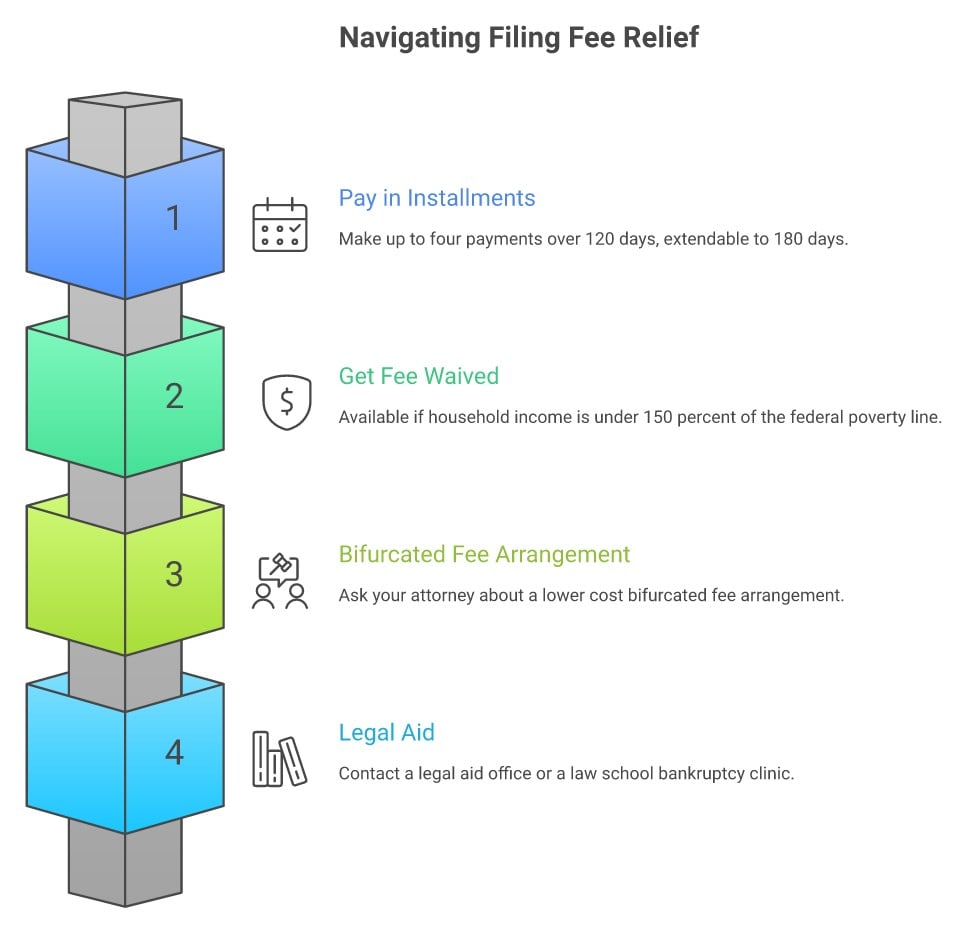
A Chapter 7 case currently costs $338 — a $245 case filing fee set by 28 U.S.C. §1930(a), plus a $78 administrative fee and a $15 trustee surcharge under the court’s own Miscellaneous Fee Schedule. That’s the court’s cost, separate from whatever your attorney charges. And the court — not your attorney — gives you two ways to handle it if you can’t pay it all at once:
- Pay it in installments. Under Federal Rule of Bankruptcy Procedure 1006(b), with the court’s permission you can split the fee into up to four payments, with the last one due no later than 120 days after filing — and the court can extend that to 180 days for good cause.
- Get it waived entirely. Under 28 U.S.C. §1930(f), if your income is under 150% of the federal poverty line and you can’t pay the fee even in installments, the court can waive it completely. Many people living on Social Security alone fall under that line — it’s worth asking your attorney to check the current figure for your household size before assuming you don’t qualify.
One catch if you choose installments: Rule 1006(b)(3) says plainly that “until the filing fee has been paid in full, the debtor… must not make any further payment to an attorney or any other person who provides services to the debtor in connection with the case.” In plain terms: if the court lets you pay the $338 in installments, you can’t hand your attorney anything more toward their own fee until that $338 is completely paid off. Ask your attorney how they structure payment around this rule before you choose installments over a waiver — it can change which option actually gets you filed faster.
Neither option requires a loan. Both exist precisely for people in your situation.
Why the Attorney Wants Paid Before They File
This part frustrates people, so it’s worth explaining rather than just accepting. In a Chapter 7 case, the debtor’s own attorney generally cannot be paid out of the bankruptcy estate the way a trustee’s attorney can. The Supreme Court settled this in Lamie v. United States Trustee, 540 U.S. 526 (2004), holding that Section 330(a)(1) “does not authorize compensation awards to debtors’ attorneys from estate funds” in a Chapter 7 case unless the attorney is separately employed by the trustee. And any fee your attorney is still owed at the moment you file is itself just another debt that gets wiped out in the discharge under 11 U.S.C. §727(b), which discharges debts that arose before the case was filed. Put those two together and you can see why most Chapter 7 attorneys ask to be paid in full, up front: if they don’t collect before you file, in most cases they simply don’t collect.
Some attorneys and courts do allow a bifurcated, or “unbundled,” fee arrangement — a smaller amount to prepare and file the case, with a separate fee for any work that comes after filing, since that post-filing debt wouldn’t be wiped out by this bankruptcy’s discharge. Whether your court allows this varies, and it’s not something to assume — ask your attorney directly whether your district permits it and whether they offer it.
Where to Find Help Paying for It — or a Different Attorney
Before taking on new debt to pay for a case designed to get rid of debt, it’s worth spending twenty minutes checking whether you can lower the cost instead.
- Legal Services Corporation. Use the LSC find-legal-aid tool to locate a federally funded legal aid office near you. Income-eligible seniors on Social Security frequently qualify for free representation.
- Law school bankruptcy clinics. Many law schools run supervised clinics where students, overseen by licensed attorneys, handle Chapter 7 cases for little or no cost. Ask a local law school whether it operates one.
- Your state bar’s pro bono referral program. Most state bar associations run a lawyer-referral or pro bono service specifically for people who can’t afford standard rates.
- NACBA. The National Association of Consumer Bankruptcy Attorneys is the professional association of attorneys who focus on exactly this kind of case — a second consult with another member firm sometimes turns up a lower flat fee or a payment structure your first attorney didn’t offer.
None of this means your current attorney is doing anything wrong by asking for a few hundred dollars up front and the balance before filing — that’s standard, for the reasons above. It means you have more paths to actually affording it than a loan. The same principle shows up in a completely different corner of debt relief: as I wrote in IRS Penalty Abatement Is a Free Phone Call — Not a Service You Need to Buy, a lot of people pay for help that a government program or a nonprofit would have given them for nothing, simply because no one told them to ask first.
What You Get When You Actually File
It helps to remember what’s waiting on the other side of this, because it’s more than just quiet.
Staying in the Hardship Program
- Collectors stay paused for now
- Balances remain, still reported to the credit bureaus
- No discharge — the debt is still legally owed
- The program can end or change at any time
Filing Chapter 7
- Eligible debts are legally discharged, permanently
- Collection activity stops immediately under the automatic stay
- Median credit scores for Chapter 7 filers rise steeply in the first few years after filing, per the CFPB’s 2019 research
- Bankruptcy erases the eligible debts themselves — and how they’re reported — which a hardship program was never designed to do; Social Security was already protected from private creditors under 42 U.S.C. §407 the whole time, with or without either one
Worth being precise about, since it’s easy to conflate: §407’s protection from private creditors was never conditional on the hardship program, and it was never conditional on filing bankruptcy either — it’s been sitting there the whole time. If the hardship program ends tomorrow, your Social Security doesn’t suddenly become exposed to those creditors; §407 already covers it. What the hardship program does is pause active collection on debts that are still legally owed and still reported. What bankruptcy does is erase those eligible debts themselves, permanently, which is something no hardship program was ever built to do. The one limit that’s always been true, for either path: §407 has never applied to the federal government itself. The IRS can still levy Social Security under 26 U.S.C. §6334(c), and it can still be reduced through Treasury offset, child support or alimony orders, and Social Security’s own overpayment recovery — I go through each of those exceptions in They Said No Creditor Can Ever Touch My Social Security — Except the Government Can. Filing doesn’t expand §407’s protection against the government. But the automatic stay can pause federal collection while your case is open, and some older income-tax debts can be discharged — ask your attorney if a federal debt is involved. None of this is relevant to ordinary credit card and medical debt, which is what most hardship-program balances are made of.
The Bottom Line
- Wanting peace of mind is enough of a reason to file — you don’t need to be facing an emergency
- Being judgment-proof means the stretch until your next Social Security deposit isn’t a legal emergency either — get through it first
- Handle rent, utilities and the car through 211, LIHEAP and your utility’s hardship program before spending a dollar on the case
- Don’t borrow — especially a credit card cash advance — to pay for the filing; ask about installments, a fee waiver, legal aid, a law school clinic, or a second attorney instead
- Tell your attorney about any money you borrow or receive before you file, no exceptions
Frequently Asked Questions
If I’m judgment-proof, do I even need to file bankruptcy?
Yes — wanting these debts legally gone so you can stop looking over your shoulder is enough of a reason. Filing is never as urgent as making rent or keeping the power on, though, so handle those first; that’s a matter of order, not whether bankruptcy is worth doing. A hardship program stops active collection; it doesn’t erase the debt or make it stop being reported. Bankruptcy does both.
Is it safe to wait until my next Social Security deposit to start the case?
If you’re genuinely judgment-proof and in a hardship program, yes — there’s no legal penalty for a short delay while you get current on rent, utilities and other essentials. Tell your attorney the timeline; most cases lose nothing by starting a pay cycle later. Waiting doesn’t change that the decision to file is yours, and it’s a valid one.
Can I take out a loan to pay my bankruptcy attorney?
Be careful. A credit card cash advance taken shortly before filing risks becoming a debt that survives your own bankruptcy under 11 U.S.C. §523(a)(2)(C), since the law presumes debts like that were taken on with no intention of repayment. Any loan you do take must be disclosed to your attorney before you take it.
Can the Chapter 7 filing fee be reduced or waived?
Yes. You can ask the court to let you pay the $338 fee in up to four installments over 120 days under Federal Rule of Bankruptcy Procedure 1006(b), or, if your income is under 150% of the federal poverty line, ask the court to waive it entirely under 28 U.S.C. §1930(f).
Where can I find a bankruptcy attorney if I can’t afford one?
Start with the Legal Services Corporation’s find-legal-aid tool, a local law school bankruptcy clinic if one exists near you, your state bar’s pro bono referral program, or a second consult through the National Association of Consumer Bankruptcy Attorneys (NACBA) — a different firm sometimes offers a lower flat fee or a payment arrangement.
I’m not an attorney and this isn’t legal advice — it’s the kind of honest information I wish someone had handed me before I filed my own Chapter 7 in 1990. Your situation has its own details that matter, and only you can decide what’s right for you. Take this as input, not instruction — a starting point for your own conversation with a qualified bankruptcy attorney, not the final word.
If this helped make sense of a decision you or someone you love is weighing, share this with someone who needs it. A lot of people in their seventies and eighties are quietly carrying exactly this weight, wondering if they’re too old, too broke, or too late to do anything about it. They’re not, and it helps to hear that from someone who’s been through it.
Facing a Similar Situation? You’re not alone — and you have more options than you think. Start with the all your debt relief options page to see what’s realistic, or take the 2-minute bankruptcy quiz if the debt feels unmanageable. Federal Reserve Bank of New York research shows filers recover faster than those who don’t file. If a company is involved, run them through the Scam-O-Meter first.



