

Quick Answer: This one’s for people who were California residents sometime between December 20, 2023 and June 11, 2026 — if that’s never been you, you don’t qualify. If it was you then but you’ve since moved, you may still qualify. Forbes Media has agreed to pay $10 million to settle a lawsuit alleging it shared visitors’ IP addresses and other identifiers with third parties (including trackers built by LinkedIn and Microsoft) without consent, using Forbes-owned websites during that window. You don’t need a notice, a receipt, or proof of anything beyond an honest yes — you just attest that you accessed a Forbes site in California during that window. The deadline to file a claim is November 9, 2026. Plaintiffs’ own court filing estimates payments of roughly $32 to $189 per approved claim, though the actual number depends entirely on how many people file. File at MediaSiteTrackerSettlement.com or call 1-833-930-0568.
More open settlements I’ve covered: the $59.5 million Flo Period Tracker data-sharing settlement and the $96.5 million generic drug price-fixing settlement — different companies, same basic story: real money, quiet deadline.
Expert Context: I’ve spent thirty years telling people to watch every dollar they’re owed, not just every dollar they owe. These website-tracking settlements are a category I keep coming back to because the money is real, the filing is free, and almost nobody hears about them before the deadline passes. If you were a California resident who read Forbes, Forbes Advisor, or any other Forbes-owned property sometime between December 20, 2023 and June 11, 2026 — even if you’ve since moved — this is genuinely worth five minutes of your time.
Let me say the most important thing first, because it saves everyone who was never a California resident the trouble of reading further: this settlement is for people who lived in California sometime between December 20, 2023 and June 11, 2026, even if you’ve since moved. If that’s never been you, there’s nothing to file here — though it’s still worth knowing this kind of privacy lawsuit is becoming common, and one covering your state may show up eventually. If it has been you, keep reading, because how you find out you qualify without ever getting a notice is exactly the part most coverage of this settlement skips.
Claiming money you are owed is one good day. What you do over the following year is what actually changes your position.
In the latest issue (Oct 9): Does Financial Literacy Make Financial Sense?
I write Your Money Actually most weekdays — actionable money information you will not find anywhere else, and the small decisions that compound. It is free, I sell nothing, and I take no money from any company I write about.
Key Terms Defined
Trackers: The settlement’s own legal definition covers “any software, code, pixel, beacon, tag, or other process embedded on a website that collects or causes to be shared data about website visitors” — including IP addresses, device information, browser information, geographic location, and unique identifiers.
Proof of Claim: The one form that actually gets you paid. Unlike some settlements, this one doesn’t ask for a receipt or screenshot — it asks for your name, contact information, a payment method, and your attestation (your word, under the claim form’s terms) that you accessed a Forbes website in California during the class period.
Pro rata share: Your proportional slice of whatever’s left in the settlement fund after administration costs, attorneys’ fees, and incentive awards are paid out — split evenly across everyone who files a valid claim. More claimants means a smaller individual check; fewer claimants means a bigger one.
What the Lawsuit Alleged
The case is Berman, et al. v. Forbes Media LLC, Case No. 3:24-cv-09287-WHO, filed in the U.S. District Court for the Northern District of California and assigned to Judge William H. Orrick. Named plaintiffs Domenica Berman and Abygael Piehl alleged that from December 20, 2023 through June 11, 2026, Forbes collected visitors’ IP addresses and unique identifiers without consent using trackers embedded on its websites, and shared that data with third parties — allegedly in violation of California Penal Code §638.51(a), one of CIPA’s pen-register provisions that some plaintiffs are now applying to website trackers — not a ruling that those claims succeed — and the California Unfair Competition Law, Cal. Bus. & Prof. Code §§17200 et seq.
According to reporting from The Record from Recorded Future News, plaintiffs alleged the trackers installed on Forbes’s websites were developed by LinkedIn and Microsoft, and that they collected and transmitted users’ unique identifiers to those companies and other third parties, who then fed the data into large databases used to build profiles of people’s browsing and shopping habits across the internet — the same kind of targeted-advertising data pipeline that funds most of the free internet.
Forbes denies all of it. The settlement notice is explicit: “Forbes denies these allegations and denies any wrongdoing.” Settling a lawsuit is a business decision to end costly, uncertain litigation — not a court finding that Forbes did anything wrong, and I want to be careful to say it that way.
The Claim: “I never got a settlement notice, so I must not qualify.”
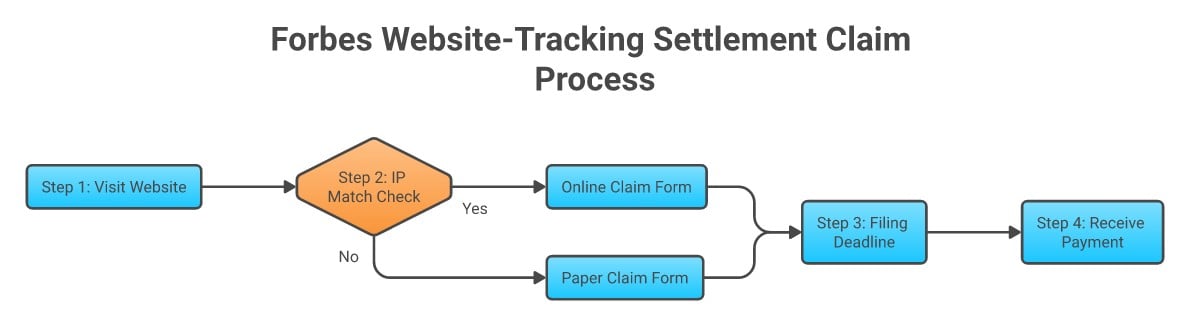
The Reality: Not getting an email doesn’t mean you’re excluded. According to plaintiffs’ own motion asking the court to approve the settlement, Forbes and the claims administrator, Kroll, built the notice list from IP addresses in Forbes’s records — and email addresses weren’t always available to match to those. If your IP address matches one in Forbes’s data, you’ll get a streamlined online claim form. If it doesn’t (a changed IP, a work or shared connection, or simply no email on file), you’re not excluded — you’re directed to a downloadable paper claim form instead, which exists specifically to add a small speed bump against fraudulent claims, not to shut real Californians out. Either path gets you paid the same way if your claim is approved.
Who Qualifies — and Who Doesn’t
Per the court-approved settlement notice, you’re a Settlement Class Member if:
The Daily Money Brief — Free, at 10 AM
Money you may be owed, scams to dodge, and the fine print decoded — the consumer money news that affects your wallet, every weekday.
- You’re a California resident, and
- Between December 20, 2023 and June 11, 2026, you accessed a website owned or controlled by Forbes, and
- Your IP address and/or a unique identifier was shared with third parties as a result of trackers present on that site.
You’re excluded if you’re Forbes itself (or its parents, subsidiaries, affiliates, officers, directors, or employees and their immediate families), anyone employed by the plaintiffs’ law firms, the judge assigned to the case and his immediate family, or anyone who already filed a timely, valid request to opt out.
One nuance worth flagging: this isn’t about where you live today. Per plaintiffs’ own description of the claim process to the court, the claim form asks you to attest that you accessed Forbes.com in California during the class period — a fact about where you were then, not your current address. If you were a California resident sometime between December 20, 2023 and June 11, 2026 but have since moved, you may still qualify — check the settlement site before assuming you’re out. If you weren’t a California resident during that window, you’re not part of this class and shouldn’t file.
Notice another thing that isn’t a requirement: proof you subscribed to Forbes, bought anything, or created an account. If you were a California resident and accessed a Forbes site while in California during that window, you’re likely in the class — attest only to what’s true, and the administrator decides. Given how often Forbes content gets shared and clicked from search results and social feeds, that’s a lot more people than the “Forbes reader” label suggests.
How to File — and What the Claim Form Actually Asks For
You have two ways in, and which one you get depends on whether your IP address is already in Forbes’s records with Kroll, the claims administrator:
- Matched IP address: Go to MediaSiteTrackerSettlement.com and you’ll be able to file a simple online claim form — your name, contact information, and how you want to be paid (PayPal, Venmo, Zelle, virtual Mastercard, or direct deposit). You attest that you accessed a Forbes website in California during the class period. That’s it — per plaintiffs’ own description of the process to the court, no receipt, screenshot, or account history is required.
- Unmatched or unknown IP address: You’ll be directed to a downloadable PDF claim form. Print it, fill it out, and mail it — postmarked no later than November 9, 2026 — to Berman, et al. v. Forbes Media LLC, c/o Kroll Settlement Administration LLC, P.O. Box 225391, New York, NY 10150-5391. If you’d rather mail your claim regardless of which path the site offers, that’s always an option.
Either way, if you have questions or need to update your contact information, call the claims administrator directly at 1-833-930-0568.
Two dates that no longer apply to most readers, for context: The deadline to opt out of the settlement or object to its terms was September 24, 2026 — already passed. The Court’s Final Approval Hearing is scheduled for December 2, 2026 at 2:00 p.m. PT in San Francisco, where the judge decides whether to grant final approval, and how much of the fund goes to attorneys’ fees and the two named plaintiffs’ incentive awards. If the court grants final approval there, everyone who didn’t opt out will be bound by the settlement whether or not they file a claim — filing by November 9 is the only way to actually get paid if the settlement is approved.
Honest Math: What Will You Actually Get
I’m not going to pretend I know your check amount, and I’d be skeptical of anyone who tells you a precise number right now. Here’s what’s actually on the record: plaintiffs’ attorneys told the court that, spread evenly across all roughly 3.9 million potential class members, the $10 million fund works out to about $2.56 a person — a number so small it explains why virtually nobody expects (or asks) everyone to file. But most people never do. Based on claims rates of 1% to 6% typically seen in comparable privacy-tracker settlements, plaintiffs’ counsel estimated actual claimants — the people who take the five minutes to file — can expect somewhere between roughly $32 and $189 per approved claim, after administration costs, attorneys’ fees (up to 25% of the fund, or $2.5 million, subject to court approval), and the named plaintiffs’ incentive awards are deducted.
I want to be precise about where that range comes from, because it matters: it’s not in the notice mailed or emailed to class members, and it’s not a promise from the court or the claims administrator. It’s the plaintiffs’ own estimate, filed with the court to justify why the settlement is fair. Treat it as an informed guess, not a guarantee — the real number depends entirely on how many of those 3.9 million people actually file, which is exactly why I’m telling you about this rather than assuming you already know.
Why This Is Worth Five Minutes Even If the Check Is Small
I’ve watched people leave real money on the table for thirty years because a settlement check sounded too small to bother with, or because they assumed a notice they never received meant they weren’t eligible. Neither reason holds up here. This costs you nothing but a few minutes, and it’s not really about the dollar amount — it’s about the habit. The fund is non-reversionary, so every dollar of your share you don’t claim doesn’t go back to Forbes — it gets divided among the people who do file. The only real effect of skipping this is handing your share to someone else, for a company that agreed to pay $10 million to end the case while denying any wrongdoing. That’s true whether the check turns out to be $32 or $189.
If you’re the kind of person who tracks every subscription and every debt payment closely — and if you’re reading a site called Get Out of Debt, I’m guessing you are — this is the same discipline pointed in the other direction. Watching what you’re owed matters as much as watching what you owe.
Never pay anyone to file this claim for you. Whenever a settlement like this makes news, copycat sites and “claim filing services” show up offering to file on your behalf — sometimes for a flat fee, sometimes for a cut of your payout, sometimes just to harvest your personal information. Filing directly at MediaSiteTrackerSettlement.com costs nothing and takes a few minutes. If a site asks for payment, a percentage of your check, or more personal information than your name, address, and payment preference, close the tab.
The Bigger Pattern: Privacy Settlements Are Real Money, Routinely Missed
This isn’t an isolated case. I’ve now covered several of these website-tracking and data-sharing settlements — the Delta Dental coverage-portal case, the Flo period-tracking app, and now Forbes — and the shape is always the same: a company used tracking technology most visitors never knew was there, and in the cases I cover, either a regulator sued or the company settled while denying liability. Forbes denies liability here, and this settlement isn’t a finding that Forbes broke the law. Either way, a real fund gets set aside that goes largely unclaimed because almost nobody connects “I read that website once” to “I might be owed money.” If you want the bigger picture on how the FTC and state regulators are cracking down on this kind of data sharing more broadly, I’ve also written about the FTC’s case alleging data broker Kochava sold location data to anyone willing to pay — a case the FTC announced it had settled in May 2026, with an order barring Kochava from selling sensitive location data without consumers’ consent.
None of this replaces dealing with actual debt, of course. But if debt is the reason every dollar matters right now, you have more real options than most people realize, and I’ve laid them out in my complete comparison of debt relief options. Start with the Find Your Path quiz for a recommendation based on your actual numbers — no company trying to sell you anything on the other end.
Key Takeaways
- This settlement is for people who were California residents sometime between December 20, 2023 and June 11, 2026 — even if you’ve since moved. If that’s never been you, you don’t qualify.
- Forbes agreed to pay $10 million to settle claims it shared visitors’ IP addresses and identifiers with third parties — including trackers reportedly built by LinkedIn and Microsoft — without consent, from December 20, 2023 through June 11, 2026. Forbes denies any wrongdoing.
- You don’t need a notice, a receipt, or proof of a subscription to qualify — just an honest attestation that you visited a Forbes website in California during that window.
- The deadline to file a claim is November 9, 2026, online or postmarked, at MediaSiteTrackerSettlement.com or 1-833-930-0568.
- Plaintiffs’ court filing estimates payments of roughly $32 to $189 per approved claim — an estimate, not a guarantee, based on an assumed 1%–6% claims rate.
- The opt-out/objection deadline (September 24, 2026) has already passed; the final approval hearing is December 2, 2026.
- Never pay a third party to file this claim for you — it’s free at the official site.
The Bottom Line
If you were a California resident who read anything on Forbes.com between December 20, 2023 and June 11, 2026 — even if you’ve since moved — this one’s worth five minutes of your time. I won’t pretend a $32 to $189 check changes anyone’s life — but it’s real money Forbes agreed to set aside to end the case, it costs nothing to ask for, and the only real risk is doing nothing and letting your share get divided up among the people who did file — the fund doesn’t go back to Forbes either way. File before November 9, and if you know someone who fits that description, send them this — they’re exactly who this was written for.
This is what I’d tell my own family if they were California residents who read Forbes anytime between December 20, 2023 and June 11, 2026 — five minutes, no risk, no cost. But you know your own situation better than I do, so treat my take as input, not instruction.
If this saved you a few minutes of digging, do one more thing: send it to the Californian in your life who reads Forbes Advisor, Forbes Health, or any other Forbes property — they’re the one most likely to qualify and the least likely to have heard this exists.
Frequently Asked Questions
Who qualifies for the Forbes website-tracking settlement?
California residents who accessed a website owned or controlled by Forbes between December 20, 2023 and June 11, 2026, and had their IP address and/or a unique identifier shared with third parties as a result of trackers on that site. That’s based on whether you were a California resident during that window, not where you live today — if you’ve since moved out of California, you may still qualify. If you were never a California resident during that period, this settlement doesn’t cover you.
I never received a settlement notice — can I still file a claim?
Yes. Not everyone in the class had an email address on file with Forbes, so not everyone got a notice. If your IP address matches Forbes’s records, you’ll get a simple online claim form. If it doesn’t, you’re directed to a downloadable paper claim form instead — you’re not excluded either way.
Do I need a receipt or proof that I visited a Forbes website?
No. Based on plaintiffs’ own description of the claims process to the court, the claim form asks for your name, contact information, and payment preference, plus your attestation that you visited a Forbes site in California during the class period — no receipt, screenshot, or account history required.
How much money will I actually get?
Nobody can tell you an exact number yet. Plaintiffs’ court filing estimates roughly $32 to $189 per approved claim, based on an assumed 1% to 6% claims rate — but that’s an estimate to justify the settlement’s fairness, not a number from the official notice or a guarantee. Your actual payment depends on how many people file valid claims before the fund is divided.
Is it too late to opt out or object to this settlement?
Yes — the deadline to opt out or object was September 24, 2026, which has already passed. At this point, your only options are to file a claim by November 9, 2026 to get paid if the settlement is approved, or do nothing and receive no payment. If the court grants final approval at the December 2, 2026 hearing, you’ll be bound by the settlement’s terms either way.
Dealing With Debt? Understanding your options is the first step. See how all your debt relief options compare — including ones most sites won’t tell you about. The Find Your Path quiz gives a recommendation based on your actual numbers, and the Scam-O-Meter checks any company’s complaint history before you sign. Federal Reserve Bank of New York research shows bankruptcy filers recover faster than those who don’t file.



