

Written by Steve Rhode, consumer debt expert since 1994 • Last updated September 30, 2026
Quick Answer: A utility can often make you pay, or set up a plan on, an old balance that really is yours, and it can also require a deposit for future service, before it connects you — but your state sets the limits. Pennsylvania bars a utility from demanding a bill from another person’s account unless you lived at the address where you’re now asking for service while that balance built up, and Texas’s retail electric rules say a previous occupant’s unpaid bill is not enough to refuse you (city, co-op, gas and water utilities, and electric utilities outside the retail-choice areas, follow different rules). Ask for the reason in writing and check the shared utility database that may have flagged you. In a bankruptcy case, 11 U.S.C. § 366 bars a utility from refusing you service solely because of a pre-filing balance you owe that same utility — and it can still refuse if you don’t provide a deposit or other assurance for service after filing within 20 days of the order for relief (in a case you file yourself, that is the filing date). If the old bill is with a different company, that rule does not by itself make that company connect you, so ask a bankruptcy attorney what the case can do about the debt itself.
What Just Happened: Why an Old Bill Is Standing Between You and Your Power
You asked for service at your new address, and before anyone flipped a switch the utility looked you up. The refusal — or the demand for a big deposit — usually comes from one of three places: the utility’s own records (an account at your old address that closed with a balance), a shared exchange that another utility or phone company reported to, or a consumer credit report.
The shared exchange is real. The CFPB describes the National Consumer Telecom & Utilities Exchange (NCTUE) as a consortium that “collects and shares information on new telecom and utility connect requests, paid-as-agreed and past-due account and payment histories including delinquencies and charge-offs” for telecom, pay TV, and electric, gas, and water service. NCTUE’s own consumer page says weak credit can mean “a utility company might require a deposit to connect your service.” That is one way your new gas company can know about an electric bill from two addresses ago — I covered a reader in exactly that spot in this letter about a 17-year-old utility balance.
What it does not mean is that the utility gets to name any price. What a utility may demand from an applicant — the old balance, a deposit, a payment plan — is set by your state’s utility commission and the utility’s filed rules, so the same old bill can be a valid demand in one state and a demand the rules don’t allow in the next. One more thing decides which rulebook applies: investor-owned utilities generally sit under those commission rules, while a city-owned utility or a co-op may be exempt or follow its own rules (New York’s rules, for example, exclude certain municipalities). Ask who regulates yours.
The Mistake You’re About to Make: Paying whatever number they quote, right now, with a payday loan, a title loan, or a credit card you can’t afford, just to get the power on. Panic makes paying feel like the only door. But that balance may include charges that belonged to someone else, may be older than your state lets the utility require, or may be something you can turn into a payment plan or a smaller deposit — and a high-cost loan to pay a utility turns one problem into two. Get the demand in writing and run the checks in steps 1 and 2 first, then decide. If someone in the home needs power for medical equipment, tell the utility that the same day and ask what medical protections your state offers. Many of those protections are written for shutoffs of existing service, so ask directly whether they apply to a new connection.
Your Options Right Now
What to Do in the Next 48 Hours
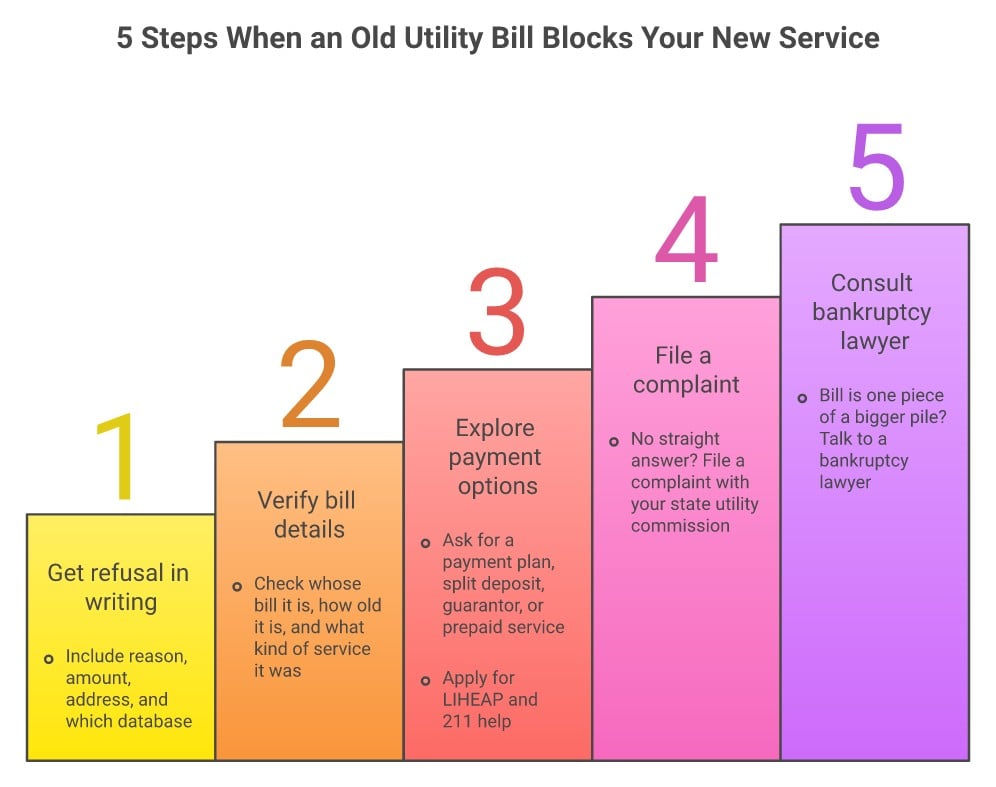
- Get the refusal, and the numbers behind it, in writing. Ask for the exact amount, the address and dates the balance covers, what the charges are, whether they used a shared database or a credit report (and which one), and what you must do to get service. Some states make them put it in writing: Texas requires a retail electric provider that denies service to give the specific reasons, in writing on request; Florida requires written notice of the reason for refusing to establish service; Illinois requires a rejection notice with “the specific reasons for the rejection” and lets you ask for the utility’s supporting records (service addresses, meter readings, usage, and bill amounts). If they relied on a consumer report to refuse you or demand a deposit, federal law requires the company to give you the name, address, and phone number of the agency that furnished it and notice of your right to a free copy if you ask within 60 days.
- Check three things: whose bill it is, how old it is, and what kind of service it was. Whose: most of the states I checked limit the utility’s ability to make you pay a bill from someone else’s account or a previous occupant — see the table below. How old: Pennsylvania’s look-back for a utility’s own account is 4 years, and, separately, federal law keeps a delinquent or charged-off account out of a consumer report after seven years — that limit applies to reports, not to the utility’s own records, which can go back further. What kind: Florida says failure to pay “a different type of utility service, such as gas or water” is not sufficient cause for an electric utility regulated by the state commission to refuse you (city-owned utilities and co-ops there may follow different rules). Then pull your NCTUE report — per the CFPB it is one free report every 12 months on request (866-349-5185, or nctueconsumerportal.com) — and dispute anything wrong. Federal law requires a free, reasonable reinvestigation within 30 days (up to 45 if you send more information during the review). If the balance isn’t yours at all, it may be identity theft — start at IdentityTheft.gov.
- Ask for something other than “pay it all now,” and apply for help the same day. Ask for a payment plan on the old balance (in New York a plan can start at as little as $10 a month with no down payment if you show financial need), a deposit in installments (Illinois’s standard schedule is one-third on the first bill and the rest in two equal installments), a guarantor or letter of guarantee where your state allows one (the person who signs can be made to pay your bill if you don’t, so they need to know that before they agree), or, where you can shop for an electric provider, a prepaid plan (in Texas, a provider offering prepaid service must not require a security deposit — but prepaid service can cut off as soon as the balance runs out, and Texas says it is not available to critical care or chronic condition residential customers, so skip it if anyone in the home depends on powered medical equipment). The same day, call your state’s LIHEAP office and dial 211 — LIHEAP is federal money that, per ACF, states use for “paying bills in arrears or in danger of disconnection” — and ask whether crisis funds can cover a start-up deposit or an old balance in your state. Get whatever they agree to in writing.
- If they won’t explain it or demand more than your state allows, file a complaint with whoever regulates that utility. For an investor-owned utility that is usually your state utility commission, whose rules decide what a regulated utility can ask of you, and it is the route Illinois points you to when you dispute a past-due debt and the utility rejects your dispute. A city-owned utility or a co-op may answer to its city council or its own board instead, so ask the utility who regulates it. Keep copies of everything. If an exchange or credit report is wrong, also file with the CFPB.
- If the old utility bill is one piece of a bigger pile, talk to a bankruptcy attorney — and know what 11 U.S.C. § 366 says. Once you are in a bankruptcy case, a utility “may not alter, refuse, or discontinue service to, or discriminate against, the trustee or the debtor solely on the basis” that a pre-filing debt owed to that utility “was not paid when due.” It can still require adequate assurance of payment for future service, such as a deposit, if you don’t provide it within 20 days after the order for relief. NACBA can help you find a bankruptcy attorney and the Find Your Path quiz shows whether the math favors a fresh start. For a read on your whole financial picture, schedule a free consultation with Damon Day, an independent debt coach (not an attorney) and my podcast co-host. I receive no payment for this referral.
How to Actually Stop It — Your 4 Paths
- Bankruptcy — when this bill is one of several you can’t carry. The automatic stay takes effect the moment you file. Not weeks later. Under 11 U.S.C. § 362(a)(6) it stops “any act to collect, assess, or recover a claim against the debtor that arose before the commencement of the case,” and § 366 (step 5) keeps a utility from refusing service solely over a pre-filing balance owed to that same utility, as long as you provide the deposit or other assurance within 20 days. The stay does not by itself turn service on. The deposit is the catch: in an Iowa case I wrote about, the court set a $200 adequate-assurance deposit against $2,184.67 of pre-filing utility arrears. After a discharge, 11 U.S.C. § 524(a)(2) bars “an act, to collect, recover or offset any such debt as a personal liability of the debtor” — whether a particular utility’s demand for a discharged balance crosses that line is a question for a bankruptcy attorney in your state. And if this one balance is truly your only debt problem, bankruptcy is the wrong tool and the steps above are the job. If it is one of many, the research I’ve collected shows filers recover faster than people who don’t file.
- Challenge what they are demanding. Ask which rule lets them demand it: someone else’s account, a previous occupant, a different type of service, a balance older than your state’s look-back, or a record they can’t produce. Illinois, for example, says past due debts may only include debts for which the utility retained summary data to support the validity of the debt. Then check your specialty credit bureau file and dispute errors.
- Negotiate the terms. A payment plan on the old balance, a deposit in installments, a guarantor, or a prepaid plan. Get every term in writing, including when any deposit is refunded — Texas retail electric providers must refund it after 12 consecutive billings paid without a late payment, for example.
- What WON’T work. (1) Saying “the statute of limitations ran out” and expecting the power to come on — that deadline limits when you can be sued; it doesn’t by itself decide whether a utility can condition new service on an old balance, which is why the state rules and records checks above matter more. (2) Borrowing from a payday or title lender to pay the bill. (3) Putting the new service in a friend’s or partner’s name to get around the balance: Texas lets a provider refuse service when the change of account holder “is made to avoid or evade payment of a bill”, and the person whose name is on the account owns the bill — see what happened to a reader who put a girlfriend’s electric in their own name.
Free Tool — Statute of Limitations Checker: Dealing with old debt? The free Statute of Limitations Checker tells you if the collection clock has expired in your state — including the zombie debt and clock-restarting traps collectors use. Check My Status →
What You Need to Know About the Rules for New Service
4 years
Pennsylvania’s look-back for a utility’s own residential account when it conditions new service (52 Pa. Code § 56.35)
7 years
About how long a collection or charge-off can stay in a consumer report — seven years counted from 180 days after the delinquency began. That limits the report, not the utility’s own records (15 U.S.C. § 1681c(a)(4), (c))
1/6
Residential deposit of one-sixth of your estimated annual bill: Pennsylvania’s figure for the applicants it lists (§ 56.32(a)) and Illinois’s ceiling (§ 280.40(c))
20 days
Window to provide a utility adequate assurance of payment after a bankruptcy order for relief (11 U.S.C. § 366(b))
Utility rules for new customers come mostly from your state commission and the utility’s filed tariff. The federal pieces are the Fair Credit Reporting Act (how long a delinquency can be reported, and your right to dispute it) and 11 U.S.C. § 366 for people in bankruptcy. The table shows five states. It is illustrative — rules change and differ by utility type — so confirm yours with your commission.
| State | Old balance — what the rule says | Deposit and alternatives |
|---|---|---|
| Federal baseline | No single federal rule on what a utility may demand; FCRA limits reporting to 7 years and gives you dispute rights | In bankruptcy: no refusal solely over a pre-filing debt owed to that same utility, but it can require adequate assurance (a deposit) for service after filing within 20 days; it does not by itself make a different company connect you, § 366 |
| Pennsylvania | May require payment of your own residential account from the past 4 years that you are legally responsible for and were properly billed; not another person’s account unless you lived at the property where you’re requesting service while that balance accrued (§ 56.35) | Deposit of 1/6 of estimated annual bill for the applicants it lists (prior termination for nonpayment, or creditworthiness not established), payable over 90 days; no cash deposit if confirmed eligible for a customer assistance program (§ 56.32) |
| New York | A distribution utility need not serve you if you owe it for a prior account in your name unless you pay in full, agree to a deferred payment plan, have a billing dispute pending, or meet another listed exception such as a commission directive (16 NYCRR § 11.3) | Payment plan installments as low as $10 a month, no down payment, on showing need (§ 11.10) |
| Texas (retail electric) | A provider may refuse over a bona fide debt owed to that provider, and an affiliated provider or provider of last resort must offer a chance to pay it; a previous occupant’s delinquency is not sufficient cause; other providers may refuse for any non-discriminatory reason, so shop (16 TAC § 25.477) | Deposit capped at the greater of one-fifth of estimated annual billing or the next two months; letter of guarantee option at the affiliated provider or provider of last resort; prepaid service may not require a deposit (§ 25.478, § 25.498) |
| Florida (investor-owned electric) | Previous occupant’s delinquency and failure to pay a different type of utility service (gas, water) are not sufficient cause to refuse; refusal must be in writing with the commission’s phone number (Rule 25-6.105) | New-service deposit capped at 2 months of projected charges (Fla. Stat. § 366.05(1)(c)); guarantor, cash deposit, letter of credit, or surety bond (Rule 25-6.097) |
| Illinois (regulated gas, electric, water, sewer) | Applicant with a past-due utility debt must pay it in full or, at the utility’s discretion, enter a payment agreement; debts must be backed by the utility’s retained records; debts for a different class or type of service, or owed by other people (except family expenses of married persons), do not count (83 Ill. Adm. Code 280.30) | Residential deposit up to 1/6 of estimated annual charges, standard schedule one-third on the first bill and the rest in two installments (280.40) |
If you live in Texas and can shop for a provider: a prepaid plan cannot require a security deposit, and the REP cannot require a connection balance above $75 for a residential customer (16 TAC § 25.498). I can’t tell you from here that prepaid costs less or more than a deposit — compare the price per kilowatt-hour before you sign. Not sure who regulates your utility, or need a state I didn’t list? Your state utility commission’s consumer line is where to start, and my Crisis Guides hub has the rest of the triage guides. If your problem is a shutoff at an address where you already have service, read my guide to an electric, gas, or water shutoff instead.
If a shared exchange or credit report is showing a balance that is wrong or too old, file a complaint with the CFPB and your state attorney general. If a regulated utility is demanding more than your state’s rules allow, file with your state utility commission. If you need legal help but can’t afford an attorney, find free legal aid through LSC.gov.
Steve’s Take
I filed bankruptcy in 1990, so I know what it feels like when your past stands in the doorway of your future. A reader named Adam wrote to me because his new electric and gas companies found a balance from an address he left 17 years earlier. Another reader moved and found a bill from seven years back attached to the new account. Neither had done anything unforgivable. An old utility bill is math wrapped in emotion — so do the math (whose bill, how old, what kind) before you pay a dollar. You are not your debt, and asking for the paperwork first costs you nothing.
Free Tool — Contract Decoder: Have a contract from a debt relief company? The free Contract Decoder analyzes it for red flags, hidden fees, and problematic terms — before you sign anything. Decode My Contract →
Frequently Asked Questions
The utility says I owe an old bill from my last address — can it really refuse to turn on my power?
Often, yes, if the balance is truly yours — but your state limits what it can demand. Illinois treats paying a past-due utility debt in full (or, at the utility’s discretion, entering a payment agreement) as a requirement for a successful application, yet it also says past-due debts must be backed by retained records and cannot include another person’s debts or a different type of service (83 Ill. Adm. Code 280.30). Pennsylvania limits the demand to your own account from the last four years, or another person’s balance at the address where you’re requesting service if it built up while you lived there (52 Pa. Code § 56.35). Ask for the reason in writing before you pay anything.
They want a huge deposit instead — is there a limit?
Many states cap it. Here are four examples. Pennsylvania sets a deposit at 1/6 of your estimated annual bill for the applicants it lists (for example, earlier service terminated for nonpayment, or creditworthiness not established), payable over 90 days, and bars a cash deposit if you are confirmed eligible for a customer assistance program (§ 56.32). Illinois also caps it at 1/6 (280.40). Texas retail electric providers are limited to the greater of one-fifth of estimated annual billing or the next two months (16 TAC § 25.478). Florida caps a new-service deposit at 2 months of projected charges (Fla. Stat. § 366.05). Ask for the calculation and when it is refunded.
The old bill is more than ten years old — doesn’t the statute of limitations protect me?
The statute of limitations limits when someone can sue you; it does not, by itself, answer whether a utility can make payment a condition of new service — I walked through that distinction with a reader in this letter. What more often helps is your state’s look-back rule (Pennsylvania’s is four years for the utility’s own account), the records the utility must be able to produce, and the federal seven-year reporting limit on delinquent accounts in a consumer report, which starts 180 days after the delinquency began (15 U.S.C. § 1681c). That limit governs the report, not the utility’s own files, so ask for both.
My new gas company is refusing me over an old electric bill — how does it even know?
Probably through a shared exchange. The CFPB lists the National Consumer Telecom & Utilities Exchange as a consumer reporting company whose members share account and payment histories, including delinquencies and charge-offs, for telecom, pay TV, and electric, gas, and water service; it provides one free report every 12 months on request. Some states also restrict the practice: Florida says failure to pay a different type of utility service is not sufficient cause for a state-regulated electric utility to refuse you, and Illinois excludes debts for a different class or type of service. See my list of specialty credit bureaus.
The old bill was in my ex’s or roommate’s name — do I have to pay it?
Usually not as a condition of service, with exceptions. Pennsylvania bars requiring payment under another person’s account unless you resided at the property where you’re now requesting service while the balance accrued (§ 56.35(b)). Texas’s retail electric rule says a previous occupant’s delinquency is not sufficient cause to refuse, but lets a provider refuse if an account-holder change was made to evade a bill (§ 25.477). Illinois excludes debts owed by persons other than the applicant, except family expenses of married persons. If you agreed to put your name on the account, the utility will treat the bill as yours. If you never signed up for it, that may be identity theft — start at IdentityTheft.gov before you pay.
I filed bankruptcy — how fast does it stop a utility from refusing service over an old bill?
The automatic stay takes effect when you file and stays “any act to collect, assess, or recover a claim against the debtor that arose before the commencement of the case” (11 U.S.C. § 362(a)(6)). Separately, § 366(a) bars a utility from refusing service to the debtor solely because a pre-filing debt owed to that same utility was not paid when due, but § 366(b) lets it refuse if you don’t furnish adequate assurance of payment for service after filing, such as a deposit, within 20 days after the order for relief (in a case you file yourself, that is the filing date). It does not by itself make a different company connect you. If your case is over and the debt was discharged, § 524(a)(2) is the provision to raise with a bankruptcy attorney. Chapter 11 has its own rule in § 366(c).
Can LIHEAP pay my deposit or my old balance?
It depends on your state. LIHEAP is federal money, but the ACF fact sheet says states and other grant recipients run the program, the federal agency does not make awards directly to households, states use funds for “paying bills in arrears or in danger of disconnection,” and grant recipients must provide crisis energy assistance through at least March 15. That is a floor, not a reason to wait: crisis money can run out, and some state programs are not open yet this early in the fall. Whether a crisis grant covers a start-up deposit or an old balance is set by your state, so call your state LIHEAP office or dial 211 and ask by name.
I live in a state you didn’t list — which rules apply to me?
Your state utility commission’s rules for residential applicants, plus the utility’s filed tariff. Search your state’s commission site for its rules on refusal of service, prior indebtedness, and deposits, then call the commission’s consumer line and ask who regulates your specific utility — a city-owned water department or an electric co-op may follow different rules. Whatever the answer, ask the utility for the reason and the records in writing, and file a complaint with the commission if it won’t give them.
One more thing — everything I share here is based on 30 years of helping people through exactly this. But my advice is input for your decision, not the decision itself. Only you know your full situation. Talk to an attorney, look at your numbers, and make the choice that serves your future.
Important: This guide is for informational purposes only and is not legal advice. Laws vary by state, and your situation may have details that change what options are available to you. For legal advice specific to your case, consult an attorney licensed in your state. NACBA can help you find a bankruptcy attorney, NACA can connect you with a consumer attorney, or schedule a free consultation with Damon Day, an independent debt coach and my podcast co-host — I receive no payment for this referral.
Key Takeaway: An old utility bill is a solvable problem, not a permanent lockout. Get the demand in writing today, check whose bill it is, how old it is, and what kind of service it was, and ask for a plan, a split deposit, or help before you pay in full. Run the debt option calculator if this is one of several balances, and talk to an attorney this week. The longer you wait, the more a deposit and a move-in date squeeze your choices.
The Bottom Line
You are not bad with money because an old bill followed you to a new address — utilities, phone companies, and the databases they share are built to remember, and state commissions have written rules that limit what that memory can be used to demand. Asking for the reason, the records, and a plan before you pay costs you nothing, and it beats wiring the full number in a panic. If someone you know just moved and is being told an old utility bill is blocking their power, send them this page — it may save them a deposit they don’t owe. See the full Crisis Guides hub and take the Find Your Path quiz if the bill is part of a bigger pile.
Dealing With Debt? Understanding your options is the first step. See how all your debt relief options compare — including ones most sites won’t tell you about. The Find Your Path quiz gives a recommendation based on your actual numbers, and the Scam-O-Meter checks any company’s complaint history before you sign. CFPB and academic research shows bankruptcy filers recover faster than those who don’t file.
Right now you are dealing with the thing in front of you, and that is exactly where your attention belongs. When it is handled — and it will be — there is a next stage, and it is the one I most enjoy writing about.
In the latest issue (Oct 16): The check that looks like a scam may be real
Each weekday I send one short email: one story that caught my attention, why it might matter to you, and one manageable thing you can do with it. It is free, I sell nothing, and I take no money from any company I write about.