

Quick Answer: SNAP’s funding model changed on October 1, 2026: states now pay 75% of the program’s administrative costs (up from 50%), and in most states a share of the food-benefit bill itself starts in October 2027, based on each state’s payment error rate. In my opinion the practical effect for a family is more scrutiny of paperwork, not announced benefit cuts, so the protection is simple: know your recertification date, turn everything in early, keep proof of every document, open every agency letter the day it arrives, and ask for a fair hearing inside the notice period if you get a reduction or closure notice. If your case closed because a renewal ran out at the end of your certification period, keeping benefits during a hearing isn’t available. The 30-day window only helps if you applied to renew on time and left a step unfinished; if you never filed the renewal, apply again the same day, and you can still request a hearing within 90 days. This post covers who pays for SNAP. The same law also changed work requirements and which noncitizens qualify, so if your work hours or immigration status could matter, ask your SNAP office before assuming your benefits are untouched.
Expert Context: In the more than 30 years I’ve worked with people in financial trouble (since 1994), the pattern I keep seeing is that families rarely lose ground because they didn’t qualify. They lose ground because they couldn’t prove it in time, or a letter sat in a pile, or they couldn’t stay on hold long enough to reach a human. This post is about that gap, and it is about paperwork mechanics, not about any party or politician.
If you get SNAP, the number to watch this month isn’t a dollar amount on your card. It’s a date on a piece of paper.
NPR reported on October 1, 2026, the first day of the federal fiscal year, that SNAP’s funding model is starting to change, with states picking up a bigger share of the bill. NPR’s report on the funding change does not say your benefits are going down. What I’m telling you is that when the people running a program are handed a new bill and a new scoreboard, the first thing that tends to change is the paperwork. Here is what is verified, what is my opinion, and what you can do about it before your next renewal.
Every weekday I read the enforcement actions, filings and fine print the outlets skip, and turn them into the one or two moves that actually improve your position — a rate worth moving for, a fee you can refuse, a deadline to beat before it costs you.
In the latest issue (Oct 9): Does Financial Literacy Make Financial Sense?
I write Your Money Actually most weekdays — actionable money information you will not find anywhere else, and the small decisions that compound. It is free, I sell nothing, and I take no money from any company I write about.
Key Terms Defined
Payment error rate: The share of SNAP benefit dollars a state paid incorrectly, counting both overpayments and underpayments, as measured by USDA’s quality control review (USDA SNAP Quality Control).
Certification period: The stretch of months your household is approved for. When it ends you must be recertified, meaning you apply again and usually do an interview and provide verification, or the case ends (7 CFR 273.14).
Notice of adverse action: The written notice a state must send before it reduces or ends your benefits during your certification period (7 CFR 273.13).
Fair hearing and continued benefits: Your right to have a hearing officer review a state action, and, under conditions covered below, to keep getting your benefits at the old level while the hearing is pending (7 CFR 273.15).
Procedural closure: My shorthand, not a federal term, for a case that ends because of a process problem (a missed interview, a document that was never logged) rather than because the household stopped being eligible.
Here’s What You Need to Know: The Funding Change in Plain English
Two different things are changing, and they start on two different dates. Mixing them up is how rumors start.
Step one, which began October 1, 2026: the cost of running SNAP (state workers, systems, training) used to be split 50/50 between Washington and the states. Under Section 10106 of Public Law 119-21, the federal share drops to 25% beginning in fiscal year 2027, which means states cover 75%. NPR reports the federal government’s own calculation is a $16.9 billion reduction in federal spending over five years.
Step two, which starts in October 2027 for most states: today the food benefits themselves are paid entirely with federal dollars. Under Section 10105 of the same law, beginning in fiscal year 2028 a state with a payment error rate under 6% pays nothing toward benefits. A state at 6% to under 8% pays 5% of the benefit cost, 8% to under 10% pays 10%, and 10% or higher pays 15%. For fiscal year 2028 a state can choose its fiscal year 2025 or 2026 error rate. The law also delays the start for states with very high error rates, so the exact date varies by state.
Where do states stand? USDA’s fiscal year 2025 payment error rates, dated June 24, 2026, put the national rate at 10.62%. Only nine states came in under 6%. NPR cites a Center on Budget and Policy Priorities estimate that nearly half of states could each owe $100 million or more if they don’t lower their error rates.
The Daily Money Brief — Free, at 10 AM
Money you may be owed, scams to dodge, and the fine print decoded — the consumer money news that affects your wallet, every weekday.
This part is not settled. The Senate Agriculture Committee passed a farm bill on September 16, 2026, on a party-line vote, that would push the benefit cost-share back one year. NACo reports the chairman expects a floor vote after the November elections, and that the administrative cost shift stays on its current timeline. Until something passes both chambers, I’d treat the October 2027 date as the law on the books, and as a date that could move. The administrative change is already in effect.
None of this changes what your household is entitled to under the cost-sharing sections themselves. Other parts of the same law did change work requirements and noncitizen eligibility, which NPR notes, and that is a separate subject from what I’m covering here.
Here’s Why You Need to Know It: The Scoreboard Rewards Paperwork
Here is the part I want you to understand, because it explains why I’m not telling you to ignore this.
The state’s dollar penalty is tied to the payment error rate. Under federal quality control rules at 7 CFR 275.10, states review two samples: active cases (households getting SNAP), checked for whether they got the correct amount, and negative cases (households denied, suspended or terminated), checked for whether the state’s decision was correct. The Missouri Independent reported that only active cases are used to calculate a state’s payment error rate. In plain terms, the number the state gets billed on counts benefits that were too high or too low. It does not count an eligible family whose case was closed by mistake.
I’m not accusing any state of doing anything on purpose. I’m saying the scoreboard bills the state for one kind of mistake and not for the other, and people and agencies respond to scoreboards. A case that stays open with a wrong number can cost the state money. A case that gets closed for a missing document costs the state nothing on that scoreboard, and it costs the family their groceries.
That is not just theory. The Missouri Independent reported on October 1, 2026 that Missouri’s Department of Social Services now requires people applying for or renewing SNAP to provide documents verifying housing, utility and dependent care costs, and financial resources including bank balances. The department said the purpose is to reduce its payment error rate before the federal cost share begins, and its media director said federal law does not require states to verify all of those items, so this is the state’s choice. Five Missouri advocacy and legal organizations asked the department to delay or cancel the change, warning that eligible people could lose benefits because they can’t produce the paperwork or because it doesn’t get processed. Missouri’s fiscal year 2025 error rate, per USDA, was 8.67%.
Missouri is one state, and every state will make its own choices. Better verification can also be a perfectly reasonable way to get payments right. What I can tell you is that this is what the mechanism looks like in practice, and that the safest thing a household can do is to get ahead of it.
One more thing from my own reading of the statute, so take it as my interpretation. For fiscal year 2029 and after, the law uses a state’s error rate from the third fiscal year before. That would make fiscal year 2027, the year that began on October 1, the measuring year for fiscal year 2030. The Senate bill described above would change some of those years, so this is another moving part. The takeaway is that states are being measured now, which is why I’d protect your case before your next renewal rather than after.
What the Federal Rules Say About Renewal
These rules come from 7 CFR 273.14 as published in the eCFR through September 29, 2026. I searched the SNAP subtitle of Public Law 119-21 (Sections 10101 through 10108) and found no provision on recertification or hearings, and I found nothing suspending or delaying these rules. These are federal minimums, and your state runs its own forms and procedures, so the notice you receive is the final word on your dates.
- Your notice of expiration tells you the dates. For most households the state must send it during the second-to-last month of your certification period, and it must state the date your period ends and the date by which you must apply to receive uninterrupted benefits.
- For most households, applying by the 15th day of the last month of your certification period counts as timely under the federal rule (some reporting systems use a different date, so go by your notice). I’d go earlier than that.
- A missed interview is not automatically the end. The state must send a Notice of Missed Interview, and if you ask for another interview, it must schedule a second one. The notice of expiration also says you are responsible for rescheduling, so call the same day.
- You must get at least 10 days to supply verification. States must schedule interviews so you have at least 10 days after the interview to provide documents before your period expires.
- There is a grace window. If you applied on time but didn’t complete a required step, the state may deny your case, but you have 30 days after your certification period ends to finish the process and have it treated as a recertification. Finish before the period ends and the state must reopen the case with a full month’s benefits. Finish within the 30 days after and the state must reopen the case with benefits counted from the date you took the action, so a gap in benefits is possible.
What the Federal Rules Say About a Hearing
The hearing rules are in 7 CFR 273.15 and the advance-notice rule is in 7 CFR 273.13. Here is what they actually say, including the limits, because the short version people repeat online leaves out the conditions.
- The notice period runs from the day the state mails the notice, not the day you open it. Before reducing or ending benefits during your certification period, the state must give notice with at least 10 days between the mailing date and the date the action takes effect (a state can use a longer period). This is why I tell people to open every agency letter the day it arrives.
- To keep your benefits during the hearing, you must ask within that notice period, and your certification period must not have expired. If you do, your participation continues at the level you had before the notice. The request form has a box for continued benefits, and if you don’t clearly waive it, the state assumes you want them.
- If you ask late, there is a good-cause exception, but I wouldn’t plan around it.
- Continued benefits can come back to bite you. If the state’s action is upheld at the hearing, the state establishes a claim against your household for the benefits you received in the meantime. You can waive continuation, and for some households that is the right call. That is your decision to make with the full picture.
- Continuation ends in certain situations, including when your certification period expires, when the hearing officer finds the only issue is federal law or regulation and your claim is invalid, and some mass changes that affect many households.
- Separately, you generally have 90 days to request a hearing on a state action or a loss of benefits. That window protects your right to challenge, but it does not by itself keep benefits flowing.
- The request can be oral or written, and the state may not limit or interfere with your freedom to make it. I’d still put it in writing and keep proof. You can also ask the state for the specific materials you need to prepare, free of charge.
- The state must decide within 60 days of receiving your request for a state-level hearing, with hearing arrangements designed to be accessible to you.
The Claim: “Once the closure letter comes, it’s over and I have to start a brand-new application.”
The Reality: Not necessarily. If the state reduces or closes your case during your certification period and you act inside the notice period, you may be able to keep benefits while the hearing is pending. That doesn’t apply to a renewal that ran out at the end of the period. Even if you miss that window, the federal rule gives you 90 days to request a hearing, and the 30-day grace window after a certification period ends can turn an unfinished renewal into a recertification. The sooner you act, the more of these options are still open.
Here Are Some Things to Consider
- The honest answer might be “nothing changes for you.” Your state may handle this smoothly, and if your recertification is months away, the right move may be to watch for your notice of expiration and do nothing else yet.
- Paperwork requirements can shift between renewals. What your state asked for last time may not be what it asks for this time. Missouri’s change applies to people renewing, not only new applicants.
- The people most at risk are the ones with the least slack. That is the person working two jobs who can’t sit on hold, the person with a disability, the person without a printer or reliable internet, and the person who moved and missed the mail. If that is you or someone you love, ask for help early rather than late.
- A food-benefit gap lands on the rest of the month. When the card goes quiet, the grocery money comes out of rent, the electric bill or the car payment. That is how a paperwork problem turns into a debt problem, and it’s the part of this I care most about. If a job loss is part of what’s squeezing your month, my guide on what to do right now after losing a job is the place to start. One reader wrote me years ago that he hadn’t sent in the proper forms to continue his food stamps, the state later said he owed about $3,000, and it was taking $305 a month out of his check. I wrote about that situation in how to stop a SNAP overpayment garnishment.
- Applying for help isn’t failing. I made that case in my piece on low-income government assistance programs. If your household needs food while a problem gets sorted out, your state’s SNAP office can tell you where your case stands, and a local food pantry can bridge a short gap.
Here Are Some Things You Might Want to Think About Doing
I’m a big believer in building a system instead of relying on willpower, which I wrote about in why budgets are a page of lies. A SNAP case is a perfect place for a simple system. Here is the one I’d build, in order of how much it protects you:
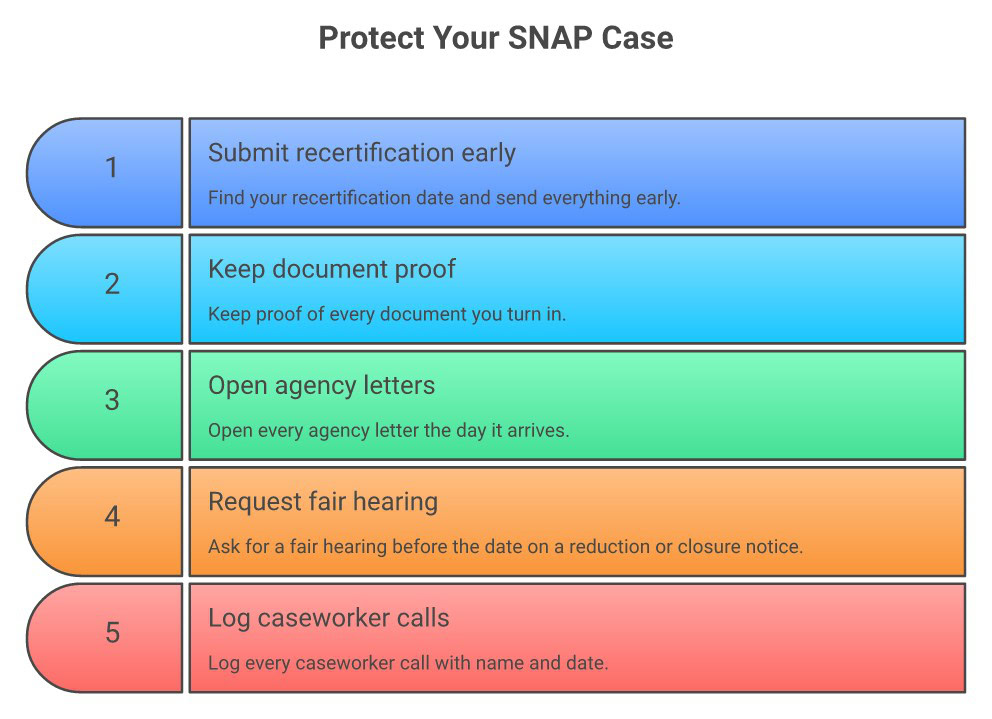
- Find your recertification date today and put it on the calendar twice. Look for your notice of expiration or your approval notice, or call your state’s SNAP office. Set one reminder for when the paperwork should arrive and another for well before the 15th of your last certification month. Then submit early.
- Turn in every document with proof you did. Use the upload portal and screenshot the confirmation, or ask for a stamped receipt, or send it by certified mail. Photograph each page before you hand it over. Keep it all in one folder, paper or phone.
- Open every agency letter the day it arrives. If it says your benefits will be reduced or closed, find the effective date and the hearing instructions first. Then count the days from the mailing date, which may be printed on the notice.
- If you get a reduction or closure notice, decide about a hearing before the effective date. If you think the state is wrong, request the fair hearing within the notice period and tick the box asking for continued benefits. Continued benefits only apply while your certification period is still running. If your case closed because the renewal lapsed, use the 30-day window and the 90-day hearing request instead. Know the trade-off: if you lose, you could owe back what you received. If you’re unsure, ask your state’s legal aid office. The federal rule says the notice must mention free legal representation when it is available.
- If you missed an interview or a document deadline, call the same day, ask to reschedule, and ask for the missed-interview notice in writing. Check whether you’re inside the 30-day window after your certification period ended.
- Log every caseworker contact. Write down the date, time, the person’s name or ID number, and what they said. A one-page log beats memory every time you have to explain what happened.
Key Takeaways
- Since October 1, 2026, states pay 75% of SNAP administrative costs. Under current law, most states begin paying a share of benefit costs in October 2027, based on their payment error rate, and a Senate proposal could delay that by a year.
- The error rate counts overpayments and underpayments in active cases. In my opinion, that gives states a reason to tighten paperwork, and Missouri has already added documentation requirements.
- Know your recertification date and submit early. Keep proof of every document, and open every letter the day it arrives.
- To keep benefits during a hearing, you generally must ask within the notice period and before your certification period expires. If you lose, you may owe a claim for what you received.
- Log every contact. You’re allowed to be the person who keeps the receipts.
The Bottom Line
If you get SNAP and the news this week made your stomach drop, that reaction makes sense, and it doesn’t mean you did anything wrong. Needing food help is not a character flaw. It’s the system working the way it was designed to when life gets expensive. The change I expect from the funding shift isn’t a cut with your name on it. It’s a bigger pile of paper, and paper is something you can beat with a calendar, a folder and a phone camera. Do the small things above this week, and the next letter that shows up in your mailbox becomes a task instead of a threat. You’re not your paperwork, and a missing form is not a verdict on your family.
Frequently Asked Questions
What changed for SNAP on October 1, 2026?
States now pay 75% of SNAP’s administrative costs, up from 50%, because the federal share dropped to 25% starting in fiscal year 2027 under Public Law 119-21. SNAP food benefits are still paid entirely by the federal government for now. Under current law, a state with a payment error rate of 6% or higher begins paying 5%, 10% or 15% of benefit costs in October 2027, depending on how high the rate is. My own count from USDA’s fiscal 2025 rates: 9 states would pay nothing, 35 states would pay 5% to 15% starting in October 2027, and 6 states plus DC have rates high enough to get a later start. States can use their 2025 or 2026 rate, so those counts can change.
Will my SNAP benefits be cut because states are paying more?
The cost-sharing sections change who pays, not what a household is entitled to, so I’m not aware of an announced benefit cut tied to them. My concern, which is my opinion, is that states trying to lower their error rates may add paperwork, and families can lose benefits through missed documents. Missouri, for example, now requires more verification at application and renewal.
Free Tool — Benefits & Free Money Finder: There may be government programs, creditor hardship options, or nonprofit grants available to you. The free Benefits Finder personalizes results by state and situation — SNAP, Medicaid, LIHEAP, and more. Find Your Benefits →
How do I keep my SNAP benefits while I appeal a reduction or closure?
Under 7 CFR 273.15, if you request a fair hearing within the period stated on your notice of adverse action, and your certification period has not expired, your benefits continue at the previous level until the hearing decision. The notice period must be at least 10 days from the date the notice is mailed. If you lose the hearing, the state establishes a claim for the benefits you received in the meantime, and you can waive continued benefits. State procedures vary, so follow your notice.
How long do I have to request a SNAP fair hearing?
The federal rule generally allows you to request a hearing on any state action or loss of benefits from the prior 90 days. To keep benefits flowing during the hearing, you generally must ask within the shorter notice period printed on your notice, which is at least 10 days from the mailing date, so I’d request it right away.
What if I miss my SNAP recertification interview or a document deadline?
The state must send a Notice of Missed Interview, and if you ask for another interview, it must schedule a second one. If you applied on time but didn’t finish a required step, federal rules give you 30 days after your certification period ends to complete it and have it treated as a recertification, though benefits may be prorated. Call the same day and keep a record of the call.
One last thing, and I say it because I mean it: this is what I’m seeing after more than 30 years of helping people with money problems, and what I’d tell my own family if they called me tonight. Only you know your actual situation, your state’s paperwork and your household, so take this as input, not instruction. Don’t let anyone, including me, tell you what to do about your benefits. Read your notice, check your state’s rules, get the answers in writing, and then decide what’s right for you.
If this helped, send this to someone who gets SNAP, or to the neighbor who always seems to be one lost letter away from trouble. Knowing the date on the paper, and what you’re allowed to do about it, can be the whole difference.
Dealing With Debt? Understanding your options is the first step. See how all your debt relief options compare — including ones most sites won’t tell you about. The Find Your Path quiz gives a recommendation based on your actual numbers, and the Scam-O-Meter checks any company’s complaint history before you sign. Federal Reserve Bank of New York research shows bankruptcy filers recover faster than those who don’t file.



