

Fact-checked by Steve Rhode, consumer debt expert since 1994 • Last reviewed October 1, 2026 • The IRS and statute claims below link to primary sources; the dollar examples are my own arithmetic and labeled as illustrations.
Each weekday I send one short email: one money story that caught my attention, why it might matter to you, and one manageable thing you can do with it. A couple of minutes, and a dad joke.
In the latest issue (Oct 9): Does Financial Literacy Make Financial Sense?
Free. I sell nothing. Unsubscribe any time.
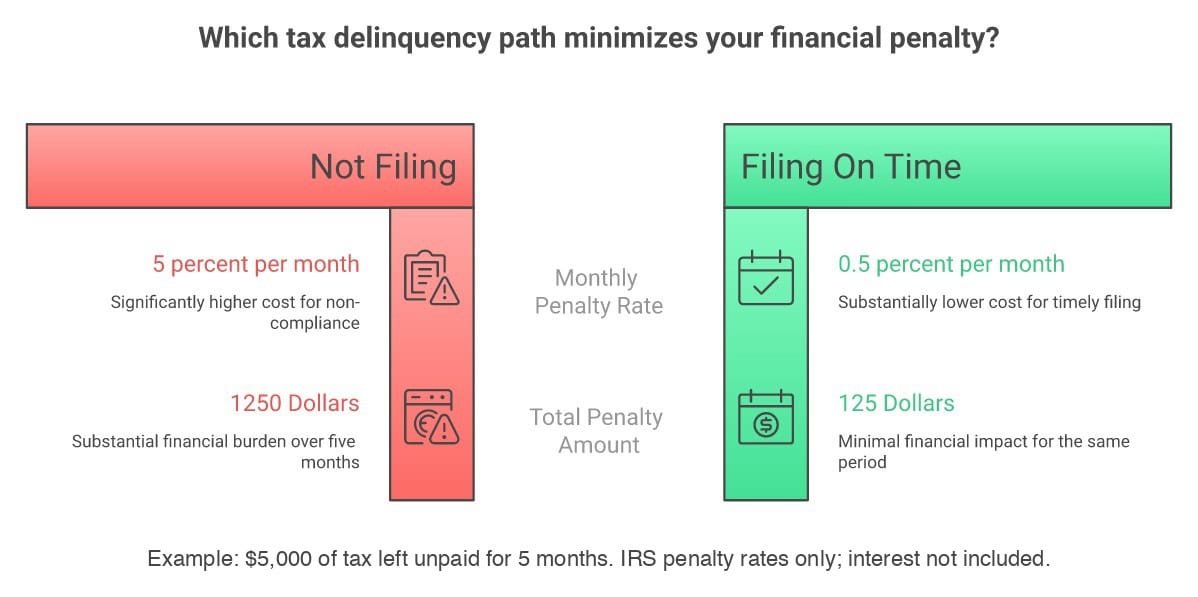
The verdict: Myth. If you owe the IRS and can’t pay, file the return anyway, because filing late is the costlier mistake. The law adds 5% of the tax due for each month a return is late (up to 25%), but only 0.5% a month for paying late — so for the first five months, the standard monthly rate for not filing is ten times the rate for not paying. The IRS’s own instruction is to file even when you can’t pay in full. The IRS failure-to-file and failure-to-pay pages and 26 U.S.C. §6651 confirm it.
Well, Actually…
Say you finish your return and the last line says you owe $5,000. You don’t have $5,000. The logic that comes next feels airtight: if I file, the bill becomes official; if I don’t, maybe it stays theoretical until I have the money. So the envelope goes in a drawer, and the drawer stays shut. (That $5,000 is an illustration, not anyone’s real bill.) It’s a belief I keep seeing, and I understand the fear behind it. It just runs straight into how the penalties are built.
Two different penalties are in play, and the law prices them very differently. Under 26 U.S.C. §6651(a)(1), filing late adds 5% of the tax due (less anything you paid on time) for each month or part of a month, up to 25%. Under §6651(a)(2), paying late adds 0.5% of the unpaid tax for each month or part of a month, also up to 25%. Same unpaid tax, same calendar — one penalty ticks ten times faster. When both apply in the same month, the IRS reduces the filing penalty by the payment penalty, so the month costs 5% in total, not 5.5% (4.5% for not filing plus 0.5% for not paying), per the IRS. Those are the standard rates: the payment penalty rises to 1% a month if you ignore a notice of intent to levy (§6651(d)), which is one more reason to open your mail. And this post is about individual returns (Form 1040); the IRS lists different late-filing penalties for partnership and S corporation returns.
Run that on the $5,000 for five months, penalties only. Not filing and not paying comes to 5% a month, or $1,250 — that’s my arithmetic from the IRS rates, not an IRS figure. Filing on time and not paying comes to 0.5% a month, or $125. The IRS says the filing penalty maxes out after 5 months while the payment penalty keeps running. So the dollar gap stops widening at month five, at $1,125 in this example — and it doesn’t shrink, because from there both paths pick up the same 0.5% payment penalty on the same unpaid balance (assuming you pay nothing in either case). Interest runs on top of all of it, and the IRS charges interest on penalties too.
There’s a floor, too. If the return is more than 60 days late, the filing penalty can’t be less than the lesser of a set dollar amount or 100% of the tax you owe. The IRS table lists $525 for returns due in 2026, adjusted for inflation each year (Rev. Proc. 2025-32 sets $535 for returns required to be filed in 2027). So if you owe $300 and file months late, the penalty can be the whole $300 (unless you can show reasonable cause). Small balances get hit hardest, and they’re the ones people are most tempted to ignore.
If I can’t afford to pay what I owe the IRS, I’m better off not filing my return until I can pay it.
Filing and paying are two separate duties with two separate penalties, and the standard monthly rate for filing late is ten times the rate for paying late: 5% versus 0.5% of the tax (26 U.S.C. §6651(a)(1) and (a)(2)). The IRS tells you to “File all tax returns that are due, regardless of whether or not you can pay in full” (IRS, Filing past due tax returns). If you can’t pay everything, the IRS says to pay what you can and apply for a payment plan.
IRS, Failure to file penalty (page updated February 7, 2026) • IRS, Failure to pay penalty (page updated June 5, 2026) • 26 U.S.C. §6651 (Cornell Law)
Why You Were Told This
This one usually isn’t a sales pitch. It grows out of fear. The return is the moment the number becomes real, and not looking feels like not owing. The two penalties also have names that sound alike, so “late is late” seems to cover both. It doesn’t: the law treats the paperwork and the payment as separate obligations, and people who can’t do the second talk themselves out of the first.
Skipping the return doesn’t make the tax disappear, and it gives up things that only come with a filed return:
- The IRS can file for you — with less in your favor. If you don’t file, the IRS may file a substitute return that might not give you credit for deductions and exemptions you’re entitled to, and the resulting tax bill, if unpaid, can lead to a levy on your wages or bank account or a federal tax lien. Under 26 U.S.C. §6020(b) the IRS prepares that return from the information it can obtain, and under §6501(c)(3), when no return is filed, the tax may be assessed “at any time.” The substitute return the IRS prepares doesn’t start that clock (§6501(b)(3)). Filing your own return is what starts it.
- A refund can expire. If you’re owed a refund, the IRS says you generally must file within 3 years of the return due date to claim it, and the IRS holds refunds while a past-due return is outstanding. And when the IRS owes you a refund there’s no penalty for filing late (IRS Tax Tip 2026-32), because the penalty is a percentage of tax owed — but the 3-year clock still runs.
- Your other options need a filed return. The IRS’s offer in compromise requires that you’ve filed all required tax returns. And if bankruptcy ever becomes the right move for old tax debt, 11 U.S.C. §523(a)(1)(B) blocks discharge of a tax for which the return was never filed, or was filed late and within two years before the bankruptcy petition — and a return the IRS makes for you under §6020(b) isn’t a “return” for that purpose. The same section defines a return as one that meets the filing requirements of nonbankruptcy law, and some courts have read that to mean a late return can never count, so a bankruptcy attorney in your area has to check this before you time anything around the two-year rule. Filing doesn’t by itself make a tax debt dischargeable — other timing rules apply (I walk through them in my posts on when bankruptcy can erase tax debt and the “never” myth) — but not filing can take that door off the table.
What to Actually Do
Here’s what changes in your week. The goal isn’t to pay the whole thing. It’s to stop the faster-ticking penalty and turn a vague dread into a number you can plan around. If your return is already more than five months late, the filing penalty has already maxed out, and filing still matters: it starts the IRS’s assessment clock and opens the payment and relief options below.
- File the return, even if the balance scares you. That’s the IRS’s instruction (File all tax returns that are due, regardless of whether or not you can pay in full). If you filed an extension on your 2025 return and you’re reading this before October 15, 2026, that’s your deadline — and an extension is only for filing, not paying. Lost your W-2s or 1099s? The IRS says you can ask the payer, request wage and income information with Form 4506-T, or get free help from the VITA or TCE programs.
- Pay something, even if it’s small. The IRS says pay what you can now and apply for a payment plan. The law figures the monthly payment penalty on what’s still unpaid at the start of each month (§6651(b)(2)), so every dollar you pay early shrinks the base.
- Ask for a payment plan the same day you file. The IRS payment plan page lists a short-term plan (180 days or less) with a $0 setup fee, and longer plans with setup fees that depend on the type and how you apply (eligibility limits apply), with penalties and interest continuing until the balance is paid. While a request is pending, the IRS is generally prohibited from levying, with certain exceptions. And if you filed on time as an individual, the IRS says the payment penalty drops to 0.25% a month while an approved plan is in effect — one more thing on-time filing buys you.
- Open the IRS mail. A notice is information, not a verdict. If a levy or lien has already started, start with what to do when the IRS is taking money from your paycheck or what to do when the IRS has filed a tax lien.
- If you skipped more than one year, file them all. The IRS wording is “all tax returns that are due.” If it’s several years, get help first from a Low Income Taxpayer Clinic or a tax professional. The IRS number for help with past-due returns is 800-829-1040. If one of those years is owed a refund, that year has its own 3-year clock.
- Then ask about penalty relief. The IRS offers First Time Abate and, starting with 2025 returns, Automatic Exemption from Penalty for people with a clean three-year compliance history; if a penalty notice shows up anyway and you believe you qualified, the IRS says to contact it. Both programs require that clean three-year history, so if you skipped earlier years you may not qualify. And the IRS says that, by itself, lack of funds is not reasonable cause for failing to pay, though other facts and circumstances can still qualify you. My post on penalty abatement covers how to ask, and it’s a free phone call.
- If the total is more than a plan can handle, you still have moves — and they all start from a filed return. See the real offer in compromise acceptance rate and my complete tax debt guide.
Steve’s Take
Debt is math wrapped in emotion, and the IRS is where the emotion gets loudest. The math here is simple: filing is the cheap step, and it’s the one you can finish this week even if the money won’t be there for a while. When I filed bankruptcy in 1990, the lesson I took from it was to deal with it and look to the future rather than spend 5 years repairing the past. Hiding from a bill never made one smaller. A filed return gives you a real number, stops the filing penalty, and opens options you can’t reach any other way. The payment penalty and interest keep running until the balance is paid or a plan changes them, so filing is the start, not the finish. You’re not your tax bill — and the sooner it’s on paper, the sooner it’s a problem with a plan instead of a dread with no edges.
Frequently Asked Questions
If I can’t pay my taxes, should I still file on time?
Yes. The IRS says to file all tax returns that are due, regardless of whether you can pay in full. Filing late costs 5% of the tax due per month (up to 25%), while paying late costs 0.5% of the unpaid tax per month (up to 25%), per 26 U.S.C. §6651.
How much is the penalty for filing late versus paying late?
The failure-to-file penalty is 5% of the tax due for each month or partial month, up to 25%. The failure-to-pay penalty is 0.5% per month, up to 25%. When both apply, the filing penalty is reduced by the payment penalty, and the filing penalty maxes out after 5 months while the payment penalty continues (IRS).
Is there a minimum penalty if I file really late?
Yes. If a return is more than 60 days late, the penalty is at least the lesser of a set dollar amount or 100% of the tax due. The IRS table shows $525 for returns due in 2026 and amounts adjust yearly (IRS failure-to-file page).
What if I’m getting a refund — do I have to file?
There’s no penalty for filing after the deadline if the IRS owes you a refund, per IRS Tax Tip 2026-32, but you generally have to file within 3 years of the return due date to claim it (IRS). Waiting costs you the money.
What happens if I never file?
The IRS may file a substitute return for you that might not give you credit for deductions and exemptions, and the resulting bill can lead to a levy or lien if unpaid. Because no return was filed, the tax may be assessed “at any time.” The IRS also says repeated failure to file can bring additional enforcement measures, up to criminal prosecution (IRS). The criminal statute, 26 U.S.C. §7203, applies to willful failure. Owing a balance you can’t pay is not a crime. Knowing you have to file and choosing not to is the kind of conduct that word describes. Filing before the IRS contacts you is the best protection, and if you have several unfiled years and significant income, talk to a tax attorney before you file.
If I file and can’t pay, will the IRS take my paycheck right away?
Unpaid tax can lead to a federal tax lien or a levy, and the IRS says so. It also says that when you request a payment plan the IRS is generally prohibited from levying while the request is pending, with certain exceptions (IRS payment plans). Filing and requesting a plan is the path that gives you the most control.
Can the late-filing penalty be removed?
Sometimes. The IRS offers First Time Abate for people with a clean three-year history, and Automatic Exemption from Penalty is starting with 2025 returns (IRS). Both programs require a clean three-year history, so skipping earlier years can rule them out. Reasonable cause can also work, but by itself, lack of funds is not reasonable cause for failing to pay (IRS). See my penalty abatement guide.
Can bankruptcy get rid of tax I owe if I filed late?
It depends on the timing rules, not just on filing. A return filed late and within two years before the bankruptcy petition is excluded from discharge under 11 U.S.C. §523(a)(1)(B), and an unfiled return is as well, so filing is a prerequisite, not a guarantee. Some courts treat any late return as not a “return” at all under that section’s definition, so ask a bankruptcy attorney in your area before you rely on the two-year rule. My post on when bankruptcy can erase tax debt lays out the rest.
This is one informed perspective, not legal or tax advice. Your situation is yours, only you decide what to do, and I’d treat everything here as input, not instruction.
The bottom line: Not being able to pay the IRS is a reason to file and ask for a payment plan, not a reason to skip the return — the standard monthly penalty rate for filing late is ten times the rate for paying late. If someone you know is hiding from a tax return because they can’t pay, send them this.
Dealing With Debt? Understanding your options is the first step. See how all your debt relief options compare — including ones most sites won’t tell you about. The Find Your Path quiz gives a recommendation based on your actual numbers, and the Scam-O-Meter checks any company’s complaint history before you sign. Federal Reserve Bank of New York research shows bankruptcy filers recover faster than those who don’t file.



