

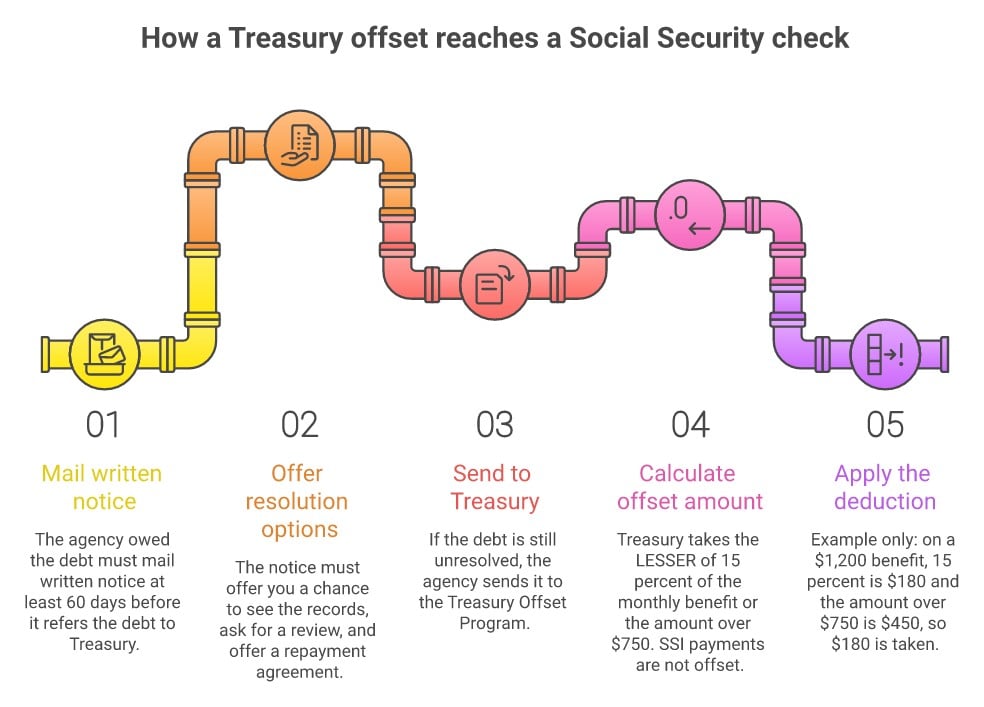
Quick Answer: For this one card, yes. A delinquent Military Star balance can be sent by the Exchange to the Treasury Offset Program, and Treasury can then take the smallest of three amounts: the debt itself, 15% of your monthly Social Security benefit, or the amount by which that benefit is over $750 (31 CFR 285.4(e)). Supplemental Security Income (SSI) cannot be offset. The agency has to mail you written notice first, with a chance to see its records, ask for a review and propose a repayment agreement. And the age of the debt does not stop it, because federal law says no time limit on an offset is effective.
Expert Context: I’ve worked on consumer debt problems since 1994, and I founded Debt Counselors of America, which later became Myvesta. This one is worth slowing down for, because the rule most people were told is true almost everywhere and wrong in this one place.
This is a sad situation I’ve seen over all my decades in this work: a military member is handed a credit card through the Exchange, and later, in retirement, the government takes part of a small Social Security check.
Every weekday I read the enforcement actions, filings and fine print the outlets skip, and turn them into the one or two moves that actually improve your position — a rate worth moving for, a fee you can refuse, a deadline to beat before it costs you.
In the latest issue (Oct 9): Does Financial Literacy Make Financial Sense?
I write Your Money Actually most weekdays — actionable money information you will not find anywhere else, and the small decisions that compound. It is free, I sell nothing, and I take no money from any company I write about.
Nobody in that picture did anything sneaky. The card was easy to get, life got in the way, and now there is a deduction in the one check you were planning to the dollar. You are not your debt, and a deduction on a bank statement is not a verdict on your character. It is a math problem with a process attached, and the process has handles you can pull.
Here is the “well, actually.” You have probably read that nobody can take your Social Security for a credit card, and for almost every credit card that is true. The Military Star card is the exception, because the creditor is tied to the federal government, and the federal government wrote itself a way around its own rule. I’ll show you the rule, the math on a small check, the notice that has to come first, and what you can do about it.
The Daily Money Brief — Free, at 10 AM
Money you may be owed, scams to dodge, and the fine print decoded — the consumer money news that affects your wallet, every weekday.
Where this topic came from: Questions in my free Ask Steve chat keep circling back to situations like this one: a small Social Security check, a deduction nobody warned about, and a government agency on the other end. I’m not giving away any personal information here — I never do — but when real questions show me a gap worth covering, I write the answer for everyone. If you’re facing something like this yourself, ask me about it in the chat. It’s free, it’s private, and I’m not selling anything.
Why This Card Is the Exception to the Rule You Were Told
Federal law, 42 U.S.C. §407, protects Social Security from private creditors. I walk through that rule, and the three places the government gets around it, in They Said No Creditor Can Ever Touch My Social Security. The one that matters here is the Treasury Offset Program. Congress wrote it to apply “notwithstanding” section 207 of the Social Security Act (that is §407), and it says Social Security payments “shall be subject to offset” for a debt owed to the government (31 U.S.C. §3716(c)(3)(A)).
How does a store card end up there? The Exchange Credit Program is run by the Army and Air Force Exchange Service, and its cardholder agreement lists, among the remedies if you default, to “submit your Account for offset through the U.S. Department of the Treasury” (section 16 of the agreement as filed with federal regulators, the copy on file at reginfo.gov; the Exchange’s current wording may differ). It also happens in practice. A federal bankruptcy court opinion records a Military Star debt that “was also placed in TOP” (In re Buttrill, Bankr. E.D. Tenn. 2016).
One word of vocabulary, because it will help you on the phone. Most of us say “garnishment.” The technical term for this is an administrative offset: Treasury holds back part of a federal payment before it reaches you. I covered the earlier version of this question in Social Security Garnishment for Credit Cards and the Exchange’s wider collection powers in AAFES Complaints Spike. This post is the walk-through those two did not give you.
Free Tool — Judgment Proof Checker: Think creditors can take everything? Many people in financial hardship are legally protected. The free Judgment Proof Checker shows whether collectors can actually collect anything from you in your state. Check My Status →
The Math: How Much of a Small Check Can They Take?
The rule is in 31 CFR 285.4(e): the amount offset from a monthly Social Security payment is “the lesser of” three things — the debt itself including interest and costs, 15% of the monthly benefit, or the amount by which the benefit “exceeds $750.” The $750 a month works out to the $9,000 a year that the statute shields.
Worked example (a made-up number, not yours): Say a retiree’s monthly benefit is $1,200.
- 15% of $1,200 = $180
- The amount over $750 = $1,200 − $750 = $450
- The lesser of the two is $180, provided the debt is at least that much. About $1,020 is left, before anything else that comes out of the check.
Now the same math on other checks. These are illustrations only, except the $850 case, which is the example printed in the regulation itself:
- $700 benefit: nothing is taken, because the check is under $750.
- $850 benefit: $100, not $127.50. Fifteen percent would be $127.50, but only $100 of the check is over $750.
- $1,200 benefit: $180.
- $2,000 benefit: $300. Here the 15% cap is the lesser number; $1,250 is over the line.
Notice what that shows. The smaller the check, the more the $750 line protects it, and 15% is a ceiling per payment, not a payment plan. It repeats every month until the debt is paid, the agency pulls the debt back from Treasury, or something else stops it. Two details to watch: the check Treasury counts is the benefit “after reduction or deduction required under the laws authorizing the program” (31 CFR 285.4(b)), so your offset notice, which shows the amounts, is the number to read, not my example. And Treasury deducts a fee from each offset that the agency “may add … to the debt” (31 CFR 285.4(g)).
Which money counts, and which does not
The offset covers payments under the Social Security Act other than SSI: retirement, survivor and disability benefits (31 CFR 285.4(a)). SSI is excluded. VA benefits are in a different spot. VA benefits are not taken for a Military Star debt: 38 U.S.C. §5301 shields them from creditors in subsection (a), and subsection (b) limits the government’s own setoff against them to VA’s overpayment claims. This card is not one of those. Military retired pay is not a VA benefit, so this protection does not cover it. I cover the rest of that in Can Debt Collectors Take VA Disability?.
The same Treasury referral can reach other federal money too. Treasury’s own chart lists tax refunds (up to 100%), federal salary (15%) and some retirement annuities (TOP Legal Authorities Quick Reference). And a delinquent federal debt makes a borrower ineligible for an FHA-insured mortgage until it is resolved with the agency owed (HUD Handbook 4000.1, Update 18, August 2026, section II.A.1.b.ii(A)(10)).
The Notice Has to Come First, and an Old Address Matters
The government cannot just start. Under 31 U.S.C. §3716(a) the agency may collect by offset “only after giving the debtor” written notice, “an opportunity to inspect and copy the records of the agency related to the claim,” “an opportunity for a review within the agency,” and “an opportunity to make a written agreement” to repay. Treasury’s rule says the agency must make “a reasonable attempt” to send that notice “at least sixty days” before it refers the debt, “at the debtor’s most current address known to the agency” (31 CFR 285.5(d)(6)).
If the letter went to an old address, here is the honest picture. It is a fair question to raise, and it is worth asking for proof of what address was used and when. But the standard is a “reasonable attempt” at the address the agency had, so an old address does not automatically undo anything. And Treasury sends its own letters, one before a benefit offset starts and one after it happens, but the regulation says that not receiving them “shall not impair the legality of the administrative offset” (31 CFR 285.4(f)(3)). Update your address with the Exchange Credit Program now, whatever else you decide.
Does the Age of the Debt Matter? No Clock Is Running
This is the part that surprises people, and it is where a lot of confident advice goes wrong. Section 3716(e)(1) says that “notwithstanding any other provision of law, regulation, or administrative limitation, no limitation on the period within which an offset may be initiated or taken pursuant to this section shall be effective.” Congress removed the old 10-year limit in 2008 (Pub. L. 110-246, §14219). Treasury’s own rule says nontax debts “irrespective of the amount of time the debt has been outstanding” can go to centralized offset (31 CFR 285.5(d)(3)(v)).
Two things follow. First, the state-law time limits on lawsuits that you may have read about do not control a federal offset. Second, a payment does not restart an offset clock, because there isn’t one. A partial payment, or a written statement admitting you owe the debt, can restart a separate deadline: the six years the government generally has to sue you on it (28 U.S.C. §2415(a)). Calling with questions or asking for the records does neither. If you dispute the debt, say that in writing rather than admitting it, and if the debt is more than six years old, ask a lawyer before you sign a repayment agreement. The offset itself continues either way.
A trap if you go searching: some older regulation text still prints the 10-year rule (31 CFR 901.3(a)(4)). The statute says no limitation in any “regulation” is effective, and Treasury’s centralized-offset rule says age does not matter. There was also a real class action, Briggs v. United States, over the Exchange offsetting old debts; it was settled in 2010 (Public Citizen’s case page), but it rested on the pre-2008 limit. Treat it as history, not as a defense today.
One narrow rule for the oldest debts: if yours was already outstanding more than ten years on June 11, 2009, Treasury’s rule requires the agency to certify that it sent you notice after the debt passed ten years (31 CFR 285.5(d)(6)(iii)). If that fits you, ask the Exchange for a copy of that notice.
What You Can Actually Do, in This Order
- Find out where the debt sits. Treasury’s automated line, 800-304-3107, tells you whether a debt has been referred. The Exchange Credit Program’s number is 1-877-891-7827. Treasury’s staff “cannot discuss your debt with you” or discuss payment options; the agency that referred it is who you deal with (Fiscal Service FAQ). Social Security is the pipe the money flows through, not the decision-maker.
- Get the paper, in writing. Ask for the notice they say they sent, the address and date used, an itemized balance (principal, interest, fees) and the payment history. You have a statutory right to inspect and copy the records.
- Ask for a review if anything is off. Wrong amount, wrong person, already paid, or a notice you never got. Put it in writing and keep a copy.
- Offer a repayment agreement the check can survive. The regulations say the size of installments “should bear a reasonable relation to the size of the debt and the debtor’s ability to pay,” and that the agency may ask for a financial statement (31 CFR 901.8). Treasury’s definition of a delinquent debt carves out one “unless other payment arrangements satisfactory to the creditor agency have been made” (31 CFR 285.5(b)). Whether to accept is the agency’s call, not your right. If it agrees, get it in writing and ask them to confirm they have told Treasury.
- If rent, food or medicine is at stake, say so with numbers. Federal collection standards let an agency compromise a debt when the debtor cannot pay in a reasonable time, and they list “age and health” and “present and potential income” as factors (31 CFR 902.2). An agency may also suspend or end collection if it cannot collect any substantial amount (31 CFR 903.2, 903.3). The Exchange’s own agreement points to those standards. I found no form that guarantees a smaller deduction here, so treat it as a request the agency may grant, not a right.
- Know who is who on the letters. The agreement says an account can go to “the AAFES Collections unit, a commercial collection agency, or a law firm.” A collection agency does not take your Social Security; only a referral to Treasury does. If an agency’s name is on a letter, ask in writing who the creditor is and for proof (my Debt Validation Letter Generator helps), and see my Transworld Systems post for the kind of record worth checking on any collector.
- Get a lawyer if the stakes are high. NACA lists consumer attorneys, NACBA lists bankruptcy attorneys, and the Legal Services Corporation can point you to free legal aid if your income is low.
Free Tool — Debt Validation Letter Generator: Being contacted by a debt collector? The free Debt Validation Letter Generator creates a personalized FDCPA validation letter in seconds — forcing the collector to prove the debt is real before they can continue. Generate My Letter →
Where Bankruptcy Fits
I filed bankruptcy myself in 1990, so I don’t flinch at the word. Of all the ways people deal with debt, I rate bankruptcy the strongest on credit, collections, speed and protecting retirement — and for this one federal debt, whether a filing ends the deduction for good is a question for a bankruptcy attorney, with your notice and dates in hand, not something my rating answers. That is my view from more than 30 years in this work, and the Federal Reserve Bank of New York research I rely on found that people who stayed insolvent without filing did worse on credit scores and access to credit than people who filed, an association rather than a matched comparison. That said, here is what I could verify about this specific debt, and the limits.
- Filing triggers the automatic stay, which stops “any act to collect” a pre-filing claim and “the setoff of any debt owing to the debtor” against it (11 U.S.C. §362(a)).
- Treasury’s own rule says debts “subject to the automatic stay in bankruptcy proceedings” are not legally enforceable for offset (31 CFR 285.5(b)), so the agency is supposed to tell Treasury to stop.
- After a discharge, agencies “generally” terminate collection on a discharged debt (31 CFR 903.3(c)).
Now the part that keeps this honest. That same rule warns that “offset and recoupment rights may survive the discharge of the debtor in bankruptcy and, under some circumstances, claims also may survive the discharge.” In the Chapter 7 case I cited above, the Exchange kept a tax refund that Treasury intercepted after the filing, because the court held the Exchange’s right of setoff existed before the filing. It found the automatic stay had been violated and allowed the offset anyway. That was a tax refund the court treated as a right that existed before the filing, not Social Security, and I am not predicting your outcome. One difference an attorney would look at: setoff in bankruptcy generally needs both debts to exist before the case began, and a Social Security payment that comes due after a filing may be treated differently — that is the question to bring, with your notice and dates. I also found no rule that makes a Military Star balance non-dischargeable the way child support is, but I did not find a case that squarely decides the question either. Bring exactly that to a bankruptcy attorney, and bring your offset notice and the dates. Timing questions are what they are for.
Key Takeaways
- A delinquent Military Star balance can be sent to the Treasury Offset Program, which can take part of Social Security retirement, survivor or disability benefits, but not SSI.
- The amount is the lesser of the debt, 15% of the monthly benefit, or the amount over $750. On a $1,200 benefit, that is $180 (an example, not your number).
- Written notice, with the right to see records, ask for a review and propose a repayment agreement, has to come first. An old address is a fair question, not an automatic win.
- There is no time limit on a federal offset, so the age of the debt does not stop it. A partial payment or a written admission of the debt can restart the government’s separate six-year deadline to sue.
- Your levers are paper, a written review request, a repayment or hardship proposal to the agency that referred the debt, and a lawyer. Bankruptcy is an option to take to an attorney, with limits I spelled out.
That’s what I’m telling friends like you over coffee. I can show you the rule and the math, but I can’t see your check, your notice or your bank balance, so only you can decide what’s right for your situation. Take everything here as input, not instruction, and don’t let anyone — including me — tell you what to do with your money. You do you.
If this made sense to you, send it to someone who needs it. A lot of retirees are staring at the same deduction and assuming nothing can be done, and knowing the process has handles is sometimes the whole thing that changes how the next phone call goes.
Frequently Asked Questions
Can the government take my Social Security for an old Military Star card?
Yes, it can. The Exchange can refer a delinquent Military Star balance to the Treasury Offset Program, and federal law lets Treasury offset Social Security payments for a debt owed to the government despite the usual protection from private creditors (31 U.S.C. §3716(c)(3)(A)). Supplemental Security Income is excluded, and VA benefits are protected by 38 U.S.C. §5301 from set-off for a claim like this one.
How much of my Social Security can be taken?
The lesser of the debt, 15% of the monthly benefit, or the amount by which the monthly benefit is over $750 (31 CFR 285.4(e)). For example, on a $1,200 benefit, 15% is $180 and the amount over $750 is $450, so $180 is taken. On a benefit of $750 or less, nothing is taken.
Does the age of the debt matter, and does a payment restart a clock?
The age of the debt does not stop an offset. Federal law says no limitation on the period within which an offset may be initiated or taken is effective (31 U.S.C. §3716(e)(1)), and Congress removed the old 10-year limit in 2008. So the age of the debt alone does not stop a federal offset, and there is no offset clock for a payment to restart. A partial payment, or a written statement admitting you owe the debt, can restart a different deadline: the six years the government generally has to sue you (28 U.S.C. §2415(a)).
What notice must I get, and what can I do once the deduction starts?
The agency must send written notice at least 60 days before referring the debt to Treasury, at the most current address it has, with a chance to inspect its records, ask for a review and propose a repayment agreement. Once the deduction starts, you can still contact the agency that referred the debt in writing to dispute it, request records, propose a repayment arrangement based on your ability to pay, or explain a hardship. Treasury and Social Security cannot negotiate for it.
Does bankruptcy stop an offset on a Military Star debt?
Filing triggers the automatic stay, and Treasury’s rules treat a debt covered by the stay as not legally enforceable for offset. But offset rights can survive in some circumstances, and one court let the Exchange keep a pre-filing tax-refund offset. I found no rule making a Military Star balance non-dischargeable, but this is a question to take to a bankruptcy attorney with your notice and dates.
Facing a Similar Situation? You’re not alone — and you have more options than you think. Start with the debt relief options page to see what’s realistic, or take the 2-minute bankruptcy quiz if the debt feels unmanageable. Federal Reserve Bank of New York research found filing associated with better credit outcomes than staying insolvent without filing. If a company is involved, run them through the Scam-O-Meter first.



