

Quick Answer: The FTC’s October 5, 2026 warning letters to 24 of the nation’s largest healthcare services companies don’t give patients any new right, but a separate federal rule already gives uninsured and self-pay patients a clock: if a provider’s bill is at least $400 more than its written good faith estimate, you can dispute it through a federal process, and your request has to go in within 120 calendar days of the initial bill. It costs $25, and it does not cover you if you went through insurance. Whatever your situation, I would not pay a hospital bill off the first statement. Ask for an itemized bill, compare it to the estimate or the hospital’s posted prices, and ask about financial assistance before a dime goes on a credit card.
Expert Context: I ran a credit counseling organization from the inside, and I saw the same pattern again and again: people paying a hospital’s first statement in full, or putting it on a credit card at a high interest rate, who never knew the bill could be questioned or reduced. Nobody at the billing office raises a hand and tells you that. I want you to know before you pay, not after.
The FTC just sent a warning to hospital and healthcare companies about hiding the true price of care. That is a good headline for patients. But the letters are aimed at the companies, not at your bill. The tool that can actually lower your bill already exists, it has a deadline, and it only works if you know it is there.
Key Terms Defined
Good faith estimate: A written estimate of what your care is expected to cost. Providers and facilities must give one to uninsured or self-pay patients when care is scheduled or when the patient asks, under 45 CFR 149.610.
Each weekday I send one short email: one story that caught my attention, why it might matter to you, and one manageable thing you can do with it. A couple of minutes, and a dad joke.
In the latest issue (Nov 13): The shelf price isn't always what you pay
Free. I sell nothing. Unsubscribe any time.
Uninsured or self-pay: Per CMS’s dispute page, to use the dispute process you must not have had health insurance or not have used it to pay for that care, and you must have told your provider before getting the care that you were not using insurance.
Patient-provider dispute resolution (PPDR): The federal process in 45 CFR 149.620 where an independent reviewer decides what an uninsured or self-pay patient should pay when a bill comes in substantially over the good faith estimate.
Financial assistance policy (FAP): The written charity-care policy a tax-exempt hospital must have, publicize, and follow under IRS Section 501(r)(4).
What You Need to Know
On October 5, 2026, FTC Chairman Andrew Ferguson sent letters to 24 of the nation’s largest healthcare services companies, which the FTC says remind them of their legal obligation to provide patients with timely, accurate and complete pricing information for healthcare services, and that failing to do so can be an unfair or deceptive practice. The FTC says its concern is particularly about routine and non-emergency care scheduled in advance.
Two details in the FTC’s own words are worth your attention. First, the FTC says a price disclosure can still be deceptive if it is incomplete, such as when it omits physician or facility fees or covers only part of the expected course of care. Second, the FTC says compliance with the CMS price transparency rules is not a safe harbor from the FTC Act.
Now the part I need you to hear. The template letter the FTC posted says it is not a particularized assessment of any company’s practices and is not a conclusion that any company broke the law. The FTC’s release does not name the companies that received the letters, and nothing in it offers patients a refund or a claim process. So I am not going to tell you any particular hospital did anything wrong. These are warnings, not findings.
What does exist, and has since January 1, 2022, is a federal dispute process for people paying without insurance. Under 45 CFR 149.620, an uninsured or self-pay patient can start a dispute when the total billed by a provider or facility is at least $400 more than the total expected charges on that provider’s good faith estimate. The request has to be postmarked within 120 calendar days of receiving the initial bill with the charges that are substantially over the estimate. CMS’s plain-language page describes it as an initial bill dated within the last 120 calendar days, and lists a $25 non-refundable fee.
Why You Need to Know It
Here is why I am writing this right after the FTC news. When an agency warns hospitals about pricing, people read it as “my bill is about to get fixed.” It is not. A warning letter does not by itself send money to a patient or stop a collection letter. The deadline in the rule, however, runs whether anybody is watching the news or not.
And the stakes are real. Under the rule, the independent reviewer looks at the bill, the estimate, and whatever the provider submits. If the provider cannot show credible information that the extra cost reflects a medically necessary item or service based on unforeseen circumstances, the reviewer sets the payment at the estimate. For a service that was not on the estimate at all, with no such showing, the amount to be paid is $0. That is what the regulation says. It is not a promise you will win, which I will get to in a minute.
While a dispute is pending, the provider or facility cannot move the bill into collections or threaten to, and must stop pursuing it if it is already in collections. If you have already felt that pit in your stomach opening a medical bill, that protection matters.
Things to Consider
Who this does not help: If you used your health insurance for the care, you do not qualify for this dispute process, per CMS. I am sorry the headline math does not reach you. Your tools are different: your insurer’s explanation of benefits, the appeal process in your plan documents, and the same financial assistance questions below. Not meeting your deductible is also not a No Surprises Act violation, according to CMS.
You need a good faith estimate. The rule compares your bill to a written estimate. If you are uninsured or self-pay, you can ask for one, and under 45 CFR 149.610 a requested estimate is due in writing within 3 business days. If you were never given one, CMS says you can submit a complaint, and the financial assistance route is still open to you.
The $400 is measured by provider, not by line item. It is the total billed by a particular provider or facility against the total expected charges on that provider’s estimate. Example, not a real bill: if a hospital’s estimate says $3,200 and its bill is $3,650, that is $450 over, and it qualifies. A $3,500 bill is $300 over and does not.
Count the 120 days from the first bill that showed the charge, not a later reminder statement. The regulation counts from when you received that first bill. If counting from the date printed on it says you are late, check when you actually received it and call the No Surprises Help Desk at 1-800-985-3059 before you give up. For example, a first bill dated October 12, 2026 gives you until February 9, 2027 on the printed-date count. The regulation lets HHS extend deadlines in extenuating circumstances, but I would not plan on it.
Do not confuse this 120 days with a different 120 days. Tax-exempt hospitals have a separate rule under IRS Section 501(r)(6): they generally cannot take extraordinary collection actions, such as reporting you to the credit bureaus, suing you, or selling the debt, until they have made reasonable efforts to see if you qualify for financial assistance. That includes a 120-day notification period and a 240-day application period, both counted from the first post-discharge bill. Different rule, different clock, different people protected. I wrote about that one in my post on how to ask for hospital financial assistance. If a nonprofit hospital already denied your financial assistance application, see what to do after a charity care denial, because a denial can change how fast collection starts.
A dispute is not a guaranteed win. CMS says if you needed items the doctor could not reasonably have anticipated, the reviewer can find the cost appropriate and leave the bill as is. If the provider should have told you about the cost, or the unplanned items were not medically necessary, the provider has to reduce the bill. Weigh the $25 against how far over you are.
What to Think About Doing
I am not telling you what to do, because I do not know your bill, your income, or your state. Here is what I would think through, in this order, before paying anything.
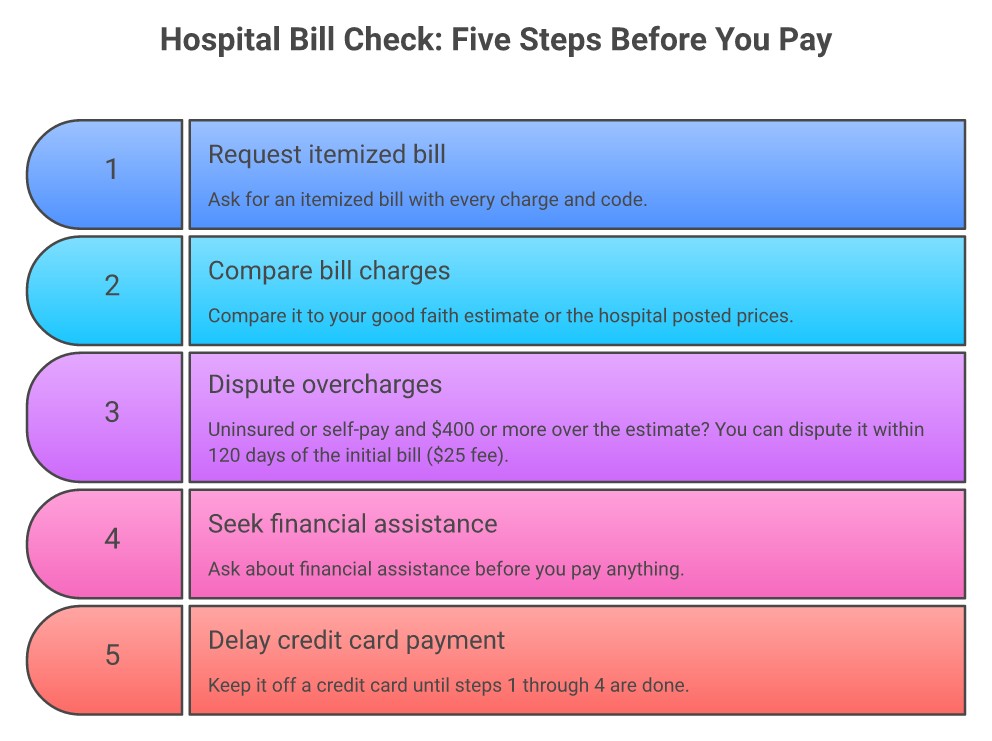
- Do not pay off the first statement — but do call or write the billing office now, ask for the itemized bill, and ask them to hold the account while you review it — a billing-office hold doesn’t change the 120-day dispute deadline, so keep counting. A first statement is an opening position. Get every charge and code in writing, and read it against what you were told. I walk through common billing errors in Your Hospital Bill Is Probably Wrong.
- If you were uninsured or self-pay for this care, compare it to your good faith estimate, if you have one. Add up the provider’s total and subtract the estimate. If it is $400 or more, mark the 120-day date on your calendar now. You will need a copy of the estimate, a copy of the bill, and the provider’s contact information, and CMS says to start at the CMS dispute page.
- Compare it to the hospital’s posted prices if you have no estimate. Under 45 CFR 180.60, a hospital must make public its payer-specific negotiated charges and its discounted cash price (if it offers one) for a list of shoppable services, at least 300 where it provides that many. Search the hospital’s name plus “standard charges.” A posted price is not a promise about your final bill, which is why the FTC’s point about omitted physician and facility fees is worth asking about: “Is anything on this billed separately by the doctors?”
- Ask about financial assistance before you pay anything. CMS says nonprofit hospitals must give financial assistance to eligible patients who cannot afford to pay. The IRS says tax-exempt hospitals must have a written policy that is widely publicized, and that eligible patients cannot be charged more than the amounts generally billed to insured patients for emergency or medically necessary care. Not sure if your hospital is tax-exempt? Look it up in the IRS Tax Exempt Organization Search. Section 501(r) is a condition of tax-exempt status, so it is not the rule that governs a for-profit hospital, though CMS says other facilities may still offer financial assistance, so ask.
- Keep it off the credit card until steps 1 through 4 are done. Once a negotiable hospital bill becomes card debt, it charges interest every month and the hospital is no longer the one you are negotiating with. If a bill has already gone to collections, tell the collector, and I would do it in writing, that you are applying for assistance and read what to do when a medical bill goes to collections.
- Get help if you are stuck. CMS runs the No Surprises Help Desk at 1-800-985-3059 with help in over 350 languages, and its financial assistance page also points to patient advocates.
If, after all of that, the balance is still more than you can realistically pay, I want you to know bankruptcy is one of your options for medical debt, not a character flaw. Take the 2-minute bankruptcy quiz to see whether the math points that way, and read my Medical Debt Complete Guide for the rest of the map. Before you pay a hospital up front, you may also want to read when a hospital can make you pay before it treats you.
Key Takeaways
- The FTC’s October 5, 2026 letters went to 24 of the nation’s largest healthcare services companies. They are warnings, not findings, and they give patients no new claim.
- If you are uninsured or self-pay and a provider’s bill is at least $400 over its good faith estimate, you can dispute it; the request has to be postmarked within 120 calendar days of the initial bill, and CMS lists a $25 fee.
- If you used insurance, this dispute does not apply to you. Ask for an itemized bill, check your explanation of benefits, and ask about financial assistance.
- Tax-exempt hospitals have a separate financial assistance and collections rule with its own 120-day and 240-day periods. Do not mix the two clocks up.
The Bottom Line
If you opened a hospital bill that is far bigger than what you were told and felt your stomach drop, you did nothing wrong, and a bill is not a verdict on you. The FTC’s letters are a signal that regulators are paying attention to hospital pricing, but if you were uninsured or self-pay, the thing that can change your number is already on the books, it has a clock, and it takes you about as long as a phone call to set a reminder. Ask for the itemized bill, compare it to the estimate, ask about financial assistance, and keep the credit card in your wallet until you have. I filed bankruptcy in 1990 and rebuilt my life, so I know a big bill is not the end of the story. It is the start of some questions you are allowed to ask.
Frequently Asked Questions
Do the FTC’s hospital pricing letters give me the right to dispute my bill?
No. The FTC’s October 5, 2026 letters went to 24 of the nation’s largest healthcare services companies and remind them of their obligations to provide timely, accurate and complete pricing. The FTC’s template letter says it is not a conclusion that any company violated the law, and the release offers patients no claim or refund process. The $400 dispute is a separate federal process under 45 CFR 149.620 that has applied since January 1, 2022.
Can I use the $400 and 120-day dispute if I have health insurance?
Not if you used your insurance for that care. CMS says that if you used health insurance you do not qualify to dispute a bill through this process. It is for people who had no insurance, or who did not use it and told the provider so before getting care. Insured patients should check their explanation of benefits, follow the appeal steps in their plan documents, and ask about financial assistance.
When does the 120-day clock start?
The regulation says the request must be postmarked within 120 calendar days of receiving the initial bill with charges substantially over the estimate. CMS’s plain-language page describes it as an initial bill dated within the last 120 calendar days. Count from the first bill that showed the charge, not a later reminder statement. The rule counts from when you received that first bill, so if counting from the printed date says you are late, check when you actually received it and call the No Surprises Help Desk at 1-800-985-3059 before giving up.
What if the hospital never gave me a good faith estimate?
Then the dispute process has nothing to compare your bill against. CMS says you can submit a complaint if your provider did not give you a good faith estimate, and its financial assistance guide still applies. Ask for an itemized bill, ask about the hospital’s financial assistance policy, and compare the charges to the hospital’s posted prices.
Can the hospital send my bill to collections while I dispute it?
Under the federal dispute process, CMS says the provider or facility cannot move your bill into collections or threaten to while the dispute is pending, and must stop pursuing a bill already in collections. Separately, tax-exempt hospitals must make reasonable efforts to determine financial assistance eligibility before extraordinary collection actions, including a 120-day notification period counted from the first post-discharge bill under IRS Section 501(r)(6). These are two different rules with two different clocks.
This is what I’m telling friends like you over coffee, and it is what I would tell my own family. Take it as input, not instruction. You know your bill, your income and your state better than I do, and nobody, including me, gets to tell you what to do with your money. You do you.
If this made sense to you, send it to someone who has a hospital bill sitting on the kitchen table. Most people never hear that there is a question they are allowed to ask before they pay, and sometimes just knowing that is the thing that changes everything.
Dealing With Debt? Understanding your options is the first step. See how all your debt relief options compare — including ones most sites won’t tell you about. The Find Your Path quiz gives a recommendation based on your actual numbers, and the Scam-O-Meter checks any company’s complaint history before you sign. Federal Reserve Bank of New York research finds that filing bankruptcy is associated with faster financial recovery than not filing.



