

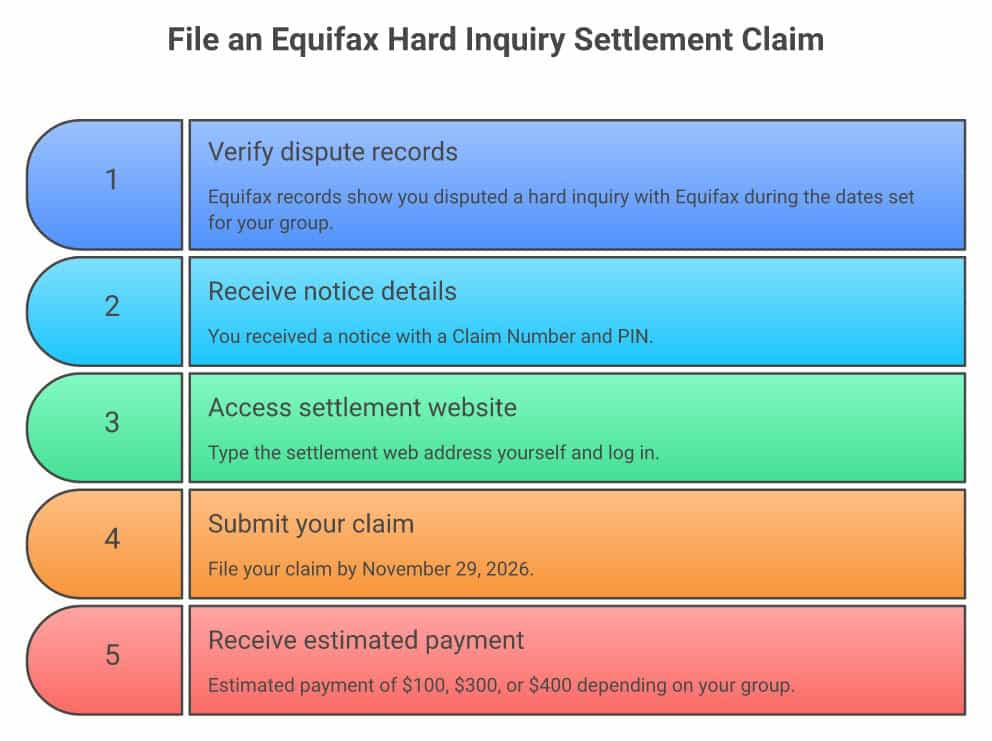
Quick Answer: The Equifax hard inquiry settlement is a $30 million class action settlement in Hines v. Equifax Information Services LLC (No. 1:19-cv-06701, U.S. District Court, Eastern District of New York), and you can only file a claim if Equifax’s own records put you in the class: you need the unique Claim Number and PIN printed on the court-ordered notice, and the claim deadline is November 29, 2026. The notice estimates payments of about $100, $300 or $400 depending on your group, but those are estimates that may be lower or higher, and nothing gets paid until the judge gives final approval after a December 10, 2026 hearing. If you never disputed a hard inquiry with Equifax, you are not in this class — and there is still something free you can do about inquiries you don’t recognize.
Expert Context: I’ve helped people navigate settlement claims since I launched GetOutOfDebt.org in 2008, and I ran a nonprofit credit counseling organization where I reviewed thousands of credit reports. I’ve seen which settlements actually pay and which ones mostly generate false hope. If the judge approves it, this one is built to pay cash to real people — just not everyone who reads the headline. I want you to know in about two minutes which side of that line you’re on.
Equifax Information Services LLC has agreed to put $30 million into a settlement fund to resolve four lawsuits over how it handled consumers’ disputes of “hard inquiries” on their credit files — but Equifax denies any wrongdoing, no court has decided who is right, and only the roughly three million people on Equifax’s class list can file for a share.
Key Terms Defined
Hard inquiry: the notation on your credit file showing that a company requested your report, usually because you (or someone using your information) applied for credit. The settlement notice describes these notations as “hard inquiries.” The CFPB says a single credit inquiry from a lender will have little impact on your credit score.
Claiming money you are owed is one good day. What you do over the following year is what actually changes your position.
In the latest issue (Nov 9): Check your power bank and your French press
Each weekday I send one short email: one story that caught my attention, why it might matter to you, and one manageable thing you can do with it.
Free. I sell nothing. Unsubscribe any time.
Certified Group: the part of the settlement class made up of people Equifax’s records show mailed it a letter disputing a hard inquiry, whose dispute Equifax coded “not mine” (001) or “unauthorized” (383), and who were sent a document containing “Cons Comm 664” — the statement that “inquiries are a factual record of file access.”
General Dispute Group: everyone else in the class — people whose disputes of a hard inquiry Equifax received between August 31, 2021 and March 27, 2026.
Claim Number and PIN: the personal log-in credentials printed on the notice sent to each person on Equifax’s class list. Claims are filed with them.
What You Need to Know
According to the court-ordered settlement notice and agreement, Equifax Information Services LLC agreed to create a $30 million fund to resolve four similar lawsuits: Hines v. Equifax (E.D.N.Y., Case No. 1:19-cv-06701), Rivera v. Equifax (N.D. Ga., 1:18-cv-04639), Oblack v. Equifax (D.N.J., 3:25-cv-01997) and Neubauer v. Equifax (now pending in N.D. Ga., 1:24-cv-04615). The public docket shows the court entered an order on the settlement motion on August 5, 2026.
Here is what the plaintiffs claim, and I want to be careful to say claim. The notice says they allege that after they submitted disputes saying their credit reports were obtained without a permissible purpose, Equifax did not contact the companies that requested the reports and did not remove the disputed notations. They also allege Equifax mailed some consumers letters stating, in part, “Inquiries are a factual record of file access. If you believe this was unauthorized, please contact the creditor.” The plaintiffs say that violated the federal Fair Credit Reporting Act (FCRA) and similar New York and New Jersey laws.
Equifax denies all of it. The notice says Equifax “has denied and continues to deny Plaintiffs’ allegations,” that it settled to avoid the expense and distraction of further litigation, and, in the notice’s words: “There has not been a decision in any of the cases about which side is right.” The settlement agreement also says it is not an admission of liability by Equifax. The notice adds that the judges in Hines and Rivera had already ruled those two cases could proceed as class actions, while the judges in Oblack and Neubauer had not yet decided that question.
Who Qualifies for the Equifax Hard Inquiry Settlement
This is the part the headlines skip. The settlement class is defined by Equifax’s own records, not by who feels they were wronged. There are three tiers, and the notice says each person can find out which one they’re in by logging in with their Claim Number and PIN:
- Certified Group (about 1 million people; estimated payment about $300): Equifax’s records show it received a mailed letter disputing one or more hard inquiries between October 4, 2016 and March 27, 2026, coded “not mine” or “unauthorized,” and that Equifax sent you a “Cons Comm 664” document.
- General Dispute Group (the rest of the roughly 3 million; estimated payment about $100): Equifax’s records show it received one or more disputes of a hard inquiry between August 31, 2021 and March 27, 2026. Unlike the Certified Group, the definition does not say the dispute had to be a mailed letter.
- New York Subclass (about 35,000 people; estimated payment about $400): Certified Group members with a New York address who were sent that “Cons Comm 664” letter between November 27, 2017 and September 10, 2024.
Why the different amounts? Under the distribution plan in the settlement agreement, each person who files a valid claim gets “points” — 3 for the Certified Group, 4 if you’re also in the New York Subclass, and 1 for everyone else — and the money is split in proportion to the points. The notice says the Certified Group and New York Subclass get priority because they’re “in a stronger position” if the case went forward.
Who Does Not Qualify (and It’s Not Your Fault)
If any of these describe you, you are almost certainly not in this class — and that says nothing about whether you were treated fairly by anyone:
- You have never disputed a hard inquiry with Equifax.
- You disputed an inquiry only with Experian or TransUnion. This settlement is about disputes made to Equifax.
- Your Equifax dispute was about something other than a hard inquiry, such as a late payment or a collection account.
- Your hard-inquiry dispute to Equifax came after March 27, 2026, or — unless you meet the Certified Group definition — before August 31, 2021.
- You never received a notice with a Claim Number and PIN. The settlement agreement says claims are submitted using “the unique identifier and access code provided to each Settlement Class Member.”
Where the $30 Million Actually Goes
A $30 million headline does not mean $30 million for class members. According to the notice, the fund also covers the costs of administering the settlement, up to $60,000 in service awards to the four named plaintiffs, up to $260,000 in litigation expenses, and attorneys’ fees. Class counsel says it will ask the court for up to $10 million in fees — a third of the $30 million fund — and the court decides whether to approve that. Money left unclaimed does not go back to Equifax — the agreement bars that. After a possible second distribution to people who cashed their checks, whatever remains goes to nonprofit consumer-credit education and advocacy charities.
The payment estimates of about $300, $100 and $400 rest on “typical claims rates in similar cases,” the notice says, and the actual amounts “may be lower or higher.” Since the pot is split pro rata, the more eligible people who file, the smaller each check.
The Dates That Matter
- October 20, 2026: class counsel’s fee request is due to be filed.
- November 20, 2026: deadline to opt out of the settlement or object to it.
- November 29, 2026: deadline to submit a claim form. That’s a Sunday of Thanksgiving weekend, so don’t leave it for the last night.
- December 10, 2026, 10:00 a.m.: final approval hearing before Magistrate Judge Joseph A. Marutollo. The court’s order says it will be held by Zoom; the notice lists the Brooklyn courthouse and says the hearing may be virtual or moved, so check the official settlement website for updates.
- After final approval, and after any appeals are resolved: payments. Nothing is paid before then.
Why You Need to Know It
Debt is math wrapped in emotion, and a credit report is where that math gets written down. When a company pulls your report, that notation can sit on your file, and when you don’t recognize it, it feels personal. So when a headline says “$30 million Equifax settlement,” people don’t read the fine print — they read “money” and “credit report” and assume it’s theirs.
The Claim: “There’s a $30 million Equifax settlement over credit report inquiries, so I can go file a claim.”
The Reality: Only people on Equifax’s class list can file, and the filing requires the Claim Number and PIN on the notice. The notice states that if you received it, “according to Equifax’s records you are a member of the Settlement Class.” The class covers about three million people — a big number, but a defined list, not a public sign-up.
This is also not the other Equifax settlement I covered this summer. That one was a $2.2 million case over duplicate collection accounts — I explained who could and couldn’t claim it here. Different lawsuit, different court, different class, different deadline.
Watch for look-alikes: In my experience, every well-publicized settlement attracts look-alike claim websites and “claim assistance” offers, and the people most likely to fall for them are the ones who aren’t actually in the class. Filing in this settlement is free. Type the settlement address into your browser yourself — it’s www.equifaxdisputeclassaction.com, the address printed in the court-approved notice — rather than clicking an ad, a text or an email link. Don’t pay anyone to file for you, and don’t give a Social Security number or bank login to any site that isn’t that one. My guide to telling a real settlement notice from a scam walks through the red flags.
Things to Consider
- Doing nothing is not neutral. If you are in the class and don’t opt out, then once the court gives final approval you give up the right to sue Equifax over the claims this settlement resolves — even if you never file for money. The notice says so in plain terms: “If you do nothing, you will not receive any benefits from the Settlement and you will give up the right to sue Equifax for the claims that the Settlement resolves.” Your four choices are: file a claim, do nothing, exclude yourself (by November 20, 2026, keeping your right to sue on your own but getting no money), or object to the terms (also by November 20, 2026).
- Read the claim form before you sign it. The agreement says a claim will be disallowed if the form isn’t completed in full or doesn’t include “the required attestation of harm.” I haven’t been able to read the live claim form, so read exactly what you’re attesting to before you submit it.
- Lost your notice? The notice says to contact the settlement administrator — Hines v. Equifax, c/o Settlement Administrator, P.O. Box 16, West Point, PA 19486, toll-free (833) 244-4150. It also says: “Please do not contact Equifax or the Court for information.” I can’t promise the administrator can reissue your credentials; I can tell you that’s who the notice says to ask.
- A settlement payment can be taxable. If you do get a check, see my explanation of whether a class action check counts as income.
- The score hit from one inquiry is usually small. That’s the CFPB’s own description. In my opinion this case is less about a handful of points and more about whether the dispute process actually looks into what you tell it — which is exactly what the plaintiffs allege it didn’t do, and what Equifax denies.
Free Tool — Contract Decoder: Have a contract from a debt relief company? The free Contract Decoder analyzes it for red flags, hidden fees, and problematic terms — before you sign anything. Decode My Contract →
What to Think About Doing
If you got a notice
- Find it. Check your email (including junk), and your mail. The court’s schedule had notices going out by September 30, 2026.
- Type the settlement address yourself — www.equifaxdisputeclassaction.com — and log in with the Claim Number and PIN from your own notice. Confirm the group you’re in.
- File well before November 29, 2026 and save the confirmation. If you’d rather keep the right to sue on your own, the exclusion deadline is November 20.
- Then wait. Payments come only after final approval and any appeals.
If you didn’t get a notice (most people reading this)
You don’t have to wait for a lawsuit to look at your own file. This is the free move everyone can make today:
- Pull your reports. The FTC says you can always get your free, weekly report from AnnualCreditReport.com. (That weekly access is a bureau program rather than something the statute guarantees — I broke that down in this They Said What? post.) Type the address yourself.
- Read the inquiries section. The CFPB says your report lists who has requested it within the past year. A name is fine if it matches credit you actually applied for — and remember that a car dealer or mortgage broker may send your application to several lenders, and a store card often shows the bank’s name, not the store’s. If you can’t connect a name to anything you applied for, that’s the one to look at closely. A name you don’t recognize deserves a closer look — in my experience an unfamiliar inquiry is sometimes the first visible sign that someone applied for credit using your information.
- Dispute what you didn’t authorize, in writing. The CFPB’s dispute guide says to explain in writing what’s wrong and why, include copies of supporting documents, and contact both the credit reporting company and the company that supplied the information. It notes you can send your letter by certified mail with a return receipt so you have proof it arrived. Keep copies of everything.
- Know the clock. Under 15 U.S.C. § 1681i(a)(1) the law generally gives the bureau 30 days to investigate, and some situations allow a little longer.
- If you think it’s identity theft, go to IdentityTheft.gov, and consider a credit freeze. The FTC says a freeze is free to place and lift and doesn’t affect your credit score.
- If you get a canned answer, don’t take it as the last word. Read how to read the results of your credit report dispute, submit a complaint to the CFPB, and talk to a consumer attorney if a real error is being left on your file.
One honest limit: disputing an inquiry today does not put you in this settlement. The class period closed March 27, 2026, and membership is set by Equifax’s records of disputes made on or before that date.
Key Takeaways
- The $30 million Equifax hard inquiry settlement covers about 3 million people on Equifax’s own class list — you need the Claim Number and PIN from the notice to file.
- The claim deadline is November 29, 2026; opt-out and objection deadline is November 20, 2026; final approval hearing is December 10, 2026.
- Estimated payments are about $300 (Certified Group), $100 (General Dispute Group) and $400 (New York Subclass), and may be lower or higher.
- Equifax denies the allegations, and no court has ruled on who is right.
- Whether or not you qualify, you can pull your free reports and dispute any inquiry you didn’t authorize.
Steve’s Take
I sell nothing here — no credit repair, no lead generation, no “claim assistance.” So let me say the quiet part plainly: most people who read this headline will not get a check, and that isn’t a reason to feel shut out. If you’re one of the three million, file, because real money is real money. If you’re not, take the energy you’d spend hoping and spend ten minutes with your own credit reports instead. A stranger’s lawsuit isn’t going to clean up your file. You are.
The Bottom Line
If you read a headline about an Equifax settlement and felt a flicker of hope, then a flicker of worry that you’d missed something, you’re not alone — and you haven’t missed anything you could have controlled. Whether you’re on Equifax’s class list is a fact in a database, not a judgment about you. If you have the notice, file on time at the address you typed yourself. If you don’t, you still hold the same rights as the people who do: free reports, a written dispute, and a clock the bureau has to respect. Your credit file is a record, not a verdict — and you get to keep correcting it.
Frequently Asked Questions
Who qualifies for the Equifax $30 million hard inquiry settlement?
Only people Equifax’s own records place in the settlement class, which the notice says is about three million people. That means either (1) Equifax received a mailed letter from you disputing a hard inquiry between October 4, 2016 and March 27, 2026, coded “not mine” or “unauthorized,” and sent you a “Cons Comm 664” document (the Certified Group, about 1 million people), or (2) Equifax received one or more disputes of a hard inquiry from you between August 31, 2021 and March 27, 2026 (the General Dispute Group). A New York Subclass of about 35,000 people gets a higher estimated payment. To file, you need the Claim Number and PIN on the notice sent to you.
What is the deadline to file a claim in the Equifax hard inquiry settlement?
November 29, 2026. The deadline to opt out of the settlement or object to it is November 20, 2026, and the court has scheduled a final approval hearing for December 10, 2026 at 10:00 a.m. Payments are made only after the court gives final approval and any appeals are resolved.
How much money will I get from the Equifax settlement?
The notice estimates about $300 for the Certified Group, about $100 for the General Dispute Group and about $400 for the New York Subclass, based on typical claims rates in similar cases. It also says the actual amounts may be lower or higher, depending on how many people file valid claims. Class counsel plans to ask the court for up to $10 million of the $30 million fund in attorneys’ fees, which the court has to approve.
I never received a notice. Can I still file a claim?
The settlement agreement says claims are filed using the unique identifier and access code provided to each class member, so without a Claim Number and PIN you generally can’t file. The notice says to contact the settlement administrator — toll-free (833) 244-4150 or Hines v. Equifax, c/o Settlement Administrator, P.O. Box 16, West Point, PA 19486 — and not Equifax or the court. Filing is free; don’t pay anyone to file for you, and type the settlement website address yourself rather than clicking a link.
Should I dispute hard inquiries on my credit report even if I don’t qualify?
Yes, if you see an inquiry you don’t recognize. Pull your free reports at AnnualCreditReport.com, and dispute any inquiry you didn’t authorize in writing with both the credit bureau and the company that requested the report. The bureau generally has 30 days to complete a reasonable reinvestigation, extendable by up to 15 days if you send relevant information. If you suspect identity theft, start at IdentityTheft.gov.
If this helped you figure out whether you’re actually in this settlement, share it with anyone else who saw the Equifax headline and wasn’t sure. “You probably can’t claim this, but here’s what you can do” isn’t exciting, but it’s more useful than chasing a form that isn’t yours to file.
A note before you go: this is what I’m seeing after more than 30 years of helping people with money and debt, and what I’d tell my own family. It’s input for your thinking, not a directive — nothing here is legal advice, and I’m not your lawyer. Only you know your full situation, and nobody gets to tell you what to do with your money. Not me, not anyone.
Dealing With Debt? Understanding your options is the first step. See how all your debt relief options compare — including ones most sites won’t tell you about. The Find Your Path quiz gives a recommendation based on your actual numbers, and the Scam-O-Meter checks any company’s complaint history before you sign. Federal Reserve Bank of New York research finds that filing bankruptcy is associated with faster financial recovery than not filing.



