

Quick Answer: No. A note you write yourself, a secret Treasury account or an “accepted for value” stamp does not pay a debt your creditor never agreed to settle, and Treasury lists the story behind it as a scam. The debt generally stays owed, Treasury says the people promoting it “are trying to defraud you into buying their fake product,” and a payment plan your creditor agrees to in writing is a different thing, a real negotiation. The Justice Department has prosecuted people who mailed these papers to creditors.
Where this topic came from: Conversations in my free Ask Steve chat keep raising questions like this. I’m not giving away any personal information here, and I never do, but when real questions show me a gap worth covering, I write the answer for everyone. If you’re wondering about something like this yourself, ask me about it in the chat. It’s free, it’s private, and I’m not selling anything.
Expert Context: This site has taken questions about strawman paperwork since at least 2010, and I have answered questions about “accepted for value” and promissory notes in posts like this one.
If someone told you a birth certificate, a hidden Treasury account or the right stamped words can erase what you owe, you are not foolish for wondering. Debt is math wrapped in emotion, and when the math is broken, a story with a loophole in it is very tempting.
What the Strawman Theory Claims
The FBI describes the “Redemption Theory” in a 2011 article. The theory claims the government went bankrupt when it left the gold standard in 1933 and now uses citizens as collateral, and that each person supposedly has a net worth, valued by believers at $630,000 to more than $3 million, in a Treasury account under a third party’s name, the “strawman.” The FBI says believers file real IRS and Uniform Commercial Code forms hoping to make the Treasury pay credit card debts, taxes and mortgages.
The pitches take a few shapes: a homemade “sight draft” or “bill of exchange” drawn on the supposed account, a “bonded promissory note” sent to a lender, as the IRS describes it, or a bill stamped “accepted for value and returned for value”.
What the Agencies Actually Say
- Treasury: its fraud page says there is “no monetary value to a birth certificate,” and TreasuryDirect accounts “must be funded by the owner.” Its page on bogus sight drafts says drawing such drafts on the Treasury “is fraudulent and a violation of federal law.”
- IRS: its guide to frivolous arguments says promoters push “a bogus financial instrument such as a bonded promissory note” to pay credit card or mortgage debt, and that “the notion of secret accounts assigned to each citizen is pure fantasy.”
- OCC: a 1999 alert to banks said homemade Treasury sight drafts have “no financial value and no legal validity,” and “under no circumstances” should a bank honor one.
- FBI: it calls the “Redemption Scheme” the “most prevalent method to defraud banks, credit institutions, and the U.S. government” among the people it calls sovereign-citizen extremists, and says seminars charge fees to teach it.
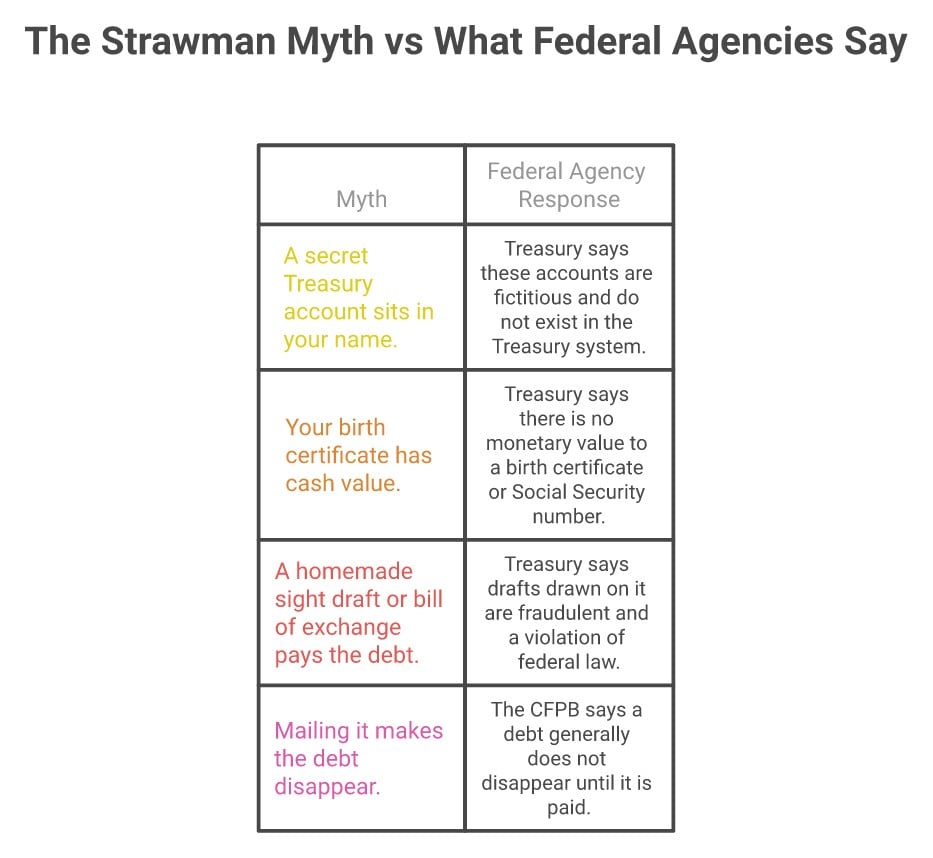
What Happens When People Try It
First, nothing gets paid. The CFPB says a debt generally does not expire or disappear until it is paid. Here is what the Justice Department says happened in three cases, names left out:
- Alabama (2013): a man mailed his mortgage servicer a $10 million “bonded promissory note” presented “as if it were a valid financial instrument drawn on a secret U.S. government account.” A jury convicted him and he got two years in prison.
- Ohio couple, Florida federal court (2014): they mailed creditors promissory notes and bills stamped “accepted for value and returned for value.” Both pleaded guilty. One got 20 months in prison for mail fraud and obstruction of Internal Revenue laws, in a case that also involved tax refund money, and the other got probation.
- Colorado (2018): a man gave acquaintances worthless instruments to submit in payment of debts, including student loans, car loans and mortgages. He got 70 months for false claims, creating fictitious financial instruments and bank fraud, and the release says banks lost about $47,000 and “various individuals suffered smaller losses.”
Money leaves earlier, too. Treasury says some websites “offer to sell videos, webinars, and coaching” on this. Even in a tax case the IRS lists, a “bonded promissory note” “did not constitute payment” and the court added a $15,000 penalty.
Asking is not a crime. Nothing in these releases says reading about this, or asking whether it works, is one. They describe people who made or mailed the instruments. If you have already mailed something, that paper did not pay the debt, so treat the balance and its due dates as still there, and any payments you skipped while waiting are still missed. Do not send follow-up notices, and do not file liens or other papers against the creditor based on this theory. Keep answering bills, collection letters and any lawsuit about the debt itself, and talk to a consumer attorney about the debt before you send anything else. You can find one through NACA. The one exception: if an investigator or a fraud department contacts you about what you sent, talk to a criminal defense lawyer before you answer.
Why It Sounds So Convincing
Because the parts are real. The FBI says believers file “legitimate IRS and Uniform Commercial Code forms for illegitimate purposes,” and Treasury’s real Savings Bond Calculator “will not verify whether a bond exists,” so a result on that page proves nothing. Real vocabulary stuck to a fake conclusion is persuasive, and I would never mock anyone for believing it.
What Actually Works Instead
Debt is math, so use math. Here is how I rate the real options on credit, collections, speed and retirement, from my published ratings (full comparison here):
- Snowball or avalanche: good on credit, meh on collections and speed, bad for retirement.
- A consolidation loan: good on credit and collections, bad on speed, meh on retirement.
- Credit counseling or a debt management plan: good on credit and collections, meh on speed, bad for retirement.
- Debt settlement: meh on credit, collections and speed, bad for retirement.
- Bankruptcy: good on all four.
Bankruptcy is the real, court-run way to have eligible debt wiped out, and it is a legal process with filing and attorney costs, not a kit. A discharge “releases individual debtors from personal liability for most debts,” and the federal courts say that, generally, excluding cases that are dismissed or converted, individual debtors receive one in more than 99 percent of Chapter 7 cases, though the same page says a discharge “is subject to many exceptions” and that a trustee can sell property that is not exempt. Not every debt goes away, so see my Chapter 7 guide and the 2-minute quiz.
Real rights work too:
- Debt validation: the CFPB says a collector generally must give you the creditor’s name, the amount and how to dispute it in the first contact or within five days of it. That rule is about debt collectors. Use my free letter generator, and read why validation is not a magic fix.
- Statute of limitations: most states set limits of three to six years (some longer) on suing over a debt, but you generally have to raise it as a defense, so answer any lawsuit, and the CFPB says a partial payment or acknowledging an old debt may restart the clock. Try my free checker.
- A real lawyer: NACA lists consumer attorneys for debt lawsuits and collector abuse, and NACBA lists bankruptcy attorneys.
Free Tool — Statute of Limitations Checker: Dealing with old debt? The free Statute of Limitations Checker tells you if the collection clock has expired in your state — including the zombie debt and clock-restarting traps collectors use. Check My Status →
My Take
Nothing you write by yourself, without your creditor or a court agreeing, pays or reduces what you owe. Do not mail a note to see what happens, because making and sending these papers is what the people in those cases did. The honest version of the debt-elimination promise exists, and it runs through a court. I have covered the pieces before: strawman vs. freeman, the Treasury account myth, promissory notes and debt relief scam red flags.
The Bottom Line
If you were about to mail something, wait, and do not feel foolish: a confident voice sold you a loophole the agencies say does not exist. You are not your debt, and you never needed a secret account to get out of it. There is no hidden account, but there is a real way forward, and it is not mailed to a creditor.
Free Tool — I'm Being Sued for Debt Guide: Being sued by a creditor or debt collector? The free I'm Being Sued Guide gives you a personalized action plan — deadlines, defenses, and options based on your state. Most states require a response within 20–30 days. Get My Action Plan →
Frequently Asked Questions
Can I pay off debt with a promissory note I write myself?
No. The IRS calls “a bogus financial instrument such as a bonded promissory note” a fake way to pay credit card or mortgage debt, and the DOJ describes a man sentenced to two years in prison for mailing a fake $10 million note to his mortgage servicer. A payment arrangement your creditor agrees to in writing is a negotiation, not this theory.
Is there a secret Treasury account in my name?
No. Treasury says these accounts are fictitious and do not exist in the Treasury system, and the IRS calls the notion of secret accounts assigned to each citizen “pure fantasy.”
Does “accepted for value” make a debt go away?
No. A 2014 DOJ release describes bills stamped “accepted for value and returned for value” in a mail fraud case, and the CFPB says a debt generally does not disappear until it is paid.
Can I get in trouble for asking about the strawman theory?
Nothing in the agency material I read says asking or reading is a crime. If you already mailed a note or a stamped bill, the debt is still owed on its normal due dates. Send no more of that paperwork, keep answering bills, collection letters and any lawsuit, and talk to a consumer attorney about the debt. If an investigator or a fraud department contacts you about what you sent, talk to a criminal defense lawyer before you answer.
What actually works if I cannot pay my debts?
Compare the real options on credit, collections, speed and retirement. Bankruptcy discharges eligible debt, and debt validation and the statute of limitations are real rights. NACA and NACBA can connect you with attorneys.
This is what I’m telling friends like you over coffee. But remember, you do you, and only you can decide what is right for your situation. Take what I have said as input, not instruction.
Know someone who watched a “strawman” video and is about to mail something? Send them this first.
For more stories like this, sign up for my free weekday email, Your Money Actually.
Facing a Similar Situation? You’re not alone — and you have more options than you think. Start with the all your debt relief options page to see what’s realistic, or take the 2-minute bankruptcy quiz if the debt feels unmanageable. Federal Reserve Bank of New York research shows filers recover faster than those who don’t file. If a company is involved, run them through the Scam-O-Meter first.



